Category Archives: Topics

Why Liberal Christianity is a Dead End

dead-endI appeal to you, brothers, to watch out for those who cause divisions and create obstacles contrary to the doctrine that you have been taught; avoid them. (Roman 16:17)

Back when I was in high school, I was a member of a “service club.” The service club provided assistance to the poor, cared for the needy, and fought hunger in our community. This was great stuff.

But to my knowledge, this group had no spiritual component to it. It appeared to function well without spirituality, so what was the point of mixing “God” up into the whole business?

So it was a really strange thing, when my church youth group back then decided that they wanted to become like this “service club.” The church group would no longer study the Bible or talk about Jesus. They wanted instead to focus on social service work, just like my service club.

My time was valuable, and so I simply could not justify being a member of two social service clubs that were doing the exact same thing. So I left the church group. If there was nothing distinctively “Christian” going on in the church group, what was the point?

I ran into a long time friend of mine this week at the hardware store, and this person had a similar story to tell me. My friend had started working for a church a few years ago, in a ministry that was doing great work caring for a needy group of folks in our community. But just recently, some of my friend’s colleagues in the ministry were offended by my friend’s sharing of “Jesus” as “the Son of God” with recipients of the church’s ministry. As the story unfolded, it turns out the church had also recently hired some people to work in the ministry, who did not believe in the classic doctrine of the Triune nature of God: Father, Son and Holy Spirit.  To deal with the division, my friend was asked by the church staff not to talk about “Jesus” anymore.

Keep in mind, this is not a government agency or a school we are talking about. This is a church.

Rightly disturbed, my friend asked to see the church’s statement faith.

“We have a vision statement that you can look at.”

“No, I want to see the statement of faith.”

Sadly, the church had no statement of faith. After my conversation, I checked the church’s website. And sure enough, there was not a single statement online as to what the church believed.

When a church begins to drift away from the “doctrine that you have been taught,” as the Apostle Paul puts it, what typically goes with it is the church’s statement of faith. I know that historically, the denomination associated with this church has for several hundred years taught the doctrine of the Triune nature of God. But like a lot of churches that tend to identify with “liberal Christianity,” communities like these put Bible doctrine off to the side. Instead, these churches put their focus on social type of ministries. These social ministries do great things for our community. These efforts must be commended.

But in the long run, the mission of such a church leads to a dead end. It becomes extremely difficult to “watch out for those who cause divisions and create obstacles,” when your community lacks a clear understanding of what is being taught. Sadly, “liberal Christianity” provides no moral or spiritual basis for why it is doing its work.

My friend learned a valuable lesson. Check out the church’s statement of faith before you sign up for the job. But my friend’s story is far from unique. It happens over and over again, hundreds of times in liberal churches across the globe. The Pew Research Center published a report last year, showing that Protestant mainline churches, which constitutes the bulk of “liberal Christianity,” is continuing to rapidly shrink year after year in America, with no sign of reversing.

Liberal Christianity is ultimately a dead end because there is effectively nothing different in this movement than what you would find in fully functioning social service clubs and organizations elsewhere in the community that make no mention of God. What is the point of a church disposing the “doctrine that you have been taught,” only to replicate what the rest of the world is doing? It just causes divisions and creates obstacles.

It is a dead end.


The Civil War as a Theological Crisis

A steep, dugout embankment defending Redoubt #1, off of Quarterpath Road, where Confederate troops waited for advancing Federal soldiers to attack from Tutter's Mill Pond below, during the Battle of Williamsburg. Sadly, relatively very few of my fellow Williamsburg neighbors even know that this place even exists.

A steep, dugout embankment defending Redoubt #1, off of Quarterpath Road, where Confederate troops waited for advancing Federal soldiers to attack from Tutter’s Mill Pond below, during the Battle of Williamsburg. Sadly, relatively very few of my fellow Williamsburg neighbors even know that this place even exists.

Does the American national tragedy over the Civil War have something to teach us about how we are to read the Bible?

As a kid, I grew up near the remains of an oft-forgotten, Civil War battlefield. Whenever I ran among the dugout, redoubt embankments, I always kept in mind the warnings of neighbors to be careful, as there was likely to be found unexploded ordinance somewhere underneath my feet.

On the same day, hundreds of miles away, when Mexico was resisting the French on May 5, 1862, remembered now as Cinco de Mayo, Federal forces met Confederate forces just east of my town, for the Battle of Williamsburg, with nearly 4,000 casualties among both sides. Within a couple of years, the significance of that battle faded, displaced in memory by placenames like Antietam and Gettysburg.

Efforts to preserve the battlefield from being run over by suburban housing developments have been somewhat, moderately successful, though the land, as well as the intellectual debates that the led up to the war, have sometimes been forgotten. I often wonder myself, if such a national crisis could have been averted, without such terrible bloodshed.
Continue reading


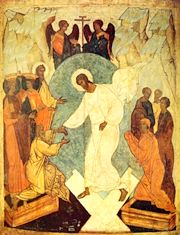
He is Risen!… (in the East)

The Resurrection of Christ, by St. Isaac of Syria Skete (Boscobel, Wisconsin), credits the Orthodox Wiki.

He is Risen! The Resurrection of Christ, by St. Isaac of Syria Skete (Boscobel, Wisconsin), credit: the Orthodox Wiki.

To all of my Eastern Orthodox friends, I say “He is Risen!” on this day when you celebrate Pascha.

For those evangelical friends who have no idea what I am talking about, Pascha is the original name for Easter. Pascha is essentially a transliteration of the Hebrew word for “passover,” or pesach. Way back at the Council of Nicea in 325 A.D., the famous church council that resolved the dispute over the deity of Christ, which made way for the mature formulation of the doctrine of the Trinity, the council also established a uniform method for calculating the date for celebrating the Resurrection of Jesus.

However, the church in those days used the Julian calendar, which proved to be flawed in its ability to keep track of the solar year. The Western churches later fixed this by going to the current Gregorian calendar. However, the Eastern churches still have retained the old, Julian calendar method of calculation for Pascha. Hence, this year, the celebration of Pascha falls on May 1st, instead of March 27.

There are some who reject Easter because of its supposed connection to Germanic paganism. But since Pascha is really the earlier name, maybe Christians in the West can drop “Easter” and adopt “Pascha” instead, for now on, and be rid of this fringe complaint.

How about this? I have an idea. Next year, Western Easter and Eastern Pascha will fall on the same date, April 16. How about if the West adopts the “Pascha” name and the East adopts the updated Gregorian calendar calculation system, so that we can all celebrate the Resurrection of our Lord on the same day, in future years? Would this not move us a step towards Christian unity?

Do I have any takers?

…………………

I blogged about this before in 2014.


Bono and Eugene Peterson on the Psalms

What do you get when you cross an Irish rock star with a Bible scholar/pastor? An interesting conversation between Bono and Eugene Peterson, the author of the English paraphrase translation of the Bible, The Message.


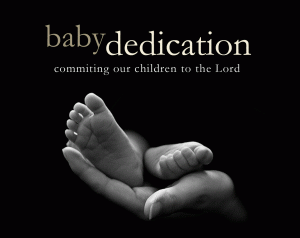
Are Baby Dedications Biblical?

Is the contemporary practice of baby dedication taught within the Bible?

Is the contemporary practice of baby dedication taught within the Bible?

Of the few people I follow on Twitter, British evangelical writer, Andrew Wilson, is right there at the top. He has the mind of a scholar and the heart of a pastor, young enough to be conversant about postmodernity, and yet wise enough to challenge me to be more humble before Scripture. In his latest blog post at Think, Wilson challenges me to consider if baby dedications, as practiced in many interdenominational churches today, are really Biblical.  His answer: They are not, but services of thanksgiving and prayers for newborns are still good ideas.

I worship in a community of faith where such baby dedications are practiced. Who is not moved when the pastor prays over a miniature human in their arms?

But it really is rather odd, if you think about it.

Consider this: Until the last thirty or forty years or so, baby dedications were rarely, if ever, practiced in any evangelical church. Why has such a novelty, with the slimmest of Biblical backing, taken off in interdenominational churches today? What Wilson does not dive into that much is summarized by his Tweet from a few months ago, “baby dedications are perhaps the most obvious symbol of credobaptist cultic deprivation.”

What I think Andrew Wilson means by that is this: Modern evangelical churches are drawn to baby dedications because they serve as a compromise solution to the long-standing baptism debate: infant baptism (paedobaptism) vs. believer’s baptism (credobaptism).  With baby dedication, it is not to be confused with baptism, while it still symbolizes the notion of bringing a child into the community, passing on the faith to the next generation (or so we hope). So, while baby dedication steps around the controversy (which is understandable), it nevertheless fails to engage the Christian to fully think through how the covenants of God work within Scripture, and how baptism is related (I stand guilty myself). So, we get a workable solution that makes peace between the differing viewpoints, but at the expense of shallowing the theological depth of our Biblical thinking in our churches.

As a first step, it might be better to rename “baby dedications” as “parent dedications” instead, as these events are more about the parents dedicating themselves to present the Gospel to their children, along with the help of the surrounding church community, and about praying to God that He would touch the hearts of those children, over the coming years, with His Word of Truth and Life. Any thoughts?