
How much do we really think about the songs we sing in church?
There is a popular Christian worship song which I have sung for years, which I admittedly have not thought too much about until recently. Written by Stuart Townend about 30 years ago, “How Deep the Father’s Love for Us” begins with this verse:
How deep the Father’s love for us,
How vast beyond all measure,
That He should give His only Son
To make a wretch His treasure.
How great the pain of searing loss –
The Father turns His face away,
As wounds which mar the Chosen One
Bring many sons to glory.
There is one line in that verse which really puzzles me now: “The Father turns His face away.” What is that all about?
As I first started to think about it, I mused that it might mean that the Father was so filled with grief about his Son dying on the cross that he could not bear to look upon the sight of seeing Jesus suffer like that. The line before it gives me a clue: “How great the pain of searing loss.”
Perhaps that is what Stuart Townend had in mind.
I am quite fine with interpreting this line in the song this way. When my mother was nearing her death about 11 years ago, extended family members of mine, who loved my mother very much, would not come to visit my mom once she was nearing being put on hospice. One cousin told me that she could not bear to see my mother suffer in her final days, as the cancer of glioblastoma slowly took away her humanity day-after-day, as she was loaded up with morphine.
My mom still recognized me up until the last day or two before she died, but during those last few weeks, she hardly knew who anyone else was. My mom was always the gracious “Southern lady,” offering hospitality to everyone she met. But the cancer had robbed that zest for life, and the morphine had dulled her senses. That was tough for members of my extended family who knew my mom for years, so I get it.
But is this what it really means to say that “The Father turns His face away?”
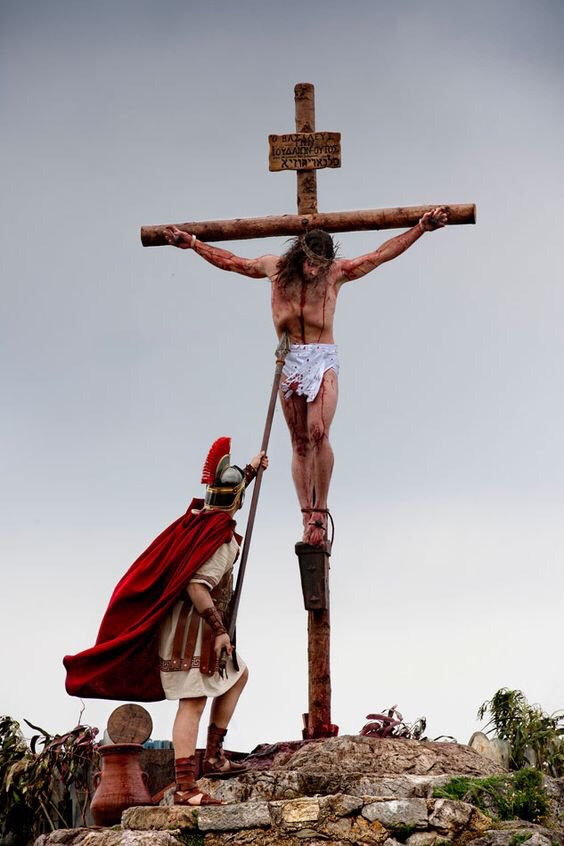
The “Father Can Not Look Upon Sin, So the Father Turns His Face Away from Jesus” Logic
There is another, more common explanation as to why the line “The Father turns His face away” is in Townsend’s song. Taken at face value, this other explanation seems straight-forward. Yet frankly, this explanation should trouble us, as it can give us a wrong understanding of God’s character. There is more to it as one dives more deeply into the Bible.
In this view, “The Father turns His face away” is in reference to Jesus’ cry of dereliction on the cross:
“My God, my God, why have you forsaken me?” (Mark 15:34; Matt 27:46).
Admittedly, once you read that, it may seem quite obvious. Jesus, as God’s Son, feels abandoned by the Father. After all, as an expression of Jesus’ humanity, it is quite natural for any human to have a sense of desperation at such a moment.
But what does this say about the perspective of the Father? This is where a common theological assumption has stirred up significant debate: So why does Jesus feel abandoned?
Explanation: Because the sin of the whole world is laid upon Jesus, and God the Father can not look upon sin. So, God the Father turns his face away from Jesus.
This makes sense. Right?
Not so fast.
Well, there is more going here than what meets the eye. This passage of the Bible has been controversial for centuries. Yet it all comes down to how the Gospel writers use the Old Testament, particularly Psalm 22, to reveal the truth about the heart of God.
Jesus’ cry of dereliction has puzzled lay readers of the Bible and scholars alike. At the beginning of the 20th century, the German biblical scholar Albert Schweitzer would broadly take Jesus’ cry of dereliction on the cross as a sign that the mission of Jesus had failed. Jesus had predicted that God the Father would intervene before Jesus’ death by bringing about the end of the world, pronouncing judgment on Israel for Jewish disobedience and bringing calamity on the Roman empire. Instead, Jesus was left alone to die on the cross.
Albert Schweitzer, one of the 20th century’s most influential liberal Christians, was struck by this. Schweitzer took this to mean that Jesus was a failed apocalyptic prophet, who only realized at the very end of his life that the promised cataclysmic end of the world would not come, and that God the Father had abandoned him. Alas, though Schweitzer was a great biblical scholar, even he misunderstood the significance of Psalm 22 for understanding this cry of dereliction.
Perhaps a better explanation is a simpler one. The Gospel writers want to point our attention to Psalm 22, which is where this line comes from. Not only that, “My God, my God, why have you forsaken me,” is the first verse of Psalm 22. The idea of numbering the psalms only began once the Hebrew Bible was translated into Greek, roughly about the time of Christ and a few centuries prior to that. It is not clear as to when the psalm numbering actually caught on across the Second Temple Judaism audience of Jesus’ day. So until the idea of a “Psalm 22” actually caught on, you typically referenced a particular psalm by citing the first line of that psalm.
Pretty simple.
But that is just the beginning as to why this idea — namely, of the Father turning his face away from the Son bearing the load of sin on the cross, because the Father can not look upon sin, — can be terribly misleading.
New Testament scholar Jason Staples has a great blog post on his Substack, which explains what is really going on with how Psalm 22 ties into the crucifixion narrative, so I will just summarize his research here. Psalm 22 is attributed to King David, written hundreds of years before Jesus roamed about Israel, about someone who undergoes great affliction. A careful read through Psalm 22 reveals a number of parallels we find in the Gospels:
My God, my God, why have you forsaken me?
Why are you so far from saving me, from the words of my groaning?
O my God, I cry by day, but you do not answer,
and by night, but I find no rest (Psalm 22:1-2; the first verse clearly quoted in Mark 15:34 and Matthew 27:46).
All who see me mock me;
they make mouths at me; they wag their heads (Psalm 22:7; alluded to in Matthew 27:39 and Mark 15:29).
My strength is dried up like a potsherd,
and my tongue sticks to my jaws;
you lay me in the dust of death (Psalm 22:15; alluded to in John 19:28, when Jesus says, “I thirst“).
They divide my garments among them,
and for my clothing they cast lots (Psalm 22:18; alluded to in (John 19:23–24; Matthew 27:35; Mark 15:24; Luke 23:34).
All the ends of the earth shall remember
and turn to the Lord,
and all the families of the nations
shall worship before you (Psalm 22:27; does this not remind you of the Great Commission, Matthew 28:18-20?).
But when you read Mark’s version of the Gospel, it stands out more clearly as to what is going on with the references to Psalm 22. In Mark’s Gospel, the disciples of Jesus are typically portrayed as being relatively clueless regarding what Jesus is all about.
Here is a sample of verses, which according to Jason Staples, shows just how clueless the disciples were:
Jesus: “Beware the leaven of the Pharisees.”
Disciples: “And they began to discuss with one another that they had no bread.” (Mark 8:15–16)
Jesus: “The son of man is handed over to men, and they will kill him, and when he has been killed, he will rise three days later.”
Disciples: “But they did not understand this saying, and they were afraid to ask him.” They then proceeded to argue about which of them was the greatest. (Mark 9:31–34)
James and John: “Grant that we may sit, one on your right and one on your left, in your glory.”
Jesus: “You do not know what you are asking. Are you able to drink the cup that I drink?”
James and John: “We are able.”
Jesus: “You will drink the cup that I drink … but to sit on my right or on my left is not mine to give but is for those for whom it has been prepared.”
The Gospel of Mark is filled with irony, so much that it is quite evident that while the disciples seem really clueless as to who Jesus really was, the reader instead is clued into understanding Jesus’ true identity as God’s Son, whose mission included dying for our sins.
But here is where the irony of Mark’s Gospel shines most clearly. Whereas Stuart Townsend’s song suggests that the “The Father turns His face away,” a look at Psalm 22 indicates just the exact opposite.
Did you catch that?
Psalm 22 shows that this common idea of the Father turning away from looking upon Jesus, because the Father can not look upon sin, is misleading. In fact, it means the very opposite.
Right after the psalmist writes about the garments being divided and those who were casting lots for the afflicted one’s clothing in verse 18, in verse 19 the afflicted one offers a prayer in response to all that is happening to him:
But you, O Lord, do not be far off!
O you my help, come quickly to my aid!
Then later we read this, arriving at the “punch line”:
I will tell of your name to my brothers;
in the midst of the congregation I will praise you:
You who fear the Lord, praise him!
All you offspring of Jacob, glorify him,
and stand in awe of him, all you offspring of Israel!
For he has not despised or abhorred
the affliction of the afflicted,
and he has not hidden his face from him,
but has heard, when he cried to him (Psalm 22:22-24)
That next to the last line in verse 24 should startle the reader: God “has not hidden his face from” the one who is afflicted.
Wait a minute… I thought…. Huh???…..
This line is shocking.
In contrast with the claim that “The Father turns His face away,” Psalm 22 indicates that just the opposite is true. God the Father has not turned his face away from Jesus.
In Jesus’ affliction, God the Father has not turned away from the Son. Rather, the Father looks upon the Son with love, mercy, and compassion. Instead of rejecting the Son, the Father extends the tenderness of the divine towards Jesus. The desperation of Jesus, as one who was fully divine and fully human, upon the cross is quite real, but the reason why Jesus experiences such desperation can be easily misunderstood.
To think that the cry of dereliction uttered by Jesus on the cross shows that God’s hatred of us as sinners has been transferred to Jesus, by Jesus taking our sin upon himself, such that God now hates Jesus, is to read something into the text that is not there. It completely misses the irony that the Gospel of Mark is trying to show us, in that while it might appear that the Father has forsaken the Son, just the opposite has taken place.
God hates our sin. God does not hate us. God loves us. God hates that our sin has gotten in the way, and so God has found a way through Jesus to deal with sin, so that we might be reconciled to God.
If there was any doubt as to the significance of Psalm 22, the psalm itself ends in verse 31:
they shall come and proclaim his righteousness to a people yet unborn,
that he has done it.
Is it merely a coincidence that John 19:30 records the last words of Jesus as “It is finished?”
Hardly.
Rather, the lesson for us, for those of us who are believers, who identify with the work of Christ on the cross, as the perfect expression of God’s love for us, is that we can remain confident that God the Father has not turned his face away from us. God has not allowed his legitimate anger towards our sin to keep him from showering us with his grace. God’s hatred is towards our sin, and not towards us. We may indeed abandon God at times (because our sin), and there are surely times where we might feel abandoned by God (when we have been sinned against). However, the Gospel story announces this: God has not and will never abandon us.
God turns away from our sin, as our sin turns us away from God. But God never turns away from us.
This is truly Good News!! Is it not??




September 25th, 2026 at 6:30 pm
[…] wrote a blog post about that line in this song a few months ago on the Veracity blog, so I will not repeat that analysis here. But Will Hess has written an entire book trying to show […]
LikeLike