
Even people who only go to church around Easter and particularly Christmas probably know this story. Joseph is betrothed to Mary, and he soon discovers that Mary is pregnant…. and they are not even married yet.
Was there another man in the picture? Someone Joseph does not know about? Either way, Joseph as a betrothed man was in a pickle.[1]

The scandal of Mary’s pregnancy is “pregnant” with meaning. Old Greek translations of the Old Testament, which were familiar to the earliest Christians, help us to solve the mystery.
It will look sketchy for Joseph’s reputation if the baby is born less than nine months after the wedding. It looks even worse for Mary. Joseph was thinking that perhaps the best thing for everyone would be for him to divorce Mary quietly.
Then an angel appears to him in a dream, telling Joseph to chill out, for all of this had been foretold by the prophet Isaiah, hundreds of years before:
“Behold, the virgin shall conceive and bear a son,
and they shall call his name Immanuel” (Matthew 1:23, quoting Isaiah 7:14).
Along with other passages, such as Galatians 4:4, this is where Christians get the idea of the Virgin Birth from.
But the story behind the story is even trickier than it sounds. If you go back and read what Matthew is quoting, Isaiah 7:14, most Bible translations say pretty much the same thing: “The virgin shall conceive.”
We get the idea. Mary was a virgin when she became pregnant with Jesus. It was a divine miracle that happened.[2]
But if you read some other Bible translations, such as the NRSVue, there is a startling difference in Isaiah 7:14:
“Look, the young woman is with child and shall bear a son and shall name him Immanuel“.
The “virgin” is no longer a “virgin.” She is simply a “young woman.” Well, it is possible for a “young woman” to be a “virgin.” But why is there a difference?[3]
The answer, in a nutshell, has to do with something called the “Septuagint.” Most Christians have probably heard about the(?) “Septuagint,” but only have some vague idea as to what it is or was.
Unpacking what the Septuagint is risks oversimplification. At the most basic level, the “Septuagint” is known as an ancient Bible translation, much like something like the NIV, the NRSVue, the ESV, or some other English translation. But in the case of the “Septuagint“, it was a Greek translation of the Old Testament, originally written in Hebrew, and it was effectively “the Bible” of the earliest Christians, before there was a “New Testament.”
Already, the term “Septuagint” has become this rather slippery thing. So, what is this “Septuagint” all about…. and what does it have to do with the “Virgin Birth?”

The Septuagint: What It Is and Why It Matters, by Greg Lanier and William A. Ross gives the reader a solid introduction to the Old Greek translation of the Bible, which was effectively the Bible of the early church. However, even this designation can be misleading, as the real story behind the Septuagint is more complex and interesting than it initially sounds.
What Is A Septuagint?
Greg Lanier and William Ross have written an introduction to the subject: The Septuagint: What It Is and Why It Matters. Lanier’s and Ross’ fascinating book dives into the mystery of the “Septuagint,” so that you have a better idea of what is going on when you sit down and study the Bible, or at least, make better sense of what the whole controversy regarding the “Virgin Birth” story told at Christmas is all about.
The biggest chunk of the Old Testament was originally written in Hebrew, the ancient language of the Jewish people. After the destruction of the Jerusalem Temple in 70 C.E., Masoretic Jewish families eventually rose up within a few hundred years to effectively maintain the Hebrew Bible over the centuries, as Jews were scattered all across the Mediterranean and elsewhere. Today, we owe a huge debt to these Masoretic Jews for preserving the Old Testament in Hebrew. But much like the story of the rise and fall of Latin in Europe, Jewish communities were not always consistent adherents to their ancient language.
Prior to the time of Jesus, when Alexander the Great came along, in the 4th century BCE, the story of the Bible got quite a bit more interesting. When Alexander the Great conquered an immense part of the then known world, the lasting legacy of Alexander’s rise to power was the spread of the Greek language. In the centuries leading up to Christ’s birth, Greek had become the lingua franca, the language of trade in the ancient world of the eastern Mediterranean, much like how English functions today as the global language of trade.
The most famous city associated with Alexander the Great was a highly active port city on the coast of the Mediterranean in Egypt, Alexandria. In those centuries leading up to Christ’s birth, a large Jewish community settled in and around Alexandria, and up river along the Nile, as far south as an island in the river, named Elephantine.
A complete record is difficult to come by, but some historians say that there were perhaps a million, if not more, Jews living in Egypt during the earthly life of Jesus. Some say that the Jewish community in Egypt even dwarfed the size of the Jewish community that settled in and around Jerusalem, in Israel.
As a result, this large group of Jews in Egypt began to lose familiarity with their ancient Hebrew language. There was a huge need to have a translation of the Hebrew Bible into their common language, Greek. The so-called “Septuagint” filled that need.
The story of the Septuagint goes back to the Letter of Aristeas, though most scholars today highly question the historical accuracy of the letter. Nevertheless, some of the underlying ideas from the Letter of Aristeas ring true.
In the Letter of Aristeas, it documents a request made by Alexandrian Greek royal officials to find a way to get a Greek translation of the Hebrew Bible placed into the great library of Alexandria, perhaps the largest repository of books in the ancient world. In exchange for returning a group of Jewish prisoners of war, the high priest of the Jerusalem Temple was asked to send six scholars from each of the twelve tribes of Israel to come to Egypt to do the translation work. These seventy-two scholars lived on an island off of the coast of Egypt, independently from one another while they did their work. When the work was completed, they ended up with seventy-two exact copies, word-for-word of the Hebrew Bible now in Greek. It was deemed as a miracle of God.
Right off the top, there are problems with this story. First, the word “Septuagint” is derived from the Latin word for “seventy,” which in Roman numerals is “LXX.” Clearly, “seventy” is not the same as “seventy-two.” Furthermore, it was not the entire Hebrew Bible which was translated at this point. Rather it was the first five books of the Bible, the Pentateuch, which were translated.
The rest of the Hebrew Bible was translated into Greek later. But the term “Septuagint” is often associated with the entire Greek translation of the Hebrew Scriptures, which did constitute “the Bible” for the earliest Christians, before the New Testament was completed and canonized. Scholars today generally call this the “Greek Old Testament,” but in common usage, the “Septuagint” or “LXX” has become the default term for this Greek Old Testament.
How Many Septuagints?
It is probably better to speak of multiple “Septuagints” as opposed to just one, but as Lanier and Ross say, we are probably just stuck with the terminology of “Septuagint” in the singular. Several efforts were made to translate the Hebrew Scriptures into Greek over several centuries before the birth of Jesus. Not only that, but several other texts originally written in Greek were also added to the Septuagint collection. Most of these texts became controversial in Christian history, as they lacked an original Hebrew source.
Among Protestants, these “Greek-only” texts are generally known as the “Apocrypha,” whereas in Roman Catholicism, these texts are known as being “Deutero-canonical,” meaning “second canon.” The Eastern Orthodox tradition has an even more expansive collection, depending on what branch of Eastern Orthodoxy you are talking about.
On top of that we have various translations of the Old Testament into Greek from Jewish scholars like Aquila, Symmachus, and Theodotion, on into the early Christian era. For example, in the second century, we find Christians citing the Book of Daniel as translated by Theodotion. One of Christianity’s earliest scholars, Origen of Alexandria, sought to make sense of all of these various forms of the Septuagint, in how the Hebrew was translated into Greek. Origen’s Hexapla sought to compare the major instances of these Greek translations, to figure out how well they drew from the Hebrew Scriptures.
As the Jewish and Christian movements began to spread apart, so did the overlap between the two communities regarding the status of the Septuagint start to fragment. In the wake of the destruction of Jerusalem in 70 C.E., rabbinic Judaism began to distance itself from the Greek Old Testament, as this was thought to be the Bible of the Christians. Instead, the Jews looked more towards a smaller canon of Scripture, the original Old Testament texts written in Hebrew. This “parting of the ways” between Jews and Christians had an impact on how Christians viewed the canon of the Old Testament.
The issue for the Christian community really came to a head in the early 5th century, when a series of letters were exchanged between the two biggest Christian intellectual voices of the day: Jerome and Augustine.
Battle Between Two Titans: Jerome Versus Augustine
Jerome was working on a translation of the Bible into Latin, but he preferred to only translate from the original Hebrew, following the pattern which the Jews had set. As a result, Jerome held to a lower view of the Septuagint, as it was only a translation itself, and for many books of the Septuagint, there were no Hebrew sources readily available behind these books, the Apocrypha or Deutero-canonical.
Augustine fired back his letters to Jerome, in defense of the Septuagint. Jerome felt the heat, as he went ahead and included numerous books from these “Greek-only” texts into his Latin Bible translation, the Vulgate, anyway. Augustine, on the other hand, while championing the Septuagint, was ironically not a skilled Greek reader. Augustine’s native tongue was Latin, and he knew little if any Hebrew, thus lacking the linguistic breadth of knowledge which Jerome had. It was an argument which would continue on well after the deaths of Augustine and Jerome.
In the 16th century in the Christian West, the debate ratcheted up to the point that the Roman Catholic Church at the Council of Trent formally argued in favor of Augustine’s position, that of acknowledging the so-called “Apocrypha,” including texts like Judith, Tobit, 1 and 2 Maccabees, etc. as at least having the status of “Deutero-canonical“. The Protestants, in turn, had taken the more restrictive approach, opting in favor of Jerome’s position, which is why Protestant Bibles today look the way they are, regarding the Old Testament.
Lanier and Ross suggest that the role of the Apocrypha or Deutero-canon has a parallel with something like the literature of J.R.R. Tolkien’s Middle-Earth stories. Any fan of Tolkien will tell you that the definitive canon of Tolkien’s works would include The Hobbit, and the three books which make up The Lord of the Rings Trilogy.
However, what does one do with The Silmarillion, the extended material which Tolkien began to write, but was only completed by the editorial work of Tolkien’s son, Christopher. Die-hard fans of Tolkien will tell you that you can not fully grasp the story of The Hobbit and The Lord of the Rings without having The Silmarillion as a background. Lanier and Ross also bring up the analogy of the “Director’s Cut,” regarding certain DVD versions of classic movies, to describe the Septuagint’s contributions to the Hebrew Bible (Lanier and Ross, p. 127).

Moses by Michelangelo, at the Church of San Pietro, in Vincoli, in Rome, Italy. Check out the horns on Moses’ head!! I took this photo from our trip to Rome in October, 2018.
Why Should I Care About the Septuagint?…. (Where Did Moses Get Those Horns??)
As Lanier and Ross note, there are several reasons why the Septuagint matters for Christians today. First, the Septuagint helps us to understand some of the ambiguities we find in understanding the Hebrew text, and how they should be best interpreted.
For example, in Exodus 34:29-30, when Moses comes down from Mt. Sinai, the Hebrew text uses a rare Hebrew word derived from “horn” to describe what Moses looked like, describing the luminescence of his face. This led some Renaissance artists to depict Moses as having horns on his head as he came down from the mountain with the Ten Commandments. But the Septuagint translates this obscure Hebrew word as “glorify,” to describe what happened to Moses (Lanier and Ross, pp. 118-119). The ESV translation renders this word from the verb “to shine.”
The lesson here should be straight-forward. When Moses descends from Mt. Sinai, he is not physically growing horns out of his head. There is one place in the Bible where this obscure Hebrew word, “qa-ran,” really means “horn.” In Psalm 69:31, we read: “This will please the Lord more than an ox or a bull with horns and hoofs.” But that is not the meaning of the word in Exodus 34:29-30, because the context is different.
Instead, this obscure Hebrew word which is associated with “horn” has a wider range of meaning, which can appeal to certain kinds of metaphors. The use of a “horn,” as in “blowing a horn,” signifies that someone is in the presence of strength, majesty, and divine connection. The Septuagint translator picked up on this and translated the Hebrew as “glorify” instead of just “horn,” which illuminates the meaning intended by the ambiguous Hebrew terminology. Therefore, we are not talking about some kind of divine miracle whereby horns appear mysterious ex nihilo out of Moses’ head.
We do not need to invent a miracle and place it into the storyline of the text if there is no warrant for it. Rather, the meaning is closer to what is found in something like the ESV translation: “Moses did not know that the skin of his face shone because he had been talking with God.”
Secondly, the Septuagint helps us to better understand how the writers of the New Testament made use of the Old Testament. More times than not, the New Testament quotes from a Greek translation of the Old Testament rather than from the Hebrew. As Lanier and Ross put it: “For such students of the Bible, the mysterious ‘Septuagint’ becomes a kind of portal to a whole new world ” (Lanier and Ross, p. 131).
However, it is important not to oversimplify the idea that the Septuagint was “the Bible” of the early church, as such a statement, while broadly true, can be misleading. For example, the ordering of the Ten Commandments in the Old Testament differs between the Hebrew text, as well as various versions of the Greek translations of the Hebrew, which even differ from one another.
Is the order of the Ten Commandments (partially) to read as not to commit murder, adultery, or steal in Exodus 20 and Deuteronomy 5? Or do you go with the Septuagint version of Exodus, as not to commit adultery, steal, or murder, or the Septuagint version of Deuteronomy not to commit adultery, murder, or steal? You can get a flavor of this by looking at how different passages of the New Testament partially list out the order of the Ten Commandments, as in Matt. 19:18; Mark 10:19; Luke 18:20; Rom. 13:9; James 2:11.
Another example Lanier and Ross cite (p. 137) is when different Greek versions of the New Testament are used to quote from Daniel:
‘For instance, Matthew 26:64 describes the “Son of Man” coming “on [Gk. epi] the clouds,” reflecting the Old Greek of Daniel 7:13—while Luke 21:27 reads, “in [Gk. en] the clouds,” reflecting the tradition of Theodotion.’
One Greek “Septuagint” translation has the word “on” whereas Theodotion’s “Septuagint” translation has the word “in,” resulting in a slight change of meaning. While “the Septuagint” offers different readings at times, the basic tenor of the Greek translation efforts holds together rather well. But there were times that reading different Greek “Septuagints” can make for slightly different understandings of the text, when digging deep into the details.
In other words, no one in the first century of Christianity was walking around with a single copy of “the Septuagint” that they picked up from Barnes and Nobles bookstore tucked under their arm. Just as Christians today might use multiple translations of the Bible today in English to gain a better understanding of the text, the earliest Christians did so as well.

Codex Sinaiticus, includes the earliest complete copy of the Septuagint (LXX), the Greek translation of the Old Testament used by the early church (credit: bible archaeology.org)
The Septuagint and Biblical Inerrancy: Requires Some Nuance
Understanding the role of the Septuagint can help in discussions about biblical inerrancy. For example, in Acts 7:14, Luke quotes Genesis 46.27 to say that when Joseph was assisting his brothers during the famine, Joseph sent for “seventy-five” of his family to come to Egypt. But in the Hebrew, Genesis 46:27 says “seventy,” not “seventy-five.” Does this indicate an error in the Bible?
One popular way to deal with this is to say that it was Stephen, in his speech in Acts 7, who was mistaken regarding the number of Israelites Joseph summoned from Israel. Nevertheless, Luke accurately and faithfully records Stephen’s speech, thereby guarding inerrancy. Stephen was wrong, but it was what Luke wrote down that matters, and Luke is without an error.
Well, sort of. I get this popular way of handling this difficulty, but I still am a bit cautious. This way of defending biblical inerrancy seems a little like cheating to me.
Lanier and Ross point to a better solution, namely that Stephen by way of Luke was following the Old Greek translation of the Genesis 46:27, and not the Hebrew. They say that there were different methods of counting Jacob’s descendants, and that the Hebrew and Old Greek version followed these different methods (Lanier and Ross, p. 151). In other words, along with Genesis 46:27, Stephen and Luke are both right, but in different ways, by following different counting methods to reach their respective conclusions.
The Dead Sea Scrolls and the Septuagint
This brings up a point that further upholds the importance of the Septuagint, and that is the relationship between Old Greek traditions with the Dead Sea Scrolls. The Dead Sea Scrolls, discovered in a cave in the 1940s, has revolutionized the study of the Bible in our day. As it turns out, in numerous places, the Dead Sea Scrolls align more with the Septuagint readings than the Hebrew reading preserved in the Masoretic Hebrew texts. What is so important about this connection is that the Dead Sea Scrolls predate our earliest copies of the Hebrew Masoretic tradition by about one thousand years!
Let us jump back to the previous passage to see how this works. The Septuagint (or “Old Greek“) version of Genesis 46:27 reads:
“And the sons of Joseph who were born to him in the land of Egypt were nine persons; all the persons of the house of Jacob who entered into Egypt were seventy-five.”
But we see the same reading in various Dead Sea Scroll documents, such as 4QExodb (4Q13) and 4QExoda (4Q1). All read “seventy-five.”
This in contrast with the Masoretic reading of just “seventy,” which interestingly is preserved in yet a different Dead Sea Scroll document, 4QpaleoGen-Exod (4Q11), which also reads as “seventy.” This demonstrates that both the “seventy” and “seventy-five” readings were preserved in Old Testament documents before the arrival of the Christian New Testament.
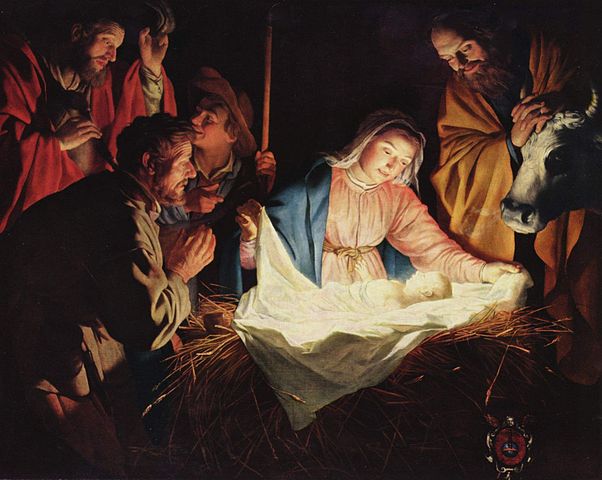
“Adoration of the Shepherds,” by Gerard van Honthorst, 1622. (credit Wikipedia: The Yorck Project: 10.000 Meisterwerke der Malerei. DVD-ROM, 2002. ISBN 3936122202)
Back to the Virgin Birth: How the New Testament Uses the Old Testament
Let us circle back to where we started.
Underneath the Jerome versus Augustine controversy was the very heart of the matter; that is, the use of the Greek translations of the Old Testament by the New Testament authors themselves to make their case for Christianity. The Septuagint does differ in numerous places from the original Hebrew text. Returning back to the famous prophecy from Isaiah about the birth of the Messiah can help to illustrate the point.
Not too long ago, I listened to Eastern Orthodox priest and scholar Father Stephen De Young making an interesting claim about Matthew’s use of Isaiah 7:14, which affirms the Virgin Birth of Jesus. In Matthew 1:23, the Gospel writer is quoting from the Septuagint version of Isaiah 7:14, and not the Masoretic Hebrew version of Isaiah 7:14, the latter which uses the Hebrew word “almah” to refer to the woman who would conceive and bear a child. A translation like the NRSVue follows the Hebrew reading, and not the Greek reading. The Hebrew word “almah” simply means “a young woman,” and not necessarily a “virgin.”
However, the Septuagint uses the Greek word “parthenos” which is typically translated as “virgin.” At first glance, it looks as though most English Bible translations today tend to “cheat” a bit when translating Isaiah 7:14, as normally such translations follow the Hebrew Masoretic and not the Septugaint. But when it comes to Isaiah 7:14, you typically find the word “virgin” and not the phrase “a young woman.”
But when English Bible translations do this, are they really “cheating?”
Stephen De Young suggests a provocative explanation as to what is taking place in this verse. He contends that while the word “parthenos” did have the meaning of “virgin” in the first century, when the Gospel of Matthew was written, “parthenos” originally had the meaning of “a young woman” a few centuries earlier when Isaiah was first translated into Greek, thus mirroring the mean of the Hebrew word “almah.” But in the providence of God, the meaning of the word “parthenos” changed over time, such that by the first century C.E., the meaning of “virgin” for “parthenos” had become normative. As evidence, De Young argues that by the second century C.E., the word “parthenos” was also used to refer to a male who was a virgin, and not simply “a young woman.”
Not every English Bible translation does this, but if you look carefully in a Bible translation’s footnotes, they will often put a note saying “Septuagint” or “LXX” to indicate when the translator diverges from the Masoretic Hebrew.[4]
There is no ominous conspiracy here to “change” the meaning of the Bible. Instead, it is a judicious use of good scholarship to give you a Bible which you can better understand.
The Authority of the Septuagint?
The final question which Lanier and Ross raise in their book of less than 200 pages is about the nature of the authority of the Septuagint for Christians: Does the Septuagint have some kind of authority for the Christian, in their study of the Bible? Two basic schools of thought have dominated the Christian world for centuries in this debate. One approach has been to favor the Hebrew text of the Old Testament, as found in the Masoretic textual tradition used by the ancient Jewish community. Some in this school tend to dismiss the Septuagint translators as clumsy or prone to error. Lanier and Ross would argue that this is a mistake, as they make the case that the Septuagint translators were quite competent in doing their work.
The other approach favors the Greek version of the Old Testament, which has prompted some extreme defenders to claim that the Jews purposefully altered the Masoretic tradition in order to eliminate Christian readings of the Old Testament. Lanier and Ross do not favor this approach either.
Given the fact that the New Testament writers, when quoting from the Old Testament, were sometimes users of the Hebrew, but who mostly favored Greek versions of the text should suggest that a more robust way to think about the Septuagint lies somewhere between the two extremes. This should also encourage some exegetical humility among Christians today who try to make sense of difficult passages of Scripture whereby we do not have complete agreement between the Hebrew and the Greek.
Lanier and Ross are hesitant to conclude that the Septuagint has normative authority for Christians today. That spot is reserved for the Hebrew Bible. But the Septuagint can be used like any good English Bible translation today, to help to clarify meaning. This “Old Greek” translation of the Hebrew served that purpose for the earliest Christians, including the authors of our New Testament.
This might sit uncomfortably among those who think that we should have some fixed text for what we know as “the Bible,” as though the Bible somehow dropped down out of the sky. Yet the Bible is what it is, and whatever we think of something like “inerrancy,” in that “inerrancy” must take into account the actual data of what we have in our Bible. It would simply be wrong to try to impose some kind of modern understanding of “authority” onto these ancient texts of Scripture.[5]
As a result, Lanier and Ross conclude that the Septuagint possesses derivative authority, much like our best English translations of the Bible today. The Septuagint’s authority is “downstream from its normative text.” The way they put it is this:
…the New Testament authors, in reaching a Greek world, prioritized the faithful communication of the meaning of an Old Testament source text higher than punctilious adherence to a set (Hebrew) wording (Lanier and Ross, p. 186).
The meaning of the text takes priority over the exact words, which is a nuanced way of how to think about the Bible. Kudos go to Lanier and Ross for giving readers a helpful introduction to such a perplexing, yet important topic.[6] [7]
Several years ago, I read and reviewed Timothy Michael Laws’ When God Spoke Greek: The Septuagint and the Making of the Christian Bible. It was this book that made me realize what the Septuagint was with respect to Christianity, broadly speaking. Laws’ book focuses more on the history of the Septuagint, whereas this book, The Septuagint: What It Is and Why It Matters, by Greg Lanier and William Ross, gives you the history along with a perspective of what Bible scholars have to say about why the Septuagint matters for studying the Bible. Lanier’s and Ross’ book is the perfect introduction for anyone who wants understand what their Bible is all about.
————————————————-
ADDENDUM: Lanier’s and Ross’ book brought out so many tantalizing tidbits, but I did not want to clutter the main body of the blog post with all of them. For the curious, check out some of the rabbit trail notes (below) I gained from reading this book, referenced in the main text of the blog post …..
Notes
[1] As early as the second century in the history of Christianity, the doctrine of the Virgin Birth was a scandal. Some early critics of Christianity, like the second century pagan Celsus, say that Mary was impregnated by a Roman soldier named Pantera. There is debate among scholars as to how this story originated and how Celsus was informed about it. But the basic idea is that when the Romans sacked and burned the city of Sepphoris, which was within walking distance of Nazareth, in Galilee, Pantera was presumably among the Roman troops who must have encountered Mary, who was from nearby Nazareth. After the death of Herod, which according to the standard chronology was in 4 BCE (scholars debate about the date of Herod’s death), there was a Jewish revolt. Syrian governor Publius Quinctilius Varus sent an army to crush the revolt, burn the city, and ended up selling its inhabitants into slavery. Back to text
[2] In other words, there is no guy named Pantera in the picture….. Attacks on the Virgin Birth by skeptics are not only based on a denial of the supernatural, they also take aim against the inerrancy of the Bible. Sadly, some well-meaning Christian apologetics distort what we can confidently say about the inspiration of the Bible, and its relation to inerrancy. As I have argued before, there are different definitions of biblical “inerrancy,” and we should be careful not to get too hung up on trying to demand a kind of technical precision from the text which was not within the intended purpose of the original author. Furthermore, understanding how the New Testament uses the Old Testament should encourage us to take a step back and look at the larger picture of how prophecy in the Bible actually works, instead of trying to use popular ideas about “300 prophecies” being fulfilled by Jesus as some kind of miracle of mathematical improbability. Is the coming of Jesus really about beating the mathematical odds of getting certain predictions right, or is it more about veiling the truth about the coming of the Messiah in a way that would catch the powers of darkness off-guard? The latter is a more defensible approach to Scripture. Back to text
[3] The first Bible translation in English to do what the NRSVue does was its predecessor, the RSV, back in the late 1940s and 1950s. Some people got really upset about this. I wrote about this in a Veracity blog post a few years ago. Back to text
[4] The YouTube video clip from Father Stephen De Young was taken from a longer video stream, which has timestamps. … .In the ESV (English Standard Version), there are several other well-known examples of the Septuagint taking precedence over the Masoretic reading: Genesis 4:8: The ESV adds the phrase “Let us go out to the field” following the Septuagint and other ancient texts (where the Masoretic Text lacks the phrase). 1 Samuel 1:24: The ESV translates “a three-year-old bull” (with the Septuagint and Dead Sea Scrolls) instead of the Masoretic Text’s “three bullocks“. 1 Samuel 14:1: The ESV includes missing text—”has not the Lord anointed you…“—which is preserved in the Septuagint but missing from the Hebrew. Deuteronomy 32:8: The ESV translates “sons of God” alongside the Septuagint and Dead Sea Scrolls, diverging from the traditional Masoretic reading of “sons of Israel“. Back to text
[5] This suggests that we would do well to realize that the New Testament does things with the Old Testament which do not often fit within our modern expectations of an “inerrant” text, due to its reliance on a Septuagint, “Old Greek” tradition, but that this should in no way diminish its authority. Sometimes the New Testament follows the Hebrew text and not the Septuagint reading, as when Matthew 2:15 quotes the Hebrew “my son” of Hosea 11:1, but not the Old Greek, which is rendered as “my children.” Contrast with Psalm 95:7-11, where the New Testament follows the Old Greek, with words like “rebellion” and “testing,” unlike the Hebrew, which has words like “Meribah” and “Massah.” The New Testament even appeals to Jewish tradition not found in the Hebrew text, and not even in any know Septuagint text, as when 2 Timothy 3:8 mentions the Egyptian magicians Jannes and Jambres, and yet we have no mention of them in Exodus. Eastern Orthodox priest Father Stephen De Young gives several other examples. Back to text
[6] This understanding of “derivative authority” is significant in how certain key texts in the Hebrew Bible were handled by Septuagint translators, as a means of settling debates concerning biblical interpretation. For example follow this rabbit trail:
Psalm 82:1-8, when reading it in the Hebrew has often lended itself to be about a critique of Israelite judges, referred to as “gods” in Psalm 82:1,6 , who judge unwisely. This is different from the Septuagint reading which suggests that the “gods” of Psalm 82:1,6 are really divine beings, members of God’s divine council. These “gods” were created by the uncreated Yahweh, so they do not stand on par with Yahweh, but they are still divine beings. Psalm 82 is significant in that Jesus refers to it in John 10:34-35, as a defense of his divinity. Since the New Testament authors tend to favor the Septuagint readings of Old Testament texts over Hebrew readings, it would make sense to say that Jesus in John 10:34-35 is referring himself as the unique “Son of God,” a clear defense of his divinity, a view favored by the late Michael Heiser. (Heiser is not alone in his conclusion).
In the Naked Bible Podcast, Episode 109, Heiser argues that the reference to “gods” here in John 10 as mere humans actually undermines the force of Jesus’ argument. For if the reference to “gods” in John 10 were to describe mere humans, as the Jewish leaders were, it would be as though Jesus is saying something like, “Well, if you Jewish leaders, who are mere humans, can call yourselves ‘gods,” then why can I not do the same?“
In contrast, Heiser makes the argument that Jesus is classified himself as a divine being, just as Psalm 82 declares. In other words, Jesus is not soft-pedaling an earlier claim that he as the Son is one with the Father (John 10:30). Rather, Jesus is not backing down! Some scholars observe that Jesus is indeed quoting from the Septuagint version of Psalm 82 as opposed to the Hebrew reading (see John Beasley-Murray, Word Biblical Commentary on John, p. 640-641). The ESV translation of Psalm 82:1-8 lends itself to more naturally follow the Septuagint understanding of the Psalm 82, whereas the NASB 1995 follows a more Hebrew reading. It is important to note that the NASB revision in 2020 has been altered to follow the Septuagint reading.
Ironically, the notes in the ESV Study Bible favor the human judges interpretation of John 10:34-35, despite how the translation of Psalm 82 actually reads in that translation. D.A. Carson rejects both the divine council reading, via the Septuagint, as well as the human judges reading, but instead prefers the view that Jesus’ reference to Psalm 82 in John 10 is to the receiving of the Law by the Israelites at Sinai. Carson holds this based mostly on v. 35 where Jesus says: “If he called them gods to whom the word of God came,” which for him recalls the Sinai context. Granted, there are rabbinical traditions which acknowledge this interpretation, something which in my reading of Michael Heiser, Heiser does not address. But it could equally be said that the psalmist in Psalm 82 also received the word of God, just as much as those at Sinai did as well. Ironically, Carson admits that the use of “to whom the word of God came” is not an unusual theme throughout the whole Old Testament, as “most naturally [it is] to be understood as those to whom the message was spoken, and is frequently so used in the OT prophets, especially in Jer and Ezek)” (Carson, p. 643). Furthermore, there is no description of those at Sinai being referenced as “gods,” whereas the text is explicit about referencing “gods” in Psalm 82. In rejecting the divine council view, Carson pushes back by saying “the Fourth Gospel fails to mention angels or Melchizedek” (Carson, Pillar Commentary: Gospel of John, p. 398). However, the force of Carson’s counter-argument is lost in that the Gospel of John never elsewhere identifies the term “gods” with any mere human beings.
Interestingly, John Piper accepts Michael Heiser’s thesis that the “gods” of Psalm 82 are indeed divine beings (contra Carson). Like Heiser, Piper reads Psalm 82:7 to indicate that these “gods” are not human beings, as the verse says these “gods” will “die like men.” For if humans were indeed in view, it would make no sense for these “gods” to “die like men” if they are already men, and not gods. But it would make perfect sense for the Psalmist to say that these divine beings, who are presumably immortal, who also fall under God’s judgment, will become mortal like human beings as part of their punishment. Yet Piper’s position is that these divine beings are lesser “gods” than Yahweh. Therefore, in Piper’s view, Jesus’ reference to Psalm 82 is to deflect the conversation by suggesting that Jesus’ divine claim is not something that should necessarily lead to the charge of blasphemy, as one can be considered a “god” without being identified strictly as Yahweh, who stands above all of the other “gods.” By giving his hearers a theological puzzle to consider among themselves, Jesus is enabled to escape his accusers (John 10:39). This sort of works, except that in John 10:38, Jesus repeats the divine claim he made earlier in John 10:30. Furthermore, it would be odd for Jesus to use a passage of Scripture in order to confuse his listeners, in order to divert attention away from himself, in order to make his escape.
However, in contrast to both Carson and Piper, Heiser’s point is not simply that Jesus is making a divine claim in John 10:34-35. The claim is more concrete than that. Rather, Jesus is making the claim that his role in the divine council is one of executing judgment against the supernatural powers that are in rebellion to Yahweh. For Psalm 82 is all about a pronouncement of judgment against the “gods” who have failed to obey the will of Yahweh. By referencing Psalm 82 in John 10:34-35, Jesus is announcing the day of judgment is coming that he is the “Enforcer” of this judgment (See Heiser’s scholarly paper defending his view, along with Heiser’s powerpoint slides). Not only is the coming of Jesus the coming of God into the world, it is a divine coming intent upon exercising judgment against those spiritual forces which are in rebellion to Yahweh. Contrast this with what the ESV Study Notes have for John 10:34-35: “John 10:34 Jesus’ point in quoting Ps. 82:6 is that if human judges (Ps. 82:2–4) can in some sense be called gods (in light of their role as representatives of God), this designation is even more appropriate for the one who truly is the Son of God (John 10:33, 35–36).”
The ESV Study Notes have this for Psalm 82: “Ps. 82:6 You are gods. John 10:34–35 tells how Jesus cited this text in a debate (see note on Ps. 82:1) to deflect criticism for calling himself the Son of God. Since the title “Son of God” is sometimes a designation of David’s heir (see note on 2:7), Jesus is probably inviting his audience to reflect more deeply on its implications. sons of the Most High. If these are Gentile rulers, they serve the purposes of God, who is the highest of all powers. This may suggest that Israelite rulers are especially in view, since Deut. 14:1calls God’s people his “sons” (i.e., the whole people is God’s “son,” cf. Ps. 80:15; and the members are each “sons”). In this latter case, the injustice is even more reprehensible since it defies the gracious covenant of God.”
Which interpretation is the more convincing? ….. I have written on Veracity several book reviews that the Hebrew Bible have readings in them that are quite ambiguous, partly due to the flexibility of the Hebrew language itself, and its high dependence on literary context to determine its meaning, more so than Koine Greek (the language of the New Testament) and even English. Lanier and Ross make a good argument that the Septuagint should play a more significant role in clarifying the ambiguities we find in the Hebrew Bible. My point here in this example of Psalm 82 and John 10 is to say while there is evidence from both sides of the debate to support either side, the derivative authority of the Septuagint plays a role in this debate which is often not discussed, which in my view should tip the scales more towards Heiser’s view than Carson’s (and to a lesser extent, Piper’s). Back to text
[7] Handel’s Messiah has a famous quote from Isaiah 9:6 which I have heard dozens of times sung and performed. However, except for some vague allusions, the New Testament never quotes from Isaiah 9:6. The Hebrew text found in the ESV translation reads these famous words which Handel popularized:
“For to us a child is born,
to us a son is given;
and the government shall be upon his shoulder,
and his name shall be called
Wonderful Counselor, Mighty God,
Everlasting Father, Prince of Peace.”
The original context for Isaiah 9:6 is in reference to King Hezekiah, one of the few “good kings” in ancient Israel history, with divine sounding names. The Jewish Study Bible comments on this verse:
“The Mighty God … ruler”: This long sentence is the throne name of the royal child. Semitic names often consist of sentences that describe God; thus the name Isaiah in Heb means “The Lord saves”; Hezekiah, “The Lord strengthens”; in Akkadian, the name of the Babylonian king Merodach-baladan (Isa. 39.1) means “the god Marduk has provided an heir.” These names do not describe that person who holds them but the god whom the parents worship. Similarly, the name given to the child in this v. does not describe that child or attribute divinity to him, but describes God’s actions. (Berlin, Adele; Brettler, Marc Zvi. The Jewish Study Bible: Second Edition (p. 900). (Function). Kindle Edition).
So, it makes sense for Handel to see a connection between Isaiah 9:6 and the divine identity of Jesus. But why did no New Testament author reference Isaiah 9:6, for such a positive affirmation of Jesus’ divinity? If you compare this Hebrew version with the Septuagint reading, a possible explanation might emerge:
“Because a child was born for us, a son also given to us, whose sovereignty was upon his shoulder, and he is named Messenger of Great Counsel, for I will bring peace upon the rulers, peace and health to him.” (New English Translation of the Septuagint)
It is evident that the superlatives used to describe Hezekiah, for the original context, and Jesus, for the New Testament context, lack the more explicit divine kind of connotations. A YouTube video done by a skeptic suggests that this difference between the Hebrew text and the Septuagint casts some doubt on the credibility of the New Testament. Yet I am not persuaded. Rather, this shows that the New Testament authors followed standard Jewish interpretive practices of the day in reading their ancient texts, in ways that aligned with their gift of Holy Spirit inspiration. Unfortunately, too many Christians remain unaware as to how these New Testament authors made use of the Old Testament, and what the role was for the Septuagint in reading and interpreting the Old Testament, in ways that made sense to them in their historical, Second Temple Judaic context. Back to text




August 28th, 2026 at 6:30 pm
[…] The English Standard Version bases its translation of the Old Testament on what is called the Masoretic text, or Hebrew version of the Bible, preserved by the Jewish community down through the centuries. With the NKJV Orthodox Study Bible, the translators follow the so-called Septuagint, or the Greek translation of the Old Testament (Take a look at a previous Veracity blog post for more info on the Septuagint). […]
LikeLike
September 2nd, 2026 at 5:45 pm
LikeLike