
Just a few weeks ago, President Trump announced a cessation of hostilities with Iran, however tenuous it appears, a conflict having an existential impact upon the modern nation state of Israel and threats upon other Middle Eastern nations as well. But the story goes back a long, long, way….
In 63 BCE, the Roman general Pompey (not to be confused with the city in Italy, Pompei, and its famous volcano) laid siege to the city of Jerusalem. Following the collapse of competing and aging Greek empires, the Ptolemaic in Egypt and the Seleucid in Syria, Rome took advantage of the power vacuum and took an interest in the ancient land of the Bible.
Pompey, a religious outsider to the Jews, after defeating some Jewish resistance, entered the Jewish Temple and even walked into the Holy of Holies, thus desecrating it. Interestingly, Pompey did not take anything. Instead, he ordered that the Temple rituals be continued, as he claimed victory over the city. A little over a century earlier, the Maccabean revolt had shaken off the shackles of their Greek overlords. but now that period of Jewish self-rule came to an end, with Pompey’s conquest of the holy city. Nevertheless, the Romans did not destroy the Jews as a people or their Temple. What then was Pompey’s objective in taking Jerusalem?
Neither the Old nor the New Testament tell us about this remarkable turn of events. Rarely do Christians hear about this in evangelical churches. But this story of Pompey sets up the narrative which stands at the center of controversy over Jesus of Nazareth, who would be born just a few decades later.
The Romans and Jews were at odds with one another. To the Jews, the Romans were idolaters, worshipping many gods. To the Romans, the Jews were peculiar in their religious practices. Yet the Romans wanted to maintain some control over Judea, as Rome detected a growing threat rising in the East. The Parthian empire, whose power was centered in modern-day Iran, challenged that of Rome.
As the Romans grew to prominence, they kept bumping into their Parthian neighbors in the East, and the two did not get along well. The relatively small Jewish nation had become sandwiched between these two great empires. Though Rome now had control of Judea, it was not without some difficulty. For there were still Jews living in the East in Parthian territory, remnants of those who stayed mostly east of the Euphrates, and did not return back to the area of Jerusalem following the decline of Babylon.
Rome needed Judea as a buffer against the Parthians. But they did not want to alienate the native Jewish population of Judea such that it would raise sympathies with those Jews still living in Parthian lands. For those eastern Jews might enlist with the Parthians to push back against Rome.
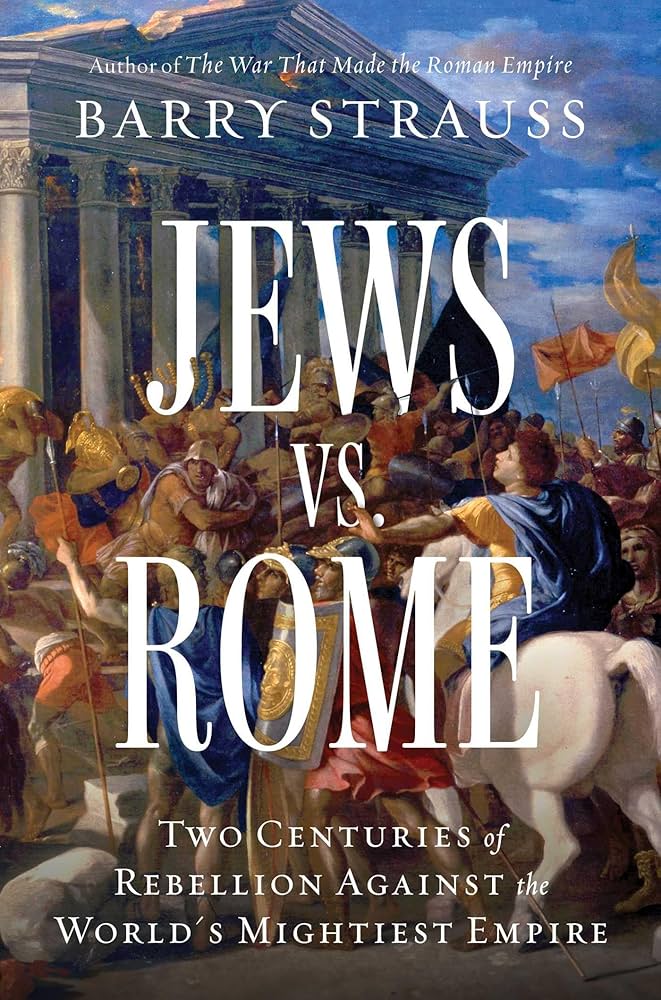
Barry Strauss’ Jews Vs. Rome: Two Centuries of Rebellions Against the World’s Mightiest Empire, tells the story of the ancient conflict between the Jews and the Roman Empire. Not only does Strauss’ book give us essential background material for understanding the Bible, it helps us understand the complexity of current events in the Middle East.
Historian Barry Strauss outlines this background material in his Jews vs. Rome: Two Centuries of Rebellion Against the World’s Mightiest Empire, which tells the tale of tensions between these two peoples, between Pompey’s arrival in Jerusalem in 63 BCE, and the ultimate destruction of Jewish nation in the land of Judea, through Emperor Hadrian’s crushing of the Bar Kokhba revolt, in the 130’s CE. The first century of the Christian movement is smack dab in the middle of it all, and yet you hardly hear much about this in many evangelical churches.
In our New Testament, Christians read about a bunch of people all named “Herod.” When first reading the New Testament, it is easy to think there was this one person named Herod who kept popping up all of the time throughout the stories of the Gospels. It can be difficult to track with the “Who’s Who” of the Herods. The New Testament itself barely tells us much about who these people really were, and how they got to be the Herods of the New Testament.
The Romans were in a quandary about what to do with Judea following Pompey’s victory. The Romans were hesitant to bring in a pagan Roman to rule a people with such strange religious habits and beliefs, such as male circumcision, eating a restricted food diet, and worshipping only one God. But within a few years, the first Herod, Herod the Great, emerged as the client ruler of choice for the Romans. Through Herod, an Idumean and not really a full Jew (though he tried to position himself as one), the Romans found someone who could look after Rome’s interests in Judea without provoking intervention from the Parthians off to the east.
In some ways, Barry Strauss likens Herod the Great to having a particular “Donald Trump” transactional quality, that of celebrating the art of the “deal.” Herod believed that he could make a deal between Rome and the Jews, where both sides could get something that they wanted, though not everything, and still both Romans and Jews can somehow live in peace together, even if it was a fragile peace.
Herod was a builder, who constructed a deep-water port in Caesarea, along the Mediterranean, as well as greatly enhancing the architecture and grandeur of the Jerusalem Temple. These marvels were attempts to show Rome and the Jews that he was on both of “their” sides. Herod was also extremely paranoid and ruthless. The Gospel of Matthew lets New Testament readers know of this reputation through the Massacre of the Innocents in Bethlehem.
After Herod’s death, around the time of Christ’s birth, Herod’s realm was divided into three pieces, one piece given to three of his sons. The New Testament tells us about Herod Antipas ruling up in Galilee, who stayed in power for a number of years. But then there was Herod’s other son, Herod Archelaus, who ruled over Judea, after he traveled to petition Rome for the right to rule in Jerusalem, following his father’s death. Mathew 2:22 gives the reader a sense that this Herod was just as ruthless as his father.
Unfortunately for Herod Archelaus, while he had his father’s ruthlessness, he did not have enough tactfulness to know when too much was too much. By 6 A.D. (CE), he was recalled by Rome, as complaints by the Jews were made against Archelaus. This led the Romans to finally bring in leadership from the outside, bringing the land of Judea under direct Roman control. The most famous of these leaders was Pontius Pilate.
Pilate had his run-ins with the Jews, but it was nothing compared to the crisis precipitated by Gessius Florus, the Roman governor appointed by the infamous Emperor Nero to rule in Judea during the years 64-66 CE. When Gessius raided the Jerusalem Temple for cash, this instigated an uprising among the Jews. Josephus, the Jewish military leader who turned traitor during the Great Jewish Revolt, blamed Gessius for the start of the conflict, which eventually led to the destruction of the Temple in 70 CE by the Romans.
Josephus remains our best source for this period, though Strauss is careful enough to acknowledge that Josephus would at times fudge the facts to make himself look better. But the record that Josephus leaves provides a detailed tale of how the Jews, in seeking to defend against the Romans, were in many ways more at war with one another. Much of the conflict among the Jews were between those who believed that Rome should be resisted at all costs, whereas other more moderate Jews believed that Jewish resistance to Rome was futile.
Ultimately, the latter group proved to be right, as the Romans led by the future emperor Titus destroyed Jerusalem and left the Temple in ruins. This was followed up by the dramatic siege by the Romans of the mountain fortress by the Dead Sea, Masada, of the last of the Jewish rebels. However, though Josephus leaves us the most detail regarding the tragedy of the Great Jewish Revolt, the outcomes of two later revolts caused more death and destruction across a much wider area.

Temple plunder depicted on the Arch of Titus, Rome, a must-see artifact at the entrance to the Roman Forum, which my wife and I visited in 2018. Titus brought back thousands of defeated Jews as slaves to Rome, after he defeated Jerusalem and destroyed its Temple in 70 A.D.
The Jewish Diaspora revolt, sometimes known as Second Jewish-Roman War, or the Kitos War, from about 116-118 CE, mainly involved the Jews in and around Alexandria, Egypt, the area which supplied a vast majority of food for Rome. Tensions between these Alexandrian Jews and the Romans in Egypt erupted, soon after Rome went to war against the Parthians. Thousands of both Jews and Romans died in the conflict, with Rome eventually gaining the upper hand.
Then finally, there was the Bar Kokhba revolt of 135 CE, sometimes called the Third Jewish-Roman war, led by the messianic leader Simon Bar Kokhba against the pagan Emperor Hadrian, who decisively defeated the Jews. Hadrian had renamed Jerusalem as Aelia Capitolina, placing a temple to Jupiter on the Temple Mount, and even renamed Judea as Palestine, which even today is taken by some Jews as a slur. The cost was certainly heavy for the Romans, but the greatest loss was for the Jews, who were effectively exiled again from much of their homeland, by the end of 135 CE.
Nevertheless, as Strauss paints it, it was the Jews who survived in the long run, while Rome ultimately failed. The Jews lost their Temple, the core element of their faith, but in the wake of the Temple’s destruction, and finally with the defeat of Bar Kokhba, the surviving Jews basically found a way to reinvent Judaism, retaining an embrace of the Law of Moses, without a Temple at its center. Furthermore, the Jews were able to do so, living as a minority in a culture dominated by those who were not like them in their beliefs and practices.
Strauss’ Jews vs. Rome weaves a fascinating story of those three great Jewish revolts, and the consequences which followed. Having this story in mind sheds a lot of light on the background for the New Testament, and the world in which figures like Jesus, Paul, and the other early disciples of Jesus lived.
One particular story stands out to me regarding the time of Jesus in Galilee. Roughly about the time that Jesus was born, there was a city, Sepphoris, just a few miles from Jesus’ boyhood home of Nazareth, which had undergone a revolt against Herodian rule. But the Romans came in and destroyed the city, taking the inhabitants off to become enslaved. A new population, more friendly to the Romans, occupied the remains of the city, which was rebuilt during the early years of Jesus. Unfortunately, the New Testament never mentions Sepphoris, despite its proximity and walking distance from Nazareth. Some historians speculate that Jesus may have accompanied his carpenter father to help rebuild that city.
Strauss’ work also helps us understand what is going on in Israel today, particularly in view of the crisis of the October 7, 2023 attacks on Israel by Hamas, and Israel’s aggressive response in Gaza for over two years, including military conflicts in southern Lebanon and with Iran. In a 2025 YouTube short video of Benjamin Netanyahu, the Israeli Prime Minister comments about his reading of Barry Strauss’ book, and why he desired to read the book. Netanyahu responded with, “Well we lost that one, and we have to win the next one.” The video pops every now and then on YouTube, but at times the video has been taken down. The last version I know about is linked here.
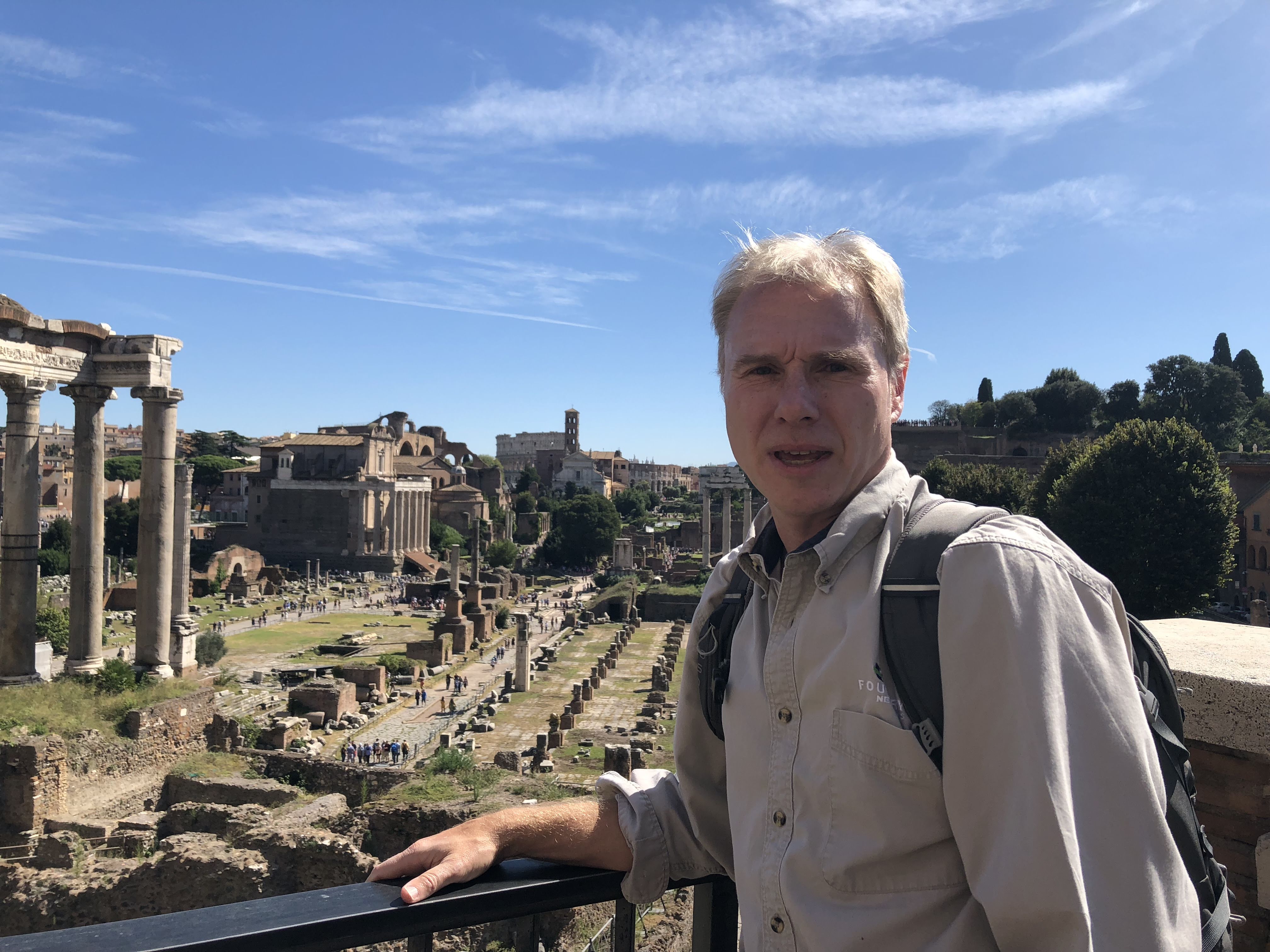
Veracity blogger, on-site, at the Roman Forum, in 2018, where the “pagan” culture of Rome reigned supreme, until the story of the Crucified and Resurrected One superseded it. On the opposite side of the Roman Forum, at the entrance, stands the Arch of Titus, which depicts the defeat of Jerusalem, in 70 A.D., which among the Jewish people was pretty much the equivalent to the “9-11” attack in the United States, for Americans.
What is so eerie about reading Jews vs. Rome is how relevant Strauss’ book is to current events. Not too long after reading Strauss’ book, the United States and Israel made pre-emptive strikes against the Iranian Shiite regime, in late February, 2026. While the war has been greatly debated in the United States, as to its legitimacy, it would appear that for the Israelis, there is less controversy (though clearly not everyone in Israel agrees with Netanyahu). One can read from Netanyahu’s comments about Jews vs. Rome, that Netanyahu believes that Israel today can not afford to make the same mistakes made some 2,000 years ago. Israel’s foreign policy understands that the Shiite regime in Iran is the rough equivalent to first century Rome. I will leave it to the news commentators and political analysts, who know better than I do, as to what Netanyahu has been thinking, and if he has been right or not.
My primary takeaway from Jews vs. Rome is historical, in how the story of this ancient conflict can help us to better comprehend the historical context of the Bible. Understanding the conflict between Rome and Jews helps Christians to better understand why so many of Jesus’ followers were hoping him to be a military and political Messiah, who would rise up against Rome, and remove the Romans from the land. The period of the Jews versus Rome conflict represents the zenith of apocalyptic writings and thinking among the Jews. The Jews were expecting a messianic figure to come, bring an end to the current world order, and start something new, with the liberation of Israel as the focal point. However, in the case of the early Christian movement, that did not turn out exactly the way many Jews were anticipating. The announcement of the coming Kingdom of God by Jesus of Nazareth took on a completely different dimension, one that would forever change the trajectory of human history.
Many thanks go to Barry Strauss for giving the reader an enthralling account of the conflict, which became the fertile ground from which the Christian faith took hold in the world, some twenty centuries ago. The fact that the situation regarding the fate of ancient Israel stills holds immense narrative power should tell us why the conflict in the Middle East seems like it is never ending.
Want more details about the book? Listen to historian Victor Davis Hanson’s interview with Barry Strauss.




July 19th, 2026 at 9:33 am
Hebrew historian Elon Gilad walks us through the evidence of the so-called “Kitos War”, which took place under Trajan, between the Jewish Revolt in Jerusalem around 70 CE, and Hadrian’s war against Bar Kokhba around 132 CE.
LikeLike