

John Calvin (1509-1564)
Aside from Martin Luther of Wittenberg, Germany, the name most associated with the Protestant Reformation is John Calvin, a Frenchman who lived most of his adult life in exile from his home country. Born in 1509, Calvin was a good bit younger than his other famous contemporary. When Luther appeared before Emperor Charles V to make his famous “Here I Stand” defense of his theology, John Calvin was only about 12 years old.
Calvin’s father had high hopes for his intellectually gifted son. He was able to send his son off to study at the Sorbonne, in Paris, when John Calvin was only about 13 years old. While Calvin was studying in the university, the humanist movement, with its cry of “ad fontes,” Latin for “back to the sources,” was in full swing. Part of that movement was to go back to the original Greek text of the New Testament, which whetted Calvin’s appetite to learn more about what that crazy Augustinian monk in Wittenberg, Germany was making such a fuss about.
Many of his professors were opposed to Luther’s Reformation efforts. But as a student, John Calvin went the other way, being converted to Protestantism in 1534. The tension created a vocational crisis in this young man’s life. He was forced to flee Paris, in search of a new home and a livelihood.
In October, 2025, my wife and I took a trip on a river cruise down the Rhine River. We got to visit several of the cities to which Calvin fled, including Basel, Switzerland and Strasbourg, France. We even made it to Paris, where the young Calvin first became exposed to the ideas of the Reformation.

Basel Cathedral, in Basel Switzerland, home to the Reformation movement in this Swiss city. Over the years, many leading Protestant figures attended this church, including Karl Barth and John Calvin. Calvin first came to Basel to flee the authorities in Paris, who were determined to wipe out the Protestant movement in France. My photo from October, 2025.
What we did not have time to do was visit where John Calvin spent most of his life, as a pastor in the Swiss city of Geneva. While Calvin was on the run from French authorities bent on silencing the Reformation in France, he made it to Geneva where he was only planning to spend one night, before making his way elsewhere. But when a fellow Protestant serving as pastor in Geneva, Guillaume Farel, discovered that the brilliant young Calvin was in town, he made his way straight over to see the Frenchman. That evening proved to be a turning point in Calvin’s life.
Prior to traveling to Geneva, John Calvin originally intended to live in Strasbourg, wanting to live a quiet life there, pursuing his intellectual studies. Calvin had spent some time in Italy, gathering together some material related to his intellectual interests. So when Calvin was merely passing through Geneva for the night, in order to avoid a path through a nearby military conflict, the thought of staying in Geneva was far from his mind.
But Farel had rushed over and confronted Calvin, threatening him with the very judgment of God, pleading with Calvin to stay in Geneva and help to establish the Reformation there in that city. Shocked by Farel’s threats, Calvin canceled his plans to go to Strasbourg, and he stayed in Geneva, where he learned to become a pastor, a shepherd caring for the souls of church goers under his care.
It was a fateful decision. Aside from a brief move a few years later to Strasbourg, Calvin spent the rest of his life in Geneva, tending his spiritual flock, and building what would become a great training ground for Reformation thinkers, who spread many of Calvin’s ideas and teachings all throughout Europe.
But despite his vocation as a pastor in Geneva, Calvin managed to find the time and energy to pursue his most well-known intellectual interest of all, a literary effort to try to convince his fellow Frenchmen of the truth of the Protestant Reformation understanding of the Gospel. According to church historian Bruce Gordon, the Institutes of the Christian Religion first saw the light of day in 1536 as a Latin text. In the Institutes, Calvin addressed his work to the King of France, pleading the cause of the Reformation.
Over the decades, Calvin would revise the Institutes several times, with the final version being published (still) in Latin in 1559. Various revisions by Calvin were then translated by him into French, to try to reach his fellow countrymen. By then, after having several decades as an active pastor, preaching, counseling people, performing baptisms and funerals, he was able to combine his pastoral sensitivities with his crisp theological acumen to produce perhaps the single most influential written work to come out of the 16th century Protestant Reformation movement.
Bruce Gordon has written a wonderful book, just a bit over 200 pages, John Calvin’s Institutes of the Christian Religion: A Biography, which looks at the history and influence of Calvin’s most well-known work. Gordon’s book is part of the “Lives of Great Religious Books” series, which focuses on the history and influence of numerous books like these, with brief summaries of the author’s life, along with greater attention to how such books have been received down the ages.
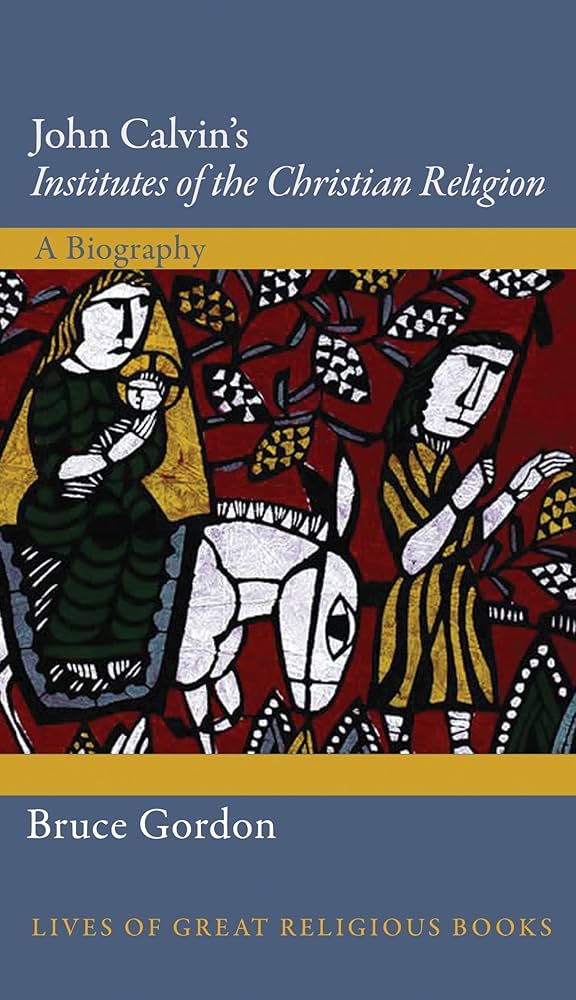
Bruce Gordon’s John Calvin’s Institutes of the Christian Religion (Lives of Great Religious Books Book 25).
Calvin in Basel Switzerland: The First Draft of the Institutes
Before Calvin made his fateful stop in Geneva, Switzerland, he spent some time in Basel, Switzerland, where he worked on that first draft of the Institutes. He most probably attended the city church there, the Basel Cathedral, which had become aligned with the Protestant movement over the previous decade.
As I stepped inside that cathedral, I tried to imagine what it might have been like for Calvin to seek spiritual refuge there in Basel, knowing that he may never be able to return to his native France. Nestled near the borders of France, Germany, and Switzerland, along the Rhine River, Basel has a special place in the history of the Christian movement.
Basel has had numerous connections to the Reformation movement over the years. This was the city where Huldrych Zwingli, the fiery Swiss preacher of Zurich, Switzerland had become first exposed to the ideas of Desiderius Erasmus and the humanist movement, as a college student. Erasmus was the Catholic scholar who produced the first major revision of the New Testament Greek text, based largely on newly discovered ancient manuscripts received from Eastern Orthodox scholars who had fled Constantinople, after it had been captured by the Turks in 1453. Erasmus’ work on the Greek New Testament was the intellectual fire which lit Martin Luther’s imagination, in his conflict with the Pope.
Erasmus himself spent his later years in Basel, though he remained a committed Roman Catholic his whole life. As a gesture of peace and reconciliation towards the Protestants, Erasmus was buried in the Basel Cathedral.
Fast forwarding to the 20th century, the great Swiss Protestant theologian, Karl Barth, spent most of his adult years in Basel, writing his Church Dogmatics, which in many ways mirrors the contribution Calvin gave to Christian readers, through the Institutes.
Calvin in Strasbourg, France, Where He Found His Wife
Going down the Rhine River from Basel, you eventually pass by the city of Strasbourg, on the border between France and Germany. Calvin’s first few years in Geneva had been pretty rocky. At one point, the city council became so infuriated with Calvin’s Reformation ideas that they kicked him out of the city. Calvin decided to join up with his friend Martin Bucer, who was serving as a pastor in Strasbourg. Calvin found a job as a pastor at Saint Nicholas Church, on the outskirts of the old city of Strasbourg.
Most of his parishioners were Protestant refugees from France, fleeing persecution there. Instead of shunning those who sought to escape state-sponsored violence, Calvin welcomed these sojourners who sought sanctuary from the French government. Some of these Protestants were actually involved in the more radical end of the Reformation movement, among the Anabaptists, which had its start in Zwingli’s church in Zurich.

In the early 20th century, Albert Schweitzer preached in Saint Nicholas Church, in Strasbourg, the same church the 16th century Protestant Reformer, John Calvin, preached in a few hundred years before. Calvin’s flock was made up of Protestant refugees fleeing religious persecution in France.
However, despite the hardships in Strasbourg, and being unable to return to both Paris and Geneva, Calvin’s life was set on a new course…. at least temporarily. One of those Anabaptists he encountered eventually cast aside those radical beliefs, and became his wife, Idelette de Bure.
Idelette had been recently widowed, leaving her with two children. Martin Bucer proved to be the matchmaker to put her and John Calvin together as a couple, and Bucer presided over the marriage in his home. Though Idelette bore Calvin several children in their marriage, none of those children survived beyond infancy. When the city council in Geneva decided to call John Calvin back to Geneva to become the city pastor again, Calvin came back with a ready made family.
Idelette eventually died before John Calvin did, and not long after she died, he wrote to his friend Pierre Viret:
I have been bereaved of the best companion of my life, of one who, had it been so ordered, would not only have been the willing sharer of my indigence, but even of my death. During her life she was the faithful helper of my ministry.
It was in those waning years in Geneva when Calvin put the final touches on the Institutes of the Christian Religion, with a last revision. Calvin died about 5 years later in 1564.
Our last stop in Europe at the very end of our trip along the Rhine River was after taking a bus ride to the city of Paris, where Calvin studied there as a young man at the Sorbonne.

The Sorbonne in Paris, part of the University system where John Calvin studied law and eventually became exposed to the ideas of the Protestant Reformation.
The Legacy of Calvin’s Institutes
Debates over Calvin’s legacy continue to generate ongoing discussion among today’s evangelical Christians. However, there is still a vigorous scholarly debate as whether or not John Calvin was even a “Calvinist.” Gordon admits this as much in observing that “Calvin never saw a tulip in his life” (Gordon, p. 9).
What is typically known as “Calvinism” today is a product of theological debates from the 17th century in the Netherlands, which eventually gave us the well-known T.U.L.I.P. acronym for the “five points” of Calvinism. Calvin was already dead decades before Jacob Arminius, a theologian in the Netherlands, became the center of the controversy regarding “Calvinism.” Gordon reports that the actual “T.U.L.I.P” acronym itself, standing for “total depravity, unconditional election, limited atonement, irresistible grace, and the perseverance of the saints,” entered the theological discussion much later, with the writings of the Presbyterian theologian, Lorraine Boettner, in the early 20th century (Gordon, p. 154). John Calvin is probably most well known for his support for the doctrine of predestination, even though back in the 16th century this was only a minor theme in the Institutes.
Calvin’s Institutes were less about predestination and more about offering a defense of the Reformation, with an original preface pleading with the King of France to hear his case for Protestantism, and stop the persecution of Protestants. Calvin’s work evolved over the years to become more of a training manual for preachers, urging them to have a right view of “the word of God and rightful administration of the sacraments.”
By the time Calvin published the last version of the Institutes in 1559, his work took on the framework of the Apostles Creed, discussing theological matters ranging from the doctrine of creation to the role of the Holy Spirit in the life of the Christian. Towards the end of the Institutes, Calvin addressed the topic of the relations between church and state, filled with ideas that eventually became incorporated into the Constitution of the United States, centuries later, which advocated for the freedom of religion.
Nevertheless, Bruce Gordon takes the position that Calvin’s Institutes not only upholds the doctrine of predestination, in the sense of God having “the card deck stacked in the believer’s favor,” an image I picked up in seminary, the Institutes also adheres to the concept of double predestination. Other reformers in Calvin’s day, like the Lutheran Philip Melanchthon and Huldrych Zwingli’s successor in Zurich, Heinrich Bullinger, accepted the former sense of predestination, but not the latter (Gordon, p. 26).
In double predestination, not only is the true Christian believer predestined to be saved, the first sense of predestination, those who are not true believers are predestined to be eternally separated from God. From a Scriptural perspective, what makes this so controversial is that the terminology of predestination is used in the Bible only in the former sense, and not the latter. However, theologically and philosophically, it makes sense to some that if predestination works one way, it should also work the other way as well. The problem with the Institutes (see chapter 21) is that it is not altogether clear how Calvin connects the idea of predestination of the elect with the fate of the permanently lost. Does Calvin’s view of predestination assume a kind of symmetry, or asymmetry with regard to the eternal state, and what does that all mean?
While scholars debate over what Calvin himself really believed, it is quite clear that many of Calvin’s followers indeed have subscribed to the concept of double predestination. For even if Calvin was not a full-on advocate for double-predestination, many of Calvin’s contemporaries thought he was, and Calvin surely opened the door for many of his followers to embrace such a doctrine.
Gordon argues that Calvin picked up this idea for double predestination from his reading of Romans 9, particularly from the line in Romans 9:13: “Jacob I have loved, Esau I have hated,” though scholars debate whether or not Calvin interpreted the meaning of this correctly (Gordon, p.27). If indeed Calvin did embrace a full-on double predestination doctrine, it would help to explain why a number of scholars today, including the vocal, controversial, and strident David Bentley Hart views Calvin with such moral disgust (as in this New York Times interview from April 2026).
Bruce Gordon acknowledges that Calvin’s holding to the first sense of predestination had a positive pastoral motive behind it. In medieval Catholic scholastic theology, there was always some insecurity about the eternal fate of someone who claimed to be a Christian. For while God would certainly find a way to purge venial sins from the soul of the Christian through purgatory, a failure to confess a mortal sin in this life was altogether a different matter. An unconfessed mortal sin might indeed lead someone who was otherwise a faithful churchgoer to effectively lose their promise of salvation. How does one really know if their sins have been properly and fully confessed before taking their dying breath, such that they would avoid eternal separation from God?
Calvin believed that this anxiety-prone medieval theology undermined the concept of being saved by faith, and faith alone, and salvation by grace, and grace alone. Calvin instead held that to put the decision for one’s salvation in the hidden will of God provided a sense of comfort for the believer, granting an aspect of assurance regarding one’s saving faith. In Calvin’s view, the status of the Christian believer before God belongs in God’s hands, and not our own. Calvin fully believed that for genuine Christians “in turning to Christ, the people behold God’s love as in a mirror“ (Gordon, p. 27).
For Calvin’s detractors however, even among his fellow Protestant Reformers, Calvin’s association with double predestination brought shock and disdain. Gordon writes:
“For Calvin, that teaching was the message of Paul’s Letter to the Romans, but for his numerous opponents it was an appalling idea that made God the author of sin. Calvin’s God— they wrote, preached, and taught— was a capricious tyrant who created women and men in order to destroy them” (Gordon, p. 33).
Whether or not Gordon’s assessment is correct, Calvin’s reputation has often been thought of in this way.
Regardless as to how double predestination fits into Calvin’s own thinking, Calvin sought to hold the tension between the sovereignty of God and human responsibility together, though awkward that may sound to his readers, if not entirely despicable to his critics. Elsewhere Gordon says:
One cannot blame God for sin, a point on which Calvin was adamant, though he was frequently attacked by detractors who believed that his arguments inevitably led to God as the author of evil. Calvin repeatedly repudiated that charge, pounding his fist on desk and pulpit, declaring that humans alone are responsible for their fallen state. (Gordon, p. 39).
For Calvin, the key to making sense of this tension is by emphasizing the role of conscience in making a person aware of their own rebellion against God. The Institutes make it a point that not only does the Bible help us know who God is, the Bible also helps us to know ourselves. Humans are discontent with themselves because they do not know themselves. The Christian faith enables the believer to truly know who they truly are, and that truth is the most liberating and exhilarating benefit of seeking after Christ.
The process of truly knowing ourselves is bound up in Calvin’s understanding of our mysterious union with Christ, as Christians. While the human proclivity towards sin is more treacherous than most people can ever imagine, the joys of knowing ourselves more and more as we learn to know more about God are priceless, beautiful, and beyond all measure.
Calvin believed with every fiber of his being that God’s goodness is so pervasive it is spoken in our ears and stands before our eyes even when we are neither listening nor looking (Gordon, p. 47).
This was the heart of Calvin’s message about our mystical union with Christ. If there was one primary takeaway that Calvin intended with the Institutes, it was this grand and beautiful vision of being one with Christ…. not predestination.
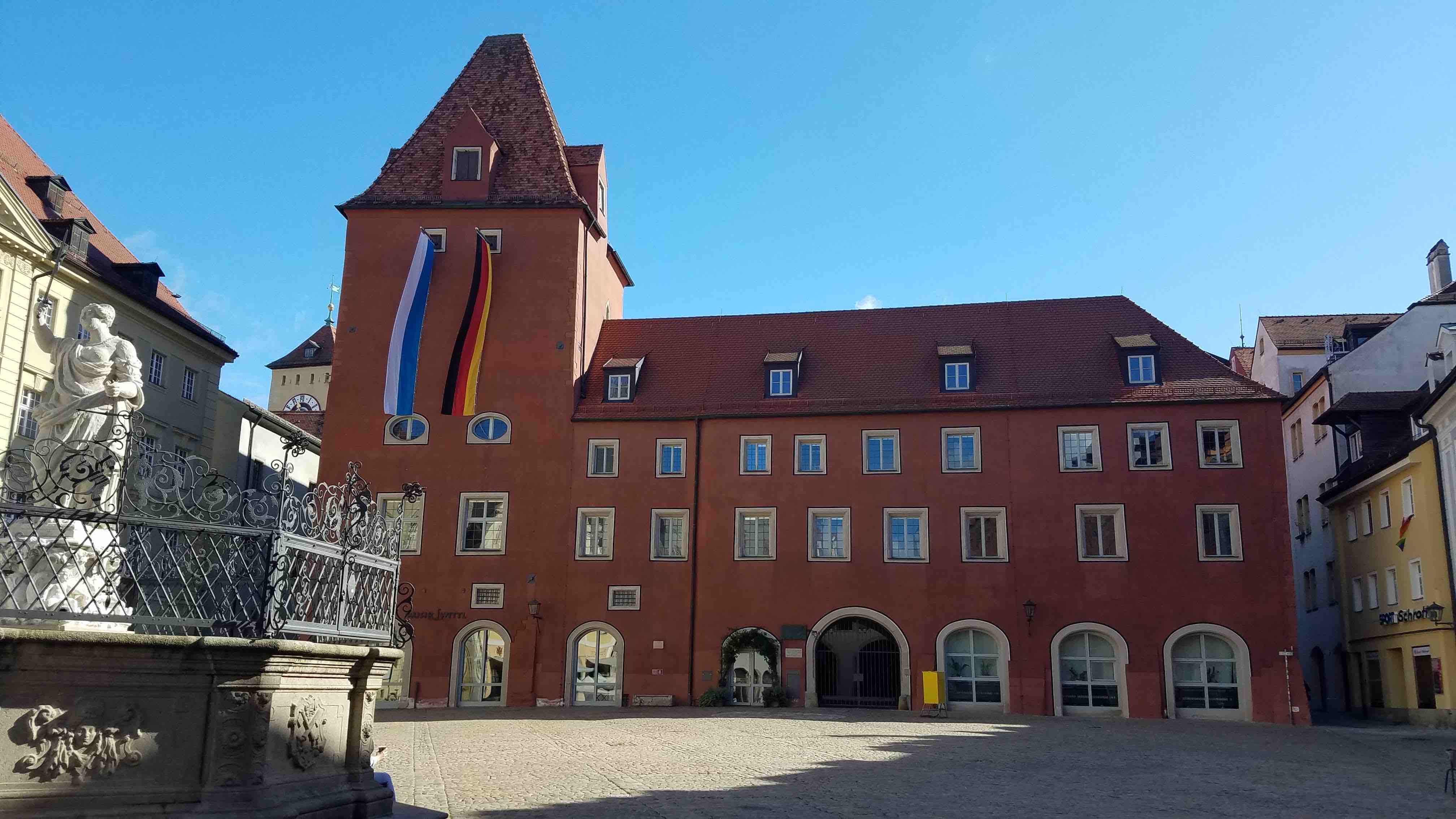
Haidplatz. In this building, off of this city square, the Diet of Regensburg was held in 1541. John Calvin attended a Colloquy (or “Diet”) here in 1541, where fellow reformer Philip Melanchthon sat down with Roman Catholic scholar Johann Eck, to see if some kind of resolution could be found to reconcile the differences between Protestants and Roman Catholics. While some progress was made, the participants found the doctrine of the Lord’s Supper to be the primary issue that could not be resolved. This meeting at Regensburg was probably the best opportunity for reconciliation, which was ultimately lost. .. I took this photo back in October, 2022, on a different trip to Europe.
The Influence of the Institutes Over the Centuries
After Calvin’s death, the Institutes established his reputation as perhaps the greatest of the Reformed authors of the 16th century. Theodore Beza, Calvin’s successor in Geneva, became the primary interpreter for Calvin.
In the 17th century, Calvin and his Institutes became synonymous with the Reformed faith. Detractors of Calvin generally depicted him as a monster, the one most responsible for the cruel death of the anti-Trinitarian heretic, Michael Servetus, at the hands of civil authorities in Geneva. Calvin’s defenders, particularly in England, viewed as the father of the Puritan movement, hoping to purify the Church of England of papist bad habits and bad theology. Others like the Dutch theologian, Jacob Arminius, had a more cautious appreciation of Calvin’s legacy. I am confident that the earliest Puritans to settle in the American colonies carried copies of the Institutes with them.
By the time of the Enlightenment in the 18th century, Calvin’s emphasis on “true religion” in the Institutes became sidelined by a new generations of thinkers who began to view Christianity as merely one religion among many others. Faith founded upon reason superseded faith founded upon revelation. When Jean- Jacques Rousseau came to Geneva and published his Emile in 1762, Rousseau publicly denied original sin and the doctrine of the Trinity. Church leaders in Geneva were no longer required to adhere to doctrinal formulations once championed by Geneva’s most well-known preacher, John Calvin.
However, as Bruce Gordon reports, more moderate voices emerged making a positive appeal to Calvin’s Institutes as a source for challenging traditional norms. In the 18th century, Jacobus Capitein, the first African to study the Calvinist theology, found in the writings of Calvin a Christian basis for undermining the morality of slavery. Later in the 20th century, South African Calvinist Allan Boesak found a theological basis in Calvin for the cause of liberation against apartheid (Gordon, pp. 75ff). Boesak had been initially horrified by Calvin, thinking him to be an apologist for racial-based slavery. Yet after making a careful re-reading of the Institutes, Boesak changed his mind about Calvin, seeing in the Frenchman’s work the theological resources necessary to completely dismantle the South African regime of apartheid (Gordon, pp. 166). Again, we see how a fresh look at Calvin has helped theologians more recently make a distinction between the original Calvin and the “Calvinism” of later generations which took the legacy of Calvin in wrong directions.
In America, the legacy of the Institutes divided Protestant Christians in a complicated way. The great philosopher/theologian Jonathan Edwards, who knew the Institutes well, cited Calvin as an authority, but also noted that he did not always agree with the famous Genevan preacher. John and Charles Wesley found much in the Institutes regarding the doctrine of election to be revolting. Yet John Wesley appealed to the Institutes for a sound doctrine of justification. John wrote:
“I think on Justification just as I have done any time these seven-and-twenty years, and just as Mr. Calvin does. In this respect I do not differ from him an hair’s breadth” (from a journal entry by John Wesley, quoted in Gordon, p. 84).
Ironically, Bruce Gordon argues that in the 19th century, the most influential reclamation of Calvin’s theology as put forth in the Institutes came from none other than Fredrich Schleiermacher, the father of Protestant liberalism. The fact that the Institutes could inspire both the conservative evangelicalism of a Jonathan Edwards and the Protestant liberalism of a Fredrich Schleiermacher illustrates just how diverse theological traditions find their home in the Institutes.
As Protestant liberalism in the late 19th century began to break the hegemony of the earlier conservative evangelical movement in the United States, the Princeton theologian of the early 20th century, Benjamin Breckenridge Warfield, championed a revival of Calvin’s theology in a conservative effort to thwart the cancer of pervasive theological liberalism taking over the church.
Though not as conservative as Warfield, back in Europe, theologians like Karl Barth and Emil Bruner sought to revive Calvin’s theology for the modern world, in an answer to the growing decline of evangelical faith in Europe, precipitated by the rise of historical criticism, particularly in German liberal Protestantism. Gordon quotes from a 1962 Time magazine article, where Barth said:
“Calvin is in Heaven and has had time to ponder where he went wrong in his teachings. Doubtless he is pleased that I am setting him aright” (Gordon, p. 133).
The famous dispute concerning natural theology between Barth and Brunner revolved around how to best interpret Calvin’s Institutes. Dutch theologians who stood somewhere in between Warfield and Barth, such as the elder statesman Abraham Kuyper and his successor, Herman Bavinck, pioneered a kind of Neo-Calvinism based on the Institutes.
Gordon quotes from Bavinck that in the Institutes Calvin expressed “clear, deep and harmonious insight into Christian truth [such] as to render any subsequent modification unnecessary” (Gordon, p. 129). Bavinck believed that John Calvin was the model pastor/theologian that any truly reformed evangelical pastor/theologian should seek to emulate. Bavinck himself was largely unknown in America, up until the last 25 years or so, when his Dutch works were finally translated into English, inspiring contemporary evangelical thinkers, such as the late Tim Keller.
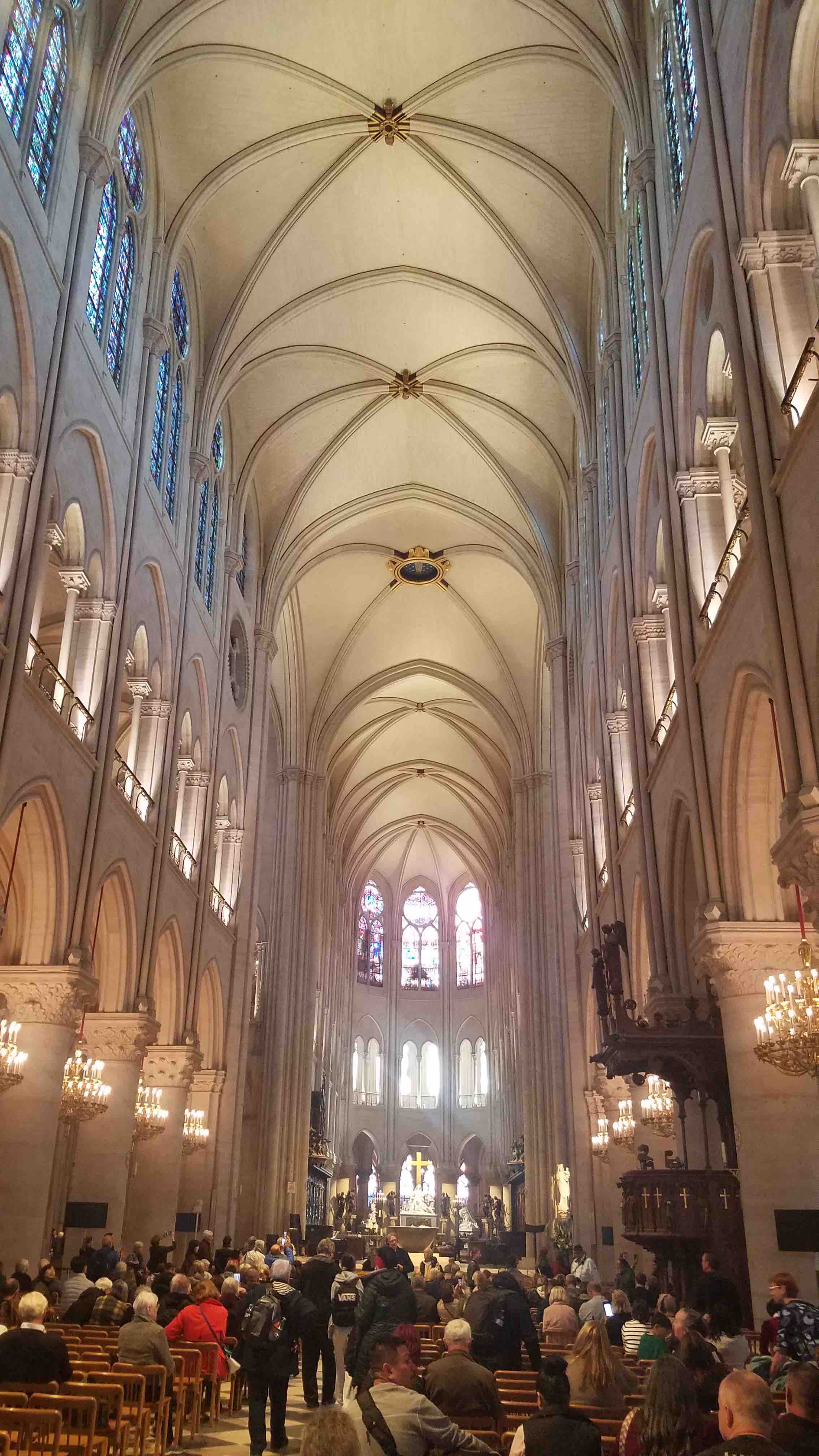
The newly restored Notre Dame Cathedral, in Paris, France. John Calvin most likely worshipped in this church, near the Sorbonne, where he studied law in Paris. This photo shows the remarkable job restorers made after the recent tragic fire nearly destroyed this iconic landmark in Paris.
Calvin’s Influence Today
The problem of evil remains perhaps one of the most troubling questions which Christian apologetics have to deal with, in a world today beset by wars and other conflicts that were basically unthinkable in certain quarters a generation ago. John Calvin had his own solution to the problem of evil, but not every Christian finds the theology associated with his name satisfying as it was in 16th century Geneva, Switzerland.
For sure, Calvin’s legacy is still a hotly debated topic these days. Even AI creators on YouTube are writing heavy-metal/rap songs about Calvin the controversialist:
On the one side, the Institutes remains perhaps the most influential theological work articulating the basic ideas of the Protestant Reformation, particularly among today’s Protestant evangelicals. There are still some who view any criticism of Calvin as an attack on the very Christian Gospel itself.
On the other side are critics like David Bentley Hart, briefly mentioned above, the eminent and erudite Eastern Orthodox theologian, who has become perhaps the world’s most outspoken intellectual advocate for a Christian doctrine of universalism. Hart routinely characterizes John Calvin as perhaps the worst of all heretics, lumping Calvin’s theology in with the cancer of Gnosticism, the second century Christian heresy which sought to derail the orthodox faith of the early church.
Both of these views of Calvin are extremes, which at a minimum are unhelpful, if not outright distorting. I view myself as advocate of a “reformed” theology, but I would be careful to use a little “r” when speaking of being “reformed,” as opposed to a capital “R” as in “Reformed,” which seems to be more along the lines of an 18th century Jonathan Edwards approach to being “Reformed” (Yet even Edwards offered some modest critique of Calvin). Put in contemporary terms, I am more like a little “r” “reformed” advocate, like the late Tim Keller, and less a capital “R” “Reformed” advocate, such as what I see in John Piper.
In my view, John Calvin got his view of the sacraments, particularly regarding the Lord’s Supper, about as correct as you can get. Calvin’s idea that we are saved by faith alone, but that faith is never alone; that is, genuine faith is always accompanied with good works, hits the mark as well.
In fact, aside from Calvin’s particular emphasis on our mystical union with Christ, the other broadly predominant themes in the Institutes includes his doctrine on the sacraments, particularly on the Lord’s Supper, and the work of the Holy Spirit. One does not need to be a “Calvinist” to appreciate Calvin’s very practical theology aligned with these themes. Interestingly, some of the most excited supporters of John Calvin today are evangelical baptists, who completely disagree with Calvin on the topic of infant baptism, which he firmly supported!
Calvin is also one of greatest and most influential Christian apologists for capitalism. We have Calvin to thank for his reading of the usury texts in the Bible, where the idea of lending money to others, as long as the interest charged is not excessive, is within the permissible ethical framework of the Bible. It is hard to imagine how the modern banking system which has enabled countless millions to obtain affordable housing through mortgages would have been possible apart from Calvin’s view of lending money at modest interest rates. In other words, if you own a house by possessing a mortgage, you might want to thank John Calvin for enabling that to happen.
My greatest gratitude for Calvin comes from his theory of divine accommodation, whereby in Holy Scripture, God condescends to us by speaking at our level. As Calvin writes in the Institutes (1.13.1):
“Who even of slight intelligence does not understand that, as nurses commonly do with infants, God is wont in a measure to ‘lisp’ in speaking to us? Thus such forms of speaking do not so much express clearly what God is like as accommodate the knowledge of him to our slight capacity.”
This idea of divine accommodation often gets misunderstood, but positively and rightly understood, it helps us parse through what the Bible actually teaches versus the particular cultural and human limitations of the author. Instead of being a hindrance, the sum of the particular cultural and human limitations of each writer of Sacred Scripture are used by God to be the vehicle by which we come to know God’s truth.
Most importantly, Calvin’s insistence on the sovereignty of God, that God knows better than what we think we know, is perhaps his most influential contribution to Christian theology. Calvin obviously was not the first to think of this, but his name in church history is often tightly linked with the doctrine of God’s “hidden decree.”
For if I was given the task of writing the Bible, there are plenty of things I would put in differently than what we find in the Bible. But the Bible is the authoritative book the sovereign God has given us, so I need to learn to trust that God knows what he is doing with the Bible, particularly when I am not so sure about some of the things I read about in the Bible.
God’s providential care over us in our world is meant to provide us comfort, when things do not always make sense to us. This can be applied any number of issues any Christian can run into in living the Christian life; whether it be struggling with some type of difficult teaching we read in the Bible, or the question of why we or someone else we care for is suffering, or anything having to do with the vexing problem of evil. I can trust that the sovereign God of the universe knows what he is doing, even when I am befuddled about my own circumstances. More than any other theologian, I have Calvin to thank for this insight.
On the other hand, I am not sure yet that Calvin got his view of penal substitutionary atonement right (at least Calvin’s critics think he is wrong here), something that I am trying to work out for myself this year. Furthermore, if Bruce Gordon is right and the Institutes does teach a form of double predestination, then I am not on board with Calvin on this. But I am not completely convinced that Calvin was really a “Calvinist” as much as Gordon suggests he was (I am not the only one who thinks this way …I have good company).
Either way, Bruce Gordon’s wonderful book on the Institutes maps out the history of how the Institutes has influenced the Christian movement, for both good and for ill. My trip last year visiting several of the cities where Calvin lived has served as a helpful reminder of the mark Calvin’s influence has made on the Christian church.

You probably know what I am standing in front of!! The seeds of Calvin’s conversion to Christ were germinated in this city when Calvin was a student.




What do you think?