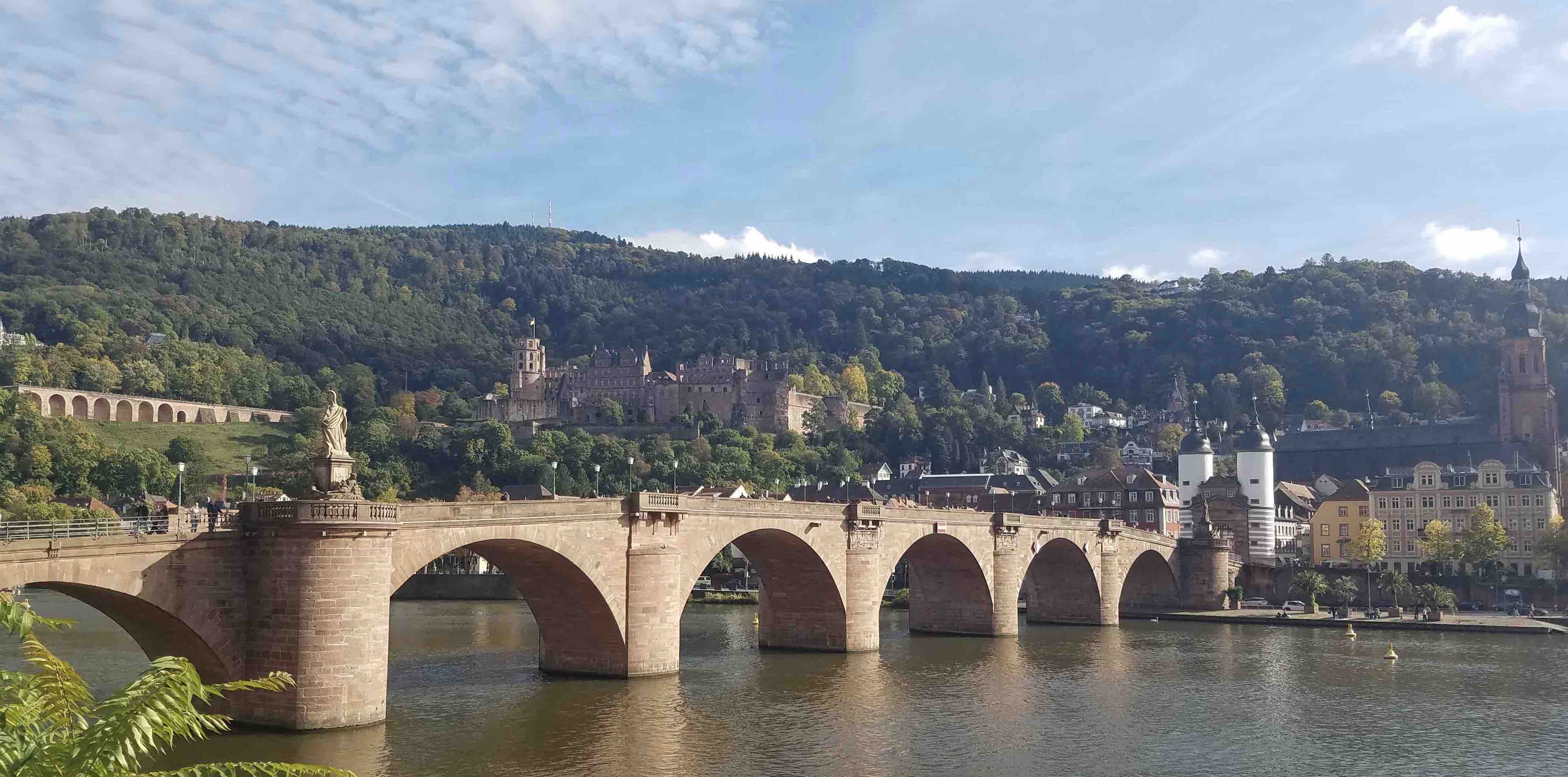
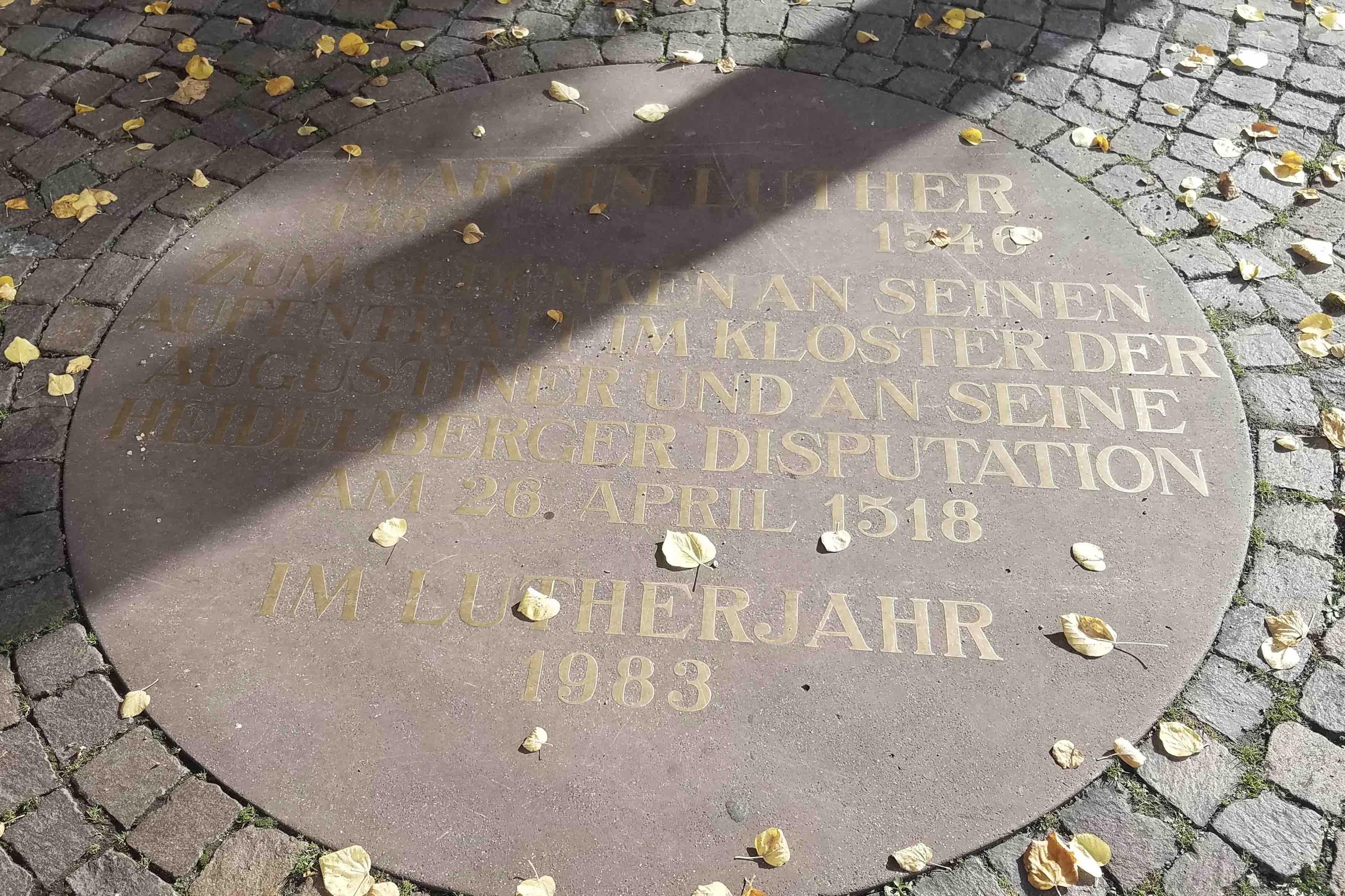
From the Christianity along the Rhine travel blog series….
Being a peacemaker is not easy. While the current conflict with Iran absorbs the headlines, it overshadows another long standing conflict: Just ask President Donald Trump, who since the beginning of his presidency has been trying to find a peaceful solution to the Russia/Ukraine conflict for well over a year.
Such was also the case in the 16th century in Europe, when theological giants, like Martin Luther and the Roman Catholic Pope, spread their influence across the land. With the exception the Holy Roman Emperor himself (Charles V), the Pope was the most prominent leader in Western Europe, whereas Luther was a seminary professor, with a sharp wit and stinging rhetoric, who knew how to use the printing press, the rough equivalent to today’s social media platforms on the Internet. The Reformation did not only result in a split within the medieval Catholic church, it also divided Protestants trying to forge a united movement in attempts to reform that medieval Catholic church.
The Protestant Reformation was not simply a theological, religious dispute. It had far reaching ramifications impacting kings, princes, and emperors, and the millions of subjects who served them. Within a century after Luther, the religious conflicts of the 16th century became intertwined with political conflicts, resulting in the Thirty Years War, where roughly one out of four Europeans died due to violence and (mostly) disease spread by the war.
Into the mix was another Protestant Reformer from Germany, Martin Bucer, who was just a few years younger than Luther, a man that most Christians have probably never heard of. Unlike Luther, Bucer was more cautious and reserved. Yet Bucer became a leading voice among the Protestants, trying to forge a “third way” through various theological conflicts, particularly in the city of Strasbourg, along the Rhine River, bordering France and Germany.
Back in October of 2025, my wife and I went on a river cruise on the Rhine River, and we spent a day in Strasbourg. I got to visit some of the sites where Martin Bucer lived much of his life.

In front of Martin Bucer’s home in Strasbourg, France. It was in this home where Bucer officiated the marriage between John Calvin and Idelette de Bure, a former Anabaptist. Calvin had been forced out of Geneva, Switzerland for several years. Bucer helped to arrange for his friend Calvin to move to Strasbourg, to get a job as a pastor for French Protestant refugees living in the city. It was a bit of a cloudy day in Strasbourg, when I took this photo in October, 2025.
Martin Bucer Becomes a Protestant
Not much is known about Martin Bucer’s early life. Born in 1491, Bucer joined the Dominican order perhaps in his late teenage years, and ended up studying theology in Heidelberg in 1515. But this was the era when the humanism of Desiderius Erasmus came to the foreground, particularly with Erasmus’ pivotal Greek New Testament, which helped inspire Martin Luther in Wittenberg, Germany to post his famous Ninety-Five Theses, reportedly on the Wittenberg church door.
Bucer’s family had encouraged him to join the Dominicans, which he did, but he was never wholly enthusiastic about it. Bucer heard Martin Luther in a disputation at Heidelberg, and that changed his life. Bucer’s interest in the humanism of Erasmus pretty much sealed his fate with the Dominicans, and he began the painful process of trying to be released from his monastic vows. He then sought to find some gameful employment outside of his world of being a Dominican monk. In 1522, Bucer married a nun, Elizabeth, who was forced out of her monastic order, for breaking off her celibacy vow. The penniless couple eventually made their way to Strasbourg, along the Rhine River.
Strasbourg
Ah, let me tell you about Strasbourg.
Strasbourg is a fascinating city, having gone back and forth between German and French control, over the centuries. They call it the “Alsace” region of France, the land “in-between,” I was told, or the land of a “foreign domain.” Because of its unique position sandwiched between Roman Catholic France and Lutheran Germany, Strasbourg played a pivotal role in the Reformation controversy of the 16th century.
With a newly pregnant wife, Bucer and his family were forced to move in with his parents until he could find a job. At that point, Bucer was not unlike a typical twenty-something today, still living on mom and dad’s car insurance and cell phone plan. At first, Bucer offered to be a tutor for students interested in the humanism of Erasmus. That helped to feed his family, but it still was not enough. He was finally able to secure a decent job as a chaplain, getting out on his own, spending most of his years in Strasbourg.
Unfortunately for Bucer, he wrote a book defending the Reformation instigated by Luther, and his intellectual hero, Erasmus, heard of this and rejected Bucer’s thesis. Erasmus wanted reform within the medieval church, but he thought Bucer and Luther had gone too far in their criticisms of Rome.
Anabaptists, fleeing persecution in both Roman Catholic and Reformation controlled areas of Europe, soon made their way to Strasbourg, and so Bucer found himself fighting a multi-sided theological and intellectual war, with Roman Catholics on one side and the Anabaptists on the other. Yet Bucer was optimistic, hopeful that dialogue with such factions would eventually yield some peace, without compromising core convictions. In the midst of this, Bucer sought to find an irenic approach which could bridge the differences between these various theological camps.
Bucer was also hopeful that a rift between the Swiss Zurich reformer, Huldrych Zwingli, and the German Wittenberg reformer, Martin Luther, could be healed at the Colloquy of Marburg in 1529, regarding the doctrine of the Lord’s Supper. However, Luther believed that Bucer was just as intransigent and wrong-headed as Zwingli regarding the Eucharist, and reconciliation was not achieved.
However, despite this failure at Marburg, it did not keep Bucer from trying to be a peacemaker. Bucer traveled across the German-speaking land meeting with different followers of Luther and Zwingli, looking for areas where different parties could find some common ground, and even resolving conflict with Rome. Bucer’s list of friends reads like a “Who’s Who” of the Reformation.
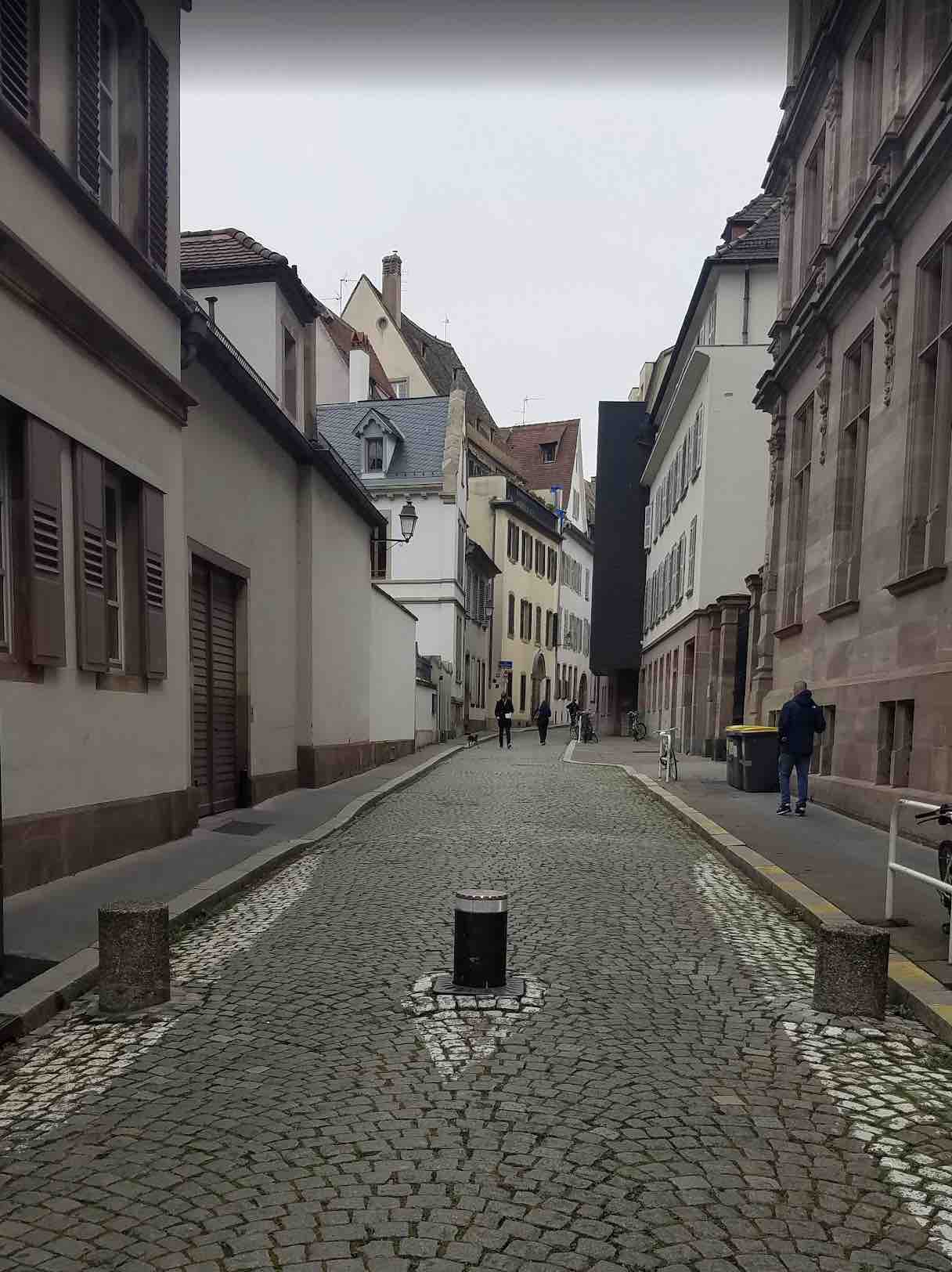
Street in the old part of Strasbourg. Martin Bucer lived in a house on the left hand side of this street (just to the left of where the two people on the street are walking). To keep automobile traffic out of the old part of the city, during certain times of the day, a column is raised and lowered to keep vehicles out so that tourists like myself could wander around and take photos…. and not get run over!!
Martin Bucer in the Crucible of Life
Sadly, the year 1541 proved to be the most challenging year for Bucer. A meeting at Regensburg, Germany between Protestant leaders like Philip Methlancthon and Roman Catholic theologians like Jonathan Eck, was envisioned as an effort to bridge the gap between the Lutherans and the Roman Catholics. A coalition of moderates on both sides of the controversy had high hopes for this meeting. However, the colloquy at Regensburg turned out to be a last ditch effort at theological unity which failed to satisfy either Luther or the papal authorities.
Also, during that year just after the meeting in Regensburg, Bucer’s wife, Elizabeth, died of the plague, along with three of their children. Bucer’s close friend and colleague, John Calvin, was forced by the plague to move back to Geneva, not too long after the city fathers of Geneva asked Calvin to return to the Swiss city and be their pastor again. With his wife dead and his close friend Calvin gone from Strasbourg, Bucer had suffered great loss.
A few year earlier, Bucer had gained a friendship with another Protestant moderate, Johannes Oecolampadius, who pastored a church in Basel, Switzerland, further up the Rhine River. Oecolampadius had died ten years earlier, leaving a widow, who in turn became married to a colleague in Strasbourg, Wolfgang Capito. However, Capito himself died of the plague himself, leaving his wife to be widowed yet again.
Bucer was in a difficult situation, with no wife and several surviving children to care for. Bucer quickly remarried Oecolampadius’ and Capito’s widow, Wibrandis Rosenblatt. The now thrice-married Wibrandis Rosenblatt found a faithful husband in Bucer, and partner in raising children. However, Bucer was criticized by other reformers for remarrying too soon.
Nevertheless, other reformers looked to Bucer as a trusted friend, who believed he was able to intercede and tone down the often-violent rhetoric of others. For example, when Martin Luther in 1543 wrote his most unfortunate tract, On the Jews and Their Lies, a letter was written on December 8, 1543, from the Zurich reformed preacher, Heinrich Bullinger, to his friend, Bucer, urging Bucer to try to persuade Luther to come back to his senses:
“Luther has written in a way that is utterly indecorous and entirely without moderation — plainly scurrilous, not serious. He writes against the Jews, and what might have been a fortunate and persuasive argument he renders offensive — indeed, even ridiculous — by his vile insults and crude invective, which befit no one, least of all an aged theologian.
This may someday bring great evil upon the Church. Perhaps you, his close friend and brother, could restrain him as a teacher — so that he may remember himself and his modesty, and write and act with greater humility, purity, and circumspection. Many pious and learned men are offended by his arrogance, which is excessive beyond measure.
A theologian should embody modesty, prudence, piety, and gratis. However, the example of his audacious impudence has spread and has now infected many church ministers” (Referenced by John Dickson, author of Bullies and Saints, reviewed here on Veracity. Original Latin source).
Sadly, Bullinger was prophetic, as Luther’s anti-Jewish sentiments were picked up and amplified by the Nazi party movement of 1930’s Germany. I am not aware of any evidence that Bucer was ever successful in intervening with the great Martin Luther, before the latter’s death in 1546.
Alas, Bucer’s position was precariously unstable in Strasbourg, and within a few years the pressure got the best of him. The setback at Regensburg, the continued vitriol leveled by Martin Luther against Huldrych Zwingli’s successor at Zurich, Heinrich Bullinger, and the returning fire from Bullinger against Luther, along with the personal losses in 1541, began to zap at Bucer’s energy. If strife among his Protestant colleagues was not enough, the defenders of medieval Catholicism were constantly seeking to have him ousted from Strasbourg, including the Emperor Charles V himself.
Bucer was effectively in a theological (and political) “no man’s land,” which ultimately forced him out of Strasbourg in 1549.

Martin Bucer pastored this church, St. Thomas, in Strasbourg, France, until he was forced to leave the city in 1549.
Martin Bucer’s Final Years…. In Cambridge, England
Charles V finally found enough leverage to get Bucer kicked out of Strasbourg. Bucer and his family found refuge in England. Bucer was assigned a teaching post at Cambridge, by another English reformer and moderate, Thomas Cranmer, who received him warmly as a colleague. Thomas Cranmer is most well known for crafting together the Book of Common Prayer, for the Church of England, as well as being a martyr for the Reformation, under the persecution of Queen “Bloody” Mary. Cranmer’s temperament mirrored that of Bucer, and most English speakers unwittingly feel Cranmer’s influence today through his translation of the Lord’s Prayer, which many memorize (“forgive us our debts” versus “forgive us our trespasses“).
But Bucer’s exile in England made him a very unhappy man. The colder northern climate in Cambridge did not help his health, either. Hopes for trying to resolve the differences between Rome and Reformers like Luther ultimately left him alienated from both sides. Conflicts with others wore him down, and within two years of being in England, in 1551, Bucer died.
Despite his death, Bucer’s troubles would haunt beyond the grave. In 1555, the new English monarch, the Roman Catholic Mary (the Queen who had Cranmer burned at the stake), had the bones of Bucer dug up and had him ceremonially burned as a heretic. It was not until Queen Elizabeth, a Protestant, took the throne that in 1560, Bucer was given a second burial with full honors.
Life Lessons from Martin Bucer
Martin Bucer embodied what it meant to wear a Union top along with a Confederate bottom. Bucer got shot at from all sides.
In many ways, in our day when so many Christians feel divided from one another, we can learn something from the Dominican monk turned Protestant reformer. From a book entitled Common Places, which features extracts from Bucer’s writings, Bucer believed the church was united in…..
“the unity of the Spirit, of love, the word of God, Christ, the sacraments, and the sharing of gifts, that we may aspire together to the same goal, and hold and express the same beliefs.”
And….
“It is essential that we hold completely in common everything instituted for the building up of the Church.”
That desire to always seek common ground among believers, without compromising essential Christian distinctives, is a virtue which is in short supply today.
Bucer believed that the medieval Roman Catholic Church was in desperate need of reform. Yet he concurred with other reformers that the Bible was indeed the written Word of God, and it was authoritative for all believers. This placed Bucer firmly in the Protestant camp, though his efforts to form a unified coalition among his fellow reformers were frustrated.
Martin Bucer’s most significant theological contribution was in defining a concept called “double justification.” He combined Luther’s theology of “imputed righteousness,” which lined up with Luther’s ideas about justification, with a Roman Catholic theology of “inherent righteousness” (or “imparted righteousness”), emphasizing growth in sanctification over time, as part of a second element of justification, a life well-lived full of good works as one follows Christ. This idea of “double justification” was thought to strike a middle-way between Roman Catholicism and the Reformation tradition of Martin Luther.
But as is so often the case, such “middle-way” theologies tend to be rejected by opposing parties in such discussions. The more extreme voices in a conversation tend to dampen voices of moderation.
Ah, such is the life of a peace maker!!
As my wife and I wandered around Strasbourg, we enjoyed (well, at least, I did!) passing by several sites associated with Martin Bucer, such as his home and the church where he served as a pastor. I had just finished reading Martin Bucer: An Introduction to His Life and Theology (Cascade Companions), written by Donald K. McKim and Jim West, a short book that filled in many of the above details about Bucer’s fascinating life. So, if you ever want to read more about Bucer, Martin Bucer: An Introduction to His Life and Theology (Cascade Companions) is a nice investment, at only 164 pages.
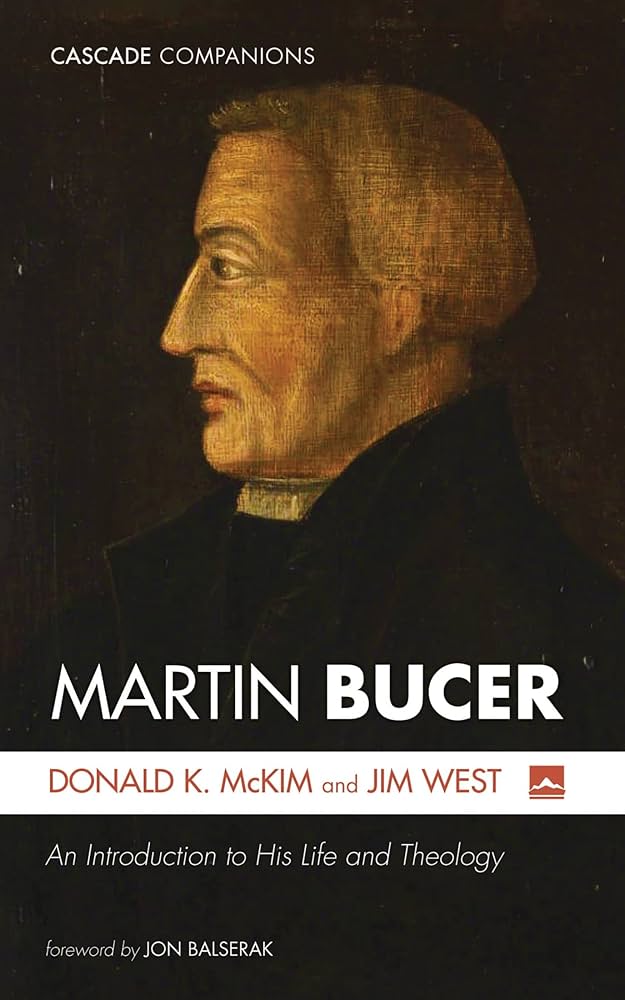
Martin Bucer: An Introduction to His Life and Theology (Cascade Companions), by Donald K. McKim and Jim West. The whole Cascade Companions series is a collection of short biographies of leading Christian figures in church history. This was the first book I read in the series, and it was a good read: short and sweet.