Category Archives: Witnesses

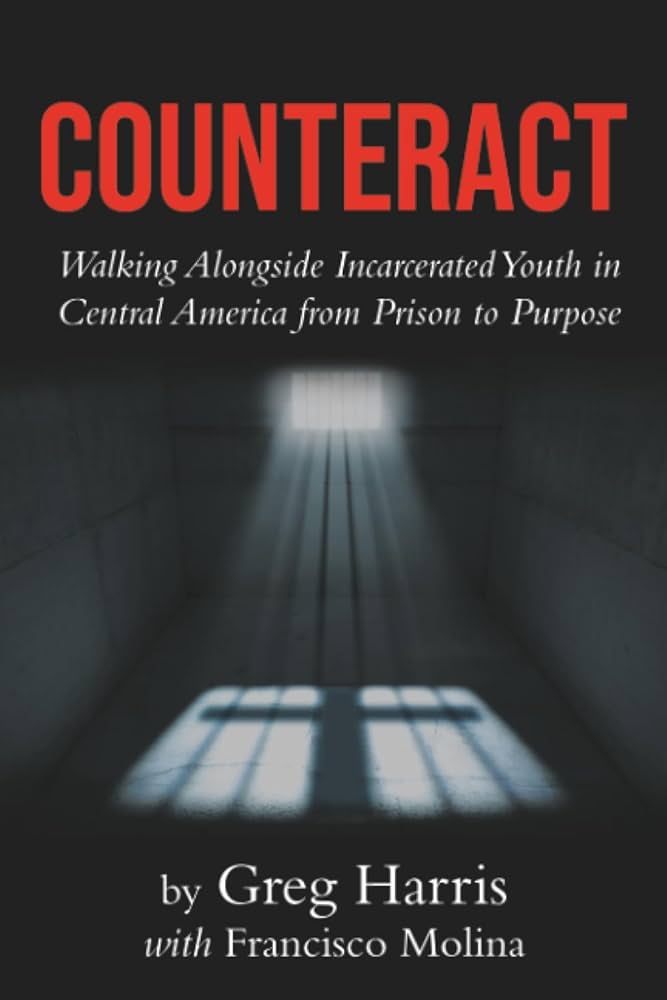
Counteract, by Greg Harris. A Brief Review. A Message of Hope for Those Who Are Strangers

Greg Harris is a friend of mine. My wife and I were in a small group Bible study with Greg and his wife Kim for a couple of years in our church. Greg is pretty soft spoken, so you would never know that he is the executive director of Counteract International, a ministry to incarcerated youth in Central America, unless you pressed him to talk about his story.

In his recent book, Counteract: Walking Alongside Incarcerated Youth in Central America from Prison to Purpose, author Greg Harris tells stories of how Counteract staff in countries like El Salvador, Guatemala, and Honduras go to Central American detention centers to offer vocational training, counseling, and above all, Christian hope, to a population of young people who have been largely abandoned due to poverty and neglect.


Hopelessness Among Central American Youth

The explosive growth of gangs in Central America is a notorious social problem, which seems distant to most North Americans.  But we do see the fallout in our society, as many young people and families fleeing violence over the past few decades have made their way as immigrants into the United States, either legally or illegally. Extreme poverty has forced countless young people to experience alienation in their homes, neglect and even abuse by their parents, part of a spiraling breakdown of families which repeats generation after generation.

Even in my own relatively quiet town of Williamsburg, Virginia, where Greg and Kim Harris also live, gang violence is not that far away. A few months ago a teenage boy was shot and killed in a neighborhood across town from where I live, resulting from gang violence.

Gangs function as alternatives to biological family and Christian community. Where biological and even church families fail to provide a structured, supportive, and safe environment for kids to flourish, they will turn to gangs who offer a promise of protection and sense of importance and value. Unfortunately, the promises that gangs offer are only a counterfeit, however appealing they might appear in times of crisis.

The effects of gang violence in Central America are staggering. Several countries in Central America have had some of the largest murder rates in the world. Honduras, for example, had 37.6 homicides per 100,000 people as of 2021. The number of homicides per person  in Latin America is roughly five times higher than in North America.

However, there is some good news recently as some trends appear to be reversing, but problems still persist, just in different ways.  El Salvador was known for having the worst murder rate in the world, roughly 106 per 100,000 in 2015,  roughly one murder per hour. Nearly ten years later, after the government started to aggressively crack down on gangs, that rate has dropped dramatically to 1.3 per 100,000 in 2025, making El Salvador one of the safest countries in the world. But the shift has come at a cost, with El Salvador having one of highest incarceration rates, about 1.6% of the population. What does one do with all of those young people in prison?

Counteract, originally named as “Orphan Helpers,” was started by a Virginia realtor, Greg Garrett, back in 2000. As a Christian businessman, Garrett wanted to know how he could help “the least of these,” quoting the words of Jesus in the New Testament. Over time, some Central American governments began to close orphanages, and so Counteract began to shift their mission purpose to meet the greatest, growing need. Since then, Counteract has focused its mission on training and sending staff into the prisons and detention centers in order to walk alongside troubled youth who experience very little hope, who tend to distrust the larger society around them.

Greg Harris, and his co-author Francisco “Pancho” Molina, tell the story ably well in Counteract: Walking Alongside Incarcerated Youth in Central America from Prison to Purpose. One of the most moving stories Greg and Pancho tell in the book comes from the COVID lockdown, when the detention centers decided to lockdown their facilities in certain areas for 21 days, where no one, including guards and other administrative personnel, could leave their respective centers for that entire time period.

Counteract staff had been told that this policy would apply to them as well: No more visits during the day, and then returning home for the night. Once you entered the detention facility, you were pretty much in there with everyone else. It was a difficult decision, as Counteract staff typically have families of their own outside of the detention center walls to take care of. Yet sacrificially, all of the Counteract staff decided to commit to the 21 day isolation policy, and stay with their incarcerated kids. These Counteract staff knew that over 90% of their job was simply to show up and be there for these kids, who had no hope otherwise.

Counteract’s Mission to “Love Thy Stranger”

Greg’s book had been out for a few months, so I finally got around to reading it this spring. I am glad I did.

About the time I read Greg’s book, I heard of another book written and released by atheist and skeptic bible scholar, Bart Ehrman, Love Thy Stranger. Ehrman grew up as a Christian, but has since walked away from the faith, while retaining his interest in the scholarly study of early Christianity. As an historian, the remarkable theme which Ehrman chronicles is that the Christian movement brought something unique into the history of humanity which was not present before the time of Christ.

Whereas most cultures have believed that one should take care of friends and family in need, caring for strangers was not part of that social ethic. Yet the New Testament stood that kind of cloistered social ethic on its head by expanding the concept of “love thy neighbor,” a phrase many know from the Hebrew Bible. In Christianity, particularly through the Gospels and the writings of the Apostle Paul, the idea of “neighbor” includes not just family and friends, but also strangers in need. For example, Ehrman observes that the entire history of “hospitals” grew out of the Christian tradition. Therefore, it should not be a surprise to find Christians in El Salvador making their way as counselors into prisons to befriend mistrusted, isolated youth.

Today, when many distrust Christianity as being something not so good for the world, it is encouraging to hear a non-believing historian acknowledge that the Christian faith introduced to human history the idea of caring for people who are strangers to you. Christianity changed the moral conscience of the West.

Ehrman’s conclusion is ironic as an atheist: “thank God for Christianity.” For atheists who have no divine transcendent metanarrative to appeal to, the best they can do is to borrow from the ethical dimension of Christianity to guide them.

What Greg Harris writes about in Counteract is the perfect expression of “love thy stranger.” While young people who get mixed up in gangs are often treated as strangers who are to be forgotten, ignored, or else marginalized from society, Counteract International offers a positive witness to the gospel message that gives hope to those who otherwise have no hope.

Greg’s book is a short read, less than 200 pages. It will stimulate you to engage in a ministry where Christians can truly become the hands and feet of Christ, offering hope to the hopeless. Through Counteract International, followers of Jesus are finding ways to connect with young people in the prison system in Central America, making friends out of strangers. I generally do not tear up when reading a book, but I teared up when reading this one.

If you want to invest in a Christian ministry doing high-quality work to care for those “strangers” hidden away in prisons, investing in the ministry of Counteract International, which Greg Harris writes about in his book, will extend that message of hope to those who feel hopeless. That message of hope actually works to change lives, which should encourage us in a day when so many negative aspects about our world can bring us down. I highly recommend Counteract: Walking Alongside Incarcerated Youth in Central America from Prison to Purpose for everyone.


Martin Bucer: The Failed Protestant Peacemaker of Strasbourg

From the Christianity along the Rhine travel blog series….

Being a peacemaker is not easy. While the current conflict with Iran absorbs the headlines, it overshadows another long standing conflict: Just ask President Donald Trump, who since the beginning of his presidency has been trying to find a peaceful solution to the Russia/Ukraine conflict for well over a year.

Such was also the case in the 16th century in Europe, when theological giants, like Martin Luther and the Roman Catholic Pope, spread their influence across the land. With the exception the Holy Roman Emperor himself (Charles V), the Pope was the most prominent leader in Western Europe, whereas Luther was a seminary professor, with a sharp wit and stinging rhetoric, who knew how to use the printing press, the rough equivalent to today’s social media platforms on the Internet. The Reformation did not only result in a split within the medieval Catholic church, it also divided Protestants trying to forge a united movement in attempts to reform that medieval Catholic church.

The Protestant Reformation was not simply a theological, religious dispute. It had far reaching ramifications impacting kings, princes, and emperors, and the millions of subjects who served them. Within a century after Luther, the religious conflicts of the 16th century became intertwined with political conflicts, resulting in the Thirty Years War, where roughly one out of four Europeans died due to violence and (mostly) disease spread by the war.

Into the mix was another Protestant Reformer from Germany, Martin Bucer, who was just a few years younger than Luther, a man that most Christians have probably never heard of. Unlike Luther, Bucer was more cautious and reserved. Yet Bucer became a leading voice among the Protestants, trying to forge a “third way” through various theological conflicts, particularly in the city of Strasbourg, along the Rhine River, bordering France and Germany.

Back in October of 2025, my wife and I went on a river cruise on the Rhine River, and we spent a day in Strasbourg. I got to visit some of the sites where Martin Bucer lived much of his life.

In front of Martin Bucer’s home in Strasbourg, France. It was in this home where Bucer officiated the marriage between John Calvin and Idelette de Bure, a former Anabaptist. Calvin had been forced out of Geneva, Switzerland for several years. Bucer helped to arrange for his friend Calvin to move to Strasbourg, to get a job as a pastor for French Protestant refugees living in the city. It was a bit of a cloudy day in Strasbourg, when I took this photo in October, 2025.


Martin Bucer Becomes a Protestant

Not much is known about Martin Bucer’s early life. Born in 1491, Bucer joined the Dominican order perhaps in his late teenage years, and ended up studying theology in Heidelberg in 1515. But this was the era when the humanism of Desiderius Erasmus came to the foreground, particularly with Erasmus’ pivotal Greek New Testament, which helped inspire Martin Luther in Wittenberg, Germany to post his famous Ninety-Five Theses, reportedly on the Wittenberg church door.

Bucer’s family had encouraged him to join the Dominicans, which he did, but he was never wholly enthusiastic about it. Bucer heard Martin Luther in a disputation at Heidelberg, and that changed his life. Bucer’s interest in the humanism of Erasmus pretty much sealed his fate with the Dominicans, and he began the painful process of trying to be released from his monastic vows. He then sought to find some gameful employment outside of his world of being a Dominican monk. In 1522, Bucer married a nun, Elizabeth, who was forced out of her monastic order, for breaking off her celibacy vow. The penniless couple eventually made their way to Strasbourg, along the Rhine River.

Strasbourg

Ah, let me tell you about Strasbourg.

Strasbourg is a fascinating city, having gone back and forth between German and French control, over the centuries. They call it the “Alsace” region of France, the land “in-between,” I was told, or the land of a “foreign domain.”  Because of its unique position sandwiched between Roman Catholic France and Lutheran Germany, Strasbourg played a pivotal role in the Reformation controversy of the 16th century.

With a newly pregnant wife, Bucer and his family were forced to move in with his parents until he could find a job. At that point, Bucer was not unlike a typical twenty-something today, still living on mom and dad’s car insurance and cell phone plan. At first, Bucer offered to be a tutor for students interested in the humanism of Erasmus. That helped to feed his family, but it still was not enough. He was finally able to secure a decent job as a chaplain, getting out on his own, spending most of his years in Strasbourg.

Unfortunately for Bucer, he wrote a book defending the Reformation instigated by Luther, and his intellectual hero, Erasmus, heard of this and rejected Bucer’s thesis. Erasmus wanted reform within the medieval church, but he thought Bucer and Luther had gone too far in their criticisms of Rome.

Anabaptists, fleeing persecution in both Roman Catholic and Reformation controlled areas of Europe, soon made their way to Strasbourg, and so Bucer found himself fighting a multi-sided theological and intellectual war, with Roman Catholics on one side and the Anabaptists on the other. Yet Bucer was optimistic, hopeful that dialogue with such factions would eventually yield some peace, without compromising core convictions. In the midst of this, Bucer sought to find an irenic approach which could bridge the differences between these various theological camps.

Bucer was also hopeful that a rift between the Swiss Zurich reformer, Huldrych Zwingli, and the German Wittenberg reformer, Martin Luther, could be healed at the Colloquy of Marburg in 1529, regarding the doctrine of the Lord’s Supper. However, Luther believed that Bucer was just as intransigent and wrong-headed as Zwingli regarding the Eucharist, and reconciliation was not achieved.

However, despite this failure at Marburg, it did not keep Bucer from trying to be a peacemaker. Bucer traveled across the German-speaking land meeting with different followers of Luther and Zwingli, looking for areas where different parties could find some common ground, and even resolving conflict with Rome. Bucer’s list of friends reads like a “Who’s Who” of the Reformation.

Street in the old part of Strasbourg. Martin Bucer lived in a house on the left hand side of this street (just to the left of where the two people on the street are walking). To keep automobile traffic out of the old part of the city, during certain times of the day, a column is raised and lowered to keep vehicles out so that tourists like myself could wander around and take photos…. and not get run over!!


Martin Bucer in the Crucible of Life

Sadly, the year 1541 proved to be the most challenging year for Bucer. A meeting at Regensburg, Germany between Protestant leaders like Philip Methlancthon and Roman Catholic theologians like Jonathan Eck, was envisioned as an effort to bridge the gap between the Lutherans and the Roman Catholics. A coalition of moderates on both sides of the controversy had high hopes for this meeting. However, the colloquy at Regensburg turned out to be a last ditch effort at theological unity which failed to satisfy either Luther or the papal authorities.

Also, during that year just after the meeting in Regensburg, Bucer’s wife, Elizabeth, died of the plague, along with three of their children. Bucer’s close friend and colleague, John Calvin, was forced by the plague to move back to Geneva, not too long after the city fathers of Geneva asked Calvin to return to the Swiss city and be their pastor again. With his wife dead and his close friend Calvin gone from Strasbourg, Bucer had suffered great loss.

A few year earlier, Bucer had gained a friendship with another Protestant moderate, Johannes Oecolampadius, who pastored a church in Basel, Switzerland, further up the Rhine River. Oecolampadius had died ten years earlier, leaving a widow, who in turn became married to a colleague in Strasbourg, Wolfgang Capito. However, Capito himself died of the plague himself, leaving his wife to be widowed yet again.

Bucer was in a difficult situation, with no wife and several surviving children to care for. Bucer quickly remarried Oecolampadius’ and Capito’s widow, Wibrandis Rosenblatt.  The now thrice-married Wibrandis Rosenblatt found a faithful husband in Bucer, and partner in raising children. However, Bucer was criticized by other reformers for remarrying too soon.

Nevertheless, other reformers looked to Bucer as a trusted friend, who believed he was able to intercede and tone down the often-violent rhetoric of others. For example, when Martin Luther in 1543 wrote his most unfortunate tract, On the Jews and Their Lies, a letter was written on December 8, 1543, from the Zurich reformed preacher, Heinrich Bullinger, to his friend, Bucer, urging Bucer to try to persuade Luther to come back to his senses:

“Luther has written in a way that is utterly indecorous and entirely without moderation — plainly scurrilous, not serious. He writes against the Jews, and what might have been a fortunate and persuasive argument he renders offensive — indeed, even ridiculous — by his vile insults and crude invective, which befit no one, least of all an aged theologian.

This may someday bring great evil upon the Church. Perhaps you, his close friend and brother, could restrain him as a teacher — so that he may remember himself and his modesty, and write and act with greater humility, purity, and circumspection. Many pious and learned men are offended by his arrogance, which is excessive beyond measure.

A theologian should embody modesty, prudence, piety, and gratis. However, the example of his audacious impudence has spread and has now infected many church ministers” (Referenced by John Dickson, author of Bullies and Saints, reviewed here on Veracity. Original Latin source).

Sadly, Bullinger was prophetic, as Luther’s anti-Jewish sentiments were picked up and amplified by the Nazi party movement of 1930’s Germany. I am not aware of any evidence that Bucer was ever successful in intervening with the great Martin Luther, before the latter’s death in 1546.

Alas, Bucer’s position was precariously unstable in Strasbourg, and within a few years the pressure got the best of him. The setback at Regensburg, the continued vitriol leveled by Martin Luther against Huldrych Zwingli’s successor at Zurich, Heinrich Bullinger,  and the returning fire from Bullinger against Luther, along with the personal losses in 1541, began to zap at Bucer’s energy. If strife among his Protestant colleagues was not enough, the defenders of medieval Catholicism were constantly seeking to have him ousted from Strasbourg, including the Emperor Charles V himself.

Bucer was effectively in a theological (and political) “no man’s land,” which ultimately forced him out of Strasbourg in 1549.

Martin Bucer pastored this church, St. Thomas, in Strasbourg, France, until he was forced to leave the city in 1549.


Martin Bucer’s Final Years…. In Cambridge, England

Charles V finally found enough leverage to get Bucer kicked out of Strasbourg. Bucer and his family found refuge in England. Bucer was assigned a teaching post at Cambridge, by another English reformer and moderate, Thomas Cranmer, who received him warmly as a colleague. Thomas Cranmer is most well known for crafting together the Book of Common Prayer, for the Church of England, as well as being a martyr for the Reformation, under the persecution of Queen “Bloody” Mary. Cranmer’s temperament mirrored that of Bucer, and most English speakers unwittingly feel Cranmer’s influence today through his translation of the Lord’s Prayer, which many memorize  (“forgive us our debts” versus “forgive us our trespasses“).

But Bucer’s exile in England made him a very unhappy man. The colder northern climate in Cambridge did not help his health, either. Hopes for trying to resolve the differences between Rome and Reformers like Luther ultimately left him alienated from both sides. Conflicts with others wore him down, and within two years of being in England, in 1551, Bucer died.

Despite his death, Bucer’s troubles would haunt beyond the grave. In 1555, the new English monarch, the Roman Catholic Mary (the Queen who had Cranmer burned at the stake), had the bones of Bucer dug up and had him ceremonially burned as a heretic. It was not until Queen Elizabeth, a Protestant, took the throne that in 1560, Bucer was given a second burial with full honors.


Life Lessons from Martin Bucer

Martin Bucer embodied what it meant to wear a Union top along with a Confederate bottom. Bucer got shot at from all sides.

In many ways, in our day when so many Christians feel divided from one another, we can learn something from the Dominican monk turned Protestant reformer. From a book entitled Common Places, which features extracts from Bucer’s writings, Bucer believed the church was united in…..

“the unity of the Spirit, of love, the word of God, Christ, the sacraments, and the sharing of gifts, that we may aspire together to the same goal, and hold and express the same beliefs.”

And….

“It is essential that we hold completely in common everything instituted for the building up of the Church.”

That desire to always seek common ground among believers, without compromising essential Christian distinctives, is a virtue which is in short supply today.

Bucer believed that the medieval Roman Catholic Church was in desperate need of reform. Yet he concurred with other reformers that the Bible was indeed the written Word of God, and it was authoritative for all believers. This placed Bucer firmly in the Protestant camp, though his efforts to form a unified coalition among his fellow reformers were frustrated.

Martin Bucer’s most significant theological contribution was in defining a concept called “double justification.” He combined Luther’s theology of “imputed righteousness,” which lined up with Luther’s ideas about justification, with a Roman Catholic theology of “inherent righteousness” (or “imparted righteousness”), emphasizing growth in sanctification over time, as part of a second element of justification, a life well-lived full of good works as one follows Christ. This idea of “double justification” was thought to strike a middle-way between Roman Catholicism and the Reformation tradition of Martin Luther.

But as is so often the case, such “middle-way” theologies tend to be rejected by opposing parties in such discussions. The more extreme voices in a conversation tend to dampen voices of moderation.

Ah, such is the life of a peace maker!!


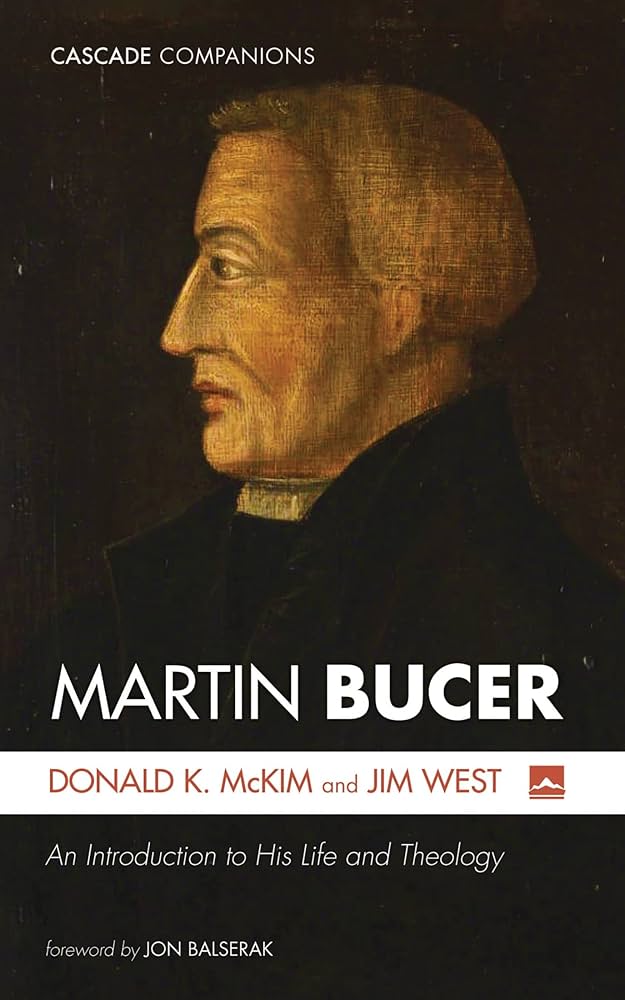
As my wife and I wandered around Strasbourg, we enjoyed (well, at least, I did!) passing by several sites associated with Martin Bucer, such as his home and the church where he served as a pastor. I had just finished reading Martin Bucer: An Introduction to His Life and Theology (Cascade Companions), written by Donald K. McKim and Jim West, a short book that filled in many of the above details about Bucer’s fascinating life. So, if you ever want to read more about Bucer, Martin Bucer: An Introduction to His Life and Theology (Cascade Companions)  is a nice investment, at only 164 pages.

Martin Bucer: An Introduction to His Life and Theology (Cascade Companions), by Donald K. McKim and Jim West. The whole Cascade Companions series is a collection of short biographies of leading Christian figures in church history. This was the first book I read in the series, and it was a good read: short and sweet.


The Triple Baptism of Felix Manz: Founder of Anabaptism

From the Christianity Along the Rhine Blog Series…

The courage and conviction of a Swiss radical reformer, Felix Manz, has inspired Christians who have since come after him for almost 500 years. But who was Felix Manz?

In October, 2025, my wife and I took a trip to Europe, visiting a few sites linked to the history of the Protestant Reformation. One of those sites was the city of Zurich, Switzerland, the home of Huldrych Zwingli, one of the leading lights of the Protestant Reformation, alongside more well-known figures like Germany’s Martin Luther and Geneva’s John Calvin. Check out the two-part blog series about Zwingli recently covered a few months ago on Veracity, which gives some background regarding Felix Manz.

Felix Manz was at one time a follower of Zwingli, the great Protestant reformer of Zurich. Desiderius Erasmus, one of the most widely read authors of the day and a theologian from the Netherlands, had shocked the medieval world with his new, authoritative Greek New Testament. Since the fall of Constantinople to the Turks in 1453, scholars from the Christian East had brought their copies of the Greek New Testament to the Christian West. In examining these copies of the New Testament, which was originally written in Greek, it became apparent that some traditional interpretations of the New Testament popularly received in the West were not accurate. In going back to the original sources, “ad fontes,” as humanists like Erasmus called it, a new effort was made to refresh medieval ideas about the New Testament. Feliz Manz had become familiar with Erasmus’ work, and it changed his life.

Zwingli and Manz were part of this effort in Zurich, Switzerland. Like Zwingli, Manz had been educated in the biblical languages of Hebrew and Greek. Zwingli was the fiery preacher who advocated for the reforms of Erasmus, but Zwingli went beyond Erasmus in challenging papal authority itself. At first, Felix Manz applauded Zwingli’s efforts for reform. However, later on, Manz did not believe that Zwingli went far enough.

Zwingli was convinced that the traditional Christian view affirming the practice of infant baptism was thoroughly biblical. But Manz was not convinced. Manz and his friends were persuaded that only the practice of “believer’s baptism,” whereby adults (or perhaps older children) who made a profession of Christian faith should be baptized.

Felix Manz, who had been baptized as an infant, was baptized as an adult near this spot in Zurich, Switzerland, an act defiance and conviction, which cost him his life. Manz’ “believer’s baptism” happened just over 500 years ago, in January, 1525. Manz was executed two years later, 1527. My photo, October, 2025.


The Anabaptist Movement:  Felix Manz, the First Anabaptist

A debate was held in the mid 1520’s, some five hundred years ago, presided by the  Zurich city council, to determine who was right, Zwingli or Manz. In the end, the Zurich government authorities sided with Zwingli.  Manz and his friends took the radical step of having themselves baptized by one another.

Imagine the shock to the medieval mind this type of thinking created. Felix Manz had already been baptized once as a baby. But now, as a believing adult, he became re-baptized, or baptized for a second time, having become convinced that his baptism as a baby was not grounded in Scriptural teaching. Ephesians 4:5 called for “one Lord, one faith, one baptism,” so Manz’ second baptism threw a wrench into the older, traditional theology. It was for this reason that Manz and his friends became founders of the Anabaptist movement, whereby the term meant to be “baptized again.”

Yet the authority of the church and the state were tightly intertwined at this time. The Zurich government decided that Manz should be punished, to set an example for others who dared to challenge the state’s authority to weigh in on religious matters.

What was Manz’ punishment? To be baptized yet a third time, but this time, it would be death by drowning in the Limmat River, which passes through the city of Zurich.

His former friend, Zwingli, did nothing to intervene. As the citizens of Zurich  looked on, Felix Manz was tied up and bound, and then tossed into the freezing Limmat River in early January, 1527.

Felix Manz became the first martyr for the Anabaptist cause, inspiring groups today like the Mennonites and the Amish, who follow in that same theological tradition established in the early 16th century.  The Anabaptists tended to pick up other radical teachings, associated with their readings of the New Testament, such as the rejection of military service and communal living with no private property, ideas which led to further persecution from both Roman Catholics and more mainline Protestant movements.

A little over a century later, Felix Manz’ specific teaching regarding believer’s baptism was embraced by another reform movement within the larger Protestant movement, which we now know as the Baptist faith.  Those early Baptists were very much like their “Reformed” cousins in their theology, except for where they stood on infant baptism. In other words, while Felix Manz did not survive his “third” baptism, his teachings did survive and flourishes in both Anabaptist and Baptist circles all over the world today.

Thankfully, Christians today generally try not to use the force of the state to regulate theological opinions. Local churches will have their differences on whether or not infant baptism is permitted for their congregations. But it is quite common for infant baptism affirming churches to maintain some form of fellowship with infant baptism non-affirming churches, and vice-versa, despite differences in such practices. This is not wholly unlike how local churches may differ regarding whether or not women may serve as elders; part of the so-called complementarian-egalitarian controversy, or with differences regarding whether or not certain supernatural gifts of the Spirit; such as speaking in tongues and prophecy, are thought to be normative today.

For centuries, most Christians in the West from the era of the early church developed the habit of having their children baptized within a few weeks, if not days, after birth. Felix Manz broke the mold which had anchored Western Christianity, and he paid for that with his life.

Many evangelical churches today, of the so-called “interdenominational” or “non-denominational” variety, have replaced infant baptism with something called “baby dedications.” This practice is kind of a half-way approach to resolving the baptism controversy.  A “baby dedication” looks like infant baptism (sort of), but it is not baptism. But at least it conveys to parents a means by which their infant children can have some type of meaningful connection to their local church.

The only problem with a “baby dedication” is that it only has vague support for it in the Bible, if any. But so-called “interdenominational” or “non-denominational” churches often go that route as it is an imperfect yet practical means of maintaining some type of peace in such churches.

Before Felix Manz, Christians never practiced “baby dedications,” for the first 1500 years of the Christian movement’s history, and scholars debate as to when the practice finally caught on. Some say that the Anabaptists themselves adopted the practice in the 16th century, looking to examples in the Bible like Hannah dedicating her child to the Lord (1 Samuel 1:11) and Mary and Joseph presenting their baby to the Lord in the Temple (Luke 2:22). But it has only really been in the modern era, with “interdenominational” or “non-denominational” churches, that “baby dedications” have become normative in at least certain parts of the Protestant evangelical world.

Basically, either you have infant baptism in a local church, or you do not. It is a binary choice. But  “baby dedications” offer such local churches a means of adhering to the common ground held by all Christians affirming the validity of “believer’s baptism” for adults or older children, and not introducing a potentially divisive issue like infant baptism.

It has become standard practice in such churches to have their children, whether dedicated or not, wait until they have made a profession of faith, as they get older, before stepping forward to be baptized.

You can pretty much thank Felix Manz for setting that precedent.

In English, this marker on the Limmat River reads: “Here, Felix Manz and five other Anabaptists were drowned off a fishing platform in the middle of the River Limmat during the 1527-1532 Reformation. Hans Landis was the final Anabaptist executed (1614).” Memorial Plaque, Schipfe Quater, Zürich, CH. My photo, October 2025.


Augustine: Conversion to Confessions, by Robin Lane Fox, A Review, Part Two

Robin Lane Fox is one of the world’s preeminent historians of the classical world. A few years ago, I read his The Classical World: An Epic History from Homer to Hadrian, which I would recommend reading, if you want an in-depth epic history of that cultural time period. I kept turning back to Fox’s work on a trip to visit friends in Sicily, back in 2022. I was in Sicily for only a few days, but I visited both the Valley of Temples and Syracuse, two ancient sites from the classical world which Fox covered in his book.

Having an interest in Saint Augustine, I grabbed a copy of Fox’s Augustine: Conversion to Confessions, and finished reading it not too long ago. Though captivated by Fox’s story of the classical world, I was curious to know of his take on Augustine, considering the fact that Fox is a professed atheist, with little interest in Christianity aside from scholarship. I was bracing myself for some occasional crudities in Fox’s writing style. To be sure, Fox is as entertaining as he is erudite. In describing Augustine’s pre-Christian life as a follower of the Persian philosopher, Mani, Fox whimsically and colorfully concludes:

Manichaeism is the only world religion to have believed in the redemptive power of farts (Fox, p. 180).

Here is the second of a two-part blog series covering Robin Lane Fox’s book, which examines roughly the first half of Augustine’s remarkable life. We pick up the story after Augustine returns to North Africa. A few years earlier, Augustine had become a Christian, under the preaching of bishop Ambrose in Milan. In North Africa, Augustine’s career as a rhetorician had started to gain him an audience when he debated opponents of the historically orthodox Christian church. In this latter part of Fox’s work, we learn more about how Augustine read, and at times, misread, certain passages of the Bible…. and why…. glimpsing into how such readings/misreadings have reverberated throughout later Christian history, particularly in the West.
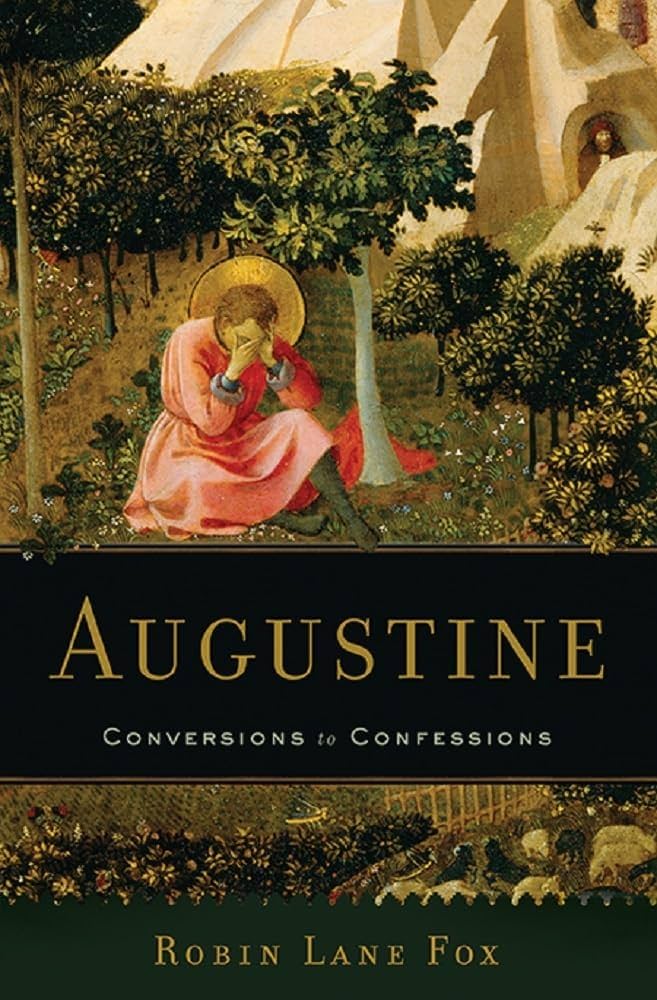
Robin Lane Fox’s Augustine: Conversion to Confessions examines roughly the first half of the great Christian saint’s life, leading up the Augustine’s most famous written work, Confessions.


Augustine as a Parish Priest

Augustine had survived becoming a priest in 391, after having only received baptism four years earlier. Augustine’s career as a churchman was now in full swing. This was ten years after the second great ecumenical council met, the Council of Constantinople (381), where the Nicene Creed, which was originally drafted in 325, was finally completed. By the end of the decade, Augustine is thought to have finished his most well-known work, the Confessions.

Among the other great church leaders Augustine corresponded with, Augustine wrote Jerome, the polyglot ascetic scholar a few years older than Augustine, who was working on a new translation of the Bible, the Vulgate, from the Hebrew where it was warranted, into Latin. Augustine quarreled with Jerome primarily over two subjects. First, Augustine was not in favor of Jerome’s efforts to translate the Old Testament directly from Hebrew, preferring the Greek Septuagint instead, the primary Old Testament translation used by Greek-speaking Christians. Augustine was concerned that various Latin translators had difficulty trying to render the Hebrew into Latin accurately, and Augustine wondered if Jerome would make the same kinds of errors. Jerome, who certainly knew the ancient languages much better, was not impressed with Augustine’s objection.

Augustine also was concerned with Jerome’s interpretation of Galatians 2:11-21, where Paul in his anger rebuked Peter. Peter had refused table fellowship with Gentile believers, preferring to eat only with Jewish Christians, an act which infuriated Paul.

Jerome was persuaded that Paul was merely pretending to be angry with Peter. Jerome did not find an “angry Paul” to be consistent with his image of a pious Paul at such odds with Peter. Jerome supposed that Paul employed a display of  an “angry Paul” in order to teach to the Galatians a theological point. Augustine, on the other hand, believed that Jerome’s view suggested that Paul was being deceptive, and that this was unbecoming to think that this form of lying could be found within the text of God’s Word (Fox, p. 667ff).

Augustine’s engagement with Jerome on this helped to spark what would become Augustine’s last book he wrote as a priest, On Lying. The Bible has several incidents whereby people lie, but then are praised for their deception. Fox notes that in Exodus, the Egypt midwives told lies in order to protect newborn sons of the Hebrews, and yet God caused them to prosper (Fox, p. 653). Rahab in the Book of Joshua lies to her fellow Jericho people, telling them that the Hebrew spies left a long time ago, all while they hid in her house, and yet Rahab is praised as a hero of faith in Hebrews 11:31.  In John 7:8-10, Jesus himself says to his brothers that he was not going up to the festival, but later on he went anyway in private.

Fox observes that Augustine believed that “if lies and pretence are once admitted in the scriptures, they will spread far and wide. Like destructive moths or worms, he now says, they will consume whole chests of clothing until nothing but shreds remain” (Fox, p. 757).  But considering that Augustine acknowledged that even Jesus did not tell the whole truth to his disciples, Augustine reread his text and found it “thorny,” and so never published it with his other works (Fox, p. 653). Augustine was perhaps right to call out Jerome on his peculiar view of Paul’s dispute with Peter in Galatians, but even Augustine never felt completely satisfied with his own answer to Jerome on the question of deception in Scripture.

Augustine was continuously wrestling with other challenges he found within the text of Scripture. Until 395, Augustine had pretty much accepted the common view based on the Book of Revelation that a one thousand reign of Christ on earth will follow Christ’s return, prior to God’s final judgment. Christians today would call this view of the future “premillennialism,” that the return of Christ will precede an earthly millennial kingdom. However, Augustine changed his mind on this, believing that there would be no such earthly millennial period. This millennial period was more figurative, and that the peace and rest a believer would experience would be delayed until after God’s final judgment (Fox, p. 670). This gave birth to the idea that the reign of Christ, symbolized by the millennium, was actually the age of the church, a view typically known today as “amillennialism.”

Augustine also wrestled with how to interpret God’s hatred of Esau and love for Jacob in Romans 9. Originally, Augustine believed that God simply foreknew whether Esau and Jacob would freely choose faith. But Augustine came to reject this interpretation, thinking that this still made salvation dependent to a certain degree on human effort, something that went contrary to his understanding of the workings of God’s grace (Fox, p. 675). Yet Fox acknowledges that Paul’s treatment of Esau and Jacob in Romans 9 had to deal with the calling of Israel and the Gentiles. It had nothing to do with Esau and Jacob as individuals and their relationship to Adam and the fall. Fox believes that Augustine misread Paul in Romans 9, as Augustine was preoccupied with questions about grace and human freewill, in his wrestling with his Manichee past (Fox, p. 678). A number of believing Christian scholars today concur with Fox’s conclusion.


Augustine as the Bishop of Hippo

Bishop Valerius saw that Augustine was more than quite capable in his rhetorical skills, and Valerius had become quite elderly and needed someone to succeed him. So he had Augustine promoted to bishop as well there in Hippo in 396. Less than a year later, Augustine began working on his most famous and influential literary work, Confessions.

The Confessions of Saint Augustine serve as the terminus for Fox’s biographical narrative of Augustine’s life. In the Confessions, Augustine admits of his sins which had kept him from knowing God. Much of the Confessions is an exploration into the deeper meaning behind one of Augustine’s most memorable quotes:

Great You are, O Lord, and greatly to be praised… You have made us so as to turn to You and our heart is restless until it finds rest in You” (Quoted in Fox, p, 710-711).

In the Confessions, Augustine finds deeper meanings found within the opening chapters of Genesis.  For example, whereas the text of Scripture teaches that humans are to “be fruitful and multiply,” this was difficult for someone like Augustine who was now committed to his celibate ideals. Instead, he interprets Genesis on this point to command that one should “multiply” fruitful meanings while pondering on Scripture (Fox, p. 740).  Instead of holding to the help of Mani, the “Paraclete,” his former mentor, to reveal the meaning of the Scriptures, he holds to “the true Holy Spirit,” in discerning the “allegorical meanings in the text” (Fox, p. 748).

Augustine continued to be troubled by Manichaean attempts to dismiss what was considered to be rather crude statements found in the Bible, particularly in the Old Testament. As a result, Augustine continued to accept Ambrose of Milan’s allegorical method of interpretation as a satisfying apologetic for Christianity.  But such allegorical readings have had their downsides, as in Augustine’s belief that the closure of a gate in Jerusalem spoken of by the prophet Ezekiel symbolized the perpetual virginity of Mary.


Augustine as a Biblical Interpreter

Fox points out that Augustine had a habit of overreading certain allegorical interpretations into biblical texts in ways that strain at credulity. Augustine took the “tunics of skins” (Genesis 3:21) which Adam and Eve were given after the fall in the garden to symbolize human mortality. When Genesis 1:1 says that: “In the beginning, God made heaven and earth,” Augustine read this as saying that this “in the beginning” should be read as “in Christ” (Fox, p. 543).

But such allegorical and other misreadings were not entirely his fault. The Latin translations of the Bible Augustine were depending on were flawed at certain points. Psalm 4:8 reads like this in many modern translations:

“In peace I will both lie down and sleep; for you alone, O Lord, make me dwell in safety” (ESV).

Yet in Augustine’s Latin translation, it read as:

“In peace in ‘it itself‘ I will go to sleep and take my slumber. You, O lord, set me in hope.”

The phrase “it itself” was a Latin mistranslation of a Hebrew word often omitted in modern translations to simply mean “at once” (the Lexham English Bible being a notable exception which includes the phrase: “In peace I will lie down and sleep at once“).  But Augustine took the Latin rendering to be a reference to God, to make it read as “In peace, in God I will go to sleep and take my slumber.” Augustine uses this interpretation of the Latin mistranslation to mean “God” some 1700 times in his writings.

This just goes to show you that simple, inconsequential misreadings of the Bible can have a ripple effect in how we read the Bible. Let that be lesson for all of us who read and take the Bible seriously!

Furthermore, the last word of the verse in Augustine’s Latin, “hope,” was yet another Latin mistranslation of a Hebrew word preserved in our modern translations as “safety.”  “Hope” and “safety” can have overlapping meanings, but the two concepts are not identical. Fox comments that if Jerome, who undertook a major effort to produce an authoritative Latin version of the Bible, the Vulgate, had read Augustine’s commentary, “he would have acidly dismissed it as based on a Latin translator’s cluster of errors” (Fox, p. 458-459).

The three lusts, an important part of Augustine’s theology of sin, are described in 1 John 2:16:

“For all that is in the world, the lust of the flesh and the lust of the eyes and the boastful pride of life, is not from the Father, but is from the world.” (NASB).

The Greek word translated as “boastful,” in the third lust, was mistranslated in Augustine’s Latin Bible as “curiosity.”  But Augustine’s Latin better fit the three lusts which delayed his own conversion: “the pleasure of the flesh, misplaced curiosity and worldly ambition.”

Augustine was certainly “curious” in his sinful misdeeds, but to be “curious” is not the same as to be “boastful.”

Another example of Augustine working with poor Latin translations of the Bible is found in Romans 7:24-25a. In an modern translation like the ESV, we read:

“Wretched man that I am! Who will deliver me from this body of death? Thanks be to God through Jesus Christ our Lord!”

However, in Augustine’s Latin translation, which Augustine never bothered to check in Greek because his knowledge of Greek was so poor, the “thanks” at the beginning of verse 25 was rendered “grace,” as in the “grace of God through Jesus Christ” would deliver him from this body of death (Fox, p. 557). This was a case of the right teaching derived from the wrong verse.
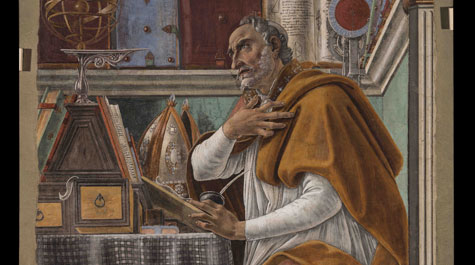
 

Sandro Botticelli, Sant’ Agostino nello studio (Saint Augustine in the studio), Fresco, Chiesa di San Salvatore in Ognissanti, Florence.


Augustine’s Misstep on Original Sin

The most egregious example is from Augustine’s Latin mistranslation of Romans 5:12, which has led other interpreters astray as well. In certain modern translations, like the ESV, the text correctly reads:

“Therefore, just as sin came into the world through one man, and death through sin, and so death spread to all men because all sinned—”

Correctly translated, “death” is the subject of the phrase “death spread to all men because all sinned.”

Augustine’s Latin version which he used mistook the “because” to be “in whom.” In this mistranslation, the subject is misplaced and thought to be a reference to the “one man,” namely Adam, “in whom all sinned“:

“Therefore, just as sin came into the world through one man, and death through sin, and so death spread to all men in whom all sinned—”

This gives the wrong impression that not only do we inherit a proclivity towards sin, due to Adam’s example, we are also declared guilty of Adam’s sin. Augustine’s dispute against Pelagius depended a lot on this notion of imputed guilt, not simply a proclivity towards sinful actions, being bestowed on all humans following Adam. Not only are we responsible for our own sin, we are also made responsible for Adam’s sin, a misinterpretation of the Bible which has been passed down through the ages (Fox, pp. 667, 677).

When coupled with Augustine’s belief about the sacraments, in his dispute with the Donatists, Augustine’s doctrine of original guilt has cast a shadow over the Western church.  The Donatists had made it a habit to rebaptize orthodox Catholics who had received their original baptism from a discredited priest. Since the Bible taught that there is only one baptism (Ephesians 4:4-6), to be rebaptized by anyone was considered a grave sin.

Anyone growing up in a Christian tradition where infant baptism is normally practiced will surely wrestle with this if they encounter friends who hold to the doctrine of “believer’s baptism;” that is, baptism should only be administered to someone who has made a profession of faith, which therefore excludes infants from being candidates for baptism. This issue can trouble the conscience of a believer, whether or not any teaching on “baptismal regeneration” is in view.

Augustine’s response was that the moral disposition of the priest performing baptism could not invalidate the sacrament of baptism, assuming the baptism was done correctly: if it was administered by water, if it was performed in a Trinitarian matter of being baptized in the name of the Father, the Son, and the Holy Spirit, and if it was done with the intention of performing the sacrament.

So if a Donatist were to baptize someone, who had not been baptized before, and that person was received back into the orthodox Catholic church, that person need not undergo a rebaptism. It was the act of baptism that mattered, not the one administering the baptism, which corresponds to the Latin formula: ex opere operato. However, in conjunction with the doctrine of original sin/guilt, as Augustine understood it, this meant that any unbaptized child would effectively be damned if that child died before they received baptism. For Augustine, baptism was considered to be the means by which grace was given to the person, a fundamental idea in Augustine’s theology of sacraments, which eventually became a flashpoint in the 16th century dispute between Protestants and Roman Catholics.

Augustine developed much of his doctrine of grace in his later years with his dispute with Pelagius. However, since the dispute with Pelagius came after writing of the Confessions, Fox does not explore this in Augustine: Conversion to Confessions.


Critical Reflection on Fox’s Augustine: Conversion to Confessions

Veteran evangelical scholar Gerald Bray assesses Fox’s work on Augustine in a manner similar to how I portray it in my own blogging about the book:

Lane Fox knows an enormous amount about the ancient world and brings his vast learning to bear in an eloquent and fascinating way. Digression is his strength, as whole chapters are taken up with studies of Manichaeism, Neo-Platonism, and the like. These descriptions are worth the price of the book.

In reading Fox’s Augustine: Conversions to Confessions, you will discover a wealth of information about the ancient world, a treasure that has helped to get me hooked on learning more about ancient history. This is spectacular. Nevertheless, Bray concludes that Fox’s work on this first half of Augustine’s life is not without fault:

But it’s when we come to the heart of the matter that Lane Fox lets us down most. His account of Augustine’s conversion contains an extended examination of the possible meaning of “tolle lege,” which led Augustine to take up Paul’s letter to the Romans. This is followed by an equally lengthy examination of the possible meanings of the text that moved his heart to turn to Christ. In the end, he concludes Augustine got it all wrong but remained convinced God had spoken to him anyway. His life was turned around, but only by mistake!

I read that section of Fox’s narrative and walked away from it like Bray has done. Fox offers some cogent critiques of Augustine’s interpretations of the Bible, but not all of his critiques work as well. As a committed non-believer, Robin Lane Fox’s presentation of Christianity as articulated by Augustine in his Confessions is vulnerable to critique.

For example, Fox claims that Augustine “evades the word ‘all’” in 1 Timothy 2:3-4, which says that “God our Saviour… wills that all men should be saved.” For Augustine, this “all” means “many” or “all sorts,” as in “all kinds” of people will be saved (Fox, p. 674).

Presumably, Fox’s assertion that when Augustine “evades the word ‘all’,” Fox means that the plain reading of 1 Timothy 2:3-4 is teaching a doctrine of universal salvation, a doctrine that Augustine does not accept. After all, Augustine was one of the most influential of the church fathers to teach the doctrine of eternal conscious torment. In Augustine’s mind, the experience of an eternal hell was not simply a psychological or sociological kind of torment, but it was a physical one as well. As New Testament scholar Paula Fredriksen says in her epic work, Augustine and the Jews, reviewed elsewhere on Veracity, Augustine actually envisioned that the number of the saved within the whole of humanity would actually be very few.

But leaving aside those weightier concerns about the ultimate fate of non-believers, Augustine’s interpretation of 1 Timothy 2:3-4 is not necessarily an evasion as Fox argues, as other contemporary commentators suggest that Augustine might be at least somewhat correct here, even if the text itself is not entirely clear. Many translations today take the forceful edge off of God being the one who “wills” that all individuals be saved and indicate that it is God’s “desire” that all individuals be saved, a less deterministic posture. Here is how the ESV renders the passage:

This is good, and it is pleasing in the sight of God our Savior, who desires all people to be saved and to come to the knowledge of the truth.

Fox’s assumptions about what the Bible actually teaches does not end there. Fox dismisses the story of creation as told in Genesis is “untrue,” from the viewpoint of modern science (Fox, p. 224). Fox claims that the Old Testament “predicted nothing about Christianity” (Fox, p. 228). Fox adds that “critical readers nowadays recognize no such harmony in the Gospels,” which reconciles the differences between those Gospels (Fox, p. 270).

These claims are no surprise as coming from an author who in 1991 wrote the book, The Unauthorized Version: Truth and Fiction in the Bible, where the publisher’s description of the book says Fox :

“….introduces us to a Bible that came late to monotheism, propounded a jumble of conflicting laws, and whose authors wrote under assumed name.”


Robin Lane Fox: Historian vs. Biblical Interpreter

While Fox, as an historian, has read enough biblical studies to offer some various fair and accurate critiques of Augustine, he apparently has not read enough to address some of these more broad-minded claims he makes against historic orthodox Christian faith in general. The evolutionary model of an Old Testament that morphs from polytheism into monotheism over time falls short when compared to the careful analysis of how progressive revelation actually works in the Bible. Scholarship on the Book of Leviticus, and other priestly material in the Old Testament, over the last fifty years, demonstrates a type of coherency of laws that is often missed by casual readers of the Bible.  And finally, various claims made about forgeries existing in our New Testament have been met with resistance by other capable scholars.

This should suffice to say, that not all biblical scholars engaged in historical criticism come to the same conclusions Fox finds so compelling, as readers of the Veracity blog will know (see particularly the review of Jesus Contradicted, by Michael Licona). Augustine sought to harmonize discrepancies which he acknowledged existed in the Bible. But as New Testament scholar Michael Licona has shown, Augustine saw some limits to common harmonization techniques. When Augustine ran into such difficulties, he would look for a deeper spiritual meaning found within the text of Scripture.

For example, according to Michael Licona, Augustine recognized a discrepancy between Mark’s version of Jesus’ baptism and Matthew’s version of Jesus’ baptism. When the voice from heaven speaks, Mark 1:11 reads:

And a voice came from heaven, “You are my beloved Son; with you I am well pleased.” (ESV)

Yet in Matthew, the same verse reads (Mathew 3:17):

And behold, a voice from heaven said, “This is my beloved Son, with whom I am well pleased.” (ESV)

It is as though in Mark the voice is speaking to Jesus himself, whereas in Matthew the voice is speaking to the crowd that was listening in.

A persistent harmonizer might conclude that the voice said both of these statements, once to Jesus and then once to the crowds, or vice-versa. But Augustine thought that this was a more improbable way to interpret the text, and taking harmonization way too far. For some might be tempted to say that the entire narrative about Jesus’ baptism happened multiple times. However, such a judgment would be far fetched, as the Gospels consistently portray Jesus’ baptism as a once in time event.

Instead, Augustine concluded that perhaps Mark is giving us a verbatim account of what was said, whereas Matthew is reframing the heavenly speech in order to instruct the crowds, suggesting a more spiritual dimension. The meaning of what the text is saying is preserved across the Gospels, regardless of how the Gospel author articulates the exact verbiage of the voice. Augustine’s approach to this text offers an improvement over his typical Ambrosian tendency to look for an allegorical interpretation, when faced with such difficulties.

As Augustine put it in his Harmony of the Gospels, the Gospel authors intentionally introduced such differences, while preserving the meaning:

…. At the same time, while preserving the sense intact, they use different modes of expression in reproducing the terms of the voice which came from heaven.

While Augustine at times shook off a strict kind of harmonization as unnecessary, he nevertheless found the Gospels to be compatible with one another, sharing the same essential message, even with a more nuanced understanding of what constitutes “harmony.” This would go against Fox’s inclination towards skepticism, which suggests that there is “no such harmony” between the Gospels.

While I do not share in Dr. Fox’s ultimate conclusions regarding Christianity, I still find him to be a compelling and fascinating writer. I have the Kindle version of Augustine: Conversions to Confessions, but I was primarily engaged in the Audible version, read by Michael Page. On a long road trip to Indiana last year, Augustine: Conversions to Confessions,  clocking in at 25 1/2 hours, made for a good companion that kept me alert the whole way.

It remains to be seen whether or not Robin Lane Fox will continue with another book examining the life of Augustine following the Confessions. Augustine was roughly 43 years old when he worked on the Confessions. He would go on to live another 33 years of service as a Christian bishop in Hippo, until his death. After enjoying Augustine: Conversions to Confessions, I hope that Dr. Fox might continue on and complete this biography of this extraordinary and influential Christian leader and thinker of the early church.

For other Veracity blog posts about Augustine, see the following:


Augustine: Conversion to Confessions, by Robin Lane Fox, A Review, Part One

Saint Augustine of Hippo is the most influential early church father of the Western church. Numerous church doctrines, such as original sin, have the indelible stamp of the late 4th / early 5th century North African bishop imprinted upon the minds and hearts of millions of Christians down to the present day.

Roman Catholics look to Augustine for understanding the theology of sacraments, while all of the major magisterial Protestant leaders of the 16th century owe a debt to Augustine. Martin Luther himself was an Augustinian monk when he nailed his famous 95-theses to the Wittenberg church door. Even the Eastern Orthodox look to Augustine as one of the primary doctors of the church.

During his long tenure as the bishop of Hippo, Augustine was known to be a writing machine. At one point he employed two full time secretaries which allowed him to dictate the books he was writing. To date, there are still works by Augustine that have not been translated into English. The man was a towering intellect, impacting a great deal of Western thought that even non-Christian scholars and other readers come back generation after generation to study.

Pope Boniface VIII in the 13th century named him one of the four great Doctors of the Church, alongside Ambrose, Jerome, and Pope Gregory the Great. Augustine wrote what many believe is the first Western autobiography, the Confessions, chronicling his journey as a rebellious teenager and libertine, to become a stalwart defender of historic orthodoxy Christianity.

Augustine almost single-handedly shifted all nearly all of Christendom away from the doctrine of a literal 1,000 year future millennium, following Christ’s return (the premillennial return of Christ) to a more symbolic view, which essentially equated the millennium with the church age, a view which remained supreme unit the era of the Reformation. Practically all of Christendom accepted his view of infant baptism for that same time period, lasting ironically about one thousand years. In the early church debate regarding the afterlife, Augustine’s specific perspective known as the doctrine of eternal conscious torment, became the dominant view of hell until the modern era.

Much of what many Christians today take for granted as to “what the Bible says” stems back to the life and mind of this North African Christian. How did this former sex-addict turned bishop of the church become so influential?

Robin Lane Fox’s Augustine: Conversion to Confessions examines roughly the first half of the great Christian saint’s life, leading up the Augustine’s most famous written work, Confessions.

Continue reading