
Greg Harris is a friend of mine. My wife and I were in a small group Bible study with Greg and his wife Kim for a couple of years in our church. Greg is pretty soft spoken, so you would never know that he is the executive director of Counteract International, a ministry to incarcerated youth in Central America, unless you pressed him to talk about his story.
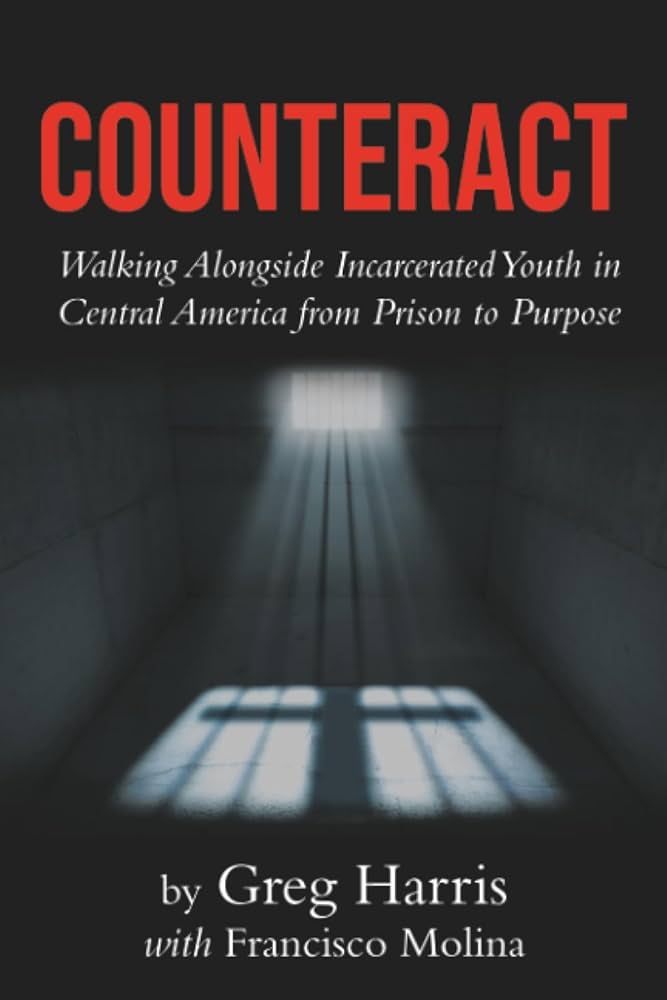
In his recent book, Counteract: Walking Alongside Incarcerated Youth in Central America from Prison to Purpose, author Greg Harris tells stories of how Counteract staff in countries like El Salvador, Guatemala, and Honduras go to Central American detention centers to offer vocational training, counseling, and above all, Christian hope, to a population of young people who have been largely abandoned due to poverty and neglect.
Hopelessness Among Central American Youth
The explosive growth of gangs in Central America is a notorious social problem, which seems distant to most North Americans. But we do see the fallout in our society, as many young people and families fleeing violence over the past few decades have made their way as immigrants into the United States, either legally or illegally. Extreme poverty has forced countless young people to experience alienation in their homes, neglect and even abuse by their parents, part of a spiraling breakdown of families which repeats generation after generation.
Even in my own relatively quiet town of Williamsburg, Virginia, where Greg and Kim Harris also live, gang violence is not that far away. A few months ago a teenage boy was shot and killed in a neighborhood across town from where I live, resulting from gang violence.
Gangs function as alternatives to biological family and Christian community. Where biological and even church families fail to provide a structured, supportive, and safe environment for kids to flourish, they will turn to gangs who offer a promise of protection and sense of importance and value. Unfortunately, the promises that gangs offer are only a counterfeit, however appealing they might appear in times of crisis.
The effects of gang violence in Central America are staggering. Several countries in Central America have had some of the largest murder rates in the world. Honduras, for example, had 37.6 homicides per 100,000 people as of 2021. The number of homicides per person in Latin America is roughly five times higher than in North America.
However, there is some good news recently as some trends appear to be reversing, but problems still persist, just in different ways. El Salvador was known for having the worst murder rate in the world, roughly 106 per 100,000 in 2015, roughly one murder per hour. Nearly ten years later, after the government started to aggressively crack down on gangs, that rate has dropped dramatically to 1.3 per 100,000 in 2025, making El Salvador one of the safest countries in the world. But the shift has come at a cost, with El Salvador having one of highest incarceration rates, about 1.6% of the population. What does one do with all of those young people in prison?
Counteract, originally named as “Orphan Helpers,” was started by a Virginia realtor, Greg Garrett, back in 2000. As a Christian businessman, Garrett wanted to know how he could help “the least of these,” quoting the words of Jesus in the New Testament. Over time, some Central American governments began to close orphanages, and so Counteract began to shift their mission purpose to meet the greatest, growing need. Since then, Counteract has focused its mission on training and sending staff into the prisons and detention centers in order to walk alongside troubled youth who experience very little hope, who tend to distrust the larger society around them.
Greg Harris, and his co-author Francisco “Pancho” Molina, tell the story ably well in Counteract: Walking Alongside Incarcerated Youth in Central America from Prison to Purpose. One of the most moving stories Greg and Pancho tell in the book comes from the COVID lockdown, when the detention centers decided to lockdown their facilities in certain areas for 21 days, where no one, including guards and other administrative personnel, could leave their respective centers for that entire time period.
Counteract staff had been told that this policy would apply to them as well: No more visits during the day, and then returning home for the night. Once you entered the detention facility, you were pretty much in there with everyone else. It was a difficult decision, as Counteract staff typically have families of their own outside of the detention center walls to take care of. Yet sacrificially, all of the Counteract staff decided to commit to the 21 day isolation policy, and stay with their incarcerated kids. These Counteract staff knew that over 90% of their job was simply to show up and be there for these kids, who had no hope otherwise.
Counteract’s Mission to “Love Thy Stranger”
Greg’s book had been out for a few months, so I finally got around to reading it this spring. I am glad I did.
About the time I read Greg’s book, I heard of another book written and released by atheist and skeptic bible scholar, Bart Ehrman, Love Thy Stranger. Ehrman grew up as a Christian, but has since walked away from the faith, while retaining his interest in the scholarly study of early Christianity. As an historian, the remarkable theme which Ehrman chronicles is that the Christian movement brought something unique into the history of humanity which was not present before the time of Christ.
Whereas most cultures have believed that one should take care of friends and family in need, caring for strangers was not part of that social ethic. Yet the New Testament stood that kind of cloistered social ethic on its head by expanding the concept of “love thy neighbor,” a phrase many know from the Hebrew Bible. In Christianity, particularly through the Gospels and the writings of the Apostle Paul, the idea of “neighbor” includes not just family and friends, but also strangers in need. For example, Ehrman observes that the entire history of “hospitals” grew out of the Christian tradition. Therefore, it should not be a surprise to find Christians in El Salvador making their way as counselors into prisons to befriend mistrusted, isolated youth.
Today, when many distrust Christianity as being something not so good for the world, it is encouraging to hear a non-believing historian acknowledge that the Christian faith introduced to human history the idea of caring for people who are strangers to you. Christianity changed the moral conscience of the West.
Ehrman’s conclusion is ironic as an atheist: “thank God for Christianity.” For atheists who have no divine transcendent metanarrative to appeal to, the best they can do is to borrow from the ethical dimension of Christianity to guide them.
What Greg Harris writes about in Counteract is the perfect expression of “love thy stranger.” While young people who get mixed up in gangs are often treated as strangers who are to be forgotten, ignored, or else marginalized from society, Counteract International offers a positive witness to the gospel message that gives hope to those who otherwise have no hope.
Greg’s book is a short read, less than 200 pages. It will stimulate you to engage in a ministry where Christians can truly become the hands and feet of Christ, offering hope to the hopeless. Through Counteract International, followers of Jesus are finding ways to connect with young people in the prison system in Central America, making friends out of strangers. I generally do not tear up when reading a book, but I teared up when reading this one.
If you want to invest in a Christian ministry doing high-quality work to care for those “strangers” hidden away in prisons, investing in the ministry of Counteract International, which Greg Harris writes about in his book, will extend that message of hope to those who feel hopeless. That message of hope actually works to change lives, which should encourage us in a day when so many negative aspects about our world can bring us down. I highly recommend Counteract: Walking Alongside Incarcerated Youth in Central America from Prison to Purpose for everyone.




What do you think?