
The question stopped me in my tracks….
Back when I was a college student, I worked as an usher at a movie theater over the summer break. It was a hot, muggy July night, as I recall. Business was slow. A friend of mine walked in and we started chatting.
My friend had grown up in church, but he blurted out this question which has stuck with me all these years later:
“Clarke, why should the death of someone 2,000 years ago matter to me today?“
I had been an active follower of Christ for several years at that time, but I was stunned by the question. As Christians, we often take for granted the thought that “Jesus died for our sins” as being vitally important, and evidently self-explanatory. But as the conversation continued I realized that I really did not have a very good answer to give.
The death of a wandering Jewish preacher in the Middle East back in the first century seems so remote and unconnected from my life as an American nearly 2,000 years later. Those worlds appear to be so far apart, particularly in our day when Artificial Intelligence is transforming our world, persistent mental health issues plague so many people, families in the midst of crisis try to make ends meet, and media reports of never ending wars all over the globe numb us. What made it even more bothersome was that this friend of mine had grown up going to church all of his life, and he did not know a good answer either.
So, does the death of Jesus, many, many years ago, in a distant culture, really matter? If so, how?
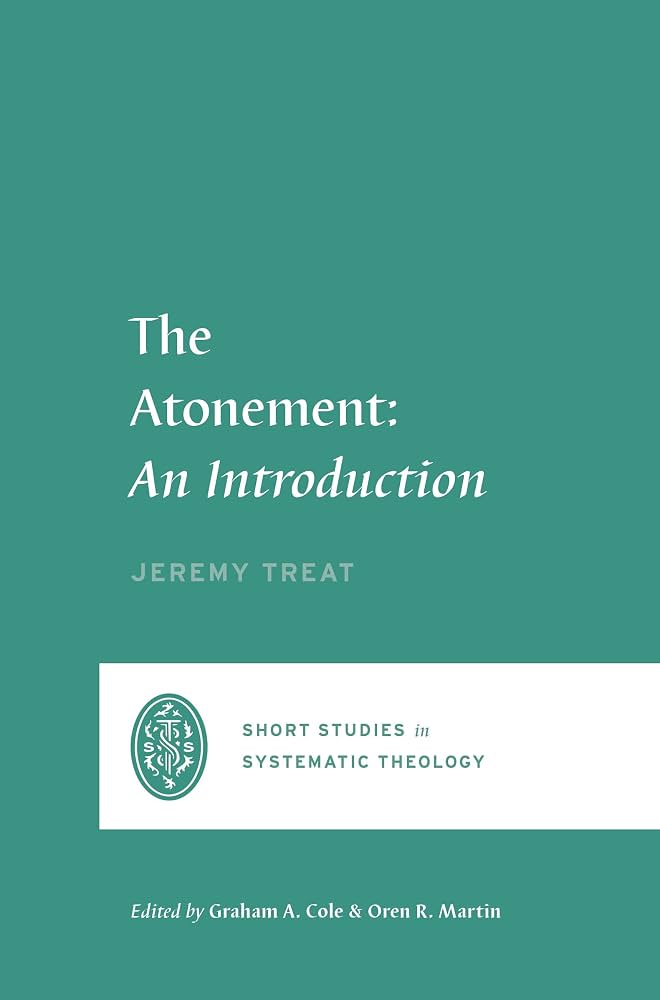
Jeremy Treat’s The Atonement: An Introduction is a concise, accessible theological examination of what the death of Christ means, for the forgiveness of sins. A perfect book for anyone, lay person or scholar, who needs a good explanation for why the death of a Jewish carpenter some 2,000 years ago is relevant to you and me today.
At moments like these, I wish I had a book like Jeremy Treat’s The Atonement: An Introduction available to hand to someone. At first, Treat’s book might seem daunting, as it is part of Crossway’s “Short Studies in Systematic Theology.” But it really is not. The book is short and accessible, less than 200 pages. I read it as an audiobook in about 4 hours. It is perfect for college students, pastors, and other lay people alike.
The topic of Jeremy Treat’s book, The Atonement, is one that sparks a lot of conversation. The early church never came up with a formal statement as to the particular meaning of Christ’s death on the cross. The Nicene-Constantinople Creed, the great ecumenical creed of the early church, is pretty brief on the subject:
….For us humans and for our salvation he came down from heaven, and was incarnate… ….For our sake he was crucified under Pontius Pilate, he suffered death and was buried….,
….I confess one Baptism for the forgiveness of sins…
As far as exactly how those ideas like the crucifixion, heaven, and the forgiveness of sins are exactly connected together, nothing is explained. But the mystery has inspired many pages of theology to be written over the centuries, with competing theories articulated to try to figure this all out.
Over the next few months, here on Veracity, I hope to bring out some of this theological discussion, interacting with a number of Scriptural texts and a few books which have attempted to make sense of one of the most intriguing questions anyone could ever think about.
But for now, I would like to start with Jeremy Treat’s excellent introduction to the topic. How would you answer the question?
Why should the death of Jesus some 2,000 years ago matter to someone today?
Jeremy Treat is a pastor for preaching at a church in California, and an adjunct professor of theology at Biola University. I am sure Treat runs into questions like this all of the time with his students.
The answer Jeremy Treat gives is reasonably thorough without being overwhelming. It is not overly technical, but it is theologically rich. Here is Jeremy Treat’s main idea: the death of Christ is the central act of God’s work to accomplish salvation for all of humanity, part of what Christians call the doctrine of atonement.
William Tyndale, who interestingly published the first mechanically printed New Testament into English, exactly 500 years ago from this present year (2026), coined the English word “atonement” to translate a difficult Hebrew word from the Old Testament. Tyndale’s idea of “atonement” comes from piecing together a phrase “at-one-ment.” Essentially, Jesus’ death on the cross 2,000 years sought to reconcile humanity to God, making us “at-one” with God.
Christians all believe that “Jesus died for our sins,” but unpacking that simple statement is really not that simple. For Jeremy Treat, the death of Christ is God’s multi-dimensional work done by God, as Father, Son, and Holy Spirit, within the story of the Kingdom of God being revealed to the world.
The concept of substitution is at the heart of the cross, as substitution holds all of these various dimensions together, which theologians debate about. The cross is about forgiveness. The cross is also about victory over sin, death, and evil. The cross is also about renewal. The cross reconciles us not only to God but to each other as well. Substitution connects all of these themes together. As to substitution, this is all about Jesus dying in our place for our sins. As Treat puts it:
“Our society is aching for atonement. How can we deal with our guilt and shame? How can we be set free from our past? How can all that is wrong be made right? The assumption in these questions is that we can atone for our sins. But the message of Christianity is not about what we ought to do for God but what God has done for us. The good news is that God has sent his Son, empowered by the Spirit, to atone for our sins and make right all that our sin has made wrong. And the gospel goes far beyond merely “making amends” (which is how the word “atonement” is often used today). Through the sacrificial death of Christ, forgiveness, freedom, healing, and restoration are available not only for broken people but for all of creation. This is good news” (Treat, The Atonement, p. 14)
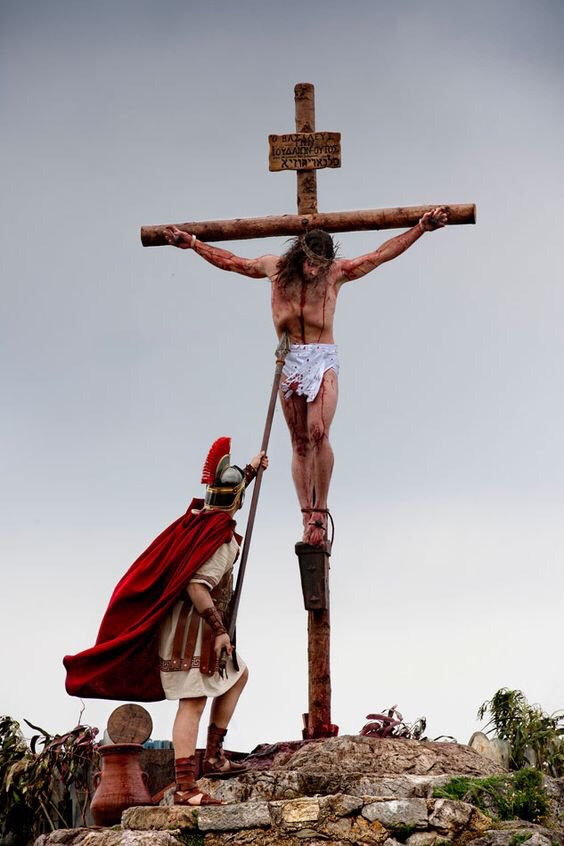
One of the most memorably moments in world history. But what does it mean for people living in the 21st century?
Critics of Christianity might want us to think that atonement is some kind of antiquated and even barbaric notion, but everyday life and even the big issues of our day would suggest otherwise. Everytime I have mistakenly cut someone off in traffic while driving, raised my voice with my wife, or loaned something out to a friend and they never pay me back, I fall back on the language of atonement, and you probably do, too. When bombs are inadvertently dropped on schools filled with elementary aged children, when millions of pounds of discarded plastics in our garbage threaten sea life in our oceans, earthquakes shake shoddily built high-story apartment buildings to the ground, along with thousands with them, and mass shooters kill innocent bystanders, we process concepts of atonement in our minds, whether we are aware of it or not.
Jeremy Treat offers a theological framework for dealing with all of this stuff. Treat’s primary dialogue partners in thinking through atonement are the 4th century North African church father, Athanasius, the 19th century Dutch theologian, Herman Bavinck, and the 20th century British pastor-theologian, John R. W. Stott. Having cut my teeth in thinking about the atonement from John Stott’s masterful work, The Cross of Christ, I resonated with Treat throughout this excellent work of deep yet accessible theology. Even better, Treat takes the same framework Stott was known for and distills it down into a concise work that can be read over a couple of afternoons, making a rich theology accessible to a new generation.
There are quite a number of theories out there that try to make sense of the atoning work of Christ; such as, penal substitution, moral influence, and “Christus Victor”. Jeremy Treat does not go into any rigorous analysis of the virtues and vices of each theory as compared to the others. He prefers to think in terms of “dimensions” of atonement as opposed to “theories.” Treat is thankfully allergic to an over-simplified reductionism, while also rejecting a cafeteria approach whereby we can merely pick and choose from different dimensions which we may like or dislike. Instead, Treat sees value in the many dimensions of atonement, and how they effectively integrate together. He offers concise definitions of twenty of these various dimensions, including propitiation, healing, and adoption. I would consider Treat’s view of atonement as a kaleidoscope approach, whereby looking through the prism at different angles, you can see different dimensions which color a rich and practical theology, a most helpful way of thinking about the meaning of the cross of Christ.
For example, in his chapter on the “Coherence of Atonement,” Treat comments on Romans 3:23-25:
“Paul uses three different metaphors from three different realms of society to explain the meaning of Christ’s death. But again, he is not saying the same thing in three different ways. He is drawing from different conceptual worlds to explain different, yet mutually enriching dimensions of what Christ accomplished. ‘For all have sinned and fall short of the glory of God and are justified (law-court), by his grace as a gift, through the redemption (marketplace) that is in Christ Jesus, whom God put forward as a propitiation (temple) by his blood to be received by faith’.“
Treat also considers unhelpful ways to think about atonement. For example, some preachers use the analogy of a train speeding down a train track, where a group of children are playing, and if not stopped the train will probably hit and kill the children. But there is a rail switch between the moving train and the children, which if triggered, can send the train down a different track and spare the lives of the children. A rail switch operator has the opportunity to flip the switch and save the day. However, standing on that other train track is the son of the rail switch operator, playing by himself. The father makes a split second decision, flipping the switch, whereby the train almost instantly kills his son, but spare the lives of the other children.
While the analogy does articulate the concept of substitution, whereby the son stands in the place of the other children, giving up his life to die in order to spare the life of the others, the analogy unhelpfully distorts the Christian view of atonement. For one thing, the fate of the son is not tied together with the fate of the father, whereas in a biblical view of the atonement, the Father and the Son, through the Holy Spirit, work in concert together to save humanity. Furthermore, the analogy stresses a kind of utilitarian solution to an ethical dilemma; that is, a sacrifice of the one for the many, and ignores God’s purpose to have a family by seeking reconciliation among a people divided against one another and alienated from their Creator.
Some Christians, when thinking about Isaiah 53, a key text for atonement theology, appear to have no problem thinking that it is somehow okay for God the Father to “crush” the Son, thereby putting God the Father and God the Son somehow in conflict with one another. Thankfully, Jeremy Treat is careful enough to say that while the Suffering Servant; that is, the Son, was indeed “crushed” in Isaiah 53:10, Treat does not say that it was “God” who “crushed” the Suffering Servant. It might appear at first glance that God did crush the Suffering Servant, but a closer look tells a far more compelling story (something to be explained further in a future blog post). Wrath is not a distinct attribute of God, but rather it is a consequence of God’s love and holiness, in response to human sin.
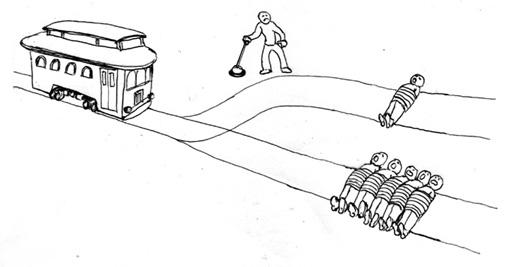
Some preachers make use of a famous ethical dilemma in moral philosophy, the so-called “Trolley Problem,” as a way of describing God’s reasoning for the atoning work of Christ on the cross. Jeremy Treat believes this to be a faulty illustration to use in trying to explain the meaning of Christ’s death.
Treat’s book on The Atonement is not meant to be exhaustive. It is but an introduction, after all. So, if you are looking for an exegetically rigorous text which sorts out all of the nuances of the debates about particular bible passages regarding atonement, then The Atonement: An Introduction is not the book you will want to read. Or, if you want to parse through all of the philosophical controversies surrounding atonement theology, you would be better looking off elsewhere. But if you want an easy to read, broad yet modestly brief look at the question as to why the death of someone 2,000 years ago might matter to you, then Jeremy Treat’s The Atonement: An Introduction is the perfect book. I came away from the book strengthened in my faith.
So, I return back to the starting question: Does the death of Jesus some 2,000 years ago matter to me today, and if so, how?
I left work that hot summer night, working through my mind as to how to answer my friend’s question. I stayed up into the wee hours of the morning, reading my Bible, still puzzled. If only I had a copy of Jeremy Treat’s The Atonement: An Introduction available to me back then, I probably would have slept better that night.
Over the next few months, stick around the Veracity blog if you want to explore with me more about this all important question.




September 25th, 2026 at 6:31 pm
[…] See Veracity book review of Jeremy Treat’s The Atonement: An Introduction, which argues that we should think of the atonement as describing […]
LikeLike