
I finally got around to reading Tom Wright’s The Day the Revolution Began. N.T. Wright is perhaps the most well known New Testament scholar living on the planet, having written over 80 books, ranging from spiritually-encouraging popular level books aimed at “soccer moms” and “weekend grill masters,” to commentaries, to other serious academic works of theology.
As noted in my previous review of Wright’s work, Paul: In Fresh Perspective, N.T. Wright is a provocative writer who makes you think. Wright is one of those few scholars whose writings engage in conversations across a wide spectrum of theological perspectives, from conservative evangelical to progressive and critical voices. Whether you like Wright or not, this former Anglican bishop might be having more reach as a Christian intellectual author than any other English writer over the last one hundred years, aside from C.S. Lewis. As a result, Wright has found himself in controversy because of his various views, from different corners of the reading public. As some would say, he is either N.T. Wright or N.T. “Wrong.”
The Day the Revolution Began provides a good example. Not too long after Wright published his book ten years ago (2016), evangelical Christian philosopher William Lane Craig came out with an alarming review, claiming that Wright had backed off from the classic evangelical formulation of the doctrine of penal substitutionary atonement. I even wrote a Veracity blog post in 2018 about the controversy.
Was William Lane Craig right about N.T. Wright becoming N.T. “Wrong?” So, I took up reading The Day the Revolution Began: : Reconsidering the Meaning of Jesus’s Crucifixion to find out.
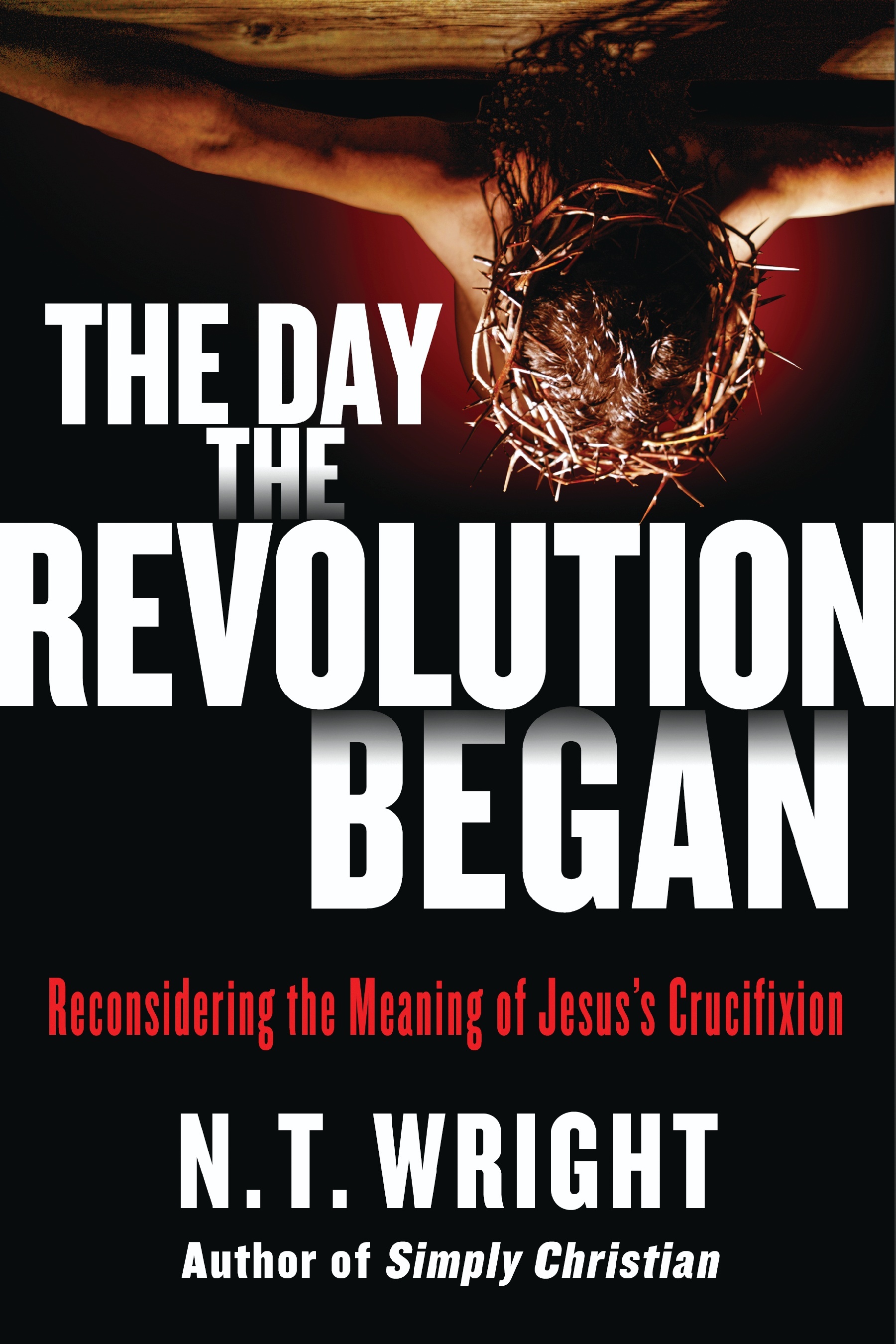
The Day the Revolution Began: Reconsidering the Meaning of Jesus’s Crucifixion, by N.T. Wright, explores the meaning of Christ’s death.
The Day the Revolution Began: Reconsidering the Meaning of Jesus’ Crucifixion
I had not read the book back in 2018, so I did not have much to say back then, other than thinking that I needed to put Wright’s book on my “to-be-read” list. This past summer it finally percolated up to the top of my list, as I have been doing a good bit of research on the topic of the death of Christ, and its meaning for people today. I am glad I finally dove into The Day the Revolution Began, as on the whole, Wright is an engaging writer and a profoundly helpful theologian, despite a few misgivings along the way. As with any book by any author, there are plusses and minuses. [1]
If one could try to boil down Wright’s overarching thesis to one idea, it would be that for too long, too many Christians have had a deficient view of the afterlife, as the goal of salvation. Is Christianity really about “going to heaven when you die?” For Wright, the popular mindset is that Christian salvation is about having some kind of conversion experience that takes us out of this world, into a more “spiritual” realm. Unwittingly, too many Christians have snuck in the ancient heresy of “Gnosticism” into their theology, envisioning salvation as an escape from the material world God has created. [2]
In response to this, Wright argues that the church needs to recover this idea of having hope for the “new heavens” and the “new earth.” Instead of expressing a desire for some disembodied existence, the New Testament teaches of the Christian hope in having a very real and concrete, future bodily existence, free from the corruptive penalty, power, and presence of sin.
What does all mean for the Christian who wants to know what the afterlife looks like for a believer? Wright explains it as a three-stage process: bodily death, intermediate state, and bodily resurrection.
A lot of Christians get a misleading picture about what Jesus tells his disciples in John 14:1-7, that in his Father’s house are “many rooms,” where Jesus is going to prepare a place for them. In recent centuries, many have envisioned permanent heavenly mansions, based on the Latin Vulgate’s translation of verse 2, mansiones, which was carried over into the 1611 King James Version of the Bible.
But Wright takes a close look at the Greek word mone, often translated as “room”, “dwelling place” or, traditionally, “mansion”. Wright argues that in the ancient world the word commonly referred not to a permanent home, but to somewhere you stopped and rested during a journey. In other words, the idea of “going to heaven when you die,” in common understanding, is actually more like a rest-stop, or a brief night’s stay, on the way towards the final destination. [3]
Jesus experienced a bodily resurrection, and the New Testament promises that those who believe in Jesus will also share in that bodily resurrection, as that final destination. Whatever one thinks about “heaven” immediately after bodily death, this intermediate state is more like a temporary rest-stop on the way to that final destination. You can forget about the Hollywood-inspired picture of those with God in the afterlife wearing wings, dressed in white, floating up on the clouds, and playing harps, where everyone is bored. Instead, the New Testament hope is about heaven coming to earth. One can think of the Lord’s Prayer to give us a better picture of that hope: “thy kingdom come, thy will be done, on earth as it is in heaven.”
This makes me think of what Joshua Ryan Butler wrote about in The Skeletons in God’s Closet, where Butler convincingly argues that the New Testament is not concerned about pairing together heaven and hell as polar opposites. Rather, the New Testament repeatedly shows that heaven and earth are out of joint with one another, a condition which gives a more accurate picture of what “hell” is. God’s salvation mission to rescue humanity is more about bringing about the reconciliation of heaven and earth.
Alongside that future hope which Wright writes about is the calling the God gives believers to live out, bit by bit, that hope in the here and now, as God is about introducing his Kingdom into this world to transform it more towards what that “new heavens” and “new earth” will look like. The “now” and “not-yet” reality of the Christian hope is a fully material existence, with the end goal of having sin and the corruption it causes completely wiped out. As Wright put it, when Christ died and then rose again, it was the “Day the Revolution Began,” beginning a new era with a new story about humanity and reality.
Part of that story is all about rethinking how we as believers should be thinking about the atoning work of Christ. Why would the violent death of a Palestinian Jewish carpenter 2,000 years ago at the hands of the Roman Empire government have much meaning for someone living today in the 21st century? Answering that question is the agenda which Wright has for The Day the Revolution Began.

N.T. Wright and his array of bookshelves, loose papers, and tilted lampshades. My wife would not approve of Wright’s untidy library.
The Meaning of the Death of Christ in Church History
Wright lays down the groundwork by rehearsing some of the history as to how Christians have thought about the meaning of the death of Christ, particularly when Protestant Reformation came along in the 16th century. Key Protestant Reformers, like Martin Luther and John Calvin, emphasized this notion of penal substitutionary atonement. In this doctrine, which the Reformers sought to ground in the teaching of the Bible, Jesus through his death takes away the penalty of sin from human individuals, dying a substitutionary death so that we might be reconciled to God.
The historical context for this focus on penal substitutionary atonement, in articulating the meaning of the death of Christ, was the spiritual anxiety experienced by millions of Western Europeans at the end of the medieval era in the 16th century. Thomas Cranmer, a Reformer and the author of the Anglican Book of Common Prayer, sought to answer this anxiety with a prayer to be uttered in weekly worship services all throughout mid-16th century England :
Almighty God, who of thy tender mercy toward mankind didst give thy Son, our Savior Jesus Christ, to suffer death upon the Cross for our redemption; who made there, by his one oblation of himself once offered, a full, perfect and sufficient sacrifice, oblation and satisfaction for the sins of the whole world.
For Cranmer, the spiritual comfort a Christian can have is grounded in both the love of God and the death of Jesus (Wright, Kindle location 562). All of the pieces that make up the concept of penal substitutionary atonement are there: the tender mercy of God, the giving of Jesus the Son to humankind, the death of the Son on the cross which makes payment for our sins, Jesus as the “full, perfect and sufficient sacrifice“, and the satisfaction for sins of all of humanity. Cranmer’s prayer does not go farther than that to connect all of these ideas together. But it was a response to the spiritual anxiety felt by many when certain teachings developed over centuries and promulgated by the bishop of Rome across Western Europe sought to bind the conscience of everyday Christians.
As an Augustinian monk with a deeply troubled conscience, Martin Luther was bothered by the concept of purgatory, and particularly the sale of indulgences, which fueled the propagation of the medieval purgatory system. The medieval church in the West taught that very few would be declared as “saints,” going on directly to experience heavenly bliss. Instead, the vast majority of Christians would need to experience a purging of any remaining sin, after they die.
This purgatory experience could be shortened or lessened by indulgences offered by the medieval church. But those indulgences would typically be obtained by monetary gifts from those who have not yet died, on behalf of those who had already died, as the latter suffered through the fires of purgation. Martin Luther was incensed by this whole theology, viewing this sale of indulgences as nothing but a money grab, stealing the wealth of the people and placing that in the hands of a corrupt church institution.
Roman Catholic theology has since Vatican II overhauled the doctrine of purgatory, and the indulgences which go along with it. Today, purgatory and the indulgences which go along with it is less about “reducing one’s time in purgatory” and is more about healing and spiritual purification.
But the basic framework of the purgatory system in the 16th century, which had left Luther depressed and anxiety ridden, still raises the kind of questions which haunted Luther centuries ago: Have I adequately dealt with sin in my life so that God would approve of me? What if I missed something so serious that it might separate me from God for all eternity? How long would I need to suffer in the intermediate state to make up for less serious sins before I could finally enter God’s heaven?
The Meaning of the Death of Christ During the Reformation
It was Luther’s careful reading of the Book of Romans that finally set him free and gave him joy. For in purgatory, it was as though the management of sin in one’s life was a never ending endeavor, carried on even after death into the intermediate state, where sin and its consequences were in continual need of maintenance.
In contrast, the death of Christ on the cross was the finished work of Christ. Now there was no more need of any additional payment to try to make up for sins, as the sale of indulgences sought to do. Because of the punishment Jesus suffered in our place on the cross, according to the doctrine of penal substitutionary atonement, where Jesus died in our place, there was no more need to suffer any more punishment, even in the intermediate state for our sins.
According to Romans 6:7, bodily death itself brings about the immediate end to the process of sanctification, “where death pays all debts” (Wright, Kindle location 758). At the point of bodily death, the sanctifying work of the Holy Spirit in the believer has put to “death the deeds of the body” (Romans 8:13 ; Wright, Kindle location 758). The wrath of God was “quenched by God’s love through the death of Jesus” (Wright, Kindle location 783).
The Reformers also pushed back on the concept of the sacrifice in the medieval Mass, whereby it was thought that the sacrifice of Jesus was re-enacted every time the Mass was celebrated. In contrast, the Reformers appealed to Romans 6:10, to say that when Jesus died, he died to sin once for all. There is now no more need to somehow re-crucify Jesus over and over again (Wright, Kindle location 809).
One might be tempted to read Colossians 1:24 to say that our experience of divine punishment is not yet over. In that difficult text, Paul is describing his own sufferings as “filling up what is lacking in Christ’s afflictions.” Yet, when Jesus says “it is finished” while hanging on a cross, as John records the last words of Christ in his Gospel, the Reformers conclude that Jesus really meant that. It is done and over! Freedom at last!
However, Wright observes that some within that Reformation tradition have taken this idea of penal substitution in wrong directions. Some evangelical Gospel presentations leave us thinking that because Jesus died in our place, taking the penalty of sin away from us, that this must be true because “someone has to die” as a demonstration of God’s retributive justice. In this case, the victim of this divine retribution turned out to be Jesus, the very Son of God (Wright, Kindle location 962).
Wright notes a level of discomfort here. For if “someone has to die,” implying that God had to kill somebody, why would anyone think this is really “good news?” For if this is really what “God’s wrath” is all about; that is, that God has some kind of need to punish someone, what kind of God is this?
Someone Must Die?? : Evangelistic Presentations That Can Go Sideways
Wright makes a good point here: I recall one evangelistic talk I heard years ago when I was involved in ministry to lost or otherwise disinterested high school kids. The topic was the cross of Christ. The speaker talked about God the Father having a loaded gun, and that because of human sin, God the Father had to shoot someone in order to demonstrate his justice. A wrong was done and that wrong needed to be punished. The speaker concluded: In the trajectory path of the loaded gun Jesus stepped in, persuading God the Father to shoot God’s one and only Son, instead of us. We who believe in Jesus are saved from that bullet, because Jesus took the bullet for us.
A lot of high school kids heard that message that night and their lives were changed. I had heard a number of gospel presentations over the years, but this time something in the back of my mind still left me uneasy. Something about it did not seem right, but I was not able to put my finger on it as to why. It was not until the next day when someone else who heard that gospel presentation walked away with the same sense of uneasiness, and he told me about it in a way that I had not carefully thought about before.
This is what my friend said: For if God is truly sovereign, why cannot God simply forgive someone without some supposed legal or existential requirement hanging over God to kill someone? Does God the Father somehow require “his pound of flesh,” as a lot of critics of Christianity are sometimes led to believe?[4]

Charles Grandison Finney, the piercing 19th century famed evangelist, who pioneered what would be come the modern “altar call.” Finney understood the meaning of Christ’s death along the lines of Hugo Grotius’ governmental theory of atonement, a popular preaching message which dominated during the Second Great Awakening in early 19th century America.
Attempts to Revise the Reformation Understanding of the Death of Christ
The 17th century Dutch scholar, Hugo Grotius, sought to resolve this dilemma with his governmental theory of atonement. According to Hugo Grotius, God was never bound by some kind of superior law, to which he had to submit. Instead, God set up the whole atoning work of Christ as simply a demonstration that God is indeed a God of justice. The death of Christ serves to display God as the great moral governor of the universe to the audience of humanity.
God was never bound to kill anyone for the sake of justice. God was perfectly sovereign and could do anything God wants. For if God was not perfectly sovereign, even over justice, God would no longer be God. However, for Grotius, it was important for us as humans to see that God is a just God, and so the death of Christ serves that purpose of displaying God’s character of justice.
In contrast to a peculiar 16th century view of penal substitution, which sees God as a judge bound by certain strict rules of retributive justice, Grotius’ governmental theory sees God as above any and all law, and therefore God can relax the rules of divine justice as God pleases. Yet as a good governor, God can not allow human creatures to sin without impunity, for if God were to do so that would encourage humans to continue in their sin. In the case of Christ’s death, Jesus dies as a kind of token punishment, not a real one as though God needed to punish anyone. While God freely forgives sinners with no strings attached, God nevertheless approves of Christ’s demonstration as sufficient in showing that God upholds the divine law.
Solutions like Hugo Grotius’ governmental theory of atonement became popular with the preaching of Charles Finney, during the Second Great Awakening in the early 19th century America, with its camp meetings, revivals, and the “anxious bench,” the forerunner to modern “altar calls.” In Finney’s mind, this appropriation of Grotius’ theory helped to uphold God’s ultimate sovereignty with a balancing act between God’s justice and God’s love for humanity.
Roughly at the same time in 19th century Scotland, another response to rather crude views of penal substitution came from the pen of John McLeod Campbell, a pastor who was dismissed from his post due to charges of heresy. John McLeod Campbell objected to certain penal understandings of the atonement, which emphasized the Son enduring punishment for the sins of humanity at the hands of the Father. Instead, Campbell subscribed to the idea that Jesus offered the perfect vicarious response to the Father on behalf of humanity, a concept he called “vicarious repentance.”
Christ took upon himself humanity’s sin, without actually sinning himself. Yet Christ offers to the Father a perfect confession, sorrow for sin, repentance, and loving obedience, a series of actions which sinful humanity could never adequately perform. What Jesus does here is substitutionary, as Christ responds to the penalty of sin on our behalf. Humanity ought to have performed these acts, but due to the enslaving power of sin, humanity could not do so. Therefore, Christ does what he does for our benefit in our place. Interestingly, C.S. Lewis adopts a variation of Campbell’s “perfect penitence” in his classic work, Mere Christianity. [5]
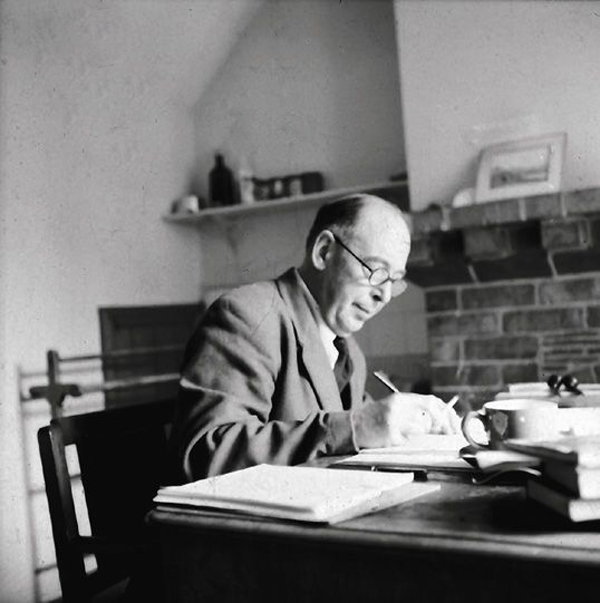
C.S. Lewis, the Oxford don who gave us his famous set of BBC radio addresses, Mere Christianity, adopted the “perfect penitence” view of the meaning of Christ’s death, articulated by the 19th century Scottish Presbyterian pastor/theologian John McLeod Campbell, who was dismissed from his teaching post at his church for disagreeing with the Westminster Standards, according to a controversial heresy trial in the Church of Scotland.
Wright’s Thesis Revising the Reformation View of the Death of Christ
But in N.T. Wright’s estimation, neither the tendency towards distorted versions of penal substitutionary atonement, nor reactionary responses to it, like Hugo Grotius’ governmental theory, or Campbell’s vicarious repentance, get at the root of the problem. Instead, Wright encourages readers to look back to the thinking of the early church and the world of Second Temple Judaism which predates the whole obsession over God’s wrath which overtook Western medieval thought. For N.T. Wright, the problem with all too common ways of thinking about the atonement, all of which have the jolt of the Reformation back in their rear view mirror, is that they build that theology with the wrong narrative to frame it.
Wright’s contention is that while all of that theology combatting “works righteousness,” the great foe of Martin Luther, was all well and good, it simply missed the main points which the New Testament is trying to convey. In one of his chapters on Paul’s letter to the Romans, Wright uses this analogy to get the idea across:
“[It is as] though a child, having longed to visit the zoo in order to see the elephants, were to arrive on a day when the elephant house was closed for repair and, desperate to avoid disappointment, somehow convinced herself that the rhinoceroses was a strange kind of elephant after all. Conversely, ideas that the letter is in fact expounding, but that have no place in the dogmatic framework are simply ignored. A rhinoceros is worth looking at for its own sake” (Wright, Kindle location 4543).
In the early church, there was greater emphasis on the idea of Christus Victor, that through the death of Christ and his subsequent resurrection, Jesus had victory over sin, death, and the very powers of evil, including the devil himself. Colossians 2:15 summarizes this concept well, in reference to the death of Christ:
“[Jesus Christ] disarmed the rulers and authorities and put them to open shame, by triumphing over them in him” (ESV).
For Wright, those earliest Christians better understood the historical context for learning the meaning of Christ’s death. First, Roman crucifixion was one of the most painful and humiliating ways to inflict punishment upon someone. In Christianity, the early church turned the meaning of the crucifixion on its head, that which was meant to humiliate became the means by which Jesus was glorified.
To borrow from Wright’s own analogy, the theme of Christus Victor is like the rhinoceros in the zoo. An over-emphasis on penal substitution as the only explanation of Christ’s death is like the elephant house in the zoo, which was closed for repair. Too often, readers of the New Testament have the elephant of penal substitution in mind when they encounter a rhinoceros like “Christus Victor” in the text of Scripture.
Then there is the language of the Jewish sacrificial system and practices like Passover, which the earliest Christians inherited from the Old Testament. The New Testament gave the early church all of these themes. Theologians from that era of the early church worked to explain what this all meant.
Yet there was no dogmatic conclusion which settled the debate over the meaning of the Jesus’ crucifixion during the early church era. None of great creeds during the era of the early church articulated any particular theory as to why and how Jesus’ death “took away the sins of the world” (John 1:29). To say that “Jesus died for our sins” seemed sufficient enough, without diving into the mechanics of how all of that worked.
Wright’s Answer to the Post-Reformation “Works Contract”
Unfortunately, along the way, certain elements of thinking over the centuries got the church off track, in Wright’s view, obscuring what the earliest Christians knew about the cross. There was a tendency in certain forms of Puritan thinking to emphasize a “covenant of works,” what Wright calls a “works contract.” Instead of a “works contract,” the Bible for Wright speaks about a sense of vocation, a calling for genuine humans to take upon the task of “image-bearing,” “reflecting the Creator’s wise stewardship into the world and reflecting the praises of all creation back to its maker” (Wright, Kindle location 1424). Creation itself “is understood as a kind of Temple, a heaven-and-earth duality, where humans function as the ‘image-bearers’ in the cosmic Temple, part of earth yet reflecting the life and love of heaven.” These “image-bearers” are to be a “royal priesthood,” a “kingdom of priests” (Wright, Kindle location 1424-1429).
While some have thought that “sin” was what preoccupied Paul in the Book of Romans, this is not Paul’s focus, according to Wright. Rather, the fundamental human problem is “idolatry.” Yes, of course, there is a “sin” problem, but at the root of the “sin” problem is “idolatry” (Wright, Kindle location 1579). Wright is therefore inclined to view Christian “faith” in terms of being loyal to the covenant which the God of the Bible has instituted. Israel’s problem, which has become everyone’s problem, is that Israel had not been faithful in worshipping Yahweh, and had been turning aside to follow other gods.
God’s purposes in terms of what our human vocation is about building God’s family (Wright, Kindle location 1924ff) and announcing God’s covenant that God is about the forgiveness of sins (Wright, Kindle location 2017ff). Along with that, God is about bringing together the theme of the Exodus, with its emphasis of freedom from slavery, and the theme of the return from the Babylonian exile, with its emphasis on the forgiveness of sins (Wright, chapter 7).
The theme of the Suffering Servant, centered around the crucial passage in Isaiah 53, became an important bridge within the world of Second Temple Judaism, linking themes of the Exodus and the return from the Babylonian exile together. Wright makes a convincing case for how the Exodus, with its Passover sacrificial ritual; the return from the Babylonian exile, with its hope for restoration, as echoed in the Book of Daniel; and interestingly, the pagan notion of dying a “noble death” on behalf of others, were themes taken up by Jews during the Maccabean period, particularly through the various Books of the Maccabees found in the “Apocrypha”. However, Wright is quick to point out one big difference between the pagan “noble death” idea and what Jewish writers during the Maccabean period had in mind: While the Greco-Romans typically had a concept of appeasing an angry deity in view, the Jews did not.
Even more dramatically, all of these themes are drawn together in such a way as to show that not only will Israel find restoration and the forgiveness of sins, the other peoples of the world will find that as well. It is this blending together of these various themes which frame the proper narrative for how to understand the New Testament theology explaining the meaning of the death of Christ, according to Wright.
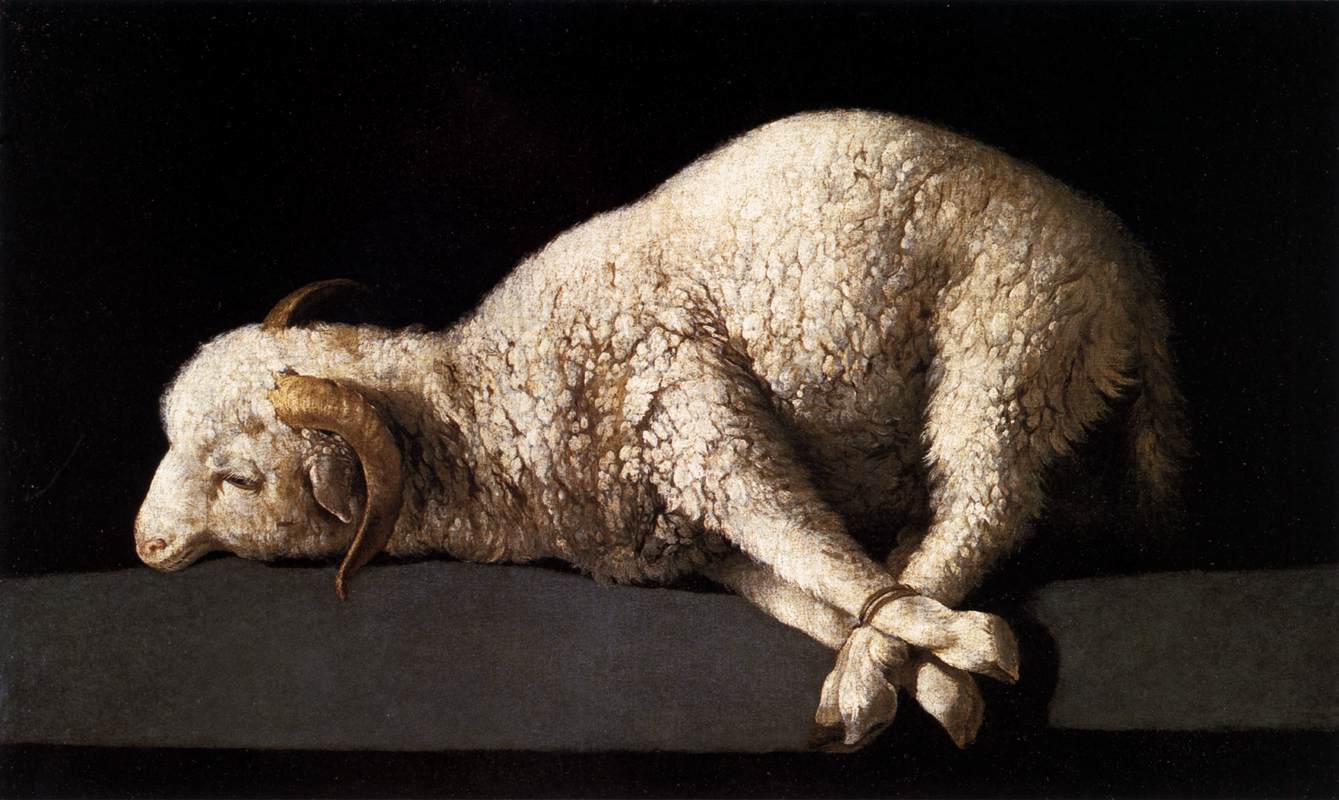
Jesus in the Lamb of God, who took away the sins of the world, by his death as a “Suffering Servant.” What does the New Testament have to say about this? N.T. Wright has some definite ideas.
Diving Into New Testament Texts About the Meaning of Christ’s Death
The second half of the book dives more deeply into how particular texts build a frame for the narrative, which helps us to develop a more robust view of what the death of Jesus on the cross really means. Wright contends that the story of Passover is central to how Jesus sought to explain the meaning of his death, when he gathered the disciples together for the Last Supper. It is through the narrative of the Passover by which Jesus frames the concept of atonement which differs from the pagan way of thinking about atonement (Wright, Kindle location 3248).
Though all four Gospels and Paul in 1 Corinthians 11 discuss the Lord’s Supper, each account offers slightly different perspectives which complement the others. For example, with one notable exception, which scholars debate, Luke never gives any explicit reasoning for why Christ died, either in his Gospel or in Acts, other than to suggest that the death of Christ was a wrongful death. This has led various scholars to say that Luke has no theology of atonement, an argument which Wright rejects. Instead, Wright contends that Luke weaves his understanding of the death of Christ into his larger narrative without resorting to explicit statements. [6]
When the thief on the cross asks Jesus to remember him when Christ comes into his Kingdom, Jesus responds with the hope of entering “paradise” (Luke 23:43). In typical Wright fashion, he reminds the reader that this “paradise” is not about “going to heaven when you die.” Instead, Jesus’ statement reiterates the theme found throughout Luke and Acts, that “the ultimate destination of God’s people is the resurrection” (Wright, Kindle location 3720). [7]
In Mark 10:35-45, there is a debate instigated by James and John, the sons of Zebedee, who want to know who will sit by Jesus’ right hand, and which to his left, suggesting that the two disciples were jockeying for position. Jesus deflates the ambitions of the two by saying that the two are clueless, and do not understand the vocation of suffering they must undergo as disciples of his. Instead, those two positions are granted to others (Mark 10:40). For Wright, those two others are the thieves on either side of Jesus’ cross, who undergo suffering (Wright, Kindle location 3839). [8]
This provides the context for Jesus saying that he gives his life as a “ransom for many.” The self-giving love of Jesus is what God uses to overcome the powers of darkness, enabling the “forgiveness of sins” in the process. It is this act of self-giving love which serves as an invitation for believers to share in that same kind of vocation of self-giving love for others (Wright, Kindle location 3852, 3888).[9]
The second half of The Day the Revolution Began includes extended exegesis of certain key New Testament texts, mainly found in the letters of Paul. Wright finds the theme of the Passover and the Exodus, as expressing God’s victory over the powers of sin and death, woven throughout Paul’s writings. Among other places, Wright looks to the Corinthian correspondence (Wright, Kindle location 4207) and Philippians (Wright, Kindle location 4349), and two full chapters on the Book of Romans.
The “deep-dive” chapters on Romans really deserve a separate blog post to consider, which I will save for another time. What follows below are some critical reflections regarding Wright’s book.
N.T. Wright: Some Love Him…. Some Not So Much
What I have given here is only a rough and partial outline of The Day the Revolution Began. There are a lot of plusses in Wright’s book. I always get a lot from reading N.T. Wright, and The Day the Revolution Began is no exception. That being said, there are those who normally would like Wright’s work, but who come across as somewhat disappointed with this book. Some even really hate it. Some have preferred taking a more cautious approach to Wright’s topic. [10]
A good bit of the ‘N.T. Wright is N.T. “Wrong”‘ reaction is a bit over the top, but his critics do have some valid points to make. As is often said about N.T. Wright, he is often right in what he affirms, but often wrong in what he denies. Or at best, one could say that sometimes N.T. Wright sounds a bit fuzzy when it comes to certain fundamental Protestant doctrines. At the very least, Wright at times frames his prose in such a way as to promote some false dichotomies. What makes this all the more ironic in The Day the Revolution Began is that in a book which aims to critique certain caricatures of penal substitutionary atonement, Wright sometimes makes certain caricatures of his own in relating to positions which he opposes.
For example, Wright has a negative take regarding the popular worship song “In Christ Alone,” written by Stuart Townend and Keith Getty. This is probably one of the most popular worship songs sung in evangelical churches today. I have probably sung it hundreds of times over the past 25 years. The second verse of the song goes like this: [11]
In Christ alone who took on flesh;
fullness of God in helpless babe.
This gift of love and righteousness
scorned by the ones He came to save;
’til on that cross as Jesus died
the wrath of God was satisfied;
for ev’ry sin on Him was laid;
here in the death of Christ I live.
Wright is not a fan of the second to the last line: “the wrath of God was satisfied.” In his interpretation of this line, Wright says: “This makes it sound like hunger that is satisfied by a good meal” (Wright, Kindle location 900). Wright continues his critique summarizing what he finds to be the message of the song:
a. All humans sinned, causing God to be angry and to want to kill them, to burn them forever in “hell.”
b. Jesus somehow got in the way and took the punishment instead (it helped, it seems, that he was innocent—oh, and that he was God’s own son too).
c. We are in the clear after all, heading for “heaven” instead (provided, of course, we believe it).
While I can not say for sure exactly what Townend and Getty had in mind for “the wrath of God was satisfied,” Wright’s characterization of the message of “In Christ Alone” is not the most generous way to interpret that song. While one could take the offensive line in the crudest of ways possible, there are other ways to think about it. To say that “the wrath of God was satisfied” could easily be interpreted as saying that what Jesus did brings about the reconciliation of fallen humanity to God. God is therefore “satisfied” with the eventual outcome of Christ’s death, without specifying all of the details in this one short line of the song. What could be more pleasing to God than for God to save the ones he created?
The “wrath of God” might be best understood as the final judgment against rebellious humanity, but that the death of Christ allows believers in the Messiah to have that coming wrath of God averted from them, on that final day of reckoning. 1 Thessalonians 1:10 is quite explicit about this: it is Jesus who “delivers us from the wrath to come.”
One need not conclude from “In Christ Alone” that God the Father was somehow satisfied with “killing Jesus,” at the moment of Christ’s death, as though God the Father is some kind of angry deity who could only be appeased by seeing someone die. In other words, the ambiguity of the lyric does not require the worshipper to take in the negative meaning which Wright ascribes to it.
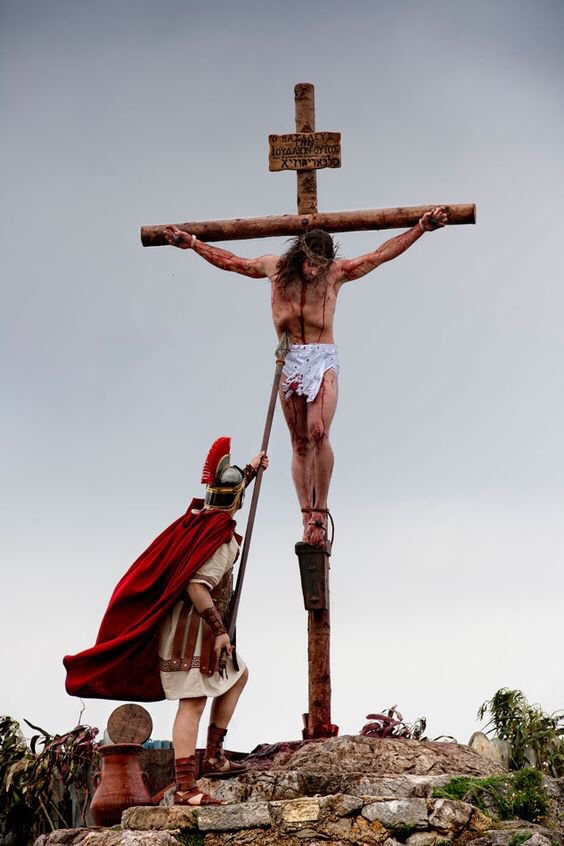
What is the meaning of the crucifixion of Jesus? N.T. Wright offers his analysis in The Day the Revolution Began
Does Wright Obfuscate What He Means?
Part of the fuzziness of Wright’s stand on certain fundamental doctrines is due to his idiosyncratic readings of certain texts. Wright’s belief that the death of Christ carries with it a sense of vocation for believers, a calling to take up our own cross for the sake of advancing the Kingdom is indeed right and extremely helpful. His way of tying Christian vocation to the cross is something that is not always heard from Christian pulpits. But when Wright uses that sense of vocation to overthrow a classic reading of 2 Corinthians 5:21, my ears perk up with puzzled curiosity. Classically, 2 Corinthians 5:21 emphasizes the “great exchange” whereby the Son who had no sin, took upon himself to be a sin offering on behalf of sinful humanity, so that we as rebellious yet forgiven humans can become the righteousness of God.
Wright, on the other hand, believes that this verse is more about Paul’s self-understanding of his own vocation as an apostle, a vocation he shared with his colleagues. For Wright, 2 Corinthians 5:21 is saying that because Paul and his colleagues were motivated by the cross of Christ to live out their specific vocation, we as believers today should live out our own vocation today in service of the crucified and risen Christ. Just as Christ suffered death on the cross, so it would be expected that Paul and his preaching colleagues would suffer as well, as servants of God’s message of reconciliation living out their vocation. This is all very much a necessary lesson for believers, but we can get this sense of calling from other texts as well. For if we follow Wright’s idiosyncratic and more narrow reading of 2 Corinthians 5:21, then we lose one of the primary texts which offers comfort for those looking to Christ for their salvation from sin.[12]
One other curiosity I noted was Wright’s translation of Colossians 2:14, “He [God] blotted out the handwriting that was against us, opposing us with its legal demands. He took it right out of the way, by nailing it to the cross.” This is in contrast with something like the ESV rendering of the same: “by canceling the record of debt that stood against us with its legal demands. This he set aside, nailing it to the cross.” Wright never explains why he eliminates the language about “debt” which most other translations have (Wright, Kindle locations, 4413, 4436). [13]
N.T. Wright on Penal Substitutionary Atonement: “PSA-Lite”
What is so ironic about the framing of Wright’s argument in The Day the Revolution Began is that while he piles on against certain (mis)understandings of penal substitution, in the end Wright actually comes out affirming his own kind of affirmation of penal substitutionary atonement; or “PSA,” for those who like abbreviations. Some call Wright’s view “PSA-Lite.”
However, Wright’s conclusion in The Day the Revolution Began is not as clearly explicit as some might like. At least, Wright’s affirmation of penal substitutionary atonement is not as direct as it could have been. While Wright does use the language of “substitution” at certain points (Wright, Kindle location 3652ff), the “penal” aspect is somewhat obscure in places. [14]
Rather, Wright’s conclusion is more implied by his rhetoric, which may explain the apprehension experienced by some readers of the book. Apparently, Wright must have felt some of the sting of reviewers, like William Lane Craig, who concluded that Wright had backed away from affirming penal substitutionary atonement, prompting Wright to later clarify his beliefs. I am not the only reviewer of Wright’s book to notice this tendency in Wright’s writings. [15]
In 2023, Wright released another book, Into the Heart of Romans, which I have only just started to read. This is where Wright affirms quite directly that Paul does teach a kind of penal substitutionary atonement (Wright, Into the Heart of Romans, pp. 56-60). Therefore, contrary to what William Lane Craig feared, it can be stated now that N. T. Wright does indeed affirm at least some version of penal substitutionary atonement. To miss this is to fail to read N. T. Wright accurately, though it may take a re-read in places to pick up on this.
So what does N.T. Wright believe about penal substitutionary atonement? Wright’s “go-to” passage on penal substitution is Romans 8:1-4, whereby Paul states that God condemns sin in the flesh, through the incarnate work and crucifixion of Jesus, language which is thoroughly “penal” (verse 3). This passage as well carries with it a sense of “substitution,” whereby Christ does something for us, accomplishing that which we could not do for ourselves. Yet Wright points out that God is not condemning Jesus, but rather that God is condemning sin. Specifically, God condemned sin in the flesh of Jesus. In the work on the cross, God is taking out his wrath on sin through Christ’s full obedience in fulfilling his divine vocation by ultimately dying for the sake of others. [16]
Nevertheless, even in The Day the Revolution Began itself, Wright is careful to refute the arguments of those who find the Christian view of Jesus’ atoning work to be appalling. One passage sticks out for me:
“[The] suggestion that “sin” does not make God angry (a frequent idea in modern thought as a reaction against the caricatures of an ill-tempered deity) needs to be treated with disdain. When God looks at sin, what he sees is what a violin maker would see if the player were to use his lovely creation as a tennis racquet.”
In other words, to think that N.T. Wright is somehow coming across as being “soft on sin,” as some of his critics have suggested, is to read the book incorrectly. [17]
In his efforts to try to dislodge this notion of “going to heaven when you die” as the final goal of salvation, thus minimizing the New Testament’s teaching on the new heavens and new earth, Wright might come across as pouring water on the fire of some favorite passages of the New Testament in affirming penal substitutionary atonement. But once a reader sticks with Wright’s whole argument throughout the book, the narrative which Wright is trying to lay out for the reader begins to make more sense.
Wright and the “Curse of the Law”
Wright’s treatment of Galatians 3:13, at first glance, made me question a lot of traditional ways of understanding this verse. Wright is emphatic in saying that “Galatians is not about ‘salvation.‘” (Wright, Kindle location 4107). Early in the book, Wright quotes his own translation of the verse and comments on it (Wright, Kindle location 1527ff): [18]
“The Messiah redeemed us from the curse of the law,” writes Paul, “by becoming a curse on our behalf.” This is not a statement of an abstract works-based atonement theology, though it is often snatched out of context and made to play that role…..
[Paul] does not go on—as such sermons regularly have—to say, “The Messiah became a curse for us so that we might be freed from sin and go to heaven,” or anything like it. He says in v. 14 that the Messiah bore the curse of the law, “so that the blessing of Abraham could flow through to the nations in King Jesus—and so that we might receive the promise of the spirit, through faith.”
Wright does have a point to make, in that the context of Galatians 3:13-14 indicates that Christ’s becoming a curse for us on our behalf is explicitly about making a way possible for the Gentiles to become members of God’s covenant family. Verse 14 follows with the exact reason why Paul mentions that Christ became the “curse of the law.” See it here in the ESV translation:
“… so that in Christ Jesus the blessing of Abraham might come to the Gentiles, so that we might receive the promised Spirit through faith” (ESV)
Paul is urging his Gentile Christian readers not to take up specifically Jewish practices associated with the Law of Moses, like undergoing circumcision. For once a Gentile Christian tries to become Jewish, by adopting all of those traditional Jewish identity markers, they also inherit the curses associated with the Law of Moses. As Deuteronomy 27:26 states, “Cursed is anyone who does not uphold the words of this law by carrying them out” (NIV).
There is nothing in the Galatians passage which explicitly ties this “curse of the law” with God’s plan of salvation more generally. Rather, to make circumcision are requirement for a Gentile believer in Jesus is to preach “another gospel” (Galatians 1:6-9), thus undermining the very message which Paul himself was required by God to preach. [19]
While Wright does not dismiss the idea of Christ becoming a curse for us having implications for our salvation from sin, the emphasis in this part of his book is not about affirming substitutionary atonement. Unfortunately, this might mislead readers, who were expecting a greater emphasis on the forgiveness of sins in his analysis of Galatians 3:
“Once again, the biblical view of what was achieved through Jesus’s death has to do with the restoration of the human vocation, of Israel’s vocation, of the larger divine purpose for the world” (Wright, Kindle location 1539).
So, what happened to the plan and promise of salvation from sin here in Galatians? If one were to stop reading The Day the Revolution Began at this point, I could understand the suspicion of Wright’s critics. Yet later in Wright’s book, he does argue for something that sounds more like penal substitutionary atonement’s emphasis on the forgiveness of sins in his treatment of Galatians, and how that ties into the rest of the New Testament. Wright quotes his own translation from the end of Luke’s Gospel and comments (Wright, Kindle location 2622ff): [20]
“This is what is written,” he said. “The Messiah must suffer and rise from the dead on the third day, and in his name repentance, for the forgiveness of sins, must be announced to all the nations, beginning from Jerusalem. You are the witnesses for all this. Now look: I’m sending upon you what my father has promised. But stay in the city until you are clothed with power from on high.” (24:44–49)
“Forgiveness of sins,” in other words, is to be seen both as the summary of the redemptive blessings promised to Israel and as the key blessing that will enable non-Jews to be welcomed into the one family. (my emphasis)
The “and” here is key: The forgiveness of Israel’s sins makes it possible for the Gentiles to be included, without requiring Gentile believers in Jesus to become Jewish. It is not an either/or here, but rather a both/and.
The idea of Jesus becoming “a curse for us,” since according to Deuteronomy 21:23, anyone who dies upon a tree is cursed by God, serves a dual purpose. First, Jesus’ becoming “a curse for us” gives God’s original covenant people, the Old Testament Jews, forgiveness for their sins, for they were a people who disobeyed God so thoroughly that they were exiled from the land that God gave them. Even though God did make a way for them to return to the land of Israel, in many ways, the Israelites were still living in a form of exile, under Roman rule, and not experiencing the blessings that God had intended for them, which were short circuited due to their continued disobedience. For them, the death of Christ made a way for them to be reconciled to God. [21]
But that is only part one of the story. Part two is that this same message of the forgiveness of sins is now extended to the Gentile, for those who believe in Christ as the promised Messiah. Why? Because Israel’s purpose was ultimately to be a blessing to the Gentiles. However, the “curse of the law” indicated that Israel would fail in that mission, precisely because she was not able to fulfill the requirements of God’s covenant with her. So, not only does the death of Christ forgive Israel of her sins, the death of Christ also makes it possible for Gentiles to become full members of God’s covenant family, without the need to take upon themselves the full requirements of the Law of Moses, with all of its demands.[22]
Furthermore, it should be noted that Christ must have done these things, to be crucified on the cross and then resurrected, in order to accomplish this work of the forgiveness of sins. In other words, “Jesus had to die in our place for our sins,” but not in the way often explained by crude versions of penal substitutionary theory. Here Wright brings into fuller focus God’s purposes for the cross of Christ, framed within this larger narrative of God’s story of redemption through the long history of Israel (Wright, Kindle location 4090ff).[23] [24]
A Summary Reflection of the Thesis of The Day the Revolution Began
As I concluded in my review of Will Hess’ Crushing the Serpent, this may sound like N.T. Wright is ultimately articulating a kind of “PSA Lite” view of the atoning work of Christ on the cross, a view I largely share as well. So be it. As I have hoped to show in this review of N.T. Wright’s The Day the Revolution Began, this understanding of the meaning of Christ’s death resonates fully with the message of the New Testament.
Much of the debate over penal substitution comes down to a couple of questions: What are the consequences of sin, and how does penal substitutionary atonement provide a remedy for those consequences?
Are the consequences of sin, namely “death,” primarily a legal indictment by God against humanity, whereby God provides a legal solution to remove the need for punishment of humanity? Or is the problem of sin mainly organic in nature, in that “death” is the final course in the “banquet of consequences” brought about by sin? Wright helpfully offers the distinction this way:
“The distinction between the ticket you will get if you are caught driving too fast and the crash that will happen if you drive too fast around a sharp bend on a wet road. The ticket is arbitrary, an imposition with no organic link to the offense. The crash is intrinsic, the direct consequence of the behavior” (Wright, Kindle location 1622).
For Wright, in penal substitution, the emphasis is more on preventing the crash and less on the resolving the legal dilemma of the ticket. But might there be a better way to put all of this together?
Perhaps a better way to summarize all of this would be something along these lines: Jesus had to die for our sins, but not in the way that certain caricatures of penal substitutionary atonement might imply. Jesus did not have to die as God’s Son so that God the Father could take all of God’s wrath out on Jesus, as some hapless victim, a “punching bag” for expressing God’s anger . Instead, there is a far grander story of what is happening with the cross of Christ.
Rather, Jesus had to die in order to conquer death, along with conquering the sin problem that results in death. Through the cross, Christ had victory over sin, death, and all evil powers that are opposed to God. Jesus needed to be resurrected to show us the promise that believers in Christ will also experience resurrection, both believing Jew and Gentile alike. But the crucifixion had to take place in order for the resurrection to happen. In the process, sin was condemned at the cross, and God’s wrath was poured out on sin itself, as the Father and the Son, in concert together, worked to punish sin. It was at the cross whereby Jesus stands in as our substitute, dying a death in our place so that we would not have to experience spiritual death.
It is in this sense that both a Christus Victor view of the cross and a penal substitutionary view of the cross actually dovetail together and find harmony. This type of theological framing was probably what N.T. Wright had in mind in The Day the Revolution Began. Wright’s framing depends less on particular prooftexts and more on broad themes interwoven into the New Testament, which are not easily identified by Christians unfamiliar with the history of Second Temple Judaism. In other words, Wright is heavily dependent on themes like exile and restoration which are more implicit in the New Testament, as opposed to be explicit.
Applying Wright’s Insights In Our Day-to-Day World
Wright’s conclusion in The Day the Revolution is a challenging one, even if controversial at certain points. Wright wants to encourage Christians not to get hyper-focused on thinking that the cross is just about “going to heaven when you die.” Rather, while the cross does indeed offer believers a future hope, it is a future hope that we are to live out in the here and now as well. The future we are promised is full bodily resurrection with a “new heavens” and “new earth,” so we should strive to make those Kingdom values relevant for today. Furthermore, just as Christ suffered for our sake, so are we to give our lives in the service of others, being the hands and feet of Christ in the very world we now live.
Some readers might think Wright is getting too “social justice” minded here at the end of the book. However, while some might question certain specific proposals made by Wright as to what embodying that “new heavens” and “new earth” in the here and now should look like, the larger ethic Wright is embracing is part of what it means to truly follow Jesus.
Despite my reservations noted in this review, I find The Day the Revolution Began to be very worthwhile reading. Wright is always engaging to read, and it was in reading this book that I was able to work out with greater clarity what I believe is the meaning of Jesus’ death.
I would classify The Day the Revolution Began as a popular level book, with a caveat: There are some elements that edge towards the more academic side, yet what Wright writes is not overly technical. I would not have written a book about the meaning of the death of Christ in the same way Wright did, but the main contours of his theology on this issue remain quite sound. I make frequent use of Wright’s The New Testament for Everyone, a passage by passage exploration of the entire New Testament in my personal devotional time, which leaves me challenged every time.
I hope to offer more reviews of Wright’s work in future Veracity blog posts, particularly in how Wright maps out the Book of Romans, a topic where Wright dedicates several chapters in The Day the Revolution Began. So even where I find myself unconvinced by certain readings favored by N.T. Wright, I am nevertheless grateful for a scholar like N.T. Wright who has had such a far-reaching impact in the church and on the world.
Notes
[1] For a basic introduction to N.T. Wright, I wrote a high-level review of his theological project about 11 years ago. A lot of evangelical Christians find Wright fascinating and frustrating at the same time. But Wright is anything but boring, and he has had an enormous influence on some of my theological heroes, such as Tim Keller, particular in Wright’s defense of the bodily resurrection of Jesus . I have a profound appreciation for what Wright is up to, even where I remain unconvinced by certain ideas he has. Back to text
[2] Any reader who has followed the work of N.T. Wright will notice that his critique against the “going to heaven when you die” way of thinking about the goal of Christian salvation has become the common theme of his books over the recent decade or so. His latest popular-level book, God’s Homecoming: The Forgotten Promise of Future Renewal – Biblical Theology from Genesis to Revelation on the New Creation, contains a promotional blurb highlighting this theme. C.S. Lewis wrote of the disjunction between heaven and earth as “the great divorce.” Healing that rift between heaven and earth is the goal of the coming Kingdom of God, which was inaugurated at Calvary. Back to text
[3] D.A. Carson does not agree with Wright here, as Carson argues against Origen’s understanding that mone pictures heaven as a series of progressive spiritual states. Carson sees that mone is a cognate of the verb meno which means “to dwell” or “to abide,” which is found within the same passage in John 14:10. In John 14:10, this theme of “abiding” in Christ resonates through much of the rest of John’s Gospel, which indicates not a temporary state, but rather the Spirit’s permanent residence in the life of the believer. Carson is right to protest against Origen’s reading, as there is nothing contextually to support Origen’s view. (Carson, The Gospel According to John, Pillar Commentary, p. 489). However, this reference to multiple mone need not imply anything more than the intermediate state experienced by multiple believers. This is consistent with Wright’s argument. To buttress his argument, Wright observes that the reference to “my Father’s house” is found elsewhere in the Gospel of John in John 2:16, which specifically identifies “my Father’s house” with the Temple. Wright observes that a traveler to Jerusalem could stay in any one of the many apartments in the Temple complex available to pilgrims (Wright, The Resurrection of the Son of God: Christian Origins and the Question of God, p. 445). It would make sense then for Jesus to use a well-known image of these Temple apartments to link the experience of a recently deceased believer with the intermediate state. Oddly, Carson does not find the metaphor of “my Father’s house” in reference to the Temple in John’s Gospel, despite the explicit usage by Jesus in John 2:16 (Carson, John, Pillar Commentary, p. 489). Given Carson’s contradiction of the text, the evidence appears to favor Wright’s interpretation over and against Carson’s. Back to text
[4] This is a common critique of penal substitutionary atonement. In this video, Greg Koukl of Stand to Reason gives his answer to the critique.
In The Day the Revolution Began, Wright summarizes his thesis like this, as a critique of common assumptions about penal substitutionary atonement:
First, we have Platonized our eschatology (with “souls going to heaven” in place of “resurrection within in a new heaven and a new earth”). Second, we have moralized our anthropology, suggesting that the crucial thing about humans is their keeping, or breaking, of a moral code, rather than their performance, or not, of their vocational tasks as the “royal priesthood.” In the Bible, “sin” is the failure, the missing of the mark, in relation to that double vocation, not simply the performance of forbidden actions. Third, we have therefore paganized our soteriology. That is, we have taken the Pauline message of representative substitution through which the dark powers of sin and death are overcome, and we have turned that message into the idea of a vindictive deity lashing out at an innocent victim.
Wright repeats his above thesis in a series of lectures given with Simon Gathercole (Gathercole, Simon, et al. What Did the Cross Accomplish? : A Conversation about the Atonement, Presbyterian Publishing Corporation, 2021). What Did the Cross Accomplish? : A Conversation about the Atonement is somewhat an awkward book in that it is basically the transcripts of a conference where Gathercole and Wright were in dialogue about their respective books, Defining Substitution, and The Day the Revolution Began. But I found the dialogue between Gathercole and Wright to be priceless. Wright tended to dominate the conversation, but in the end, I believe Gathercole to be a stronger presenter. As Gathercole addresses Wright at one point: “You like big pictures, so the bigger the picture, the better. I think the danger is that if you focus on the whole sphere, as it were, then there is a danger of missing what is in the center“. I tend to agree with Gathercole. Back to text
[5] While John McLeod Campbell lost his job as a pastor in the Church of Scotland, due to his views on the atonement, his influence has continued to offer a revised theological response to strict forms of penal substitutionary atonement. See this YouTube video for more about John McLeod Campbell’s life and controversy. Lewis describes certain notions of God “killing Jesus” instead of us for our sin, as a legal explanation for the meaning of Christ’s death, as basically “silly” on the face of it. For if God was intent to “let us off” for our sin, why would not God just simply do so? However, if one conceives of sin as a kind of “debt,” then there is more merit for paying off someone else’s debt, for which that someone else could not pay. Yet Lewis admits in Mere Christianity that his proposal of Christ being the “perfect penitent” may or may not be helpful. What matters more is not the theory which best explains how Christ’s death works to free us from sin, but rather that the death of Christ somehow “works.” Lewis’ believed that the various theories of atonement all fall short in adequately explaining the meaning of Christ’s death. So if someone is not convinced of Lewis’ particular way of thinking about the atonement, then Lewis’ suggestion is to simply “drop it” (Mere Christianity, p. 56-59). For an analysis of C.S. Lewis’ appropriation of Campbellian themes in Mere Christianity, Joel Edmund Anderson gives a summary of Lewis’ thought about the atonement. Here is my Veracity review of C.S. Lewis’ Mere Christianity. Back to text
[6] The one exception for Luke in making a mention for why Christ died is found in Luke 22:15–20, which records Jesus’ words about the meaning of the Last Supper. A textual variant here has puzzled scholars, though most scholars prefer what is often known as the longer version of this text. Starting in verse 19, Jesus says: “This is my body, which is given for you. Do this in remembrance of me.” “And likewise the cup after they had eaten, saying, ‘This cup that is poured out for you is the new covenant in my blood.‘” This parallels texts found in 1 Corinthians 11:23–25, Matthew 26:26–29 and Mark 14:22–25. However, the controversial textual variant skips everything after Jesus says: “This is my body.” This eliminates the latter half of verse 19, and completely removes verse 20. Not only is this variation much shorter, it removes the explicit reasoning for the significance of the Lord’s Supper for explaining the meaning of Christ’s death, as in identifying his body, “which is given for you,” and the cup representing his blood, which “is poured out for you” identifying the “new covenant.” Some say that the shorter variant resolves a problem found in the longer variant. The longer variant mentions the cup twice, once in verse 17-18 and verse 20, such that Jesus comments about the cup first, and then the body, in verse 19, and then repeats the mention of the cup, which sounds awkward. Some scholars, like Bart Ehrman, reason that that the shorter variant was original, and that the longer variation was introduced by scribes later on in the copying process, as scribes were more likely to add to the text, instead of removing material from the text. Ehrman’s reasoning is part of his larger argument which relies on Luke to say that Jesus, like Luke, has no theology of atonement, indicating that Jesus offers forgiveness, without any need for atonement. Therefore, the other Gospel writers, and Paul, invented the concept of atonement in order to explain why Jesus died, as a basis for the forgiveness of sins. However, the majority of scholars observe that the longer variant actually has support in more and older manuscripts, a view which Wright would surely affirm. Plus, the longer variant, because it sounds so awkward, is probably more original, thus suggesting that later scribes tried to fix the text by removing the difficult elements. Back to text
[7] Wright largely manages to sidestep the issue of the intermediate state, as Luke 23:43 is often used as a prooftext to say that the intermediate state is either one of consciousness, or a state of sleep; that is, soul sleep. The debate comes down to where one places the comma associated with “today.” Is it “Truly, I say to you, today you will be with me in paradise,” where the comma precedes “today,” thus indicating the intermediate state as a conscious experience, or ““Truly, I say to you today, you will be with me in paradise,” where the comma appears after “today,” which might suggest that the conscious soul is only relevant at a future time; thus making a way for a doctrine of soul sleep? Wright’s own translation appears to follow the former approach, which is the more typical Protestant view. But Wright’s larger point is that “paradise” is really a reference to the ultimate experience of future bodily resurrection of the believer. I leave it to the reader as to whether or not Wright is clear in his meaning, as it comes across to me somewhat muddled. See some of the following notes for more examples of Wright’s tendency towards fuzziness. Back to text
[8] Some will wonder about the one thief who continued in his mockery of the Jesus. But I can leave that comment of Wright’s aside. Back to text
[9] While I agree with Wright’s larger point, it would have more helpful for him to better explain why Mark uses the language of “ransom” here in making the atonement argument. Back to text
[10] I should note that while this has nothing to do with the content of Wright’s book, but from a practical perspective in the reading this on Kindle is that the Kindle version does not reference pages, only Kindle locations, which made it completely useless to try to use the book’s index because the index uses page numbers and not Kindle locations, which makes sense for a printed book, not a Kindle book. To make it even worse, the Kindle version does not allow searching, as an accommodation to this flaw in the Kindle version. The publisher really blew it on this one. Back to text
[11] The mainline Presbyterian church, the PCUSA denomination specifically, sought to rewrite this verse because of an opposition to penal substitutionary atonement in their theology. The controversy is discussed in this previous Veracity blog post from several years ago. A Presbyterian group proposed changing the controversial line “the wrath of God was satisfied” to read “the love of God was magnified,” which is not bad, but the songwriters refused to allow the denomination to change the lyric of their song. Wright’s proposal is to rewrite it to say “the love of God was satisfied,” which probably better reflects the intent of the songwriters. As I will note below, Wright in a 2018 interview has softened his position regarding the song. Back to text
[12] In my estimation, Wright is correct to emphasize the importance of “vocation,” or the calling of the believer to live out what it means to be an imager of God. However, Wright’s emphasis on “vocation” tends to come at the expense of just as important an emphasis on identifying human disobedience as to what the cross of Christ was meant to address. In other words, Jesus died not only to re-orient humanity to fulfill the vocation for which we are called to live out, but also to deal with the problem of human disobedience and rebellion, which is the driving force behind human sin in the first place…… I am still not yet convinced that Wright’s reading of 2 Corinthians 5:21 is correct, namely that the righteousness of God here is about embodying God’s covenant faithfulness, in terms of Paul’s apostolic calling. In the verses leading up to 2 Corinthians 5:21, Paul makes several universalizing statements about the position of the Christian in light of the gospel message; “One died for all, therefore all died” (2 Corinthians 5:14), “If anyone is in Christ, he is a new creation” (2 Corinthians 5:17), “Christ was reconciling the world to himself” (2 Corinthians 5:19). “Be reconciled to God” (2 Corinthians 5:20) directly mentions the primary point Paul and his colleagues are making in their preaching. So, why would Paul not include a summary of his messages in 2 Corinthians 5:21 to tie a fitting bow onto the knot of his argument? Even Paul’s reference to Isaiah 49:8 in 2 Corinthians 6:1-2, which follows the controversial verse, makes an appeal to “salvation,” which would be more consistent with a traditional reading of 2 Corinthians 5:21. Aside from the vexing problems with the debate between imputation versus impartation here, what it comes down to is who is the referent of the “we” in the last phrase of 2 Corinthians 5:21, all believers in Corinth, and by extension, all Christian believers everywhere, or merely Paul and his preaching colleagues? Wright’s reading is plausible, assuming that Paul was strictly making emphatic use of the “we” pronoun in verse 21 to refer to Paul himself and his colleagues, but does this argument effectively overturn 2,000 years of Christian readings of the verse, which views Paul’s use of pronouns in a looser sense? Wright’s position has some degree of explanatory power, in that the “righteousness of God” in certain contexts does mean “God’s covenant faithfulness,” and that Paul is going on at length in 2 Corinthians to defend his apostolic calling, but does Wright’s reading really fit here in 2 Corinthians 5:21 in particular? (See Wright’s discussion about 2 Corinthians 5:21 at Kindle location 4314). See Thomas Schreiner’s critique of Wright’s view of 2 Corinthians (Schreiner, Justification: An Introduction, Kindle location 1915). Schreiner’s main complaint regarding Wright’s view of 2 Corinthians 5:21 is in Wright’s idiosyncratic translation found in most English translations as the word “become,” in the sense that “we might become the righteousness of God.” I can not dismiss Wright’s view here entirely, but I am not ready to jump across the fence to join him here. It would seem to me that one needs to have a more ironclad case to make such a profound argument. I have tried to untangle some of the issues primarily with Paul’s use of the pronouns in this passage elsewhere on Veracity. As far as imputation goes, I will save more commentary on that for the follow-up post to this one which focuses on Wright’s treatment of the Book of Romans. Back to text
[13] It is true that the word “debt” as found in the ESV translation of Colossians 2:14 is not found in the original Greek, a point noted on an episode of The Shape and the Story podcast. However, most scholars argue that this Greek word cheirographon, which in a most general way means a “decree,” “regulation,” “statue,” or “ordinance“ should best be treated as “a certificate of debt,” as it is rendered in most English translations today, following BDAG 1083. A minority of scholars, such as Kyu Seop Kim, “The meaning of cheirographon in Colossians 2:14 revisited,” Tyndale bulletin, Year: 2017, Volume: 68, Issue: 2, Pages: 223-239, argue that a cheirographon can be read as “the handwritten document which contains the declaration or oath with regard to the observance of religious regulations,” with no reference to the language of “debt.” Back to text
[14] It took a few re-reads, but ultimately in my view, Wright does appear to be affirming the language of “substitution” regarding the atonement, as well as “penal,” without much hesitation. For example, Wright at one point states that Christ ‘must drain to the dregs the ‘cup of the wrath of God’ so that his people won’t have to drink it (see particularly Jer. 25:15–17; 49:12; 5:7; Lam. 4:21)‘ (Wright, Kindle location 3834). How someone as astute as William Lane Craig can miss this is puzzling. Wright makes it clear that both penal substitution and Christus Victor work together in explaining atoning work of Jesus on the cross.
From this YouTube video, the late John MacArthur said that he read N.T. Wright’s The Day the Revolution Began and concluded that it is never clear as to what Wright believes. MacArthur thinks that Wright is rather obfuscating in his approach, but MacArthur is simultaneously persuaded that Wright does not believe in penal substitutionary atonement. MacArthur’s comment is puzzling in that if he thinks that Wright is a master of obfuscation, how is it that MacArthur can be so confident as to knowing what Wright does not believe? MacArthur’s view is heavily overstated, but admittedly Wright is not always as clear as he could be. In my reading, you have to read through certain sections of the book several times to try to get at what Wright is seeking to communicate. My guess is that MacArthur lost patience with Wright’s text and writing style. It is as though Wright and MacArthur are speaking past one another. Back to text
[15] Wright does this kind thing in other popular level books. For example, in his book on defending the authority of Scripture, N.T. Wright never directly addresses the concept of biblical inerrancy. But if you read between the lines in that book, I as the reader got the sense that Wright does affirm some concept of biblical “inerrancy,” but he seems quite allergic to using that particular term. As with a number of theological issues, much of this comes down to how someone defines their terms, as with “inerrancy,” or “penal substitutionary atonement.” Back to text
[16] In his treatment on Romans 8:1-4 in The Day the Revolution Began, it must be admitted that even here Wright does acknowledge a concept of “penal substitution” at work here, but at first glance it would appear that Wright sounds somewhat vague in writing about “vocation.”:
‘If anywhere in the whole New Testament teaches an explicit doctrine of “penal substitution,” this is it—but it falls within the narrative not of a “works contract,” not of an angry God determined to punish someone, not of “going to heaven,” but of God’s vocational covenant with Israel and through Israel, the vocation that focused on the Messiah himself and then opened out at last into a genuinely human existence’ (Wright, Kindle location 4,851).
In contrast, Wright’s Into the Heart of Romans is a lot more explicit in affirming penal substitutionary atonement, yet still within narrative framework which Wright champions. In his comments on Romans 8:3-4 , Wright says:
So Paul says that, on the cross, God condemned Sin itself. The word Sin, here and in Romans 7, appears to be a way of talking about the ultimate enemy, the sub-personal force we sometimes call ‘the satan’. Here is the delicacy and inner complexity of Paul’s atonement theology. On the cross, God wins the victory over evil, through penal substitution. And penal substitution itself works through the Messiah representing his people, and thence the whole world. And the sacrificial system, here represented by the sin-offering …, does the job, not of punishing an animal, but of cleansing the place where God will come to dwell; in the present case, making it possible for God’s spirit then to fill his people. Subsequent thought has often played these ideas off against one another, with frustrating results. In Paul they are held tightly together.
From Wright’s Into the Heart of Romans, p.59-61. Back to text
[17] The link provided here to a dialogue with theologian Michael Horton, in 2018, has softened his aversion to the modern hymn: “In Christ Alone.” Wright reveals some of the criticisms he had received about The Day the Revolution Began. Back to text
[18] The ESV translation of Galatians 3:13 reads: “Christ redeemed us from the curse of the law by becoming a curse for us—for it is written, ‘Cursed is everyone who is hanged on a tree’ .” Wright’s view of the “curse of the law” differs from that of Will Hess’ view in his Crushing the Serpent (see my Veracity book review), which suggests that this “curse” is the “curse of death.” In my view, this “curse” is both the “curse of death” (Will Hess) AND the curse heaped upon any Gentile who tries to follow the Jewish identity markers (circumcision, kosher eating, etc.) while also professing faith in Christ (Wright). Both ideas are important in Paul’s thinking. Back to text
[19] Wright is a champion of the so-called “New Perspective on Paul,” which views that the God of the Old Testament, whom the Israelites followed, is just as much a God of grace as God is portrayed in the New Testament. What the New Testament does, particularly through the writings of Paul, is to open up a way for Gentiles to become members of God’s covenant people, without having to adopt all of the trappings of Jewish adherence to the Mosaic covenant, which emphasizes Jewish identity markers, like circumcision. Other aspects commonly associated with the “New Perspective on Paul” have become problematic, and as evangelicalism’s most prominent advocate this “New Perspective,” Wright has taken positions which in my view (and in many others) are not convincing. One way of putting it is that Wright is often right in what he affirms but wrong in what he denies. See this Veracity blog post which covers the controversy concerning the “New Perspective on Paul” . Back to text
[20] As an aside, Wright is persuaded that Galatians 2:19-20 is not simply a statement of Paul’s own personal testimony. It is also a statement about what happens when one comes to be “in the Messiah” (Wright, Kindle location 4147). For a good summary of the exegetical and theological issues found in the Galatians 3:13 reference to the “curse of the law”, I would recommend Anthony Thiselton’s Puzzling Passages in Paul: Fourty Conundrums Calmly Considered, chapter 6. When Paul is writing about the “curse of the law” is he saying that we have been redeemed from sin, a reference to our salvation, or we have been redeemed from the law, meaning that we are no longer required to follow the law, with all of its traditional Jewish identity markers? My answer is to say that both are true. Back to text
[21] The “curse of the law” also recalls other passages in the Old Testament, such as Deuteronomy 28:15, Jeremiah 11:3, and Ezekiel 18:4, which suggest that the requirements of the Law upon Israel were binding upon them, thus highlighting their disobedience to the Law, and the consequences of that disobedience. Authors like Matthew Barrett, in Faith Alone — The Doctrine of Justification (p.247ff), argue that Wright is presenting the reader with a false dichotomy, diminishing the the role of salvation in theology of Galatians, and instead focusing on Paul’s “gospel” that the Gentiles need not embrace Jewish identity markers to become true believers in Jesus. All they need to have is faith in Jesus as the Messiah. Barrett acknowledges that the latter is indeed true, but not at the expense of a classic Reformation understanding that Galatians is also fundamentally about salvation as well, for both Jew and Gentile.
Barrett explains this with an illustration: “When I was young, I remember running into a person who held to baptismal regeneration, insisting that baptism was only effective if it took place in his church. He told me I was not a Christian but a seeker since I wasn’t baptized in his church. I think the false teachers in Galatia said something similar regarding circumcision. They believed the Galatians were seekers but not yet members of the people of God since they had not submitted to circumcision. But Paul assures the Galatians that they truly belong to God since they had received the end-time promise of the Holy Spirit (3:1 – 5), and warns them that if they submit to circumcision that they will be cut off from Christ forever (5:2 – 4)“. (Matthew Barrett: Faith Alone — The Doctrine of Justification: What the Reformers Taught… and Why It Still Matters (p. 247).
Barrett’s critique applies well to Wright’s comments about Galatians earlier in the book, but in the latter part of the book, my reading is that Wright has less of a sense of a false dichotomy. In other words, later in The Day the Revolution Began, Wright sees that the idea of salvation, associated with the forgiveness of sins, as being tied to the Pauline principle that Gentiles need not embrace Jewish identity markers like circumcision to become true believers in Jesus. As a side note, I would recommend Matthew Barrett’s Faith Alone: The Doctrine of Justification as a worthy attempt to find some middle ground in the debate between N.T. Wright and John Piper . Back to text
[22] Wright’s view is a variation of Ronn Johnson’s view, which Ronn Johnson argues on the Divine Council Worldview podcast. Wright’s view emphasizes the core problem as human exile, broken covenant, and Israel’s failure to be a light to the Gentiles. Therefore, salvation is about the end of exile, the arrival of God’s Kingdom, and human renewal to steward creation. Sin is covenant unfaithfulness and idolatry that produces exile. Cleansing/Forgiveness means resetting the covenant relationship so Israel can fulfill its mission. Jesus acts as the true Israel/Messiah who bears the curse of the covenant exile, defeating sin and death. Justification is an expansion of the covenant to include the Gentiles, which is different than the standard Reformed view, where justification is the first step of salvation. In contrast, Johnson sees the core problem as cosmic rebellion, idolatry, and confusion between ritual cleansing and moral salvation. Johnson’s view of salvation is about loyalty and allegiance: Turning away from regional gods to serve Yahweh as King; participating in God’s divine council vision. Cleansing addresses ritual impurity to grant access to sacred space. Salvation addresses moral allegiance. Sacrifices were never meant as moral legal payments. At the cross, Jesus’ sacrifice purifies space/believers and breaks cosmic powers; it rejects legal debt models entirely. With respect to justification, faith is loyalty and public alignment with Jesus as the rightful Lord over false gods. According to AI, Johnson draws a hard line between sacrificial cleansing (which dealt with physical/purity boundaries) and salvation (which dealt with loyalty to God over rival spiritual powers), whereas Wright integrates cleansing into the story of Israel’s covenant renewal—the cross cleanses humanity so they can be restored as God’s covenant family to rule the renewed earth. Wright’s view is closer to the standard Reformed view than that of Johnson’s. Back to text
[23] This where is where Wright becomes the most explicit in using the language not only of “substitution” but also in terms of “penal” to describe the work of Christ, though he wishes to distance himself from excesses of certain traditional approaches to the atonement: “To use traditional language for a moment, this is undoubtedly ‘penal’ (you can’t get more ‘penal’ than the Deuteronomic curse), and it is undoubtedly ‘substitutionary’ (the Messiah’s accursed death means that others are no longer under the curse). But this form of ‘penal substitution’ has little or nothing to do with the narrative in which that theory is normally found” (Wright, Kindle location 4120). Back to text
[24] A good example of an attempt to over-correct a misuse of Galatians 3:13 is found on an episode of the The Story and the Shape podcast. At the 21:21 mark in the video, the podcasters critique the doctrine of penal substitutionary atonement by appealing to the idea that we participate in Christ’s suffering and death, and this is not an act of substitution. This idea is repeated in a later episode of the same podcast series. The podcasters correctly note that the “curse of the law” is specifically about the curses associated with the adoption of Mosaic law, and not some general curse associated with the whole of humankind. Paul does not want Gentile believers to caught up under that “curse of the law,” because their freedom is found through their faith in Jesus as the Messiah, and not through acts like circumcision. For if a Gentile believer were to take up circumcision, they would still inherit the curses associated with the Law of Moses. Jesus became that curse, by participating in the curse of exile experienced by disobedient Israel. Just as the Jews suffered under Roman occupation, Jesus voluntarily took upon himself the suffering of crucifixion, participating with the Jews in their suffering. All of this sense of Christ’s participation with the suffering of God’s people is indeed central to Jesus’ ministry. But the podcasters then argue that this sense of participation is not an act of substitution. However, it is important to acknowledge that Christ takes upon himself that curse of the law so that the Gentile believers would not need to experience that curse. This is inherently substitutionary! Not only that, but because Jesus was able to do what Israel failed to do; that is, to live in that state of exile (through Christ’s death) and then emerge out on the other side in restoration (through Christ’s resurrection), Christ fulfilled what Israel was supposed to do but could not. Again, this is an act of substitution. Therefore, substitutionary and participatory dimensions the death of Christ complement one another. They are not mutually exclusive of one another. Furthermore, the podcasters unfortunately downplay the idea that the curse is indeed penal. Therefore, in contrast, the concept of penal substitution is still a valid dimension of what it means to say that Christ died for our sins. Despite these criticisms, I do find these episodes of The Story and the Shape podcast to be beneficial in thinking through penal substitution. Back to text



What do you think?