
In 1526, William Tyndale published for the first time a copy of the complete New Testament into English, based on the original Greek. Ten years later, Tyndale would be dead, strangled and then burned at the stake for his crime of translating the Bible into English without authorization.
Tyndale’s translation of the Bible gave us a slew of words that did not exist before in English, as the renegade scholar sought to give the English speaking world a translation that even the ordinary “plough boy” could understand. Here is a list of some of the most creative words which Tyndale invented, mainly derived from other English words compounded together:
• Atonement (compounded from “at-one-ment”, meaning the state of being “at one” or reconciled)
• Scapegoat (derived from translating the Leviticus 16 term for the “escaping goat”)
• Mercy seat (the cover of the Ark of the Covenant, combining German and Hebrew ideas)
• Jehovah (transliterating the divine name of God from Hebrew)
• Passover (translating the Hebrew word “Pesach” for the feast celebrating Israel’s escape from Egypt; as the angel of death “passed over” the homes of Hebrew slaves with blood marked on their door posts)
• Peacemaker
• Fisherman
• Castaway
• Busybody
• Landlady
• Seashore
Exactly five hundred years after Tyndale’s monumental achievement, people are still reading the Bible in English today, having some of the same phrases derived from Tyndale that have become part of common, everyday speech.
From a blog post I first published about 12 years ago….
William Tyndale’s Gospel
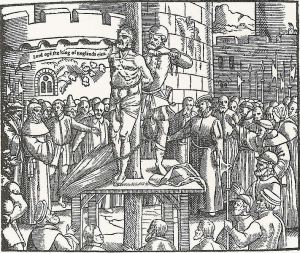
Woodcut from John Foxe’s The Book of Martyrs. William Tyndale (1494-1536) cries out, “Lord, open the King of England’s eyes.”
Are you willing to “go the extra mile” for someone?
If you know what I am talking about, you might know that this phrase, “go the extra mile“, comes from the Bible (Matthew 5:41). But did you know how this phrase became part of the English language?
William Tyndale (1494-1536) was bothered that his typical neighbor was not able to read the Bible in their native English language in the 16th century. So he went about learning ancient Greek and Hebrew and began translating the Bible into English. Unfortunately, the political and religious establishment of his day opposed his efforts, so he took it all underground, fleeing to mainland Europe to complete his work.
To his critics, he announced, “If God spare my life, before very long I shall cause a plough boy to know the scriptures better than you do!” He kept pumping out Bible translations until he was arrested and burned at the stake for his crimes.
- “salt of the earth” (Matthew 5:13)
- “eye for an eye, tooth for a tooth” (Matthew 5:38)
- “signs of the times” (Matthew 16:3)
- “all things are possible” (Matthew 19:26)
- “they made light of it” (Matthew 22:5)
William Tyndale had an incredible passion for the spread of God’s Word. His faithfulness to God’s calling on his life is continuing to have an impact on generations of English speaking people whether they know Jesus or not, hundreds of years after he lived.
Can you read the signs of the times today? We are living in an increasing Biblically illiterate culture. Do we as believers have such a desire for God’s Word that it just pours forth from our daily speech, transforming the world around us?
Are we teaching our children to feast on the words of Holy Scripture, or do we acquiesce to the lyrics of Taylor Swift that saturate their minds instead?
We need more people like William Tyndale with a passion for God’s Word. Tyndale challenges me to incorporate Scripture more and more in my daily life. I hope that we will not make light of the task that God has set before us. With Jesus, all things are possible when we fill our hearts and minds with God’s Word.
. . . . . .
As we honor what William Tyndale gave his life for 500 years ago, now in 2026, Crossway publishers has produced a short 20-minute film telling the story of Tyndale, his influence on the King James Version of the Bible, down to translations like the English Standard Version of the Bible, which Crossway publishes….. (And here is a link to my favorite documentary on William Tyndale, the story that got me hooked on learning more about this brave and passionate scholar)



What do you think?