The purple wildflower, heather, covers much of rural Scotland. In early medieval times, a person living among these heather fields, was considered to be a “heathen,” or “from the countryside,” or “from the heath.” However, in Christian usage, the term has taken on a number of meanings, sometimes controversial.
A question came up the other night in a Bible study. When we read Matthew 18:15-17, Jesus is describing the principles of church discipline. If someone who claims to be a Christian, but who acts in a non-Christian manner and will not change their behavior, what is the rest of the community supposed to do?
If your brother sins against you, go and tell him his fault, between you and him alone. If he listens to you, you have gained your brother. But if he does not listen, take one or two others along with you, that every charge may be established by the evidence of two or three witnesses. If he refuses to listen to them, tell it to the church. And if he refuses to listen even to the church, let him be to you as a Gentile and a tax collector (Matt 18:15-17 ESV)
Jesus’ use of the description “Gentile” for someone who is making up their own rules for Christian behavior sounds confusing. Are there not “Gentiles” who are genuine Christians? If someone is already a “Gentile,” that is a non-Jewish person, how can you then be disciplined and treated as a “Gentile?” How do we make sense of this? Continue reading
Bruton Parish Church courtyard… where my parents remains are buried.
There is …a time to weep, and a time to laugh, a time to mourn, and a time to dance (from Ecclesiastes 1:1-8).
Over the past year, I have lost both of my parents to death. Less than a month ago, my dad died. It has been very interesting, watching the reactions of people who hear the news. Cordially, everyone is sorry for my loss. But it is astonishing how many folks will then gloss over the reality of death in their efforts to be nice to me.
For example, I am quite frank in saying that my father died. But most people I run into would rather talk euphemistically about someone’s passing instead. I am sure it is a desire to be polite and not offend a grieving person, but when someone passes, what does that really mean? Does that really tell the truth about death?
Here is a list of some sentiments that have been expressed to me over the past month:
“At least there is an end to your dad’s suffering. There is too much suffering in the world.”
“Your dad is in a better place. He is with your mother now.”
“Your dad is looking down upon you now… and smiling!”
All of these are quite bold statements, if you think about them. How do we know there is no suffering after death? How do we know that a loved-one is in a happier, better place, with others that are also loved… and smiling? Are any of these assertions true?
A curious one is that both my mom and dad are together now, implying that they are still married in the afterlife. But according to classic Bible teaching in Matthew 22:23-33, the bonds of matrimony are terminated upon death. Mormons, however, do believe that marriage goes on into eternity, but my parents were never Mormons, though we did have some Mormon missionaries knock on our door once back in 1978. I think they gave my mom some kind of pamphlet while my dad snuck out the back door to go cut the grass.
So, what then is the basis for the truthfulness of any of these assertions? Is scientific substantiation possible? Is it through some sort of revelation from a divine being, an intervention into human history? Or is it through the speculation offered by one’s own wishful thinking? How reliable is that? Could it be, that such sentimentality is a type of coping mechanism designed to take our minds off of what we fear the most? Continue reading
For those of us who may be in a position to dialog with Muslim friends about our faith, here’s a series of thought-provoking videos that may be helpful.
Reasons To Believe scholar Fuz Rana, who had a Muslim father, interviews Abdu Murray, who converted from Islam to Christianity and now shares his faith with Muslims through several high-profile ministries.
Abdu has hard-won, firsthand insights about how to share the Christian faith with Muslims. Among his most powerful points are the value of respect for the individual and how bridges can be built in a positive way, without attacking the person or his worldview.
One of the best things on sale is the new NIV Zondervan Study Bible eBook, where the content was briefly reviewed a few months ago on Veracity. I have been wrestling with the idea of getting the new NIV Zondervan Study Bible, since it really looked to be a fantastic resource for digging into God’s Word. But Zondervan has it on sale this week for $4.99, so for less than the cost for lunch, you can have about a 3000 page, packed Bible study resource in eBook form (that is a steal compared to the $26.43 for the hardcover). So I gave up my lunch break yesterday and got it. Here is what I found….
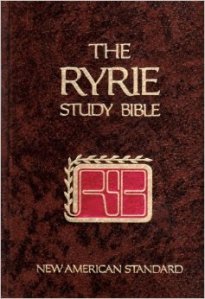
So, I was in for a confusing shock as a young person in college at a Bible study meeting. An engineering student next to me, wearing blue jeans, flannel shirt, and an old pair of sneakers, was puzzled over a passage of the Bible. To find an answer, he began to read from the notes of his new Charles Ryrie Study Bible. Across from the engineer sat a young brunette woman, dressed to the “nines,” propped up in her high heels and adorned with plenty of makeup. Though evidently they were friends, she nevertheless visibly glared at the engineer, as he spoke for about five minutes. Suddenly, this woman, who later told me, she was the daughter of an executive at Pat Robertson’s Christian Broadcasting Network (CBN), sat up straight in her chair and challenged the engineering student. “That is not what my Bible teaches! Who does this ,’Charles Ryrie,’ think he is?”
The atmosphere in the room had become so thick, you could cut it with a knife.
After a few minutes of rigorous back and forth, the casual engineering student and the dolled up brunette finally made peace with one another, but I sat there stunned. I had no idea what kind of mess I just found myself in. I had no clue what these folks were talking about. I had no idea who this ‘Charles Ryrie’ even was. But I was determined now to find out.
The Ryrie Study Bible. One of the most influential (and, at times, controversial) aids for understanding the English Bible for almost four decades.
In the twentieth century, Charles Ryrie was among the most influential conservative evangelical Bible scholars on the American scene. I would consider him to be one of the last, great classic dispensationalist theologians. Before Tim LaHaye’s Left Behind novel series overtook the church by storm, there was the Ryrie Study Bible. Classic dispensationalism championed ideas still commonly taught in many evangelical circles today, particularly the importance of a literal, futuristic interpretation of Bible prophecy, and the distinction between Israel and the church, as one of the primary interpretive keys for understanding the unity of the Bible. Is there a common thread of logic that unites the Old and New Testaments together, and the Bible’s vision of the future? Ryrie sought to tackle these type of grand questions.
Among Charles Ryrie’s mentors, dispensationalists commonly held a hard and fast distinction between the term “kingdom of God” and the similar phrase used in the Gospel of Matthew, “kingdom of Heaven.” Some even refused to utter the Lord’s Prayer as a part of corporate worship, believing that the Lord’s Prayer belonged strictly to a future dispensation. Charles Ryrie began to question such rigid, hyper-systematic interpretations of the Bible, that were originally intended to combat the prevailing liberal Protestant theologies of the early 20th century. But classic dispensationalism also rubbed against the mindset of those older conservative evangelicals who embraced covenant theology. The “iron sharpening iron” effect of these different schools of theology eventually caused the more conciliatory Ryrie Study Bible to supersede (pun intended!) the older Scofield Reference Bible that dominated previous generations in many Bible-believing churches.
Young Millennial Christians have never heard of Charles Ryrie, and thus the Ryrie Study Bible has lost its popularity for the new generation. Nevertheless, the influence of this forceful and yet gentle scholar of the Bible remains within the evangelical church, his legacy encouraging believers today to grow in their knowledge, love, and obedience towards the Scriptures.