
Category Archives: Topics

Who is the AntiChrist?

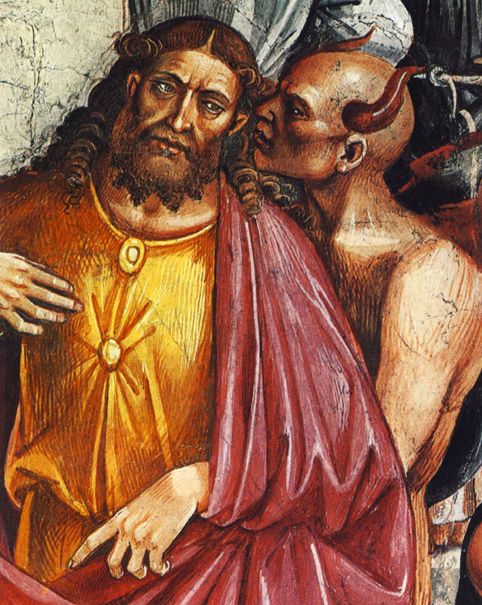
Luca Signorelli. The Deeds of the Antichrist (1499-1504). Signorelli portrays the devil counseling the Antichrist. With an American Presidential election coming around the corner, I wonder who so-called "prophecy experts" might be pick as the one and only Antichrist?

Luca Signorelli. The Deeds of the Antichrist (1499-1504). Signorelli portrays the devil counseling the Antichrist. With an American Presidential election coming around the corner, I wonder who so-called “prophecy experts” might pick as the one and only Antichrist in our day?

So, who exactly is “the” antichrist?

Back in high school, I knew someone who was convinced that President Jimmy Carter was the antichrist. Carter was a very convincing orator in the 1970s, connecting extremely well with voters frustrated with the then current political situation. Carter even said that he was a “born again” Christian. But by negotiating a peace treaty in the Middle East between Israel and her enemies, was Carter fulfilling the prophecy of Daniel 9:27, the antichrist who would “confirm the covenant with many?”

Okay, let us fast-forward some 35 plus years. He may not have been the best President we have ever had…. but the antichrist?

A lot of people speculate on who this antichrist might be. From military dictators to American presidents, the list of possible candidates seems about as endless as the human imagination (some folks even vote for their favorite picks). Most people get their information about the antichrist from books, movies, late-night cable TV, neighbors and friends.

But how many people know what the Bible actually teaches about the antichrist?  You might be surprised to discover that a lot of popular ideas about antichrist owe more to overly fertile imaginations than the clear teaching of Scripture.
Continue reading


Nat Turner’s Virginia Slave Rebellion, Hollywood, and How We Read the Bible

In August, 1831, a literate slave and Bible preacher, Nat Turner, led a rebellion against his white masters, in rural Southampton County, about a one hour drive south of where I live in Williamsburg, Virginia. After the 48-hour mass killing of 55 whites ended, Turner’s insurrection was eventually crushed, and tougher laws were enacted to try to prevent such slave uprisings in the future.

Nate Parker’s new film, The Birth of a Nation, is a fictionalized retelling of this tragic and violent story (deserving of the R-rating)…and just to think, the events depicted only happened less than two hundred years ago, practically in my own backyard. The film’s director is enveloped in controversy, and early reviews of the film are mixed. Intended to subplant the legacy of the 1915 silent film of the same name, a cinematic apology for the Ku Klux Klan, Parker raises a number of important issues, but one wonders what the film will actually accomplish.

Gospel Coalition blogger, Justin Taylor, summarizes some of the most significant elements regarding the history behind the film’s story. For more details on the history, you can start with the Nat Turner Project. Some historians are disappointed with the inaccuracies of the film, which frustrates me, as I am more interested in the actual history than I am in Hollywood’s fantasies. Does the film tell us about what really happened, or does it tell us more about the mind and state of contemporary pop-culture? How much of the film is about Nat Turner, and how much of it is about the film’s director, Nate Parker?

In the film trailer below, the Nat Turner character recites 1 Peter 2:18, in an effort to encourage his fellow slaves to keep in line. I confess that I, as do so many other evangelicals, tend to water this passage down:

Servants, be subject to your masters with all respect, not only to the good and gentle but also to the unjust (1 Peter 2:18 ESV).

I have euphemistically tried to replace “servants” with “workers,” and “masters” with “supervisors,” but does that really get at the original context? I am afraid not.

Slavery during the New Testament period is difficult to comprehend in modern terms, and it was very different from how many Americans viewed slavery prior to the Civil War. As I have argued elsewhere (here and here), many of my southern, Virginia evangelical forefathers did not properly understand passages like this either. Instead, they read things into the Bible that were not there.

If any Veracity readers end up seeing the film, I would like to know your thoughts.


Final Update to the ESV?… Well, Not Exactly

Here on Veracity a few weeks ago, we noted the decision by Crossway, the publisher of the English Standard Version (ESV), that they had finally produced a permanent edition of the text of ESV Bible translation. However, Crossway has just announced that they have reversed this decision.

Have you ever wondered what it is like to listen in as Bible translators go about making decisions on how to translate a verse of Scripture? The following 4-minute video is an example of discussion by the ESV translation committee about I Corinthians 7, with respect to changing the word “slave” to the word “bondservant.”

HT: Dave Rudy

And “finally,” here is a very extreme view expressed by a King-James-Only advocate, Steven Anderson, an independent Baptist pastor in Tempe, Arizona, arguing why modern translations, like the ESV, “the NIV, the NAS[B], the RSV, [and] the SUV,” tamper too much with “changes” to the Bible. Conspiracy theory at its most “entertaining?” View at your own risk.


When A Jew Rules the World: Joel Richardson’s Defense of Future Israel, An Extended Review

Young author, Joel Richardson, makes a measured yet passionate plea for a premillennial view of the End Times, that includes a definite future for ethnic Israel, as an antidote to Christian Antisemitic sentiment.

Prophecy teacher and author, Joel Richardson, makes a measured yet passionate plea for a premillennial view of the End Times, that includes a definite future for ethnic, national Israel. But hold onto your Bible: Is this an antidote to Christian Antisemitism?

And now, time for an in-depth book review… so pour yourself a beverage, before you dive in…

Are Christians in danger of forgetting national, ethnic Israel’s role in God’s “End Times” program?

According to New York Times bestselling author, Joel Richardson, the answer is “yes.” Joel Richardson is a fairly young, articulate spokesperson promoting Christian Zionism, hosting an Internet biblical prophecy program, “The Underground.” Joel Richardson travels widely in the Middle East, with a genuine excitement about God’s mission to proclaim the Gospel in that part of the world. He is passionate about keeping Christians informed about the Middle East through various books and films. Nevertheless, Joel Richardson is deeply concerned. In a promotional advertisement for Richardson’s 2015 book, When a Jew Rules the World: What the Bible Really Says About Israel and the Plan of God, we read, “In the past thirty years, the trend among American evangelical’s view of Israel has shifted dramatically.”

As Richardson’s ad continues on later, “A new generation of Christians are not only turning away from traditional support for Israel, but from the very belief that there yet remains any ongoing calling and election upon the Jewish people. As this portentous shift is seen on a growing number of evangelical seminaries, and even on Facebook, are Scripturally-grounded Christians prepared to provide solid responses?”

When A Jew Rules the World, which I recently finished in an audiobook form, is designed to present arguments to reverse this trend. I wanted to read this book, since I keep hearing quite a bit about the dangers of so-called “replacement theology” these days. The terminology of “replacement theology” was something unknown to me until about five years ago, so I wanted to understand what the fuss was all about. If “replacement theology” was a theological error that needed to be addressed in the evangelical church, I figured that Joel Richardson might be able to help me out.

Prophecy teacher Joel Richardson impresses me as an articulate, well-informed defender of an Israel-centric view of the End Times, which stands at the heart of the concern over “replacement theology.” This is a hard-hitting book, and it deserves wider exposure, for those not familiar with the arguments proposed by folks like Richardson. But I would be careful before you raise the issues that concern Richardson in your small group Bible study. For example, in that same Richardson ad, there is also an extraordinary claim: “There is a sudden rise of anti-Israel and anti-Semitic sentiment among Christians today. ”

There is? Really? In the wider culture, I thought being Jewish was cool. In a post-Holocaust era, with movies like Steven Spielberg’s Schindler’s List permeating popular consciousness, have Christians bucked the cultural trend and grown more hateful towards Jewish people in recent years? Continue reading


The Final Update to the English Standard Version (ESV)

Plumb LineCrossway Publishers recently announced that they have arrived at a permanent revision of the English Standard Version (ESV) of the Bible. This last revision, conducted in the summer of 2016, involves just 52 words out of 29 Bible verses, as detailed on Crossway’s website.

I bought my first ESV translation of the Bible in 2008. Even though the first edition came out 2001, there had been rumors of a Study Bible being produced. I am glad that I waited. This is now my favorite Bible to use, as it contains a wealth of resources and maps to aid the student of Scripture (though I also really like the Zondervan NIV Study Bible, too). Unlike some other study Bibles produced by a single Bible teacher, the ESV Study Bible was produced by a team of evangelical scholars across a wide set of backgrounds, thus making sure the reader is not limited to one person’s view of the Bible.

The original vision of the ESV translation committee was to produce a modern, and yet permanent, alternative to the venerable King James Version (KJV) of the Bible, for English readers. The idea of having a fixed text that would stand the test of time was the primary reason why the church that I am a part of selected the ESV as our new pew Bible.

But not every initial printing of a new Bible is perfect, and so the ESV made allowances for some changes since 2001. The largest set of changes were announced in 2011, and while I could not find those changes listed anymore at Crossway.org, another blogger at Bible-Researcher.com has still hung onto them (PDF format), 500 words out of 275 verses. Before the ESV Study Bible appeared, another set of changes were made in 2007 (If you know of any other previous changes, let me know, as I would like to link to them here).

But it looks like the ESV translators are now finished with their work. Note that the “final” version of the King James Version of the Bible was not fixed until 1769, 158 years after the KJV was originally produced.

ChristianityToday has an article about the summer 2016 changes to the ESV here.   I blogged about how believers can navigate through their decision on what Bible translation they should use, the ESV vs. NIV 2011, in a earlier Veracity post. Blogger Jon Burnett details some of the recent 2016 changes. For you total Bible geeks, Old Testament professor Claude Mariottini has reviewed these changes (spoiler alert: Mariottini does not like some of the changes. One of his biggest gripes deals with an issue related to the complementarian/egalitarian debate, which is pretty current in evangelical circles and explored at Veracity here). And finally, blogger Scot McKnight addresses the most controversial change.

UPDATE: September 15, 2016. Dave Rudy, a faithful Veracity follower, sent me this link to a post by blogger/theologian Denny Burk interacting with Scot McKnight, defending the ESV’s permanent revision.

UPDATE: September 30, 2016. Crossway has reversed their decision. Details here.
