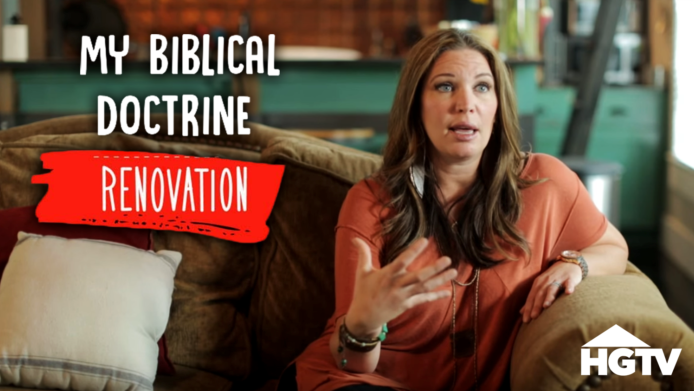
Last night, I went with members of our small group to a local movie theatre, to view Kirk Cameron’s Revive Us, a film urging Christians to pray for America, and be involved in the political process. Along with former Presidential candidate and brain surgeon, Dr. Ben Carson; public intellectual and Charles Colson BreakPoint radio commentator, Eric Metaxas; and inspirational author/speaker, Jennifer Rothschild, who has been physically blind since a child; Cameron led what he called a “national family meeting.”
I had some mixed thoughts about the movie event. It was actually better than I thought it would be. But let me tell you about why what Kirk Cameron is doing is significant, then speak to the difficulties I had with the film, and then close by telling you what I thought was really good about Kirk Cameron’s Revive Us.
Unless you have been disconnected from the power grid for the past year or so, you have probably heard something about the 2016 Presidential campaign, perhaps one of the most …. errrh ….. uuhmmm…. “interesting” cultural events I can ever recall in my American life. Lurking underneath the present national discussion is a very profound cultural shift going on in American culture, that has been having repercussions in evangelical Christian communities. Christian leadership has been undergoing great change, as elder statesmen, like Billy Graham, are no longer providing the type of glue needed to keep evangelical Christians together. Denominational barriers are breaking down, but with the fast pace of information exchange brought on by the Internet and 24×7 social and news media, Christians are finding it difficult to figure out what really brings us together. If doctrine is not able to unite us, then what does?
Most of the news we hear in these media outlets is bad news. Christians are anxious about the nation’s future, as the presence of some critical, assumed Christian values in the culture at large appears to be rapidly disappearing. For many, the voting process is about deciding over the lesser of two evils. “Where is our culture going, and why does it look like God is not doing much about it,?” as many of my Christian friends might put it.
Into the breach steps in Kirk Cameron, an outspoken, Christian movie actor. Frankly, I was a bit nervous about what Cameron might do. Though I will have to give him credit. He admits that he is not the smartest guy in the world, and he has a lot of passion about what he cares about, and I share many of his concerns. But I was a bit embarrassed by some of the factual and interpretive missteps in his 2012 cinematic attempt to “correct” popular errors in American history, Monumental. When we attempt to fix false understandings of history by passing on further misinformation, where key facts and ideas are misrepresented, it only leads to further confusion.
So, I really had a rough start, in the first twenty minutes or so, of Revive Us. Dr. Ben Carson suggested to Kirk Cameron that Americans need to learn the “real history” about America. Carson is a brilliant brain surgeon, but “real history?” I can give him some leeway here, but this is coming from a man who believes that the pyramids of Egypt were built to store grain, from the days of the Biblical Joseph, instead of accepting the well-known archaeological research, showing that the pyramids were actually burial tombs.
But when Cameron interviewed Eric Metaxas in Independence Hall, in Philadelphia, Pennsylvania, there were moments I wanted to crawl under my seat. Yes, the importance of religious freedom as being essential to the American experiment, and that only a virtuous people can keep democracy, are two basic ideas that we are losing in an age when the knowledge of America’s past is being forgotten, as many young people seem more interested in their iPhones than they do in learning about history. As I have noted before, Metaxas is to be commended on this account, but he injudiciously passes on half-truths to an eager Kirk Cameron, according to historian Robert Tracy McKenzie, a Christian scholar teaching at Wheaton College. Metaxas misled the audience when he recalled that Benjamin Franklin, hardly an orthodox Christian, called for prayer at the Constitutional Convention in the late 18th century. Metaxas conveniently does not tell Cameron that Franklin’s call to prayer was ignored by most of the other participants at the Convention. Franklin later wrote, “The Convention, except three or four persons, thought Prayers unnecessary” (Eric Metaxas: That is kind of an important detail to leave out, do you not think?).
Furthermore, Metaxas wrongly attributes the aphorism, “America is great, because America is good,” a phrase currently serving as a motto for the 2016 Democratic Presidential candidate (who also gets it wrong as well), to Alexis de Tocqueville, the famous French observer of American culture in the early 19th century.
Thankfully, pastor Francis Chan finally got the evening back on track. Chan reminded Kirk Cameron that the central issue regarding the plight of the American nation is ultimately a problem with the American church. Pray for the nation, yes, but the real battle is to pray for revival in our churches. For too long, Christians have looked to the state to provide assistance in promoting Christian values. Instead, we as the church, as Christ’s body, are to lift up His name. Then and only then, can we expect God to move among our secular neighbors and institutions, throughout our nation.
So, by the time, we got this idea straight…. at least, I hope we got this straight… I felt much, much better about Cameron’s “national family meeting.” Sure, it was a bit weird to think of going to the movie theatre, watching a film recorded from the week before (apparently, this was a second showing… presumably the first showing was a live event), and trying to maintain a sense of worship. For those Christians who treasure the classic hymns, you might have stumbled a bit with the contemporary worship music Cameron had lined up, nearly all played in U2-style, with lots of drums, guitars, and acoustic delay.
Furthermore, Cameron’s urging that all Christians should get out and vote on November 7, referring audiences to lookup MyFaithVotes.org, failed to account for the theological reasons why some Anabaptists would conscientiously object to voting. But the nuances required to address issues like these were not in Cameron’s purview. Cameron’s goal has been to encourage Christians, who do not think too much about wider issues in the culture, to start thinking more about these things, and engage these issues instead of waiting on the sideline.
Thankfully, neither name of the main Presidential contenders were mentioned during the nearly two-hour film. No flashpoint issues of public policy distracted from the main theme. In this way, I was glad that this was not a “political” event, despite the undercurrent of American election controversies that are difficult to ignore. To the extent that Cameron was able to encourage Christians to view the question of America’s future as really a question about the condition of evangelical churches, and the need for revival in our homes and churches, I would then say that Cameron did well to call this “national family meeting.”