Category Archives: Apologetics

For Your Summer Listening Pleasure (in 2023)…..

As we head into the summer of 2023, I wanted to list out some of best video/audio that I have dabbled in so far this year. Most of these talks and videos I have only started, only wanting come back to them later. It seems like everybody has a podcast or YouTube channel theses days, but I mainly want to highlight some of the best stuff out there…. and there is some really good stuff!

So far in 2023, we have lost a number of Christian leaders who have had a worldwide impact. The most recent being Tim Keller. This reflective article by Collin Hansen about Tim Keller at Christianity Today is one of the best remembrances of Tim Keller. But I would also recommend Russell Moore’s survey of Tim Keller’s contribution to evangelicalism in the YouTube video/podcast below, highlighting Keller’s gentle yet firm approach to evangelism, and especially Keller’s Christ-honoring posture when faced by critics on the theological left and the theological right. As Molly Worthen (see below) writes in her article in The Atlantic, more progressive leaning Christians rejected Keller’s view of marriage as being only between a man and a woman, as well as his view that the Bible does not permit women to serve as elders in a local church, while more conservative leaning Christians rejected Keller’s “third way” approach to cultural disintegration as “compromising” with the world, calling for a more aggressive stance against secularism in the political sphere, as opposed to Keller’s more irenic, conversational approach.

These deaths fall on the heals of a few notable deaths in late 2022, including Gordon Fee and E. P. Sanders. Gordon Fee was one of the most well-regarded evangelical New Testament scholars of that last quarter century, a curious mix of a keen intellect that produced some of the most outstanding commentaries of various New Testament books that thousands of pastors weekly consult for their sermons, and controversially having a strongly charismatic, Pentecostal background, with egalitarian convictions regarding women in ministry. Here is an 8-minute interview with Dr. Fee a few years before he died:

Yet Fee’s great impact was eclipsed by E. P Sanders, who was widely regarded as the most influential New Testament scholar in the last quarter of the 20th century. Most conservative evangelical Christians have never heard of E. P. Sanders, as he tended to move around in more progressive circles, but his impact on how all scholars, theologically conservative and progressive, think about the New Testament is undeniable. Just as the German Rudolph Bultmann towered above everyone else in the mid-20th century, so did the American E.P. Sanders since the 1970s, following his landmark work Paul and Palestinian Judaism. E.P. Sanders, who in the late 1970s or early 1980s was once a visiting professor at the College of William and Mary, where I work on staff, will forever be connected with the so-called “New Perspective on Paul,” which has revolutionized New Testament understandings of the Apostle Paul. While the “New Perspective on Paul” is widely misunderstood, and even outright rejected by some, serious scholarship today can not afford to ignore the ideas articulated by E.P. Sanders. Sanders scholarship has permeated just about every study of Paul, notably through the popular New Testament British evangelical scholar, N.T. Wright.

The death of Jack Hayford, the well-known Pentecostal preacher and leader of the Foursquare Church, started off the year 2023. Hayford built bridges between Pentecostals and non-Pentecostals, a major force in the Promise Keepers men’s ministry in the 1990s, and wrote the popular worship song, “Majesty.” In college, I served as worship leader at a Foursquare Church, using a number of Hayford’s songs.

Then there is the death of George Verwer. After committing his life to Christ at a Billy Graham crusade in 1953 at Madison Square Garden, New York City, Verwer went onto being not only an evangelist himself, but one of the most outspoken promoters of global missions. Known for wearing his jacket with a map of the world printed on it, whenever he spoke at churches, Verwer founded Operation Mobilization, one of the most innovative and radical missionary agencies started in the 1960s, and going strong today. Here is a 5-minute video about George Verwer:

I have noted the death of Old Testament scholar Michael S. Heiser earlier this year, perhaps my favorite Old Testament teacher around. My upcoming blog post series this summer on “head coverings” is really inspired a lot by listening to and reading his teachings.

Yet I was also struck by the death of Atlanta Baptist pastor Charles Stanley. My first encounter with Charles Stanley’s ministry some 25 years ago was unfortunately not very positive (sorry Charles Stanley fans, but that is the truth). I had never heard of Charles Stanley before, and I was taken aback when one of Charles Stanley’s fans got really annoyed in one of my church history classes that I was teaching at my church. This woman rebuked me in front of the whole class, and sent me a stack of Charles Stanley tapes the next week, hoping that by listening to them they would straighten me out. She had somehow gotten the odd impression that I believed that the study of church history was more important than studying the Bible. The teaching on the tapes was actually pretty good. But I was still so bothered as to why this woman in my class felt that I needed to listen to Stanley, that I became pretty suspicious of him. Fast forward to about ten years later, I gained a more favorable appreciation of Charles Stanley when I went to hear him preach at the First Baptist Church of Atlanta.

After his recent death, I learned more about Charles Stanley’s life story, learning that he had a very difficult childhood, growing up for time with a single mom, and then enduring abuse from a step-father. I had no idea that his early life was so difficult, and how his relationship with Christ got him through very troubling times. His life story is worth listening to:

After the death of Queen Elizabeth, we now have a new King of England. Charles III was recently coronated as King of the United Kingdom. The ever delightful, contrarian, and indeed quirky atheist historian David Starkey remarks that the UK coronation ceremony is deeply rooted in Christian ritual. Starkey has a couple of videos that tell the history about the coronation down through the centuries, if you like that kind of stuff:

Probably some of the best listens I have had so far this year come from the Rest is History podcast. Everyone has probably heard about Dan Brown’s blockbuster novel, The Da Vinci Code, which became a Ron Howard movie starring Tom Hanks in 2006. In 2023, we stand at the 20th anniversary of when The Da Vinci Code was first written and took the world by storm. Brown’s book popularized a conspiracy theory that began in certain academic circles in the late 1970s, suggesting that Jesus Christ never went to the Cross, contrary to what you hear week after week in most church services across the globe. Instead, Jesus and Mary Magdalene got married, scuttled off to the other side of the Roman Empire, and their progeny had been living in Southern France for centuries, much to the consternation of the Roman Catholic Church who wanted to supposedly suppress the “truth.” If you could possibly pinpoint a date where “fake news” really began to take off in the 21st century, this might be the best candidate.

The Rest is History podcast creators, historians Tom Holland and Dominic Sandbrook, tell the story behind The Da Vinci Code, in Episode 301. But the tale is actually much bigger and more interesting than the narrative which filled Dan Brown’s pockets with a lot of money.

The story goes back to the Mystery of the Cathars, the mysterious group of heretics in the 12th to 14th century Southern France. In Episode 302, Holland and Sandbrook tell the background story of how the Cathars originated, and the controversy among historians still today who are trying to figure out what really happened, and how this heretical group might or might not be connected back to the Gnostic Christian heresy of the 2nd century. It is a mystery about mysteries, as spellbinding as any Agatha Christie novel.

The tragedy of the Cathars led to the Bloodiest Crusade in the Christian history, told in Episode 303, where Christians were pitted against other supposedly heretical Christians, the beginnings of the infamous Inquisition, which later became such a controversial part of Roman Catholic Church history. The surprise ending, best listened to those three episodes played back to back, will tell you a lot about why the current culture wars we are living through during the 2020s is so crazy….. and think this is all began with The DaVinci Code.

YouTube apologist Gavin Ortlund has some absolutely fantastic content that I need to listen to over again, just because it so rich. Ortlund has an interview with author Christopher Watkin, about his book Biblical Critical Theory, which is probably one of the most talked about books in the past year in evangelical circles.  Watkin offers a biblical critique of the so-called “critical race theory.” I already have too many books on my “to be read” list, but this interview with Watkins sure entices my interest:

The Pints with Aquinas channel has great debate featuring Gavin Ortlund defending the Protestant doctrine of sola scriptura with Roman Catholic apologist Trent Horn criticizing sola scriptura. This is an excellent example of how charitable debates should be held with believers who strongly disagree with one another.

Baptist preacher and YouTuber Matt Whitman has an informative video interviewing Ligonier Ministries’ Dr. Stephen Nichols about “What Was the Great Schism and Why Did It Happen?,” talking about when Western and Eastern Christianity parted ways with one another about 1,000 years ago:

Christianity is growing globally, where about 1/3 of the world’s population profess to be Christian, which is great news. But the story is not so rosy in the United States. According to the latest Pew research, by 2070 the number of professing Christians in America will drop to less than half of the country’s population. Professing Christians make up 64% of the population currently, but by 2070, according to current trends, this percentage will drop to around 46%. Christianity is on a decline in America, with more and more deconstructing and deconverting, just in case you never heard about this. Some of this decline is really about younger people getting disillusioned with large denominational institutions, like the Southern Baptists. But the shift away from Christianity in general is hard to ignore. In the last 30 years alone, 40 million Americans have “de-churched” making this one of the largest sociological shifts in American history. A Gospel Coalition podcast gives us a discussion with Ryan Burge, a political scientist, to talk about who are leaving evangelical churches and why:

Along those same lines about “deconstruction,” Lutheran YouTuber Dr. Jordan B. Cooper, host of the Just and Sinner podcast, has a talk about Jacques Derrida, one of the foundational thinkers of postmodernism. Derrida popularized the terminology of “deconstruction”:

A lot of great documentaries/films are showing up on YouTube now, that once belonged behind a paywall. One of them is Fragments of Truth, where New Testament scholar Dr. Craig Evan’s talks about the discoveries of the New Testament documents we have found over the past few centuries which bolster our confidence in the historical reliability of the Christian faith. This gives Christians good answers to those who have read Bart Ehrman’s New York Times bestseller Misquoting Jesus:

A book by Collin Hansen is out now discussing the life and thought of the late Timothy Keller: His Spiritual and Intellectual Formation, interviewed by Gavin Ortlund:

Next before last, there is the remarkable conversion story of historian Molly Worthen. Dr. Worthen wrote an historian analysis of the “crisis of authority” within American evangelicalism, a subject of a Veracity blog post from 2014. Since then, and particularly over the past year, Molly Worthen has moved from a position of skepticism about Christianity that she had held for decades to become a follower of Christ.  A most inspiring story, showing that even really, really smart people can have their lives transformed by the love of Jesus Christ!

…and FINALLY….. something a little fun, in honor of the late Tim Keller. How about “Carpool Karaoke with Tim Keller!”

ONE QUICK ADMINISTRATIVE NOTE: WordPress is no longer distributing blog post announcements via Twitter, so be sure to sign up via email by clicking the black “Follow” button on the right hand side of the Veracity page, if you want to receive announcements of new blog posts from Veracity, and stop using the “Follow” button for Twitter, which no longer works.


Is the Apostle Paul Being Anti-Semitic in 1 Thessalonians?

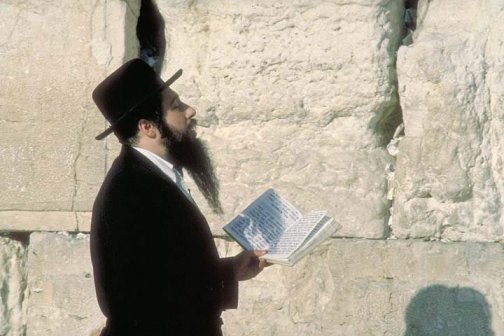
A common critique against Christianity that I run into is that the New Testament promotes a certain degree of antisemitism; that is, a kind of hatred towards the Jews. This may sound strange and offensive to some Christians today, but history has shown us that anti-Jewish statements by supposed followers of Christ, and actual acts of persecution, have indeed tarnished the image of the Christian church. If you have Jewish friends who know about Jewish history, they can probably tell you all about it.

For example, the late Jewish intellectual Richard Rubenstein grew up in New York City. In the mid-20th century, groups of Roman Catholic young people streamed through Jewish neighborhoods after Good Friday Masses yelling “Christ-Killers!” That is pretty intense!

A few other points of evidence stick out in people’s minds:

  1. The Jewish holocaust perpetrated by Nazis during World War II. Germany had a reputation for being a stronghold of Christianity for centuries, yet Adolph Hitler was able to find fertile ground for his poisonous ideas in the early-to-mid 20th century, that led to the murder of 6 million Jewish people. How could that have happened?
  2. The great Protestant Reformer, Martin Luther, who articulated so beautifully the doctrines of salvation by grace, and grace alone, wrote several antisemitic tracts towards the end of his life. For those who have visited the United States Holocaust Museum in Washington, D.C., you will learn that these antisemitic tracts were circulated and read by many across Europe for several centuries. What warped Luther’s otherwise Gospel-saturated mind during the twilight of his life?
  3. Even into the 21st century, some who say that they are followers of Jesus have stirred up controversy over their antisemitic statements. Anti-Jewish prejudice did not simply die off during the Nazi era. It is sadly alive and well today.  I mean, what will Adidas do with $1.3 billion worth of unsold Yeezy shoes??

However, the charges become more poignant when we find certain passages in the New Testament that have what appears to be an anti-Jewish edge to them. Here is one of the most controversial, from the Apostle Paul:

(13) And we also thank God constantly for this, that when you received the word of God, which you heard from us, you accepted it not as the word of men but as what it really is, the word of God, which is at work in you believers. (14) For you, brothers, became imitators of the churches of God in Christ Jesus that are in Judea. For you suffered the same things from your own countrymen as they did from the Jews, (15) who killed both the Lord Jesus and the prophets, and drove us out, and displease God and oppose all mankind (16) by hindering us from speaking to the Gentiles that they might be saved—so as always to fill up the measure of their sins. But wrath has come upon them at last! (1 Thessalonians 2:13-16 ESV)

The language Paul uses is quite strong. So, is the Apostle Paul being antisemitic here?

Paul in prison, by Rembrandt (credit: Wikipedia)


Should We Conclude that the Apostle Paul is Antisemitic? …. Not So Fast

The issue came to mind a number of weeks ago when I was listening to an episode of Mere Fidelity, one of Timothy Keller’s favorite recommended theological podcasts. I am a big enthusiast for Tim Keller, and this particular episode grabbed my attention, because frankly, I have read 1 Thessalonians several times before, but the issue had never crossed my mind.  However, my CSB Apologetics Study Bible had a note about the controversy in it, so it caught my attention. This passage provides a good opportunity to look at out how some very good resources, several of which are freely available on the Internet, can help us study the Scriptures more fruitfully.

In case the gravitas of the difficulty does not hit you, consider the following quote from a 19th century German Bible scholar, Ferdinand Christian Baur:

This passage has a thoroughly un-Pauline stamp. It agrees certainly with the Acts, where it is stated that the Jews in Thessalonica stirred up the heathen against the apostle’s converts, and against himself; yet the comparison is certainly far-fetched between those troubles raised by the Jews and Gentiles conjointly and the persecution of the Christians in Judaea.1

Baur, known to most Bible scholars simply as “F.C. Baur,” was an early champion of the so-called “higher criticism” of the Bible, falling under the broader category of the “historical criticism” of the Bible. One of my first religion classes in college required me to read quite a bit of F.C. Baur’s writings.

Like many other advocates of the tradition of “higher criticism,” Baur was tired of all of the often conflicting and contradictory interpretations foisted upon the Bible, by various denominational traditions, and so he sought to use the principles of scientific investigation, that in the 19th century was beginning to unlock many of the mysteries of the physical sciences, in fields like chemistry and physics, and apply those same kind of principles to the study of the Bible, in hopes of trying to arrive at a scientific interpretation of the Bible. 200 years later, people are still trying to follow F.C. Baur’s example, but with decidedly mixed results.

Despite a number of drawbacks about Baur’s approach, Baur did make some good observations here that are worth noting, namely that Acts 17:13 shows that the believers in nearby Berea had been persecuted by other Jews from Thessalonica:

But when the Jews from Thessalonica learned that the word of God was proclaimed by Paul at Berea also, they came there too, agitating and stirring up the crowds.

The comment about the passage having a “thoroughly un-Pauline stamp ” stems from the evidence that Paul was not antisemitic for several reasons.  First, Paul was Jewish. Christians often forget this simple fact, that has become the topic of considerable debate, as to what the ramifications of this fact suggests. But the main point is that Paul did not throw his entire Jewish tradition away, once he became a Christian.

Secondly, Paul had a tremendous heart for his fellow Jews, that they might come to know Jesus as their Messiah:

I have great sorrow and unceasing anguish in my heart. For I could wish that I myself were accursed and cut off from Christ for the sake of my brothers, my kinsmen according to the flesh. (Romans 9:2-3 ESV)

Far from being antisemitic, Paul grieved that many of his fellow Jews had not yet embraced Jesus as the Christ. If anything, Paul still held to the notion of a type of preeminence that the Jews had with respect to the Gentiles. True, the Gospel was for both Jew and Gentile equally. Nevertheless, the Jew was still first when it came to the Gentile, regarding the order of God’s saving purposes. This did not mean that Jews were somehow better than Gentiles, or that Gentiles were somehow inferior to Jews.

For I am not ashamed of the gospel, for it is the power of God for salvation to everyone who believes, to the Jew first and also to the Greek. For in it the righteousness of God is revealed from faith for faith, as it is written, “The righteous shall live by faith.” (Romans 1:16-17 ESV)

This suggests, for some, the exact opposite of antisemitism, that might be wrongly confused with Paul having actually a lower view of the Gentiles, in comparison to the Jews: Paul evidently believed that God focused on presenting the story of the Gospel through the Jewish people, but why? What makes them so special? Paul speaks of the relationship between the Jews and the Gentiles (non-Jews) in the economy of salvation, in terms of an order, but he frankly admits that this is a “mystery.”

Lest you be wise in your own sight, I do not want you to be unaware of this mystery, brothers: a partial hardening has come upon Israel, until the fullness of the Gentiles has come in (Romans 11:25 ESV)

It is curious that Paul uses the word “mystery” here to describe the order of God’s salvation plan. When I come to things like this, I like to consult the StepBible to dig a little deeper.  For this passage, you can go right to the chapter, Romans 11, and then go down to verse 25 and hover your mouse over the word “mystery,” and it will give you some word analysis of this Greek word, “musterion,” which is “a matter to the knowledge of which initiation is necessary; a secret“. Interestingly, in Saint Jerome’s translation of the Bible, the famous Vulgate, he translated that word into Latin as “sacramentum,” from which we get the English word, “sacrament.”

This word “mystery” is used elsewhere in the New Testament to describe other “mysteries,” such as the picture of Christ’s relationship to the church, which serves as an analogy to help us understand the meaning of marriage (Ephesians 5:32) and God’s overall plan of salvation (Ephesians 3:9). With respect to Paul’s understanding of the relationship between Jew and Gentile, it opens up a deeper way of appreciating Paul’s thought:

There is neither Jew nor Greek, there is neither slave nor free, there is no male and female, for you are all one in Christ Jesus. (Galatians 3:28 ESV).

Is Paul turning his back on his own people, the Jews, in 1 Thessalonians? Veracity investigates the claim, and suggests a better answer.


What To Do with This Passage in 1 Thessalonians? Does it Really Belong Here?

Going back to F.C. Baur, conservative evangelical scholars have taken issue with Baur’s insistence that the comparison is “certainly far-fetched” in associating the persecution of Thessalonian Christians with the persecution of believers in Judea. First, it is important to rightly observe the types of persecution in 1 Thessalonians 2:14 suffered by (a) the Thessalonian believers from their “own countrymen;” that is, Jews in Thessalonica who were not convinced by Paul’s message, and (b) that suffered by the Judean believers from “the Jews.”

Note that this reference to “the Jews” at the end of verse 14 is not about all Jews everywhere and at all times. Rather, Paul’s focus is on the Jews back in Judea, living in and around Jerusalem, who opposed the Christian message about Jesus being the Risen Messiah. This is not an ethnic slur against “all Jews.”

Still, the real sticking point for F.C. Baur comes in the last verse of this perplexing passage.

(14) For you, brothers, became imitators of the churches of God in Christ Jesus that are in Judea. For you suffered the same things from your own countrymen as they did from the Jews, (15) who killed both the Lord Jesus and the prophets, and drove us out, and displease God and oppose all mankind (16) by hindering us from speaking to the Gentiles that they might be saved—so as always to fill up the measure of their sins. But wrath has come upon them at last!

That phrasing of “so as always to fill up the measure of their sins” is harsh enough, but it is puzzling to consider what is meant by the last phrase, “But the wrath has come upon them at last.”

In Baur’s view, Paul’s statement seems over-the-top. Baur argued that this passage was actually an interpolation, a fancy word used by scholars to suggest that someone else added this passage into Paul’s letter, long after Paul had written the letter, so that over the years copyists of the New Testament simply just included the passage into the main body of the text, assuming that this actually came from the pen of Paul.2

Whoops!!! How did that sneak in there??

A fundamental problem with Baur’s hypothesis as that we have no existing manuscripts that indicate these verses were ever left out of the New Testament. It is quite tempting to be drawn to an interpolation hypothesis when you run into verses in the Bible that come across as objectionable. If everyone were to call out verses of the Bible as being “invalid” insertions, simply because they were objectionable, we might end up with a Bible a lot thinner than the one we already have!! Nevertheless, it is worth considering Baur’s further reasoning here.

As evidence for this late addition into the text, Baur argued that this interpolation hypothesis makes sense since relationships between the Jewish and Christian communities were still fairly positive in the early days of the church, at the time Paul had written this letter, roughly about the year 49 C.E.  Despite notable conflict between Christian and traditional Jews, Jews were still coming into the Christian community. However, by the time of the destruction of the Jerusalem temple in 70 C.E., the relationship between Jews and Christians began to strain severely. Decades later, in the time of the Bar Kokhba Revolt in 132 C.E., the flow of Jews into the Christian church practically slowed down to a mere trickle, if not completely stopped.

Many Christians had concluded that the destruction of the Temple was a sign of God’s judgment against the Jews, more broadly speaking. More than any other event in the 1st century C.E., the destruction of the Temple in Jerusalem was the equivalent of America’s 9/11, in the early 21st century, with the destruction of the Twin Towers of the World Trade Center, in New York. The psychological blow to America in many ways echoes the type of negative psychological impact that the Jews felt with respect to the destruction of their central religious site in Jerusalem. Therefore, Baur proposed that the statement of wrath against the Jews, here in 1 Thessalonians, reflected a view held by Christians decades after Paul wrote this letter.

In other words, someone stuck this passage into a copy of 1 Thessalonians in order to give Paul a certain anti-Jewish edge, according to F.C. Baur, and others sympathetic to Baur’s reasoning.

As it turns out, Baur’s interpolation proposal begins to weaken further once you understand other possible factors involved, based on other evidence. That same year that Paul wrote this letter, which many scholars suggest is indeed Paul’s earliest letter, Emperor Claudius had expelled the Jews from the city of Rome. Also that same year, a riot in Jerusalem during Passover led to the death of thousands of Jews. There was also a great famine in Judea in the previous years. Paul probably had one if not more of these events in mind.3

Nevertheless, there are still those who believe that these incidents in 49 C.E. do not necessarily rise to the level of citing God’s wrath in the severe way that Paul does so in this passage. However, a better solution might be to suggest that Paul is making use of typological interpretation to emphasize the point that opposition to the Gospel in Paul’s current day actually points toward a more fulfilling future event.4

In the typological interpretation of Scriptural prophecy, a particular event (or person) in history serves as a “type” of that which is to come, “the real thing,” sometime in the future. The classic use of typological interpretation by Paul can be found in Romans 5:12-14, where Paul speaks of Adam as a “type of the one who was to come,” that is, Christ. Adam is the first Adam, and Jesus is the second Adam. Jesus was able to fulfill the task that Adam failed at doing. The use of typology was a common interpretive method used, not only by the writers of the New Testament, but by other Jewish writers in the period of Second Temple Judaism.

The language of God’s wrath in this passage might indicate that Paul saw that events like the expulsion of Jews from Rome and/or the death of many Jews at Passover in Jerusalem served as a type of judgment against the Jews that anticipated a yet future event of even greater significance, a catastrophe that would have lasting impact on the Jewish community. In this case, the destruction of Jerusalem and its Temple, some 20 years after this letter was written would fit the bill.

This interpretation is reinforced by other translations that suggests that Paul had this typological thinking in mind. BibleGateway.com allows you to see footnotes in various English translations. For the Christian Standard Bible, you can find a note under 1 Thessalonians 2:16 that reads that “and wrath has overtaken them at last” could be better translated as “and wrath has overtaken them to the end,” which more clearly demonstrates Paul’s prophetic insight, linking the current events of his day with God’s coming future judgment.

I can reference a few other resources for those who wish to dive deep into this perplexing passage:

On the weekend when so many Christians in the West ponder the meaning of the death of Jesus on the cross, Christians should always consider that for centuries the ancestors of our Jewish friends have felt the sting of being called “Christ-killers.” Instead of giving into an antisemitic impulse, we as believers today, whether from a Jewish or Gentile background, probably would have championed for the death of Jesus, if we had been among those Jewish leaders who condemned Jesus 2000 years ago.

In summary, the argument that this passage in 1 Thessalonians 2:13-16 is antisemitic, while at first might seem plausible, in its full analysis does not have the full force of the evidence in its favor. Paul is not antisemitic, nor is it warranted to say that this passage was somehow slipped into the letter by later Christians who wanted to make Paul sound anti-Jewish. Instead, it is quite probable that this passage offers a prophetic glimpse into the type of persecution that believers in Jesus will experience, and that such persecutors will eventually have to face accountability for their actions against those who seek to be faithful to the Truth they received as revealed in Jesus. Paul was no more singling out a particular group of Jews than he was pagan opponents who also sought to persecute the early Christian movement. As verse 13 states, Paul is thankful to God “constantly for this, that when you received the word of God, which you heard from us, you accepted it not as the word of men but as what it really is, the word of God, which is at work in you believers.” May that be true of all believers who experience opposition to their faith in Christ.


Notes:

1. Quoted from Peter C. Hodgson, The Formation of Historical Theology (New York, 1966). See The Harvard Theological Review, 1971, Volume 64, No.1, pp.79-94, “1 Thessalonians 2:13-16: A Deutero-Pauline Interpolation” by Birger A. Pearson.  ↩

2. Another example of possible interpolation into Paul’s letters can be found in 1 Corinthians 14:34-35.  See earlier Veracity posting about that passage. ↩

3. See discussion in Charles A. Wanamaker, The Epistles to the Romans,. p. 30. Josephus reports in Antiquities 20.112 and Jewish Wars 2.225 that twenty to thirty thousand people were killed in that riot. Many scholars believe that Josephus’ numbers are inflated, but this is still a major event.  ↩

4. An exploration of how the New Testament writers used the typological method of interpreting prophecy can be found in an earlier Veracity blog post. It is also important to note that the verb in verse 16, “the wrath has come upon them at last,” is in the Greek aorist tense, a past tense, describing an action without indicating whether it is completed, continued, or repeated. This suggests that the events in 49, though in the past, might point yet forward to a future event.   ↩


A Chapel Institute Conversation on Progressive Christianity (Veracity Video Special !!)

My friend and one of my pastors, Hunter Ruch, sat me down after lunch not too long ago to record two sessions for the Williamsburg Community Chapel Institute. The Chapel Institute is a ministry of the Williamsburg Community Chapel, in my hometown, Williamsburg, Virginia.

During this interview, Hunter and I talk about some very important topics. First, we briefly share about another ministry that he and I are very much excited about, the Cambridge House, at the College of William and Mary. The Cambridge House is a Christian Study Center located within walking distance of the College, where I work. Just a week or so before my interview, another friend and new director of the Cambridge House, Jon Thompson, was interviewed by Hunter about what it means to be human. Read more about the Cambridge House here!

After that, in the first session, we launch into a conversation about what is “progressive Christianity“, how it differs from “historic orthodox Christianity,” and some of the history behind the movement, offering a few examples of what “progressive Christianity” might look like in certain expressions of the church. We talk about how the “progressive Christianity” of the 20th century has morphed into the “progressive Christianity” of the 21st century.

In the second session, we drill down on one particular example of “progressive Christianity,” the idea of “Christian universalism,” which contends everyone will ultimately be saved and reconciled to God in the end, through Jesus. At first, ideas like this look attractive, but it can lead to warped understandings of what the Bible actually teaches. It is very sad and disconcerting when certain evangelical influencers drift off in this direction. We wrap up our conversation talking about ways that we can help others who are wrestling with “progressive Christianity,” and trends like “deconstruction,” and how we can avoid drifting into “progressive Christianity” ourselves.

Just a few comments about what you will see and hear. First, Hunter introduced me as the senior networking “director” of IT at the College, which is not accurate. I am more properly a “senior network engineer,” part of a team of IT staff, though my main responsibility is in the area of architecture and design. Secondly, I got a little lost halfway through the second segment, explaining some of the problems associated with “Christian universalism,” but hopefully I got back on track!! Please let me know what you think in the comment section below.


Did Matthew Botch Christmas? (…. Or How World Cup Soccer Helps to Better Understand Bible Prophecy)

It is the season of Advent, which means it is time for critics of Christianity to try to poke holes in the Christmas story, as people scramble to put up what is left of their Christmas decorations, fill their Amazon cart with last minute gifts, and believers in Jesus prepare for the celebration of the Incarnation of the Son of God.

Dr. Bart Ehrman, professor of religious studies at the University of North Carolina at Chapel Hill, New York Times bestseller author, and perhaps the most well-known public skeptic of Christianity, has been making the rounds on various atheist YouTube channels, promoting a new seminar regarding “Other Virgin Births in Antiquity,” just in time for the holidays.

Croatia beats Brazil at the 2022 World Cup, after a dramatic penalty shootout. Do you think penalty shootouts have nothing to teach us about Bible prophecy?…. Think again.

In one particular promotional video, on the atheist Paulogia channel, Paulogia asks Dr. Ehrman to interact with a video by Dr. Michael Heiser, an evangelical expert in Semitic languages, and perhaps my favorite Old Testament scholar. I posted a blog article asking “Is the Virgin Birth Prophecy a Mistranslation?,” back in 2016, which at the end featured the full-length video of Dr. Heiser’s lecture.

In the recent 20-minute video, Paulogia states in the subtitle: “Dr Bart Ehrman joins us to determine if [Dr. Michael Heiser’s] work is scholarly… or just more Christian apologetics.” Of course, this assumes Dr. Ehrman’s work is purely scholarly with no biased apologetics of his own….  NEWSFLASH: Every scholar has their biases, using their own style of apologetics to defend their views, including Bart Ehrman.

However, if you are interested, the recent 20-minute Paulogia interview with Dr. Ehrman, critiquing the Heiser video can be viewed here. You could just read on for now, and come back to it at a later time:


The Virgin Birth Prophecy…. Did Matthew Botch the Whole Thing?

To my knowledge, this is the only YouTube presentation where Dr. Ehrman interacts with Dr. Heiser’s material. I only want to highlight the main controversy here, as it has to do with the famous Virgin Birth prophecy found in Matthew 1:23, which quotes Isaiah 7:14, indicating that the birth of Jesus fulfills this prophecy, made about 700 years earlier.

The English Standard Version (ESV) translation, starting in Matthew 1:22, reads as follows to describe the very first Christmas:

All this took place to fulfill what the Lord had spoken by the prophet:

“Behold, the virgin shall conceive and bear a son,
and they shall call his name Immanuel”

This closely mirrors what the ESV has in Isaiah 7:14. However, compare the same passage in something like the New Revised Standard Version, Updated Edition (NRSVue), for Isaiah 7:14:

Therefore the Lord himself will give you a sign. Look, the young woman is with child and shall bear a son and shall name him Immanuel.

The highlighted portion demonstrates the controversy. Both Dr. Ehrman and Dr. Heiser agree that the NRSVue rendering is the accurate translation of the original Hebrew. The Hebrew has the word “almah,” which generally means “young woman,” or “young maiden.” However, these two scholars then begin to differ.

Bart Ehrman argues that treating the Hebrew word “almah” to mean “virgin” is a mistranslation. The Septuagint, the Greek translation of the Hebrew Bible, produced a few centuries before Jesus, by a group of Jewish scholars near Alexandria, Egypt, then carried this “mistranslation” into that Greek text, which Matthew borrows and places in his Gospel.

Michael Heiser argues otherwise. For the term “almah” is actually a rather ambiguous word in the Hebrew lexicon. Yes, it does generally mean “young woman.” However, an “almah” might also be considered to be a “virgin,” depending on the context. The concept of “virgin” is more restrictive, in the sense that it could refer to a “young woman” who has not yet experienced sexual relations. In other words, you simply can not rule out the idea that “almah” could mean “virgin.”

What the Paulogia video neglects to tell viewers is that there is a clear instance in the Bible when “almah” does mean “virgin,” a translation which Dr. Heiser explains in a separate article, that I will summarize here: In Song of Songs 6:8, the ESV reads:

There are sixty queens and eighty concubines,
    and virgins without number.

This verse is talking about the women in the king’s harem, where the Scripture writer delineates three different classes of women. You can ignore the obvious moral difficulty of a king having a number of women at his disposal to focus on these three classes. A “queen” would be a wife of the king. A “concubine” would be a “secondary wife” or “slave woman.”  That last category, “virgin” corresponds to that Hebrew word “almah,” for reasons that the Orthodox Jewish Bible gives in a footnote:

….the word means explicitly or implicitly “virgin” and where “young woman” is not an adequate rendering, in this case, since the King was hardly interested in only young women in his harem, but demanded “virgins”; the older Jewish translations like Harkavy’s so translated the word as “virgin” in this verse until it became politically incorrect to do so in later, more liberal Jewish translations into English].

I like to use the online StepBible as a great tool for exploring such a word study, as in how the Hebrew word “almah” is translated throughout the whole Bible, to see this for myself. While Matthew’s method of Old Testament prophecy interpretation may sound weird to us, he was far from being careless or clumsy.

…..So much for Dr. Ehrman’s critique against Dr. Heiser on this point….

The Flight Into Egypt, by Vittore Carpacccio (1466-1525). Based on Matthew’s interpretation of prophecy in Hosea being fulfilled through his Virgin Birth narrative. The Gospel of Matthew takes a lot of heat from critics who think that Matthew was “making things up” as prophecy fulfillment in his Virgin Birth narrative. In this blog we tackle one of those criticisms, namely Matthew’s use of Isaiah 7:14 to announce the Virgin Birth.


On the Nature of Bible Prophecy: Why the “300+ Prophecies of Jesus” Can Be Misleading

Nevertheless, it is important to recognize that Bart Ehrman does raise an important issue that is often neglected: There is a specific Hebrew word for “virgin” found in the Old Testament: “betulah.” If the prophet Isaiah really meant “virgin” to be the word here in Isaiah 7:14, why did he choose the ambiguous word “almah” and not the more specific word “betulah?”

To answer that question you have to think more deeply about the nature of biblical prophecy. Both Dr. Heiser and Dr. Ehrman agree in the video that it would have been completely absurd for Isaiah to have one and only one meaning in mind regarding Isaiah 7:14, looking hundreds of years into the future, simply based on the original context of the passage.

A closer look at the whole chapter, in Isaiah 7, demonstrates what is going on. In the 8th century B.C.E., King Ahaz of Judah is being threatened by two kings from the land to the north. Verse 2 even says that Ahaz was “shaking” in fear. Would the God of Israel deliver Ahaz from this military threat?

Ahaz says that he will not test the Lord in this moment, but the prophet Isaiah is not buying into Ahaz’s fake piety. Isaiah then makes his famous prophecy, but then in verses 15-16, Isaiah says that before the promised child is old enough to know the difference between right and wrong, those two northern kings will no longer be a threat to Ahaz.

Just think about it. If Isaiah was only prophesying the coming of Jesus, would that have really made any sense to Ahaz? Imagine such a conversation that Isaiah would have had with Ahaz, if this indeed was the case:

“King Ahaz!  I have great news for you. Seven hundred years from now, a child will be born, and before that child reaches an age of moral maturity, those two kings that are causing you to shake in your boots now will no longer be a threat to you!”

Huh???

What type of comfort would that really give to Ahaz? He would be long dead before the prophecy would have any meaning for him.

Unfortunately, there are many Christians who never really think about this problem at all…. and it is a real problem. I had been a Christian for nearly several decades before I realized that this was indeed a problem. It does not help that there are a handful of evangelical scholars who perpetuate this idea that Isaiah 7:14 is solely a messianic prophecy, whose only purpose is to predict the coming of Jesus, at the first Christmas, nearly 700 years after Isaiah and Ahaz were living.

I presume they mean well, but I do not understand the full thinking process used by such scholars who promote this “single messianic prophecy” view. Assigning a prophecy to have a purely future, single meaning to it is attractive, in that it is simple to understand: Isaiah predicts the birth of Jesus… end of story.

But it comes across as a kind of wishful thinking approach to biblical prophecy. While there is not anything necessarily harmful in wanting something to be true, it becomes a serious problem when the evidence is either completely lacking or leads to nonsense, or far worse, the available evidence contradicts with the proposition that we want to believe to be true.

Many Christians familiar with at least some form of Christian apologetics are often told that at least some 300 prophecies in the Old Testament have been fulfilled by Jesus. In fact, several friends of mine have told me that they became believers in Jesus because of those 300+ prophecies. Understandably, many Christians want to see how Jesus fulfills centuries of Old Testament prophecies, hundreds of years into the future. But the story is more complicated than what you get in a typical Sunday morning sermon, particular during the season of Advent…. and frankly, the story is far more rich and profound.

Many imagine Jesus was probably walking around at some point in his life with clipboard underneath his tunic, checking off things to make sure they were being fulfilled: “Born in Bethlehem…. CHECK…. Born of a Virgin…. CHECK…. Avoiding the wrath of Herod by escaping to Egypt with Joseph and Mary and then returning…. GOT THAT, TOO!”

Well, it just is not that simple. While there are some prophecies that have a single, direct fulfillment in view, such as most probably with Micah 5:2’s prediction that the Messiah would be born in Bethlehem, the weight of the evidence overall points to something more nuanced.

More often than not, both Second Temple-period Jewish and early Christian interpreters used a particular form of Bible interpretation to understand how prophecy works: typology. A typological interpretation of prophecy suggests that there is a “type” or pattern of prophecy fulfillment or partial fulfillment that anticipates a later, full fulfillment of the prophecy, or the “real thing” being prophesied. Some scholars refer to this as a “double-fulfillment” view of prophecy, but the terminology of “typology” is a theologically richer way of thinking about it.

Perhaps the best example is in Roman 5:14, when the Apostle Paul describes Adam as the type of the one who was to come, namely Jesus. In this example, Adam is the “type” while Jesus is the “real thing.” Or to put it another way, Jesus is the “Second Adam.” The curious thing about a lot of typology is that it is typically not that easy to figure out how a particular statement in the Old Testament anticipates its New Testament fulfillment, just by reading the Old Testament itself.

Most Jews today associate Isaiah 7:14 with a more near-term fulfillment of the prophecy, namely in the birth of Ahaz’ son, Hezekiah, the future king who would live beyond the deaths of those two northern kings who threatened Ahaz. When the Jew Trypho had his famous 2nd century C.E. debate with the Christian apologist Justin Martyr, Trypho made the case that Isaiah 7:14 prophesied the coming of Hezekiah, whereas Justin argued that it was Jesus who was prophesied.

However, many scholars have since argued that the prophesy initially referred to the birth of Isaiah’s own son, described in Isaiah 8, who actually receives the name of “Immanuel” in Isaiah 8:8-10.

Furthermore, there is nothing specific in the Old Testament that links Isaiah 7:14 to any particular, future messianic expectation. Also, we have no demonstrable pre-Christian Jewish texts after Isaiah that associate Isaiah 7:14 with a future coming Messiah, according to Beale and Carson’s Commentary on the New Testament Use of the Old Testament. 

However, when the Septuagint translators translated “young woman” into “virgin,” this might indeed suggest that at least some Jews eventually began to think that there was something more to the Isaiah 7:14 prophecy, as a future son having some type of supernatural conception, centuries beyond the days of Isaiah, Ahaz, or Hezekiah. It is difficult to know for sure.

Nevertheless, Matthew in the New Testament ultimately settles the matter by linking the “virgin” to Jesus’ mother, Mary. For in Matthew’s mind, Jesus does more than simply deliver two northern kings from threatening King Ahaz, back around the 8th century B.CE. Instead, Jesus delivers the whole world from the deadly grip of sin, from Satan, and other powers of darkness.

World Cup 2022 Penalty Shootouts : a match of wits and skill.


The Cryptic Nature of Bible Prophecy: A Lesson from World Cup Soccer

Back to the discussion by Bart Ehrman that raises an important question: Why so cryptic?

Why is it that the prophecy in Isaiah 7:14 is so ambiguous? If the whole point of Isaiah 7:14 was to point to Jesus, why did Isaiah not settle the matter himself and use the word “betulah” to describe the mother of the promised child?

The answer is found here: … think about World Cup penalty shootouts.

As I am writing this, the 2022 FIFA World Cup tournament in Qatar is wrapping up. Once you get into the semi-final and final rounds, games where the score is tied is settled by a penalty shootout. Each team brings up a shooter against the other team’s goalie. The standoff is almost all mental. Both the shooter and the goalie has to somehow anticipate what the other is going to do. Will the shooter feign a shot to the right, when the shot is really meant to go into the left side of the goal? Will the goalkeeper dive to his right, anticipating that the shooter will try to put the ball in that side of the net? Will the shot come low and straight-on, or will it go high and up to a corner?

It is all a battle of wits and skill, trying to read what the other player plans on doing.

In other words, the key to success in a penalty shootout in the World Cup is in trying to be as cryptic as possible, regarding what one intends to do.

The lesson of World Cup penalty shootout strategy can help us to understand why Bible prophecy is so cryptic: The key to understanding it is not by saying that Isaiah 7:14 was mistranslated, or that Matthew misused Isaiah’s prophesy. Instead, it is to recognize that the cryptic nature of the prophecy was cryptic by design. It was not some “mistake” that crept into our Bibles, sneaking under the radar of the early church fathers who affirmed the New Testament canon of Scripture. Instead, Matthew does what he does on purpose, to make a theological point. The Apostle Paul explains why this was the case in 1 Corinthians 2:6-10 (ESV):

Yet among the mature we do impart wisdom, although it is not a wisdom of this age or of the rulers of this age, who are doomed to pass away. But we impart a secret and hidden wisdom of God, which God decreed before the ages for our glory. None of the rulers of this age understood this, for if they had, they would not have crucified the Lord of glory. But, as it is written,

“What no eye has seen, nor ear heard,
    nor the heart of man imagined,
what God has prepared for those who love him”—

these things God has revealed to us through the Spirit. For the Spirit searches everything, even the depths of God.

The big clue here is the meaning of “the rulers of this age.” Some suggest that these are political rulers in Paul’s day, but Paul is thinking of a bigger, supernatural picture here. In Michael Heiser’s The Unseen Realm these “rulers of this age” are supernatural beings that seek to challenge the authority of the God of Israel, and who wish to derail God’s program to reveal the messiah to the world through the person of Jesus of Nazareth (Kindle location 2134).

In order to thwart these dark powers who wish to thwart the one True God’s plan to bring about the redemption of humanity, God veils his plan in the Old Testament to reveal Jesus as the Christ in such a way that these “rulers of this age” would not be able to figure out what God was up to, until after the fact. By then, the “rulers of this age” would be powerless and too late to stop God’s redemption plan. The only way you would then be able to discern what God was doing was through hindsight.  This was what Matthew was doing by understanding in hindsight what the prophet Isaiah was getting at with Isaiah 7:14, whether Isaiah himself was fully aware of this added typological dimension or not.

In other words, the powers of darkness thought that God would strike the ball hard and low to the right side of the net, but instead, God feigned a move and then cranked the ball into the upper left hand side of the net.

Game over.

While this way of interpreting Isaiah 7:14 may not be as exhilarating as the “single messianic prophecy” view propagated by some Christians, it is still a defensible position to hold, given the available evidence. The “single messianic prophecy” view faces the onslaught of critics, like a Bart Ehrman, who can tear down such a indefensible thesis into shreds, which he manages to do in the Paulogia video.

On the other hand, a more nuanced, typological reading of Isaiah 7:14 is supported by the weight of evidence that undergirds it, and it can withstand the volley of criticisms  that skeptics might throw against it. Plus, it makes sense of the broader contour of the Bible’s story, of how God has sought to reveal his plan of redemption through the history of Israel, despite the opposition of the powers of darkness.

SO… back to the question in this blog article title, “Did Matthew Botch Christmas?” Hopefully the case has been made that the answer is “NO.”

At Christmas, the light of Christ breaks through the darkness to show to a hopeless world that there is still hope, and that Jesus himself is the living incarnate expression of that very hope.  The powers of darkness, intent on destroying God’s plan, were caught off guard, unaware of the deeper reality of God’s plan of redemption. Recipients of God’s mercy and grace instead benefit from that Good News. With that truth in mind, we have a wonderful reason to celebrate a Merry Christmas!

If you want a deep dive look at this, consider Dr. Michael Heiser’s full presentation regarding Isaiah’s Virgin Birth prophesy, as opposed to Paulogia’s heavily edited version with Bart Ehrman above. While I am not saying that the truth of Christianity rises and falls on the Virgin Birth story, I am saying that Christianity makes more sense with the Virgin Birth than without it. For that reason, I would consider the Virgin Birth to be an essential doctrine of the Christian faith, a hallmark of orthodox faith and belief. However, I would also add that Christians should learn that there are defensible ways of upholding the Virgin Birth, that we should consider, and let go of certain wishful thinking fantasies that simply can not be defended…… But before you check out the Dr. Heiser video, you can re-live the moment when Argentina beat the defending champions, France, in a World Cup penalty shootout in the 2022 Final!


Oberammergau – The Passion Play

My wife and I originally planned to spend our 20th wedding anniversary a year early by taking a trip to Europe to view the Passion Play in Oberammergau, in southern Germany. COVID delayed all of those plans, but we were able to go this year when the Passion Play was rescheduled for 2022.

I learned about Oberammergau from my mom’s cousin, Lee Southard, who went to see the Passion Play when it was presented in 2010.  He told me that we should definitely make an effort to go see it. Lee was right.

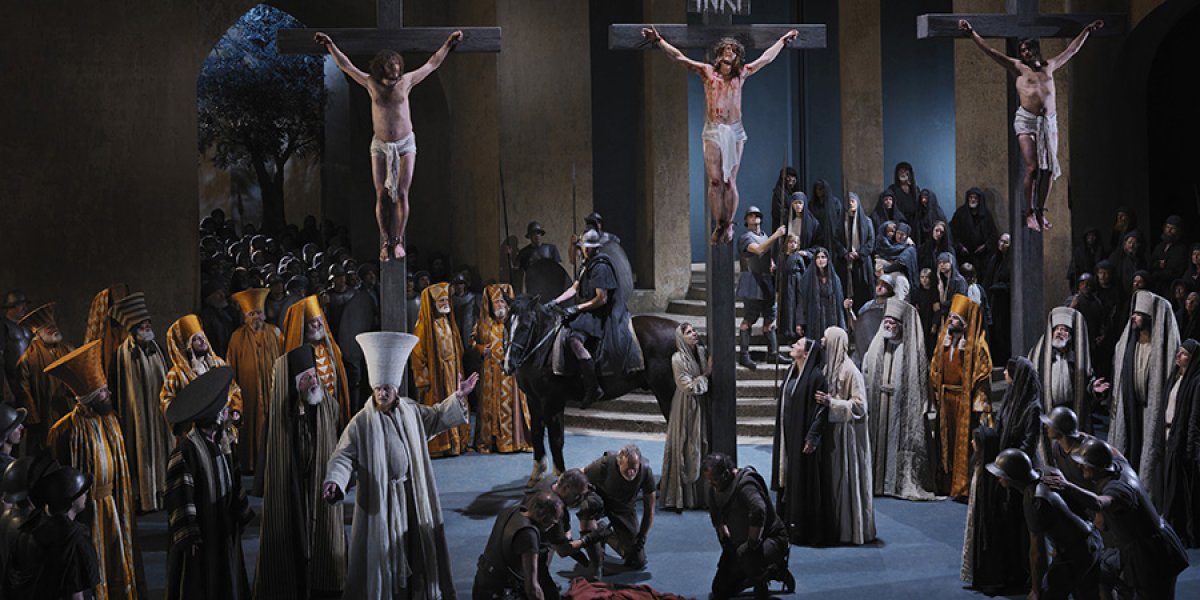
The Oberammergau production does not allow photography during the performance, so I got this from their website. The Passion Play, performed once every ten years in Oberammergau, southern Germany, is an incredibly moving experience.

As the legendary story goes, the Thirty Years War (1618-1648) devastated the whole of continental Europe. Originally, the Thirty Years War had its genesis in the conflict between Roman Catholicism and Protestantism (a topic which I will cover in a future blog post). During that period, armies criss-crossed Central Europe in an attempt to redefine national boundaries, at least originally along theological commitment lines, though it got more complicated as time wore on. But along with these armies came the plague.

In 1633, the plague finally struck the small village of Oberammergau, nestled in the foothills of the southern Germany’s Alps. Half of the village’s population, about 81, died within about a month. The fathers of the village vowed that if God would spare the town further deaths that they would put on a “Passion Play,” retelling the last week of Jesus’ life, once every 10 years, as long as the town would endure.

From that moment on, there was no more death from the plague in Oberammergau.

Passion plays have been part of European history for a long time, but what makes Oberammergau unique is how these townspeople kept this pledge. Despite some fudgy-ness with the above details, Obermmergau kept their pledge, by ultimately settling on performing the play once every decadal year. Only a few times, such as around World War I and II, did they miss or delay their performance. When COVID hit in early 2020, they postponed the play until 2022. Other than that, once a decade, you can visit Oberammergau and witness the performance. Thousands travel from all over the world to see the play.


Oberammergau is a small town in Bavaria, Southern Germany, with a big name. Thousands come every ten years for the Passion Play (My wife is standing off in the corner, to the right)


You have to be a resident of Oberammergau to perform in the play, which means that nearly everyone is an amateur… hundreds of them! Plus, there are live animals going across the stage (including camels!!), and everyone wears long hair, with terrific costuming. The play is 5-hours in length, with a dinner intermission in the late afternoon. But the familiar story is so gripping the way it is presented, it does not feel like you are there quite that long. It helped to have an English copy of the script in hand, as all of the dialogue is in German.

My wife and I caught the last weekend of the performance in early October, and as the theater is open air, it got pretty cold. I got a head cold that very night as a result. This was the first stop on a Viking tour that she and I took, that concluded with an 8-day cruise down the Danube from Regensburg to Budapest (more blogs articles on that to come!).

The most controversial part of the play is the history surrounding how anti-semitism made its way into the play script over the centuries. Adolf Hitler saw the play and loved it when it was performed in the off year of 1934, so that might tell you something. Hitler’s review went like this: “It is vital that the Passion Play be continued at Oberammergau; for never has the menace of Jewry been so convincingly portrayed as in this presentation of what happened in the times of the Romans.” 

Yikes.

Not too long after Vatican II, the Roman Catholic Church called for changes to be made to the Passion Play. A new young director, Christian Stückl, in 1986 assumed the task of revising the script, that had remained largely unchanged since the early 19th century. Over the past thirty years or so, efforts have been made to rid the story of anti-semitic elements not found in the Gospels, and I think they did a very good job in doing so. The current version makes it clear that while the Jewish leadership, symbolized by the office of the Jewish High Priest, engineered the fate of Jesus, it was the Roman government, through the office of Pontius Pilate who possessed the actual power to crucify in first-century Judea.

The most challenging and frankly refreshing interpretation for me was in the portrayal of Judas Iscariot. In the Oberammergau interpretation, Judas is contrasted with Peter a lot. Peter comes off like you would think he would, someone who has great confidence in Jesus, but then who shamefully denies Jesus when things get tough, three times.

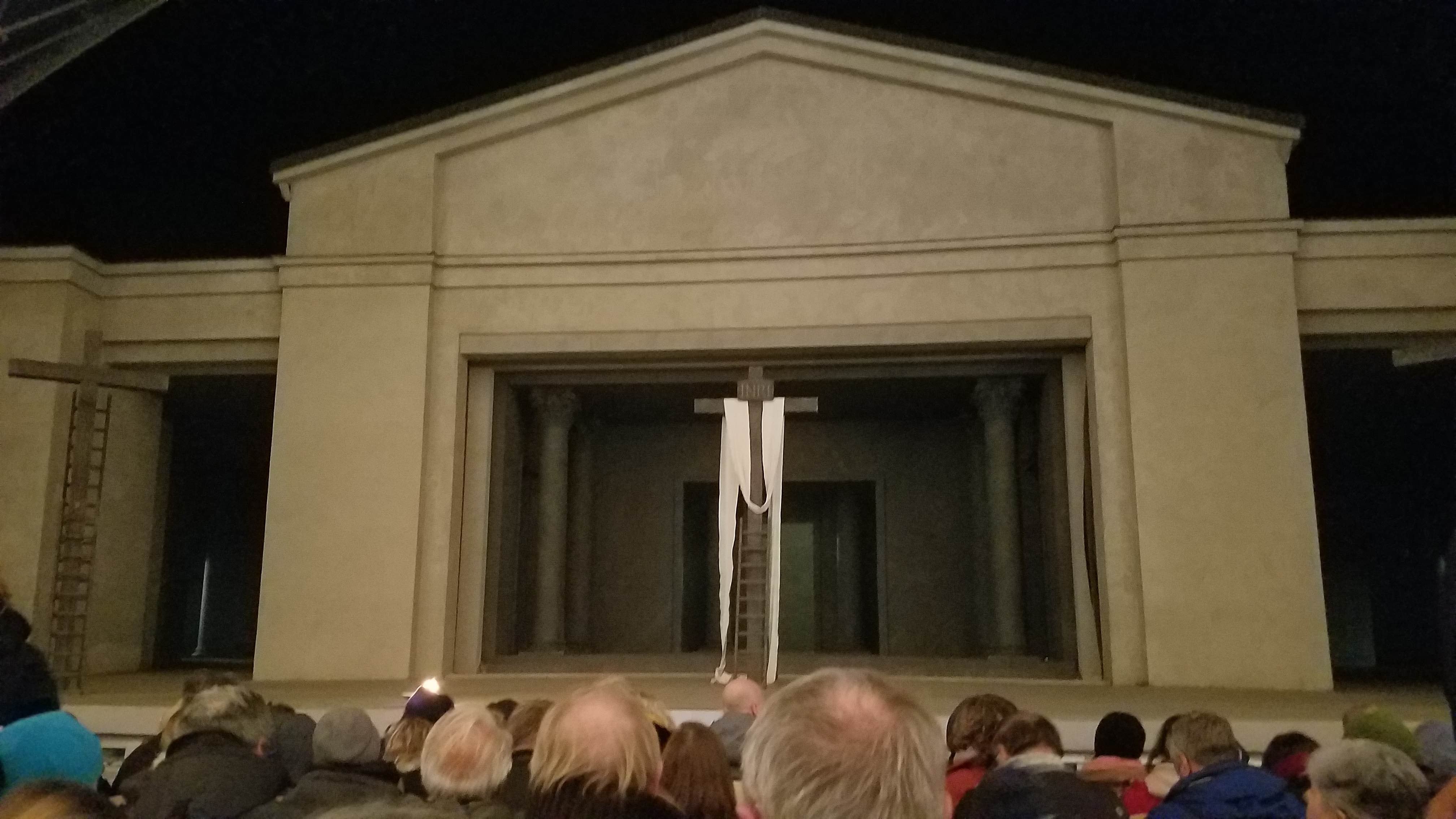
The Oberammergau stage prior to the beginning of the performance, around 2pm. It was a rainy, cold afternoon, so I am glad that the open-air theater had a roof!

Judas, however, comes across differently than I had thought of him before, but I think Oberammergau got it right. Judas is portrayed as a Zealot, who was trying to force Jesus to reveal himself as the militant Messiah, ready to pick up the Davidic banner and exert his Kingship and kick the Romans out of Palestine. Judas goes to the Jewish leadership, looking for a way to force Jesus to act, by pointing out Jesus in the Garden of Gethsemane. But when Jesus fails to act and it looks like execution lies ahead for Jesus, Judas realizes that he had made a huge mistake. Judas confronts the High Priest, Caiaphas, for deceiving him, but the damage was already done. Judas cannot forgive himself, and rejects the offer of silver pieces from the Jewish leadership as irrelevant in his struggle with guilt. Instead of coming across like the Devil, Judas instead looks like a disillusioned revolutionary, who eventually commits suicide in his shame.

A lot of invented characters carry the plot along, along with additional plot elements to tie the story together. Advisors to Caiaphas, the High Priest, have dialogues that show the precarious situation that the Jewish leadership was in. Jesus had to be stopped for if Jesus did reveal himself as the full-blown military Messiah, then surely the Roman government would come in and crush the Jews, including their leadership. Faced between the alternatives of having Jerusalem destroyed by the Romans (which ultimately happened in 70 A.D., anyway), versus derailing Jesus’ public ministry, Caiaphas felt he had no other choice but the latter.

At the crucifixion, Mary cradles the dead Jesus, a tip towards Roman Catholic theology regarding Mary.

As a break between scenes, a choir came out, supplemented by a great orchestra, and different still scenes from the Old Testament were displayed and described in song, that really helped to frame the story of Christ’s Passion. The banishment of Adam and Eve from the Garden, the story of Cain and Abel, and various scenes from the Exodus with Moses really stood out for me.

About 10:30pm at night, the drama of the Passion Play comes to a close. The stage is left with the empty cross.

In a surprise twist at the end, the Passion Play does not give us a Resurrected visit from Jesus. The play basically follows the brief outline given by the Gospel of Mark, which has no appearance of the Resurrected Jesus, only an Empty Tomb (unless you read from a King James Version Bible). Once Jesus is buried after the Crucifixion, we never see Jesus again, and yet the message of the angel at the tomb gives the women hope and confidence that Jesus is indeed alive. Just like modern interpretations of the passion, like the musicals Jesus Christ Superstar and Godspell, the Bodily Resurrection of Jesus is never presented in visible form.

The evangelical theological convictions in me finds this to be immensely disappointing, since without a Resurrection appearance, the whole story misses the whole point. Though one could argue that it would be difficult to do justice in making some believable Resurrection appearance work in a live stage production, without it feeling a bit hokey. About a month before we were in Oberammergau, New Testament theologian Ben Witherington saw the play and walked away with a similar perspective.

Aside from that, the whole production was great. The dinner meal was a total bonus as well. Plus, my wife and I had great seats! Just a few rows from the front, and we could see everything. So glad we did this! Your next chance will be in 2030.

MORE BLOG POSTS IN THIS SERIES:

  • Prague’s Jan Hus: The Reformation Before Luther. Towards the end of our trip in Europe, we spent a few days in Prague, the home city for Jan Hus, the most prominent forerunner of the Protestant Reformation.
  • Defenestration of Prague & the Thirty Years War. The Thirty Years War of the first half of the 17th century devastated Europe. The amount of destruction to impact Europe would only be rivaled by the Napoleonic Wars of the 19th century, and the two World Wars of the 20th century. Sadly, what started it all was the conflict between Roman Catholicism and Protestantism…. and it all began in Prague, Czech Republic.