Category Archives: Apologetics

Can We Still Believe the Bible? A Review

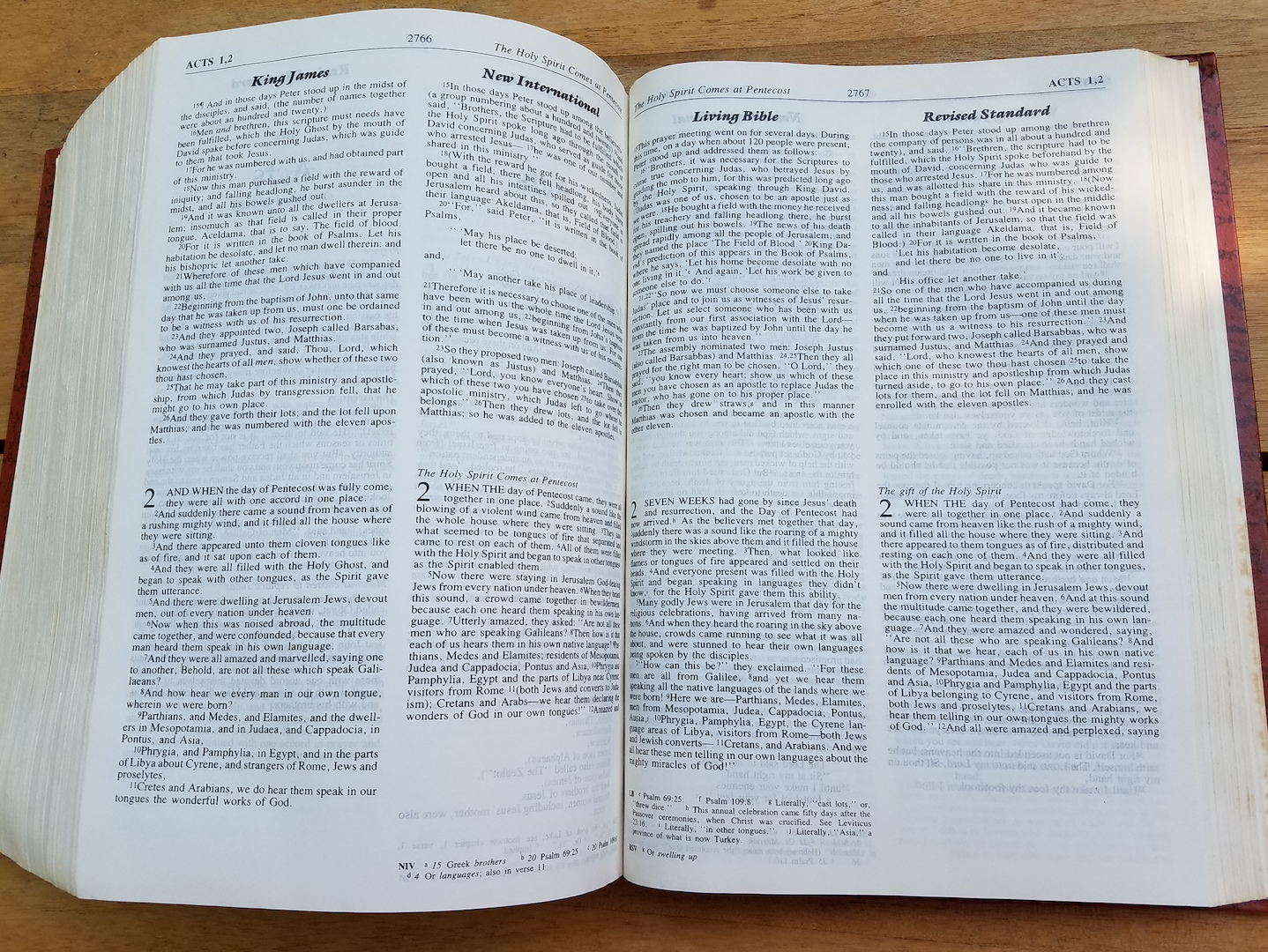
How can a 1962 film classic about the Korean War, help to teach us about  believing the Bible to be true?

This may sound like an odd way of introducing a book review, but hang with me….

In his 1959 novel, The Manchurian Candidate, Richard Cordon writes about an American serviceman, captured during the Korean War, who was brainwashed by the Communists. This former POW, and son of a prominent U.S. politician, was being manipulated to try to assassinate a U.S. Presidential candidate. The story was originally put to film in 1962, a classic starring Frank Sinatra.

Though fictional, The Manchurian Candidate was based on news reports of American soldiers, who were captured as Prisoners of War (POWs), but who refused to repatriate back to the United States, once a truce was agreed upon by both the United Nations and North Korea. Out of nearly 3,500 returning POWs, 23 Americans had chosen to stay in North Korea. Why did these 23 servicemen, in the latter category, defect?

In the 1970s, a study was done to try to learn why these Americans refused to come home, after the fighting had ceased. It was discovered that nearly all of these American defectors came from one, single United States military training camp. In that particular training camp, the military indoctrination trainers were teaching the troops that the North Koreans were evil to the core, that the North Koreans all hated Americans, and that they could not be trusted for anything. The experience in that camp was in contrast to the vast numbers of American POWs, who received either no indoctrination training, prior to capture, or whose indoctrination materials were more moderate in their description of the North Koreans.

According to author Peter Boghossian, in his How To Have Impossible Conversations, the research demonstrated, that when the captured American servicemen were actually treated with kindness and compassion, by their North Korean captors, the American POWs from the hardline indoctrination camp were far more likely to defect to North Korea, than were the vast majority of American POWs who returned to the U.S., who received either no indoctrination, or whose training was less extreme.

I call the defection of those American soldiers, to the Communists, an example of the “Manchurian Candidate Effect.”
Can We Still Believe the Bible? New Testament scholar Craig Blomberg says “YES!”

The Danger of Misrepresenting the Beliefs Held By Others, Who Do Not Exactly Hold Your Own Convictions about Christian Faith

In my years of doing Christian youth ministry, I have seen this scenario sadly played out multiple times: A worried Christian parent would tell me that they were fearful that their son or daughter was in danger of walking away from the faith, in which they were taught. In many of these cases, the parent’s concern was genuine, as harmful influences were indeed tugging away at the young person’s fidelity to their parent’s faith.

But every now and then, upon closer inspection, I would learn that the parent was teaching their kids ideas that misrepresented the character and/or beliefs of their child’s non-Christian, non-believing influencers. In some cases, such misrepresentations were even of other Christians, who were still orthodox in their Christian beliefs, but who held to particular views that were still out of step with what the parents believed.

Yet when the child began to learn that their agnostic, atheistic, etc. teacher, coach, or new friend, truly cared for them, and did not fit in with the caricature painted by their parent, this would inevitably raise questions in the mind of that child. The child would learn that not all atheists desperately hate God, or that their new sports teammate, from a Muslim home, was really a nice person, and not the terrorist that their parents imagined them to be. When that happened, the wayward child’s fidelity to their parent’s faith would begin to unravel. They would begin to wonder if their parents had mislead them about other, more fundamental teachings about the Christian faith, a form of doubt that would put their commitment to Christ in jeopardy.

Invariably, such misperceptions would also apply to other Christians, who might have read the Bible slightly differently from the child’s parents. For example, if the wayward child had a Christian friend, who adopted a different view of the age of the earth, or the historicity of the Book of Job, than that being taught by the child’s parents, the orthodoxy of the friend’s faith was viewed with grave suspicion, when in fact, the fundamental orthodoxy of the friend’s faith was never seriously in question. Again, like pulling a thread out of a nicely knit sweater, the complex structure of a rigid form of Christian belief would start to fall apart. This is the “Manchurian Candidate Effect” in motion.

At the same time, it is true that the forces that tug away at undermining Christian belief are constantly at work, and they do creep in and influence the church. Having discernment as to what properly constitutes those negative influences is essential. But like the hardline indoctrination received by those American defectors to North Korea, it is counterproductive to demonize other people in ways that completely misrepresent them.

There is no surefire way to prevent a child from abandoning the faith. No magic formula will guarantee that a child will adopt the faith of their parents. The obstacles to maintaining an orthodox view of Christian faith are extremely difficult, in a culture that is constantly bombarding believers with alternative messages. Biblical illiteracy is at an all-time high, even in many otherwise solid evangelical churches, and the attacks on Christianity, within the wider culture, only make the task of Christian discipleship all the more difficult.

Prayer is the key to see the Holy Spirit at work, but it is also deserving to have a fair look at why critics of the Christian Bible hold the positions that they do. A Christian can offer a reasonable defense, to such criticisms, without sticking one’s head into the sand.

What are the Top Questions that Critics Have About the Christian Bible?

Why is it that so many people today conclude that they can not believe the Bible? In the age of the Internet, social media, and the skepticism of popular scholars, like Bart Ehrman, such issues are unavoidable. I know that many of my Christian friends are not interested in these matters, but as I work on a college campus, I run into these type of issues, almost on a daily basis.

Here are some of the top questions that many are asking today:

  • Are not the copies of the Bible hopelessly corrupt?
  • Was not the selection of books for canon just political?
  • Can we trust any of translations of the Bible?
  • Do not the issues rule out biblical inerrancy?
  • Are not several narrative genres of the Bible unhistorical?
  • Do not all the miracles make the Bible mythical?

It is within the context of these questions about the Bible that Craig Blomberg’s Can We Still Believe the Bible?: An Evangelical Engagement with Contemporary Questions is a valuable resource for encouraging Christians to have a greater confidence in the Bible, as truly being the reliable Word of God. I bought this book at an apologetics conference five years ago, and I finally made my way through it just recently. In an age where godly, Scriptural discernment and responsible scholarship is sadly lacking in many corners of the church, Blomberg’s work is like a breath of fresh air and clarity, providing sound answers to all of the above questions.
Craig Blomberg is a professor of New Testament at Denver Seminary. For those readers unfamiliar with Blomberg, but perhaps familiar with the more well-known writings of Timothy Keller, it is helpful to know that Craig Blomberg is the “go-to” source for all of Timothy Keller’s research on the reliability of the New Testament documents.

There are a lot of areas where one could focus on the Bible’s trustworthiness, such as the Bible’s relationship to science, or the moral teachings of the Bible. But in Can We Still Believe the Bible?, Craig Blomberg focuses his attention on the six questions highlighted above. The passion out of which Blomberg writes is to defend the Bible against unbelieving critics, who would completely reject the trustworthiness and inerrancy of the Bible. We live in an age of relentless skepticism, and Craig Blomberg suggests that there are still good reasons to believe the Bible. Yet Blomberg finds dangers on the other side, advanced by those who contend for hyper-conservative views of the Bible, mischaracterizing more moderate voices, even to the point of labeling such moderate positions as “liberal” or “compromising.”

For example, some critics, like the famous agnostic Bart Ehrman, say that the New Testament we have today is made up of copies of copies, of copies, of copies, of copies, of copies, of original documents, that are completely lost to us today. This claim suggests that we simply have no reliable way to get back to the original New Testament documents, with the manuscript data we currently possess, making our degree of confidence in our English Bibles extremely low. Skeptical voices, like Bart Ehrman’s, dominate today’s media outlets, and percolates down to social media. But Blomberg demonstrates that such pessimism about the Bible is not the case. The plethora of New Testament manuscripts, available to scholars today, instead reveals an embarrassment of riches, demonstrating that we really can get back to the original writings, of say, Paul or Luke, with a very high degree of probability.

Likewise, on the hyper-conservative side, many King-James-Only (KJV) advocates strongly assert that modern Bible translations can not be trusted, as they are based on the false premise that the original Greek text, behind the New Testament of the older KJV translation, represents a more recent tradition, as opposed to an earlier tradition of reliable manuscript data. By misrepresenting modern Bible translations, this claim introduces a different form of doubt, in the minds of some Christians, who wonder if they can really trust their modern English translation. While such hyper-conservative arguments may succeed at keeping certain Christians within the KJV-Only fold, they may also trigger the “Manchurian Candidate Effect,” leading other Christians to distrust ALL Bible translations, and waver in their faith.

Again, Blomberg successfully shows how modern translations in no way take away from the fundamental teachings of Christian doctrine, such as the deity of Christ. In other words, if you use the ESV, or English Standard Version of the Bible, it is not the “English Satanic Version” of the Bible, as so many KJV-Only proponents claim. But rather, it is the result of years of faithful research into understanding how God has preserved the essential reliability of His Word, across the centuries.

Appreciating the Diversity of Literary Genre in the Bible

Perhaps the most contentious area that Blomberg addresses concerns the question of whether or not certain biblical narratives are historical. But Blomberg discusses the use of how different literary genres are employed throughout Scripture, even within otherwise primarily historical narratives, such as the Gospels. In particular, Blomberg argues that the trustworthiness of Scripture needs to be defined within the standards of antiquity, when the text was actually written, as opposed to arbitrarily imposing contemporary, 21st century standards upon the text.

Most Christian know that the parables told by Jesus are fictional in nature. Jesus actually, historically told these parables, but the parables themselves appeal to metaphor, and not observable history, to make their theological points. But are there other cases, where a mixture of literary genre exists within an otherwise historical narrative?

For example, is the story of the Rich Man and Lazarus, in Luke 16:19-31, to be considered as purely historical narrative? Since this is the only story told by Jesus, whereby Jesus gives names to the main characters, Lazarus and Abraham, in describing the afterlife, some contend that Jesus is describing a historical event, assuming a type of human eyewitness perspective. In other words, advocates of this view believe that Lazarus was a real, historical person who died, sometime before Jesus told this story to his followers, and Jesus is describing Lazarus’s experience in the afterlife, with the Rich Man, from the eye-witness perspective of sometime living in that afterlife world.

But since this story follows immediately after Jesus is telling his disciples three unambiguous parables, that are understood to be fictional, it is overwhelmingly likely that the Rich Man and Lazarus story is also a fictional account, designed to teach profound theological truth, just as the parables are designed to do.

Does the type of literary genre being used here by Luke in any way compromise the doctrine of biblical inerrancy? Craig Blomberg makes the most persuasive case that the answer is surely, “NO.” These are matters having to deal with the correct means of biblical interpretation, and they do not impinge on the trustworthiness of Scripture itself. Blomberg defends a more nuanced approach to the inerrancy of the Bible, that allows for scholars to hone in on a more accurate interpretation of the Scriptural data, without any compromise of inerrancy itself.

As a corollary to Blomberg’s discussion about genre, one might wonder if the story of Jonah and the big fish should be understood as a specific historical event. The great Oxford don, C.S. Lewis, had his doubts, as expressed in a letter to Corbin Carnell, dated April 4, 1953:

“….the question about Jonah and the great fish
does not turn simply on intrinsic probability. The point is that the whole
Book of Jonah has to me the air of being a moral romance, a quite different
kind of thing from, say, the account of King David or the New Testament
narratives, not pegged, like them, into any historical situation.”

C.S. Lewis, who is hailed as a hero by most evangelical Protestants today, undoubtedly did not embrace a strict definition of biblical inerrancy. Ironically, Lewis therefore would not be allowed to teach at many evangelical theological institutions today, that revere him so highly, partly because of his view of Jonah.

Yet perhaps the story of Jonah is indeed an historical narrative, but with a few metaphorical elements mixed in. Perhaps the metaphorical imagery of the great fish describes the calamity of Jonah’s being thrown overboard, and his miraculous survival, as opposed to asserting something like a massive whale shark, capable of supplying Jonah a ready supply of oxygen, for Jonah’s three day and three night underwater journey. Perhaps the great fish was a metaphor for Sheol, the realm of the dead, and the story of being vomited out upon the seashore testifies to how God rescued Jonah from death.

Craig Blomberg would not want to rule out the use of the fish as a fictional metaphor here, as an interpretive possibility. Jesus did attest to the story of Jonah and the big fish. But Jesus also used parables, which were clearly fiction, to teach essential theological truth.

Blomberg’s suggestion does not imply a flat-out skepticism of the miracles in the Bible, as a whole. Far from it. If one accepts the testimony of Jesus’ resurrection as an historical, bodily event, as one must to be a truly Bible-believing Christian, then that paves the way open to accepting any miracle story in the Bible as historical event, at least in principle. If we really are talking a great, non-metaphorical fish swallowing Jonah whole, then we need to be prepared to accept it. But it need not conflict with the possibility of God using something like the fish story, as a metaphorical image instead, to convey God’s Truth. The trustworthiness of various stories in the Bible need not be rejected, simply because we assume a particular way of reading, that would be alien to the intended literary purposes of the writer.

Interpretive decisions, regarding how one should read particular texts as metaphorical or non-metaphorical, must be made on a passage by passage basis, paying careful attention to the particular literary genre, and other elements of literary context. This is a nuanced, evidentially informed, sensible, and wise approach to the Bible. Blomberg’s work is balanced, a good example of how evangelical Bible scholarship has improved over the recent decades, avoiding the pitfalls of liberal critical scholars, who undermine the Bible’s authority, as well as hyper-conservative defenses of the Bible, that often invite ridicule. I wish I had something like Craig Blomberg’s book in my hands, when I was a 1980s college student, struggling with difficult questions about my faith, particularly regarding issues like biblical inerrancy.

When Christians are presented with challenges to their faith in Jesus, and their trust in the Bible, by antagonistic critics of Christianity, it obviously can be disturbing to those who feel like they are not prepared to defend their faith. But it can be even more disconcerting when otherwise well-intentioned “defenders” of the faith, misrepresent the views of other Christians, who also believe the Bible, but who nevertheless find themselves being the object of scorn by supposedly fellow Christians. It often feels like living through the backstory of The Manchurian Candidate.

Can We Still Believe the Bible? is not an exhaustive look at the issues about the Bible, as the Bible is indeed a big book, and scholars continue to pour their lives into the faithful study of what God is continually revealing to His church, about the plans and purposes of God. But Blomberg’s fantastic work, while being a bit technical for the average, casual reader, is an incredibly helpful resource for those who study the Bible with the utmost seriousness and intensity, who nevertheless find themselves asking good, honest questions about Scripture’s reliability. Craig Blomberg presents enough case studies in his research to make a profoundly compelling case that, yes, we can still believe the Bible. He effectively steers a middle course, between an unbridled skepticism and an overzealous, anti-intellectualism. Blomberg’s work has received enthusiastic reviews, from some evangelicalism’s top scholars, such as Michael Kruger, and Dan Wallace. For those who are concerned about whether the Bible can still be trusted, I heartedly recommend this work by Craig Blomberg.

Craig Blomberg wrote a followup to Can We Still Believe the Bible?, which focuses in greater detail on apologetic concerns within the New Testament. The Historical Reliability of the New Testament: Countering the Challenges to Evangelical Christian Beliefs (B&h Studies in Christian Apologetics) is on my “to-be-read” list, as it taps into Blomberg’s particular focus area of scholarship, the New Testament.

Can we still believe the Bible? In walking away from my reading of Craig Blomberg, the answer is clearly, “YES!”

The following is a 2016 lecture Dr. Blomberg gave at Cornell University, covering the main themes of Can We Still Believe the Bible?:

His Dark Materials: The Seductive Power of Atheist Children’s Novels

I was greeted this morning by an ad for tonight’s premiere on HBO and AmazonPrime of Philip Pullman’s His Dark Materials. Adapted to film by the BBC from his series of childrens novels, His Dark Materials presents a fantasy world, just as captivating as J.K. Rowling’s Harry Potter and C.S. Lewis’ Chronicles of Narnia.

The symbolism evoked by Pullman’s “Magisterium,” the evil antagonistic empire, that the 12-year heroine, Lyra, must contend against, is meant to represent the Roman Catholic Church. But evangelical Protestants should not be too smug in Pullman’s denunciation of Rome as tyrannical. Mark my word, His Dark Materials is targeted as an attack on a Christian worldview, as a whole.

Soon after Pullman finished writing these children novels in 2003, he marveled at just how little criticism he received, in comparison to the scrutiny of J.K. Rowling’s novels. Pullman states, “Harry Potter’s been taking all the flak…. Meanwhile, I’ve been flying under the radar, saying things that are far more subversive than anything poor old Harry has said. My books are about killing God.”

Pullman does not hide the fact that His Dark Materials is meant to convey a world that is completely opposed to the Christian world of C.S. Lewis’ Narnia. Pullman has publicly characterized Lewis’ Narnia series as “blatantly racist,” “monumentally disparaging of women, “immoral,” and “evil.”  Yet some Christians have been generous in considering His Dark Materials as more of a critique of religious dogmatism, and less of a full-throttled subversion of Christianity, properly understood. Furthermore, while some readers of Lewis have at times accused the Chronicles of Narnia as being “preachy,” it could equally be said that His Dark Materials is just as “preachy,” if not more so, in promoting atheism.

Rumor has it that HBO/BBC’s His Dark Materials intends to remove the most objectionable parts of the story, that admittedly sank the 2007 movie, that first tried to bring Pullman’s novels to film. But no matter how well viewers will take to the new film series, His Dark Materials will most probably generate a lot of interest. Pullman is an engaging and exceptional writer, even if the message is deeply flawed, according to Christian literary scholar, Alan Jacobs. Christians should be prepared to think through how they should respond, when a new generation of young, children readers begin to consume Philip Pullman’s books.

Here is Christianity Today’s take on His Dark Materials.


Carl Trueman on Why I Am a Protestant

Carl Trueman, a professor of history at Grove City College, the alma matter of several of my Christian forefathers, has written a brief essay, explaining “Why I Am a Protestant,” particularly as it relates to our current cultural situation. Trueman sums up pretty much where I stand on the Protestant question. For a deeper look, may I suggest Kevin Vanhoozer’s work towards a “Mere Protestant” statement of faith, for a “A Reforming Catholic Confession.”

Nevertheless, I am quite fine with the Nicene-Constantinople Creed (sans the Filioque) and the Apostle’s Creed, too, as great summaries of what C.S. Lewis called, “Mere Christianity.”

OK. Trueman’s essay does have a wee bit of snark to it, but he does appeal to the recently sainted, John Henry Newman for support:

As the years go by, being a Protestant becomes easier and easier for me. Pope Francis is, after all, the gift that keeps on giving. What with his apparent desire to turn the Roman Catholic Church into a standard form of liberal Protestantism (but with a bit more color), his program is less than compelling to anyone who, to borrow a phrase from Newman, is deep in history.

However, Trueman is not soft on the problems of Protestantism:

The myriad magisteria of multitudes of parachurch ministries offer tin-pot spheres of influence for a plethora of popelets. And doctrinal orthodoxy is at a premium: A narrow focus on scriptural authority has led to a neglect of the catholic creedal dimensions of the faith. 

Trueman highlights why we need a truly more “Catholic” expression of faith today, in a world where secularism reigns supreme:

Reformation Day … brings the temptation of nostalgia… that it often looks to the wrong eras for guidance in the present. The real analogs to today are not found in the High Middle Ages or the sixteenth and seventeenth centuries. Reformation Protestantism occurred within the cultural context of Christendom. For all of the important differences between Luther and Leo X, Calvin and Trent, Catholics and Protestants shared a common assumption that some form of Christianity would provide the dominant culture…But that is not our world today. In modern society, few have time for Christianity of any flavor. The basic Christian context of our Reformation forefathers is long gone and, if not completely forgotten, utterly despised. We must look to an earlier time for help: Specifically, to the second and third centuries.

Sober words for sure. Read the whole essay here.

Bottom line: There are still some very good reasons to be Protestant. But in many ways, Protestants and Roman Catholics (along with Eastern Orthodox) have a lot more in common with one another, that is often given credit. Healing the gaps that exists between Protestants, Roman Catholics, and Eastern Orthodox will go a long towards enhancing the witness of the church in an increasingly secular world.


Invasion of the Nones

The Pew Research Center reports an increase on Americans who have no religious affiliation. Is this an alarming trend?

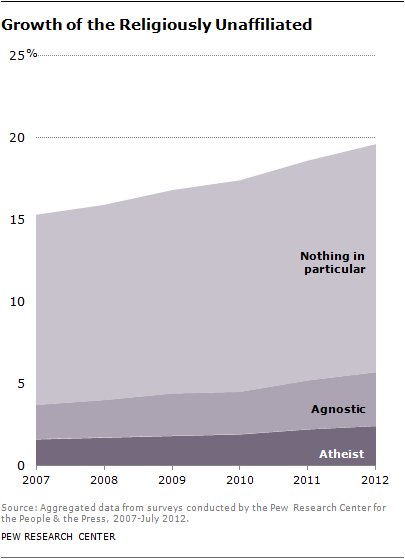
From 2012: The Pew Research Center reported an increase of Americans who have no religious affiliation.   Some of these “nones” are atheists, some are agnostics, but many are folks who simply prefer to “roll” their own religion. Is this an alarming trend?

I started blogging seven years ago. The biggest trend I have seen in those seven years is the startling rise of the “nones” in America, those who say they have no particular “religious preference,” whenever polls are conducted. I call it the “Invasion of the Nones.”

In 2012, the Pew Research Center reported that the number of Americans who have no religious affiliation had grown to its highest percentage ever of the American population. One in five Americans marked “None” on questionnaires when asked about religious belief or association with a church. Over the previous five years, prior to 2012, the number of “nones” had increased from 15% to 20%…. and these are not ladies wearing black dresses with white trimming.

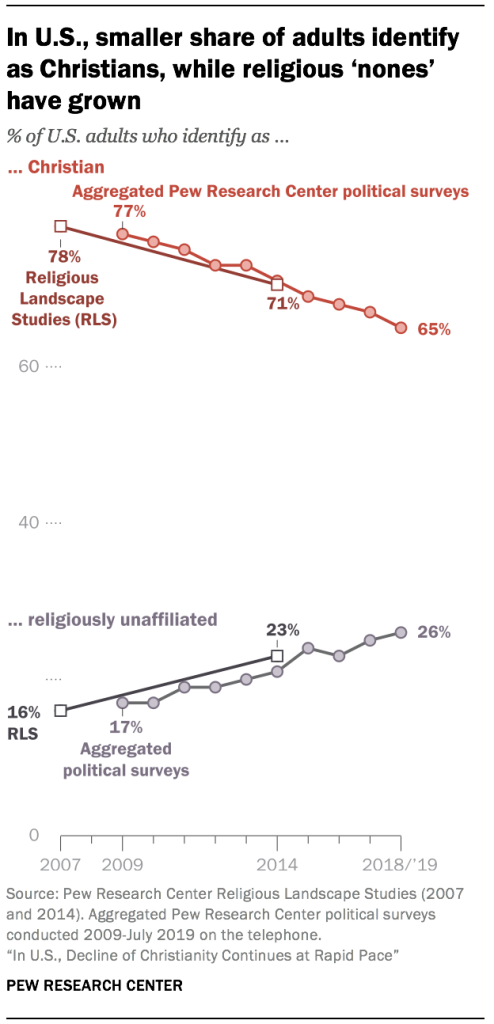
Subsequent research has shown that the growth of Protestant evangelical Christians; that is, those who hold to a high view of Scripture, as the written Word of God, has pretty much remained stable, during this time frame. But the latest 2019 Pew Research study shows that the American culture, more broadly speaking, is growing less and less Christian, with every passing year.

Several new highlights standout regarding the latest Pew study:

  • The percentage of the American population, that claims to be either Protestant or Roman Catholic, is shrinking, as well as in terms of absolute numbers.
  • All categories of those who mark themselves as “None,” with respect to religious preference, including those who adhere to no particular expression of faith, those who are agnostics, and those who are atheists, are continuing to rise.
  • Church attendance in the United States continues to decline, except for those who identify themselves explicitly as Christians.
  • Younger generations of people are less inclined to identify as “Christian” as are older generations.
  • Women are generally more religious than men (Christian are attracting less and less men to church).
  • While there is some decline among Republicans who profess to be Christian, the greatest decline of professing Christians is among the Democrats.

What is the takeaway from this latest research? While the percentage of Protestant evangelical Christians continues to be pretty much the same, adherents to more nominal forms of Christian faith, among certain Protestants and Roman Catholics is dropping rapidly. Another way of putting it is this: mainline liberal Christianity, in particular, Protestant mainline Christianity, is in steep decline.


In U.S., smaller share of adults identify as Christians, while religious 'nones' have grown Continue reading


Is Christianity a “Useful Fiction” to Explain the World, or Is It the Ultimate Truth?

No doubt, my answer is the latter, but I will let the discussion below explain why…

I was planning on writing a blog post about “critical race theory,” “intersectionality,” and the “social justice warrior” movement, but I just got bogged down thinking about it. If you do not know what those terms mean, then you are not alone. The vocabulary is complex and elusive. Additional terms like “identity politics” and “wokeness” abound. But allow me a few paragraphs to set up the story, as to why this topic is so important….. A lot of hysteria surrounds this topic. But some of the craziness is surprisingly far too true.

In September, 2018, a group of conservative evangelical pastors drafted and published “The Statement on Social Justice & the Gospel,” discussed here on Veracity. As many as perhaps 9,000 Christian pastors have signed the document, claiming that the modern trend towards “Social Justice” is incompatible with Christianity.

Nevertheless, a number of Christian leaders, ranging from Al Mohler, to Tim Keller, to Francis Chan, have rejected the document, believing that “Social Justice,” rightly understood, is perfectly compatible with orthodox evangelical faith. As Al Mohler, the president of the Southern Baptist Seminary, the flagship seminary for the Southern Baptist Convention, explains, some forms of “Social Justice” are consistent with Christianity, while others are not.

To complicate matters, in the summer of 2019, a resolution at the Southern Baptist Convention addressed the controversy over “Critical Race Theory” and “Intersectionality.” Some were in favor of the resolution, whereas others believe that it did not go far enough in condemning the “Social Justice Movement.” Some fear that the controversy will split Evangelicalism as a movement, within just a few years.

So, what is this whole controversy about?

Get your thinking cap on. You will need it.

All Christians are children of God, equal in his sight. “So in Christ Jesus you are all children of God through faith (Galatians 3:26 NIV). But in a post-modern, post-Christian society, some people adopt a different narrative, whereby the world is divided between the privileged and the oppressed, whereby the oppressed are called upon to silence the speech of the privileged. Can a postmodern world survive this new narrative, or do we need to resurrect Christianity as a “useful fiction” to counter this new narrative? Or is there a better answer?

The Rise of “Social Justice” in Post-Modernity, and Its Impact on the Church

This can get a bit heavy, so some background might help frame what is going on: Just in case you did not know, we are living in an increasingly post-modern, even post-Christian, society.

To be post-modern is in contrast with the idea of modernity. Modernity is the project of the Enlightenment come to fruition. Philosophers tell us that in pre-modern times, people lived in an age of faith. Whereas in modern times, we live in an age of reason. With modernity, religious faith has been marginalized to the preferences of the individual. What really remains supreme in modernity is reason, guided by the all-knowing hand of scientific progress. The so-called subjective talk of God has been pushed aside in favor the human ability to solve all problems, and come to the knowledge of absolute Truth, through reason alone.

The problem with modernity, however, is that the application of universal human reason has not actually delivered what was promised. Post-modernity, in contrast, has a more pessimistic take on human reason, as the pathway to true enlightenment. Two broad approaches to post-modernity are felt in today’s culture.

One approach is simply to say, “Yes, there is an absolute Truth, but we simply can not know it completely. We can only do the best that we can to approximate what that Truth is, but the limitations of reason prevent us from fully apprehending absolute Truth, in its fullness. So while absolute Truth is hypothetically there, we must simply settle for the notion of relative Truth in practice.” One application of this approach is to say that the various competing claims of absolute truth must be adjudicated through conversation and dialogue, at least in the public sphere. At a pragmatic level, this is an acknowledgement that we live in a pluralistic society. We will not all agree with one another, but we must learn how to live alongside one another.

The second post-modern approach takes a more activist form. “There is no absolute Truth. All claims to absolute Truth are, in reality, merely the exercise of power. The key to living in a post-modern world is then to equalize the power structures that articulate competing narratives of truth.”

It is this second approach to post-modernity that has fueled the contemporary interest in themes such as “Intersectionality,” “Critical Theory,” and being a “Social Justice Warrior.” Perhaps the easiest to explain is “Intersectionality.”

By “intersectionality,” a term coined in 1989 by legal scholar Kimberlé Williams Crenshawmany scholars in the humanities say that different groups of people, who do not have lives marked by privilege, live their lives from the perspective of being oppressed. For example, many persons of color, such as African Americans, experience oppression. Likewise, many women experience oppression, at the hands of men. But when the experiences of being African American overlap with being female, the intersectionality of those experiences produces yet another complex form of marginalization within society.

Those who have lives marked by privilege, who empathize with the marginalized, are said to “ally” with the marginalized. Those who “ally” are encouraged to stand shoulder to shoulder with those who lack privilege, in order to correct social injustices.

Many social theorists find the category of “intersectionality” a helpful tool for understanding how social structures work. Many evangelical Christian thinkers would agree. After all, the Bible talks a lot about “Blessed are the poor,” and how all of us are created equal, within God’s perspective. So far, so good.

However, we must be exceedingly careful here. What might be seen as a helpful intellectual tool for some, could be carried on by others to mean something radically different.

The pursuit for “social justice” can become the basis for building a worldview, predicated on the same intellectual foundation as Marxism. It is as though being a “social justice warrior” takes on the trappings of a religion. As Christian apologist Neil Shenvi puts it, in his explanation of the related concept of “critical theory,”  “it views reality through the singular lens of power, dividing people into oppressed groups and oppressor groups along various axes like race, class, gender, sexuality orientation, physical ability and age.”

This may all seem like foreign territory for the average church-going Christian. But in a university setting, the quasi-religious character of being a “social justice warrior,” in the ideological sense, can be quite evident. It can get really bizarre.

For example, in 2017, a group of students sought to shout-down a representative of the American Civil Liberties Union (ACLU), who came to speak at the campus where I work. Many conservative Christians have a less than positive image of the ACLU. But when a group of activist college students protest the mere presence of the ACLU on a secular college campus, then you begin to wonder if something else is going on. In a “social-justice-warrior” as-an-ideology worldview, the only way to respond to oppressive sounding voices on campus is to silence free speech. To my knowledge, aside from a rebuke by our then college president, no disciplinary action was taken against this group of students. Other attempts to shut-down conversations, and deny free speech, instigated by ideologically-minded professors, and/or aggressive school administrators, and propelled by organized groups of student followers, have been growing across college campuses, nationwide.

This is yet a glimpse into a crisis in academia, as the ideological tendency of this “social justice warrior” movement has threatened to compromise the very integrity of the intellectual viability of certain strands of humanities studies. This is not merely a concern of Christians. It also bothers more secular minded thinkers, those who lean towards the more progressive side of culture. If you want to be entertained and horrified, all at the same time, you can learn about the “Grievance Studies Affair,” exposed by left-wing academics James Lindsay, Peter Boghossian and Helen Pluckrose, in 2018. Following the YouTube playlist for this is mind-blowing.

In a postmodern world, where the premodern categories of religious faith have been deemed obsolete, and the modernistic hope for a view of scientific progress, that can solve all of humanity’s problems, is seen to be elusive, the postmodernist can see the world as merely the realm for power struggles. Orthodox Christian faith is left off to the side, for those who advocate an ideological commitment to “critical theory” and “intersectionality.”

But not only is historically orthodox Christian faith rejected, as being a form of privilege, the practice of science, as generally understood, is also under threat, due to an idealogical embrace of Marxist-inspired “critical theory.”  As a result, evangelical Christian thinkers and secularized atheists are finding some common ground, with their concerns, about the idealogical application of “intersectionality,” and the like. It might seem strange that evangelical Christians might have something in common with atheists, in working against a growing intellectual trend, but keep reading….

The War Against Biology: The “Social Justice Movement” as Becoming an Ideology for Some

Take for example, the case of evolutionary biologist, Brett Weinstein, when he taught as a professor at Evergreen State College, in 2017. When a group of students, invigorated by ideas taught by certain other professors of the humanities, sought to ask white faculty and students (particularly those who were male) to leave campus for a day, Professor Weinstein objected to the planned event as ill-conceived. In response, a group of student protestors interrupted his class, sparking a national conversation. WARNING: OBJECTIONABLE LANGUAGE IN THE VIDEO BELOW:

Professor Weinsten, and his wife, also an evolutionary biologist, and both who are not professing Christians, resigned from Evergreen State College, as they felt that their lives were being threatened by this student movement, and the school administration did little to intervene. This sets us up to get to the reason as to why this blog post is so important.

Brett Weinstein is now a public intellectual, a member of what some call the “Intellectual Dark Web,” populated by other public intellectual figures, such as Canadian psychologist, Jordan Peterson and orthodox Jewish commentator, Ben Shapiro. Weinstein’s experience at Evergreen State helped him to see that there are intellectuals, within the humanities, who advocate for a more ideological approach to intersectionality, such as in the case of what constitutes “gender” in a post-modern world. Such intellectuals have been convincing a new generation of students to think that the category of “gender” is merely a social construct. Weinstein sees this as an attack on the very foundations of biology, as a scientific discipline, where the distinction between male and female is a fundamentally biological description, not merely a social construct.

Weinstein suggests that the modern approach to evolutionary biology has failed, as evidenced by his own experience at Evergreen State. He is still an evolutionary biologist, but he believes the current secular hostility towards “religion,” including Christianity, has created a cultural crisis. The postmodern rejection of absolute truth, being promoted by certain disciplines in the humanities, has led to the development of distorted forms of traditional religiosity. For Weinstein, this new situation requires that scientists need to rethink how to approach evolutionary biology.

Secular, Atheistic Thinking That Wishes to Revive Christianity/Religion as a “Useful Fiction”

In his mind, Professor Weinstein contends that “religion,” which would include Christianity, still serves as a “useful fiction,” necessary for the survival of the human race. So while Weinstein rejects Christianity as an ultimate truth claim, it is nevertheless an invaluable aid that should be tapped to help secular society transcend the current cultural crisis, marked by the rise of ideologically-driven “critical theory” and “intersectionality.”

At the recent Unbelievable? conference in London, podcaster Justin Brierley sat down with Brett Weinstein and theologian Alister McGrath to discuss Weinstein’s ideas, as part of Brierley’s Big Conversation program. Given the background of Weinstein’s academic experience, the discussion is pretty amazing.

Brett Weinstein rejects the New Atheism of a Richard Dawkins, that negatively views Christianity as a disease or “virus of the mind.” (If you do not understand what Dawkins is talking about, view the following video. Otherwise, skip it, and move on to what I have written below):

Brett Weinstein believes that Dawkin’s approach to religion deserves a much better explanation. Ironically, for Christian listeners, Brett Weinstein thinks that Neo-Darwinian evolution holds the key for understanding and accepting “something” like Christianity, as a positive force for good for humanity. In that sense, something like Christian faith can be a “useful fiction,” to help humanity survive. This is the same type of message being propagated by those like Jordan Peterson. It is just that Peterson and Weinstein seem unable to make that jump of seeing Christianity as actually being true, in and of itself. This is a massive topic, and this blog post merely reveals the tip of a really, really big iceberg.

What interested me the most about the conversation below was the lack of enthusiasm for Alister McGrath’s response to Brett Weinstein, among a number of Christian listeners. But since McGrath does NOT subscribe to the “conflict thesis”; that is, the idea that evolutionary science and biblical faith are in direct opposition with one another, there was not a whole lot to disagree with, aside from Weinstein’s wishful thinking for something like Christian faith, but not exactly Christian faith, to emerge, to address our current problems, as a human race. McGrath’s answer was straight-forward enough, suggesting that historic orthodox Christian faith is sufficient to address the challenges that Weinstein brings up….(plus Christianity is true, and not merely a “useful fiction”).

Two hours, yes, but worth the intellectual workout. Enjoy.


For a similar discussion/debate that Alister McGrath had with skeptic Michael Shermer, please view it here.