
Category Archives: Apologetics

We Believe in Dinosaurs: A Film Review

Dinosaur at Toronto Airport

Veracity founder and blogger, John Paine, shows where he found a dinosaur at the Toronto airport….. Many Christians never bother with the thought of dinosaurs, but some Christians lose a lot of sleep over the existence of dinosaurs. Do you believe in dinosaurs?

We Believe in Dinosaurs is an independent documentary chronicling the story of the Ark Encounter museum in Kentucky, and will be featured as part of PBS’ Independent Lens programming in February, 2020.

Ten years ago, the world’s most well-known Young Earth Creationist ministry, Answers in Genesis (AiG), announced that they would build a full-scale replica of Noah’s Ark, as a Christian theme park, in Kentucky, deep in the heart of the American Midwest. Ken Ham, the president of AiG, envisioned that along with the AiG Creation Museum, the Ark Encounter would inspire a new generation of Christians to rethink how they read the Bible, to show how the story of a global flood, as taught in the Bible. according to Ken Ham, provides a better explanation of earth history, as the most Scripturally faithful alternative to a secular worldview, the latter which is currently undermining morals and other Christian values in the Western world today.

A full size replica of Noah’s Ark!!? Many Christians look to the work of Answers in Genesis as a way of supporting their belief and confidence in the Bible, whereas other Christians have the opposite reaction, and struggle with doubt, as to how accurately Answers in Genesis portrays science and faith. Others are curious and not sure what to think.

In February 2014, Ken Ham publicly debated famed TV personality Bill Nye, the “Science Guy,” which has since garnered millions of views on YouTube. The debate gave Answers in Genesis the exposure needed to make the Ark Encounter a success. Once the Ark was completed, Nye even returned to the Ark Encounter, for yet another impromptu, casual debate with Ken Ham, as they walked together through the exhibit.

Ken Ham has envisioned the possibility of “seven billion people” coming to the Ark Encounter. Given the record breaking attendance, over the past few years, Ken Ham maybe on the way to see this vision becoming a reality.

Humans existing side-by-side with dinosaurs, at Answers in Genesis’ Creation Museum, in Kentucky, in stark contrast with the narrative nearly every public school educated child learns from the modern scientific consensus, namely, that the dinosaurs died out millions of years ago before modern humans entered the scene.

Since the opening of the Ark Encounter in July, 2016, I have known dozens of my Christian friends who have visited the museum. Regardless of how my friends view the Scriptural accuracy of Young Earth Creationism, everyone I know who has seen the exhibit has walked away overwhelmed with the top quality and workmanship of the park. The Ark Encounter makes for quite an impressive visit, though it does represent a significant development away from the version of the Young Earth Creationist story that I learned during my years in college, at my college church.

Back some 35 years ago, the Institute for Creation Research (ICR) was one of the premier Young Earth Creationist groups in the world, as the American version of Answers of Genesis, did not exist in those days. The Young Earth Creationists at ICR could not imagine how evolution could work, to account for the biological diversity we see today, except at the micro-evolutionary level, a biological process generally found within species. For example, Young Earth Creationists readily accept that the flu virus mutates every year, requiring a new flu vaccine on a yearly basis. This is a type of micro-evolution, which is compatible with a biblical view of history. The version of Young Earth Creation I was taught in my college church, as promoted by ICR, did not allow for any case for evolution beyond that.

So, what has changed over the years? Well, one big challenge for the Young Earth view of Creation, is in demonstrating how the placement of the animals on the Ark, in a global flood model, can adequately explain the great wealth of biological diversity we see in our world today, less than 6,000 years after the global flood occurred. Today, at Answers in Genesis, the solution has been to propose that Darwinian natural selection took place after the great flood event, but at a greatly accelerated rate.

Instead of the standard Darwinian view, which sees all of biological life within a tree of life, where all living organisms share a common ancestor, the Answers in Genesis view proposes an orchard of life, whereby the diverse animal populations on-board the ark, represent different trees within the orchard, that are responsible for generating all of the future diverse animal populations we find on planet earth today.

Old Earth Creationists do not accept a global flood, but rather say that the message of the Bible is consistent with a large local flood. Such Old Earth Creationists, who accept the standard view of a 4.34 billion year old earth, as being compatible with Scripture, are skeptical of the Answers in Genesis orchard of life proposal, in that it assumes that the animals on-board the Ark, were somehow genetically supercharged to accomplish this amazing feat. But Old Earth Creationists maintain that such genetic “supercharging” could never have been sustainable, in such a short period of time, in less than a few thousand years. That is part of the reason why a large local flood makes more sense, wiping out only a part of the earth’s creaturely world, at least from a scientific perspective, compatible with Old Earth Creationism.

While biology informed by the scientific consensus affirms a “tree of life,” the Christians with Answers in Genesis believe in an “orchard of life.” Yet other Christians believe in a “lawn of life.” What diagram of life do you affirm, and why?

But Old Earth Creationists are not the only ones who find the ideas offered by Answers in Genesis, to visitors of the Ark Encounter, to be less than convincing. The Institute for Creation Research, (ICR), whose material I read back in the 1980s, argues that Darwinian natural selection, in any form, including Answers in Genesis’ version, is completely incompatible, not only with science, but with the Bible as well. But if natural selection is off the table, as ICR proposes, what then actually is the mechanism that could result in today’s biological diversity? One should note that Answers in Genesis founder, Ken Ham, once worked with ICR, eventually splitting off to form the U.S. version of Answers in Genesis, in 1994.

It all makes for a confusing situation, for those who try to examine the details of Young Earth Creationist views of the Bible, and how they relate to science. Which version of Young Earth Creationism is correct?

One of those avid Young Earth Creationist thinkers, who has since had serious second thoughts about Young Earth Creationism, is David MacMillan. MacMillan was interviewed by independent filmmakers, Monica Long Ross and Clayton Brown, to create the documentary We Believe in Dinosaurs. MacMillan was interviewed by Christian apologist, Randal Rauser, detailing how he got involved in the making of the film.

One of the strengths about We Believe in Dinosaurs is that there is no narrator in the film. The film is made up of interviews with people deeply invested somehow in the Ark Encounter project.  On the side sympathetic towards Answers in Genesis, is the talented Doug Henderson, who headed up the sculpture team, who produced all of the animal representations found in the Ark Encounter exhibit. Outspoken critic of the Ark Encounter, Dan Phelps, a geologist with the Kentucky Paleontological Society, is also interviewed in the documentary.

Though several Christians are interviewed in the film, Christian viewers of We Believe in Dinosaurs might feel uncomfortable about the film’s secularized approach to the topic of Creation. The film sides clearly on the side of promoting evolutionary science, but its stance towards biblical Christianity is undecided, offering multiple Christian viewpoints in the film’s interviews.

Yet regardless as to how Christians might think about this documentary, one think is for sure: Christians themselves today are divided about how to think about the relationship between Creation and the Bible, and this division threatens to have a profound impact on the Christian witness for the Gospel, in an increasingly non-believing world.

Some Christians are quite content to believe in a 6,000 year old earth, and never give it that much thought. Other Christians have wrestled with the Scriptural text, and have come to different conclusions as to how God might have created the world, and how long that process took place. Even other Christians are aware of such problems, that face the Christian believer today, but who are wholeheartedly convinced that the scientific argument is still there, waiting for us to discovery it in nature, and that argument will eventually win over, even the most skeptical scientists, towards a more traditional, six-24-hour day interpretation of the opening chapters of Genesis. And yet, sadly, there are also others, for whom the cognitive dissonance between the Bible and science is so great, and so disturbing, that they walk away from the faith, in disbelief.

As a Bible-believing Christian, with an interest in sharing my faith with others, I tend to steer clear of such topics, like the age of the earth, or evolution, unless the discussion of such topics would provide an opportunity to talk about Jesus. I want to stay focused on the Gospel, and not get sidetracked by conversations, that would leave Jesus off to the side. Nevertheless, science-based topics can be a real stumbling block for those, who wonder how the Bible and science fit together. With that in mind, We Believe in Dinosaurs might give some good food for thought.

We Believe in Dinosaurs would be a helpful discussion starter, for Christians to view, to help gain a more balanced perspective, as to why the topic of Creation and the Bible, is so divisive in Christian communities today. Is Christianity and science fundamentally at odds with one another, or are they in harmony? Watch We Believe in Dinosaurs to explore that question. We Believe in Dinosaurs will be broadcast on PBS television stations, on February 17, as part of their Independent Lens programming.

Great Tools for Doing Awesome Bible Study

Happy Epiphany!

As I have remarked before, we live in an age where we have easy access to great resources for learning the Bible. As we start a new year… and a new decade (unless you think it begins in 2021 !), I thought I would highlight just a few of these excellent tools for doing rewarding, and dare I say, awesome, exciting, … and even fun, Bible study. Some of the best tools available are for free online.

Believe me. I like the idea of “free.” But there are a few standout resources that I can recommend, that might cost you just a few bucks. Here we go:

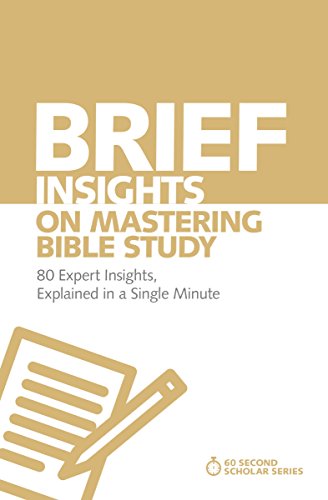
Dr. Michael Heiser’s Brief Insights on Mastering Bible Study. One of Dr. Heiser’s several books that can help anyone make better sense of the their Bible, without having to be a total geek, dumping tons of money going to a seminary or Bible college. This book costs a few bucks, but many of the other great tools for Bible study are available for free on the Internet. See below!!

Obviously, the first place you want to start is to get a good Bible. If you are totally new to the Bible, and you want to read quickly through the Bible, something like Eugene Peterson’s The Message is a great place to start. For a high level introduction to God’s Word, The Message is really helpful.

Another great tool for getting a high level survey on the Bible, available in short videos, is the awesome work done by the folks at The Bible Project.

For reading the Bible, while on the go, with your phone or tablet, download an app like YouVersion, or the ESV Mobile App, or the NIV Bible App, that can even read the Bible to you, while you go about your daily business.

However, if you really want to dig in, and really understand the Bible, in a verse-by-verse manner, a paraphrase like The Message will often end up doing you more harm than good. What you really need is a good study Bible. There is a big difference between READING the Bible and STUDYING the Bible. Try to get into the habit of studying the Bible, and not simply reading it.

I will admit it. After awhile, simply reading the Bible can get boring, and you will eventually lose interest. Actually studying the Bible, on the other hand, will offer you a lifetime of rewards.

A good study Bible has selected commentary and notes, that will aid you in your understanding. I have reviewed a number of excellent study Bibles here at Veracity, put together by the best Bible scholars in the world, that I can highly recommend, such as the English Standard Version (ESV) Study Bible, the Zondervan New International Version (NIV) Study Bible, the NIV Faithlife Study Bible, the Reformation Study Bible, or anyone of the fine Christian Standard Bible (CSB) Study Bibles. My “go-to” favorite is Crossway’s English Standard Version, and they have probably the best looking Bibles you can buy. But anyone of the ones I have listed above are great.

I would personally stay away from Bibles that have been translated, or filled in with study notes, written by just one person. When you do that, you are just limiting yourself to one scholar’s point of view. I mean, a good study Bible (even some of the online ones) can be expensive, so why make an investment, that is only going to limit your thinking process?? We all have our blindspots. But hey, if you really want to drop $50 bucks on the “Joe-I-Am-A-Popular-Pastor-But-I-Am-Not-The-Pope-But-Some-People-Think-I-Am—-And-I-Am-OK-With-That” Study Bible, do yourself a favor and drop another $50 on a different study Bible, to give you a more rounded perspective, please?

On the other hand, if you are cheap, like me, you might want to check out some of the great Bible study helps available for free online:

  • BibleGateway.com.  You can read and compare multiple Bible translations, of all of the major English translations available (and non-English, too), from your favorite web browser. There are even options at BibleGateway to read notes from a few other study Bibles.
  • Biblehub.com. For a quick glance looking at how a single verse compares with various popular translations, I often will use Google or DuckDuckGo to search for a reference, and look for the hit at Biblehub.com, to see the list of various translations.
  • The NET Bible (otherwise known now as Lumina). Done by a number of folks at Dallas Theological Seminary, including the esteemed veteran Bible scholar, Daniel Wallace. In particular, if you are puzzled about all of the “some manuscripts” blah-blah-blah this and that, the NET Bible explains all of that for you. By far, this is my favorite study Bible available online.
  • The STEP Bible. Just recently put out by the good folks at the Tyndale House, at Cambridge, in England. This is the easiest way to do word studies and word searches in the Bible. You will never need a separate concordance or interlinear translation again, if you use the STEP Bible.
  • (and for the ultra-Bible nerd) The KJV Parallel Bible. The total Bible geek can consult this online parallel Bible to compare how the trusty ole KJV compares with modern translations.

The point is that there is simply no excuse for not having the resources available to you to do good Bible study, assuming you have a computer and an Internet connection. Probably for most folks, a good study Bible is really all you will ever need. Yet for more in-depth study, if you are thinking about leading a Bible study, you can look at other online tools, or spend some money on something like a concordance (where you take a word found in the Bible, to locate where else in the Bible, that word can be found), a Bible dictionary (for looking up what those words mean), or an interlinear Bible (to figure out which Greek or Hebrew word matches the English, in your Bible translation).

As noted above, there are also some really good, inexpensive and short books available to aid in your study of the Bible, without flooding your bookshelf, or filling up your computer hard drive, with stuff you will probably never look at.

Bible commentaries can be really helpful, if you really want to dig deep into a particular book of the Bible. I would suggest that the best ones out there, that will not take up all of your mental energy, and that will not totally destroy your bank account, would be either a volume out of the IVP Tyndale Bible Commentary series (for more nerdy readers), or the NIV Application Commentary series (for less nerdy readers). Sometimes, there are book sales on individual books in these commentary series, so keep your eye out.

I also like having a Bible background commentary, to help you dive in, behind the scenes, to better understand the culture of the Bible. The NIV Cultural Backgrounds Study Bible is my personal favorite.

All-in-one resource systems for your computer, like Logos Bible Software, or Accordance, are great for folks who want to be more hardcore in their Bible study. But just be prepared to shell out some bucks, once you get involved in that.

If you have hung around Veracity long enough, you will know that I am a big fan of Dr. Michael S. Heiser. He is an Old Testament scholar who most recently worked with Logos Bible Software, and who is host of the Naked Bible Podcast.

Michael Heiser has released a set of books designed to give you profound insights into understanding the Bible, and each insight can be read and digested in less than 60-seconds. That is my kind of way to start at really getting into Bible study.

Here is my top tip on one of my favorite Michael Heiser books. The first book in the series is Brief Insights on Mastering Bible Study: 80 Expert Insights, Explained in a Single Minute.  Here is a sample of the topics:

  • Read the Bible with a Critical Eye — It Can Take It
  • The Aim of Bible Study Is the Meaning of the Text, Not a Defense of Your View
  • Ignorance Is Not a Gift of the Spirit
  • Attention to Detail and Clear Thinking Are Not Antithetical to Loving Jesus
  • Listening to a Sermon Isn’t Bible Study
  • All Interpretations Are Not Equally Plausible
  • Some Things in the Bible Are Clearer than Others — By Design
  • Nonliteral Doesn’t Mean “Not Real”
  • If It’s Weird, It’s Important
  • You Can’t Understand the Bible Without Understanding the Worldview of the People Who Wrote It

Each essay can be read in, yep, less than a minute.

You can get it on Kindle for $9.99. The paperback version is a little more, but it is worth it. I do not follow Mike on everything, but he is really good at dismissing a lot of the foolish talk that passes itself off as “Bible study” in some circles today. So, stop just reading the Bible, and get excited about studying it. Brief Insights on Mastering Bible Study is a “quick read” tool to help get you started.

Are you more excited now about digging into God’s Word this year? I know I am. So, go for it!


The Big Conversation: The Best Debates of 2019

One of the more useful features of YouTube is the ability to deliver great Christian apologetics content. Debates are perhaps the best way I learn, that help me to have more effective conversations with non-believers. At the top of the list are the debates moderated by Justin Brierley, host of the Unbelievable? podcast, out of London.

There were some real winners in 2019. Pastors Andy Stanley and Jeff Durbin gave an electric discussion about apologetic methodology. Scientist and theologian Alister McGrath interacted with evolutionary biologist Bret Weinsten about whether or not Christianity is a “useful fiction.” But this fall, a whole host great debates made for incredibly lively discussions, as part of the The Big Conversation (or follow this YouTube link). Here are some of my favorites:

  • Syndicated podcaster Dave Rubin and Oxford’s John Lennox, at Calvary Chapel in California, talking about the question, “Is God Dead?”
  • Cambridge Bible scholar Peter J. Williams and skeptic Bart Ehrman discuss the reliability of the Gospels.
  • Philosophers William Lane Craig and Sir Roger Penrose, on the Universe, and how we got here.
  • Historian Tom Holland and philosopher A.C. Grayling on whether or not Christianity has given us our contemporary human values.

I will often just bring up the YouTube video on my phone, or convert it to MP3, and make it into a podcast. I will link to each debate below in order. Exercise your brain with these gems, while you spread out your Christmas decorations! Enjoy!

If you want more,  be sure to check out last year’s Big Conversation debates, particularly Susan Blackmore and Jordan Peterson, on whether or not we need God to make sense of life (over 1.7 million views!!!!), and Harvard’s Steven Pinker and Nick Spencer, and whether or not science, reason, and humanism has replaced faith.


Were There Humans Before Adam Was Created?

During the great age of exploration of the 15th and 16th centuries, European Christians faced a nagging problem in how they read their Bibles. Traditional belief understood that all humans were descended from a single human couple, Adam and Eve, as taught in Genesis 2. But as folks like Christopher Columbus set forth on their famous journeys, they ran into humans no one ever expected. Thinking he was near India, Columbus thought of them as “Indians.” But Columbus was nowhere near India.

This created a problem: Who were these Native Americans? Where did they come from? And how did they get to the Americas?

The most popular theory that emerged speculated that these Native Americans were the descendants of the Ten Lost Tribes of Israel, the people of the biblical Northern Kingdom, which according to the Bible, was overrun by the Assyrians, over 700 years before Jesus was born. A common example can be traced back to 1660, when a New England Puritan missionary to some of these Native Americans, John Eliot, helped to spread this idea, to English settlers coming to the New World.

Then there was a well-known 19th century attempt to solve this problem. A New York treasure hunter had a read a book by an American Congregationalist minister, Ethan Smith, View of the Hebrews, that explored this possible connection between the Native Americans and the Ten Lost Tribes of Israel, in considerable detail. Yet this treasure hunter, Joseph Smith, was to popularize this view through his translation of the Book of Mormon, capitalizing on the same theme, and thereby creating a uniquely American sect of Christian religion. Aside from the Mormons themselves, no one takes this view seriously today.

Most researchers conclude that the ancestors of today’s Native Americans came across the Bering Straight from Russia, within the past 35,000 years, but probably no less than roughly 16,500 years ago. So, does this mean that the Bible got it wrong, when it came human origins?

The Naming of the Animals, by John Miles of Northleach 1781-1849 (media credit: sothebys.com). Adam named the animals, but were there any other humans existing at the time, who were not in the picture (outside the Garden, in the Americas?)

There is more to the story. The efforts of Ethan and Joseph Smith (not related), were preceded in the 17th century by French theologian Isaac La Peyrère. La Peyrère, who had a Marrano Jewish background, was originally a Calvinist, though he later converted to Roman Catholicism. La Peyrère’s proposal endeavored to solve some persistent problems in biblical interpretation, in the process of explaining the origin of peoples like the Native Americans.

Isaac La Peyrère’s Biblical Reconstruction of Human Origins

In Genesis 4 we read that after the murder of his brother Abel, Cain obtained a wife and built a city. But the text gives us no description as to where his wife and the population of this city came from. Many Young and Old Earth Creationists propose Cain must have had a sister, another unknown child of Adam and Eve, and that Cain must have married her. But this introduces yet the strange difficulty that God might have changed his moral law to allow such an incestuous relationship to take place. For Christians today, who believe that God’s law prohibiting same-sex relations never changes, such an exception to incest, in the case of Cain, is problematic.

La Peyrère concluded that there must have been a human population existing alongside Adam and Eve, from where Cain could have obtained his wife. La Peyrère appealed to another biblical passage to further his case. In Romans 5:12-14 (ESV), we read:

Therefore, just as sin came into the world through one man, and death through sin, and so death spread to all men because all sinned— for sin indeed was in the world before the law was given, but sin is not counted where there is no law. Yet death reigned from Adam to Moses, even over those whose sinning was not like the transgression of Adam, who was a type of the one who was to come.

The troublesome phrase here is highlighted. Who were those whose sinning was not like Adam’s transgression? What was the Apostle Paul talking about here? La Peyrère suggested:

“if Adam sinned in a morally meaningful sense there must have been an Adamic law according to which he sinned. If law began with Adam, there must have been a lawless world before Adam, containing people” (Almond, Philip C. (1999). Adam and Eve in Seventeenth-Century Thought. p. 53)

La Peyrère’s solution was to challenge the long-held traditional view, that the creation of humans on day six, in Genesis 1, was the same event as the creation of Adam and Eve, in the garden of Eden in Genesis 2. It has been long recognized that syncing up the events on day six of creation, in Genesis 1, with the events described in Genesis 2, is not without difficulty (I go into detail in this previous Veracity blog post).

La Peyrère proposed that Genesis 1 speaks of the creation of a human population, and that these humans pre-existed Adam and Eve. Specifically, Genesis 1 has no mention of a single couple being created. These humans were the start of the Gentile, or non-Jewish peoples.In Genesis 2, Adam and Eve, on the other hand, were the start of the Jewish people, from whom the Messiah would come to redeem the world.

La Peyrère further went onto suggest that these Gentile peoples in Genesis 1 eventually became geographically isolated the Adam and Eve descendants, and eventually unknown to Adam and Eve’s progeny. So, when we get to the story of Noah and the flood, La Peyrère argued that the great flood was local in scope, wiping out the then known humanity of Adam and Eve’s descendants, and thereby not touching the other unknown humans who had migrated elsewhere around the globe.

Even though La Peyrère made a clever proposal, Jewish, Calvinist and Roman Catholic theologians of his day condemned La Peyrère’s “pre-Adamism” as a heresy. His 1653 book on the subject, Præadamitæ, was burned in an effort to censor his views. La Peyrère escaped the death penalty himself by supposedly retracting his views, though copies of his book have survived.

In view of events in subsequent years, the theologians of the day were probably correct in rejecting La Peyrère’s teachings (La Peyrère had other peculiar ideas that caught the attention of the enlightenment philosopher, Baruch Spinoza, one of the fathers of modern skepticism). Furthermore, in the 19th century, scientists used pre-Adamite theories about humanity, like that taught by La Peyrère, as a justification for racism. Before the rise of Charles Darwin, many scientists believed not in one human race, but rather, in multiple human races, who were distinguished based on the color of a person’s skin. Defenders of Christian orthodoxy were surely right in rejecting such views.

Despite whatever disagreements many Christians have with Charles Darwin’s theory of evolution, both Darwin and the Bible share the common view that humans, of all colors, shapes, and sizes, share the same humanity. As a result, no scholar today would contend against the notion that we all share a common humanity.

However, other, modern developments in evolutionary biology complicate matters, when it comes to trying to synchronize science with a traditional interpretation of the Scriptural text. For example, we have continuing questions about the presence of hominids, or pre-human creatures, like the Neanderthals. Where do they fit in the Bible’s story? Archaeological research today suggests that modern humans rose out of East Africa, and not, strictly speaking, the Middle East. Then there is the research on the human genome, for which many genetic scientists argue that the earliest human population had upwards to 10,000 individuals… and NOT 2!

In view of these developments, some Old Earth Creationists, and even perhaps Evolutionary Creationists, look to some elements of La Peyrère’s work today as a potential solution. For example, Genesis 1 could be understood as referring to humans originally created in East Africa, some of whom eventually migrated to the Middle East, the traditional location of the Genesis 2 narrative. Furthermore, if La Peyrère is correct, then there is effectively no difficulty in associating a Bering Sea crossing of the ancestors of the Native Americans, to populate the Americas over 10,000 years ago, and no need to appeal any “Lost Ten Tribes of Israel” proposal as an alternative means of explanation. As with a lot of things like this, research in these areas have a speculative component.

Isaac La Peyrère (1596-1675), who wrote under the pen name of Samuel Maresius. Some find him as a precursor to modern biblical criticism, but others see him as a pious scholar, who sought to solve a nagging problem in biblical chronology. He was also known as an early proponent of a type of Christian Zionism, believing that the returning Messiah would join the king of France, to set up rule in Jerusalem, and rebuild the Temple.

An Objection to La Peyrère: How to Interpret Genesis 3:20?

For example, one of the most serious problems with La Peyrère’s proposal is with Adam’s naming of Eve, in Genesis 3:20 (ESV), that “she was the mother of all living.” For many students of Scripture, this single verse makes La Peyrère’s proposal of other humans living before and alongside Adam and Eve, a non-starter. Traditionally, this verse has been assumed to teach that every human person ever born, was and is, a physical descendant of Eve, herself. But is this interpretation the only possible way of reading this text?

For example, taking this verse too literally would be absurd. Does the text really mean that every living thing comes from Eve, like every plant and animal? Surely not. Adam was already living, by the time Eve came along, so it makes no sense to say that Eve was Adam’s mother. There must be some limitation, or qualification, to the notion of Eve being “the mother of all living.” Unfortunately, the text does not spell that out for us.

As it turns out, different translations of Genesis 3:20 might give us a different clue as to how this verse should be interpreted. For example, in the NIV 2011 translation, we read the whole verse as: “Adam named his wife Eve, because she would become the mother of all the living.”  Taking this in a reasonable, yet still strictly literal fashion, the highlighted “would become” might imply that Eve is the mother of all who would come after her, but not the mother of all humans, already living at the time Adam named her. Or it could be that Eve “would become” mother of the Israelite line of humans. Or it could be that Eve “would become” the mother of all living, say at a future point in time, such as when Jesus Christ comes as the Messiah, which would be quite relevant for the Apostle Paul, when in Romans 5, Paul argues that Adam was the type of the one who was to come, namely Jesus.

Furthermore, it could be interpreted that by naming Eve, as “the mother of all the living,” Adam was uttering a rebellious statement against God’s curse, that had little to do with the reality of the situation. Other scholars suggest that Adam’s naming of Eve was instead a sign of faith, that through Eve she would be the bearer of children. To make this even more complicated, some early Jewish commentators link the name “Eve” with a similar Aramaic word for “serpent,” implying that Eve was the deceiver of Adam, a designation that the narrator of the story reinterprets.

Some of these interpretative options are better than others. The traditional argument, that Adam and Eve were the parents of all humans to have ever lived after them, was is one of the better options. But it is not a slam dunk. Either way, the exact meaning of saying that Eve was the “the mother of all living” remains unclear.

For those who wonder how the ancient story of Genesis might be correlated with the discoveries of modern science, La Peyrère’s ideas might be worth considering. There are still questions out there that are difficult to answer. Nevertheless, the bottom line should be evident: Those who insist that science somehow “disproves” the Bible can be safely set aside.


F.F. Bruce on Biblical Inspiration and Interpretation

On my to-read list is Tim Grass' biography of F.F. Bruce (1910-1990), one of best British biblical scholars in a hundred years.

On my to-read list is Tim Grass’ biography of F.F. Bruce (1910-1990), one of the best British biblical scholars in a hundred years.

What do we mean we say that the Bible is inspired? There are some, on one side of this question, who say that the Bible is inspired because it is inspiring.

Sorry folks, but that type of fluffy sentiment does not cut it. There are too many people in our churches who think of the Bible as a huge, oversized Hallmark card. There you will find inspiring thoughts, but are they merely sentiments born from human religious experience? Or are they truly the thoughts from a God who has spoken?

The Bible has been under intense scrutiny for a long time. You often hear these days that the Bible is an outdated, outmoded book. Has not modern science disproven the Bible? Has not the study of archaeology, history, and ethics rendered the Bible as obsolete? The Bible has been under serious attack, but thankfully God has raised up some really smart people who have helped to set the record straight, supporting the integrity and reliability of Scripture.

However, this does not mean that every defense has been a good defense. Unfortunately, there are those who so desperately want the Bible to be true, that they are afraid to ask tough questions. That does not cut it either.

F. F. Bruce was one of the premier evangelical scholars of the 20th century. During his era, there were relatively few who possessed such a deep love and reverence for Holy Scripture, who also championed responsible scholarship. The many students of F.F. Bruce today are now the senior members of the scholarly, evangelical community who love God’s Word, but who are not afraid to address tough issues. One of my absolute favorite seminary professors, Donald Hagner, received his PhD while studying with F.F. Bruce, at the University of Manchester.

Just recently, I glanced back at my highly annotated copy of one of Bruce’s last books that he completed before his death, Paul: Apostle of the Heart Set Free, that I read in seminary nearly twenty years ago. I tell you what… to this day, this guy still gets me really excited about studying God’s Word.

Here is a very appropriate selection from his autobiographical work that gets at how he viewed the Bible. As a student of the Bible, this is what I aspire to:

“I should not find the career of a Bible teacher so satisfying as I do if I were not persuaded that the Bible is God’s word written. The fact that I am so persuaded means that I must not come to the Bible with my own preconceptions of what the Bible, as God’s word written, can or cannot say. It is important to determine, by the canons of grammatical, textual, historical and literary study, what it actually does say. Occasionally, when I have expounded the meaning of some biblical passage in a particular way, I have been asked, ‘But how does that square with inspiration?’ But inspiration is not a concept of which I have a clear understanding before I come to the study of the text, so that I know in advance what limits are placed on the meaning of the text by the requirements of inspiration. On the contrary, it is by the patient study of the text that I come to understand better not only what the text itself means but also what is involved in biblical inspiration. My doctrine of Scripture is based on my study of Scripture, not vice versa. The question, ‘how does that square with inspiration?’ is perhaps asked most insistently when one part of Scripture seems to conflict in sense with another. I suppose much depends on the cast of one’s mind, but I have never been bothered by ‘apparent discrepancies’, nor have I been greatly concerned to harmonize them. My faith can accommodate such ‘discrepancies’ much more easily than it could swallow harmonizations that place an unnatural sense on the text or give an impression of special pleading. If the ‘discrepancies’ are left unharmonized, they may help to a better appreciation of the progress of revelation or of the distinctive outlooks of individual writers.”

–F.F. Bruce. In Retrospect (pp. 311-312).
