Clarke Morledge -- Computer Network Engineer, College of William and Mary...
I hiked the Mount of the Holy Cross, one of the famous Colorado Fourteeners, with some friends in July, 2012. My buddy, Mike Scott, snapped this photo of me on the summit.
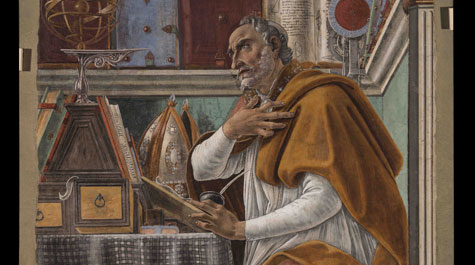
As an Italian renaissance painter, who counted Michangelo and Leonardo Da Vinci as contemporaries, my favorite painting is that of Saint Augustine, in his study. Augustine is in the process of writing to St. Jerome, who had recently died, though Augustine was not aware of this, when he began his letter. As the story goes, the scene anticipates Augustine’s reaction to a vision of hearing St. Jerome’s voice, rebuking him for trying to understand the mysteries of Heaven, with Augustine’s earthbound reason.
Many of Botticelli’s works were lost when an exuberant 15th century Dominican priest, Girolamo Savonarola, sought to rid Florence, Italy of objects that might tempt one to sin, on the Mardi Gras festival. Thankfully, not all of Botticelli’s works were destroyed during the Bonfire of the Vanities, so be sure to catch a glimpse of them at this, the first traveling exhibit of Botticelli’s work, to the United States.
(37) Now when they heard this they were cut to the heart, and said to Peter and the rest of the apostles, “Brothers, what shall we do?” (38) And Peter said to them, “Repent and be baptized every one of you in the name of Jesus Christ for the forgiveness of your sins, and you will receive the gift of the Holy Spirit” (Acts 2:37-38 ESV).
Acts 2:37-38 is one of the most controversial set of verses in the New Testament. Particularly in verse 38, the larger issue concerns the order of salvation; that is, what is the process by which a person becomes saved? This doctrine of ordu salutis, from the Latin, has been discussed in various ways by different Christian traditions, ranging from Catholic, to Calvinist, to Wesleyan. We will save this bigger question for a later discussion but will focus here on one narrower, particular part of the puzzle, namely water baptism.
Does water baptism save a person? According to some traditions, such as a few branches of the Churches of Christ in Protestantism, water baptism is a requirement for salvation. In fact, in some cases, if you are not water baptized in certain churches, then these church traditions will not consider you to be a true Christian. This doctrine of baptismal regeneration argues that Acts 2:38 describes a sequential process prescribing what salvation entails, specifically, that water baptism leads a person to be forgiven of their sins.1
Critics of baptismal regeneration say that this flips the New Testament teaching on salvation by faith, and not by works, upside down, suggesting that the physical act of baptism is somehow a work that saves a person. How can this be?
If baptism can save a person, what does this mean? Continue reading
Thankfully, there are a number of great study Bibles available today, with helpful tools to get you into God’s Word. But I want to tell you about a new one, the NIV Faithlife Study Bible, that I am really excited about, and why I recommend it.
The NIV Faithlife Study Bible has actually been available online for sometime now, from Faithlife, the company known for its Logos Bible Software. The NIV Faithlife Study Bible was designed for online use, either from an iPhone, iPad, Android, Logos Bible Software package, or via web browser on your desktop computer (and it is FREE!!!). It has detailed verse-by-verse notes, to aid your understanding, plus some visually engaging graphics, charts, timelines, and sidebar articles. Plus this online version, links into other helpful study resources, including Veracity’s “blogger-in-chief,” John Paine’s favorite, the NET Bible.
Now, the NIV Faithlife Study Bible has been released as a standalone book, something that you actually hold in your hands. I like the digital stuff, but there is still something about having a bound stack of paper in my hands, that I can take to a Bible study small group. Here is a sample.
Secondly, Faithlife sought to give a broad perspective, with respect to various denominational traditions, as to the content of the study note materials. They are committed to this idea that the study of the Bible should not be conducted inside an echo chamber, where all you hear and read is from a single evangelical tradition. Unfortunately, there are some study Bibles out there that only give you one point of view, typically the perspective of the guy with his name of the cover (In other words, if you ever see something like the Morledge Study Bible in your local Barnes and Noble, you are better off if you take a pass on it).
Are there any downsides to the NIV Faithlife Study Bible? Well, from what I have seen, the maps in this study Bible are not as good, as compared to what you find in my ESV Study Bible. With respect to the online version, it takes some time getting used to the navigation, which at first can be confusing. But once you get the hang of it, it is rather cool.
I am still wedded to my trusty ESV Study Bible, with the NIV Zondervan Study Bible, a close runner up, but the NIV Faithlife Study Bible is right up there near the top of the list. You can always try it out online or via a SmartPhone app, to see if you really like it, first. Michael Bird is an Australian Bible scholar, who is an enthusiastic endorser for the NIV Faithlife Study Bible. View his videos below, and consider getting this study Bible for you, or a friend, who really wants to dig in deep into God’s Word.
God, The Bible and The Shack is a short pamphlet, designed to help readers of W. Paul Young’s The Shack navigate through some tough theological issues.
In the study of logic, a false dichotomy is when only two options are presented, either believe this or that, even though there might be yet a third option available. The fallacy of the false dichotomy is that it excludes other reasonable alternatives.
I really hope I am wrong. But sadly, it appears that several recent Christian films (and their associated books) are trying to exploit certain false dichotomies that are increasingly popular in the church today.
On one side, stands something like Del Tackett’s Is Genesis History?, blogged about several times here on Veracity (#1, #2, and #3). According to some reviewers, such as Alan Shlemon at Stand to Reason, though there are some very positive elements in the film, Shlemon thought that Is Genesis History? plays into the notion that the church is divided into two different groups: the sole defenders of the Bible, who unswervingly hold to a view of the earth as being young, around 6,000 years old, versus compromised Christians, who undermine the Bible by accepting anti-Christian, scientific evidence of an earth that is millions of years old. Of course, Del Tackett, in an admittedly kind, warm and unassuming way, urges Christians to pursue the first option, and shun the second.
For Del Tackett, the question of, “Is Genesis History?,” is of great interest, in terms of the age of the earth. But it is often a misleading question. “Is Genesis True?,” is a much more profound and disturbing reality to consider. Alan Shlemon rightly sees the fallacy here, regarding the fundamental argument from the movie as a false dichotomy. Continue reading