Why Does God Allow Evil and Suffering?

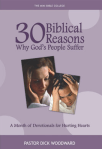
When God gave us His Word, He was not in denial regarding the suffering of His people. Have you discovered the Bible is filled with Scriptures that answer the ‘why’ questions the people of God ask when they are hurting? I have been in a wheelchair since 1983 and have been totally paralyzed for many years. What I have written here is not unproven theory from passages in the Bible. I have personally needed to search the Scriptures and find these “Thirty Biblical Reasons Why God’s People Suffer.” If you are suffering, or you know someone who is, join me as I explore thirty biblical responses of God to people with hurting hearts.
Dick Woodward, 30 Biblical Reasons Why God’s People Suffer
30 Biblical Reasons Why God's People SufferHow can an all-powerful and good god allow evil and suffering?  As William Lane Craig points out, the problem of evil and suffering is the primary argument against the existence of God.  In this presentation he argues that “Christian theism is man’s last, best hope for a solution to the problem of evil,” distinguishing between the intellectual and emotional versions of the problem of evil.

But the question is so profound that it can be particularly difficult to separate emotions from intellect.  It can gnaw at our soul. Even those who accept the existence of God can have a hard time resolving evil and suffering. Continue reading


Veracity’s Top 10 Scorers

Veracity's Top Scorer Award

Do you ever wish there was a blacklist we could use to avoid being blindsided by bad doctrine or theology?  After all, there is so much material out there—who has the time to sort through it all?

When you think about it, a blacklist is a pretty ridiculous idea isn’t it? Not that there aren’t all kinds of names—from the famous to the infamous—that deserve to be called out, but there is a much better way for thinking men and women to attack this problem.  Study the good guys.

Welcome to Veracity’s Top 10 Scorers list. These are the players who consistently “put the puck in the net.” No deking and skating around—just on-target discipleship.

The list includes pastors, philosophers, professors, a historian, theologians, apologists, an astrophysicist, several world-class scholars, and some exceptionally gifted teachers.  (Actually there are 12 winners on our Top 10 Scorers list, because they all deserve the award.) Continue reading


Can We Trust the Bible?

“The Bible says it, I believe it, that settles it.”  Really?!

Many theologians and pastors strongly disagree.  If there was such a thing as a fantasy theology team, my top (living) draft picks would include: Dick Woodward, William Lane Craig, Hugh Ross, Ravi Zacharias, Matt Slick, Tim Keller, John Yates, Michael Card, Ray Vander Laan, Andy Stanley, Lee Strobel—and Daniel Wallace.

Here’s a slightly irreverent, very funny, and spot-on lecture by Dr. Wallace given at Dallas Theological Seminary about the “worst Christian slogan ever concocted” (my apologies in advance to people from Arkansas).

Seriously, how much research is there to corroborate Dr. Wallace’s observations and conclusions?  How reliable are the Bibles we have today?

Continue reading


Parsing Greek

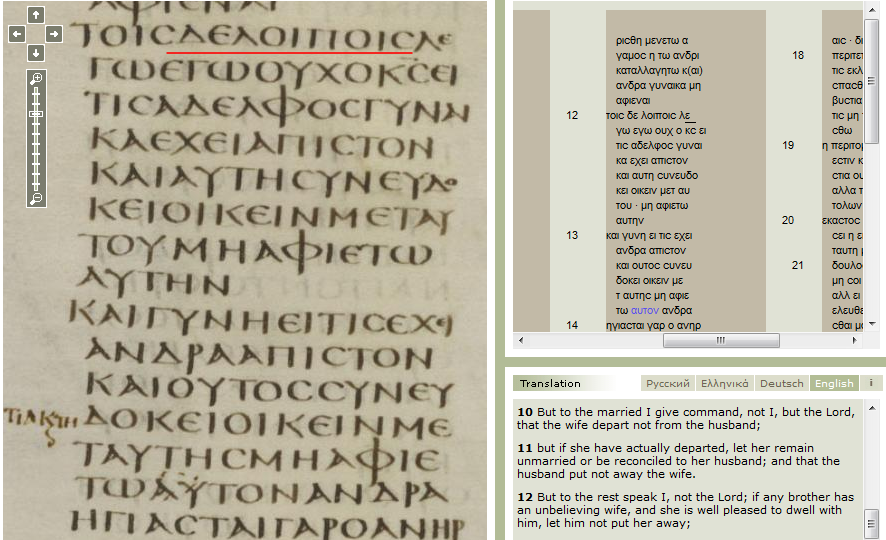
1 Corinthians 7:12

1 Corinthians 7:12 in the Codex Sinaiticus

Scripture contains some amazing context clues that point to its trustworthiness. For example, consider the Apostle Paul’s words in his letter to the Corinthians:

To the married I give this charge (not I, but the Lord): the wife should not separate from her husband (but if she does, she should remain unmarried or else be reconciled to her husband), and the husband should not divorce his wife. To the rest I say (I, not the Lord) that if any brother has a wife who is an unbeliever, and she consents to live with him, he should not divorce her.
1 Corinthians 7:10-12 (ESV)

Paul makes a point of stating that verse 10 is from the Lord.  But in the very next statement (verse 12) Paul writes, “I just want to add my thoughts here.”   He makes it completely clear that these are not God’s words verbatim.  This does not imply that Paul’s words should be deprecated or discredited in any way—quite the opposite.  Paul was careful to differentiate that which was directly from God and that which was from Paul.  Not exactly the approach of someone who is making things up or playing loose with the facts, is it?

This is not a post about divorce.  Divorce has to be considered in the context of what Jesus said in the Sermon on the Mount, and Paul’s words here and elsewhere have to be read in context.  But what is particularly exciting is the nature of Scripture that is revealed in these verses. Continue reading


How Does God Reveal Himself?

According to a recent study, 80 percent of Americans never doubt the existence of God.  No surprise really; there are many powerful arguments to support theism.  The simplest arguments for God’s existence—and some of the most effective—involve the fine tuning we observe all around us.  Nature gives us innumerable reasons to believe.

Check out this stunning time-lapse video from TSO Photography.

The Mountain

It’s no accident that gazing up into the firmament inspires awe for our Creator.  Our Creator intended that it should.  God clearly reveals himself in the world around us. Continue reading