Category Archives: Apologetics

A Fake-News Jesus? Why “Jesus Myth-ers” Should Take a Trip to Rome … (for Christmas)

After Thanksgiving, I was greeted by the following Tweet message being passed around from Harvard psychologist, Steven Pinker:

Pinker is a brilliant cognitive psychologist, linguist, and popular science author, but apparently he needs some help with his history. This new book by R. G. Price is hoping to popularize the notion of “Jesus Mythicism,” namely that Jesus of Nazareth never existed. Perhaps such “Jesus Myth-ers” should consider taking a trip to Rome, and dig a little through history.

This idea that Jesus never existed has really taken off over the past few years, picking up a lot of intrigued interest among atheists, that apparently now includes Steven Pinker, even as early as two years ago!  If professor Pinker has no opportunity to go to Rome anytime soon, say in time for Christmas, he might want to consider reading material from Tim O’Neill, a fellow atheist, who gets his history right, as discussed months ago here at Veracity. The details are too much to go into here, but O’Neill’s series on “Jesus Mythicism” is simply fantastic, where he basically argues that “Jesus Mythicism” is roughly the atheist equivalent of the belief in a “Flat Earth,” being promoted by some conservative Christians.

I guess we all have our embarrassing, crazy family members to deal with at holiday family gatherings.

But why is Rome important when it comes to talking about “Jesus Mythicism?” (… and why Christmas?)

Price’s self-published book is a revisionist reading of the Gospels, but “Jesus Myth-ers” more commonly make a different, yet just as historically convoluted, argument. Long time Veracity readers would know that those who promote “Jesus Mythicism” often say that Christianity stole much of its belief system from the Roman cult of worshipping Mithras, popular among Roman soldiers during the first centuries of the Christian era. For example, “Jesus Myth-ers” typically contend that the Christian claim, of Jesus being “born of a virgin,” at Christmas, was actually taken from the Mithraic religion, which supposedly claimed that Mithras was also “born of a virgin,” on December 25th.

Tim O’Neill has a great (yet long) post about the cult of Mithras, that should effectively dismantle such spurious claims (O’Neill has another great post that critiques R. G. Price’s own, even more peculiar version of “Jesus Mythicism,” that does not address the Mithras religion). The evidence to support the claim, that Mithras was “born of a virgin” on December 25th, is either non-existent or terribly “stupid” at best (“stupid” is how Price’s “fellow” atheist, Tim O’Neill, describes it!).

So, when my wife and I had the opportunity to go visit Rome earlier this year, I was determined to find out more about Mithras myself…. just to make sure.

The Mithras cult was a big deal in ancient Rome, and there are several places in Rome where archaeologists have found Mithraic temples buried well below buildings from the later Christian era. The closest modern equivalent to Mithraism might be the Masonic movement. Imagine a fraternity of like-minded, Roman soldiers coming together to perform sacred rituals, with all of their secret handshakes, and whatnot.

It helps to have an idea of what Mithras looked like. I was able to get this snapshot below of Mithras stabbing the cosmic bull, at the Vatican Museums. It was hard to get a good, front-on shot, due to the crowds, but this is what I saw: That is a dagger in his right hand, being thrust into the right shoulder side of the bull:

Mithras slaying the cosmic bull, at the Vatican Museums (from Clarke Morledge’s Android phone)

Tours to see the archaeological remains of these Mithraic temples were hard to get, as the spaces to get into these underground areas were pretty tight. Thankfully, we were able to go to the Basilica of San Clemente, a church in the Lateran part of Rome, which has a unique, multi-layered architecture. At the main entrance (see photo below), of the church, you enter the main sanctuary, built in the 11th century.
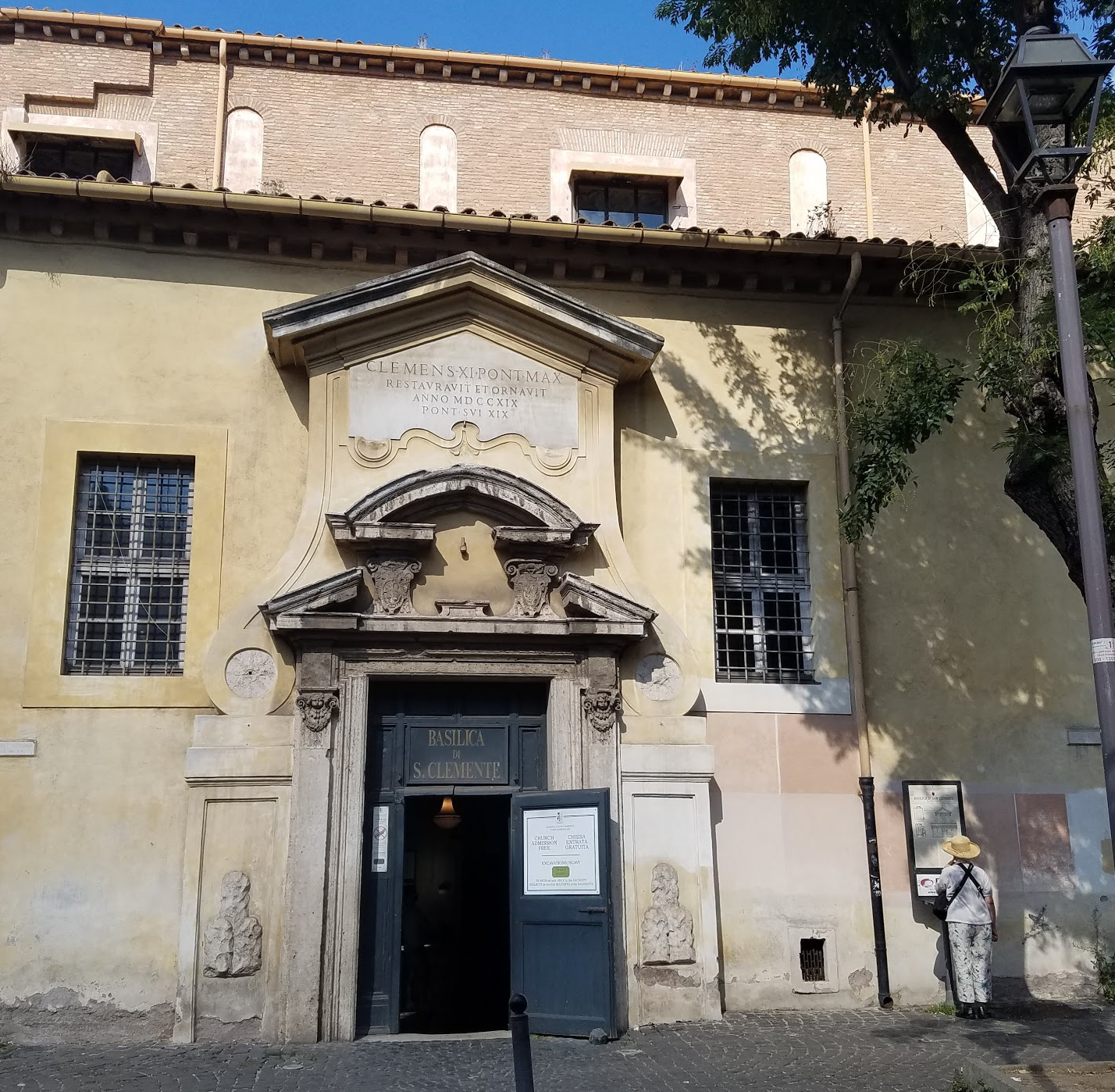
Entrance to the Basilica of San Clemente, in Rome, Italy (my wife has her back to me, as she is reading the entrance sign to the far right of the door).

From the sanctuary, I was able to walk to the church’s courtyard to get a better outside look, facing the entrance to the sanctuary:
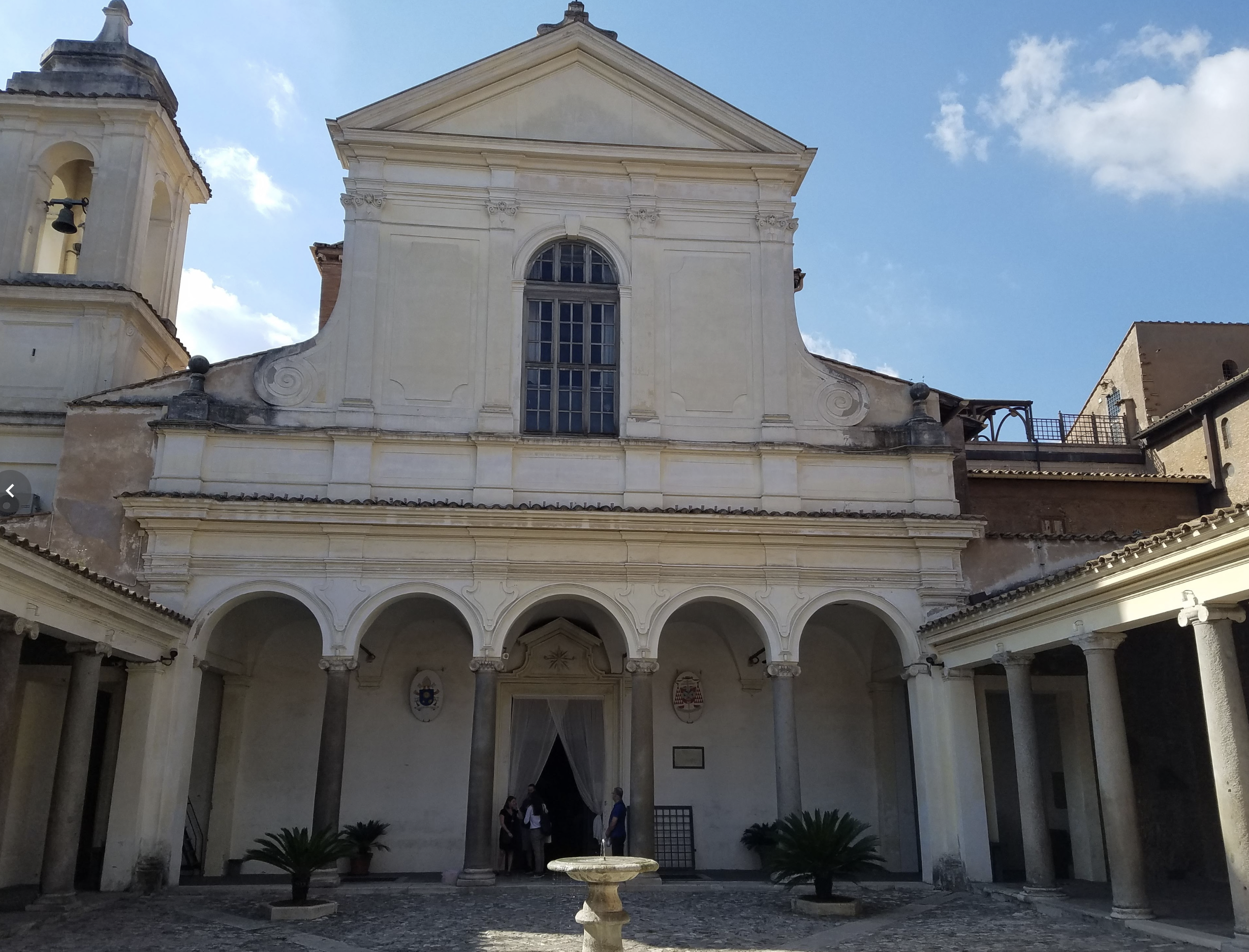
Basilica of San Clemente courtyard, on a beautiful day in Rome (October, 2018)

Below that level is a 4th century church, which itself was built out of a home temporarily used for Christian worship, dating back to the 1st century. In the basement of this home, was a Mithraic temple, that was in use briefly in the 2nd century A.D.

Apparently, the Christians were here in this house first, before the Mithras worshippers got to the basement. The docent we had was pursuing graduate studies in Italian history, and she was a wealth of information about all things Mithras. Not one word about the supposed parallels between Christianity and Mithraism came up. We were not allowed to take photographs inside the church or underground, but this photo comes from the guidebook you can buy from the church’s bookstore:
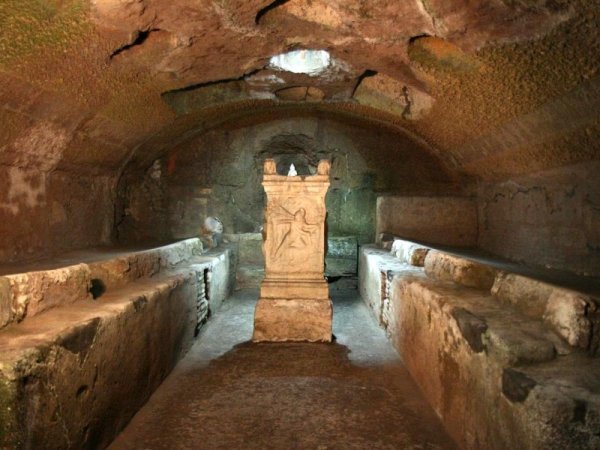
Basement Mithraic temple, underneath the Basilica of San Clemente (from the church guidebook). Note the relief image of Mithras stabbing the cosmic bull, on the altar.

Once you do a little “digging” (pun intended!), you get the idea that far from being a copycat faith that stole from Mithraism, Christianity is actually quite different. Neither Mithraism nor Christianity lines up anything like what the “Jesus Myth-ers” imagine them to be.

Sure, the fact that Mithraism and Christianity are very different, does not necessarily mean that Christianity is true. A strong consensus of scholars is convinced that Jesus indeed did exist, even if many of these scholars reject the idea of God becoming Incarnate at Christmas. There are atheists, like Stephen Pinker, R. G. Price, and the more historically astute, Tim O’Neill, who do not “buy into” the Christian claim of Jesus being risen from the dead. I pray that God might touch their hearts and minds in a manner that they might see the Risen Jesus clearly.

But at the very least, the trip to Rome that my wife and I took helps to confirm that when someone says “Merry Christmas,” it is not just a clever way of saying “Merry Mithras” instead.


Listen to Nick Peters’ Deeper Water’s apologetics podcast, where Nick interviews Tim O’Neill discussing Jesus’ Mythicism. Tim O’Neill wrote a short review of Steven Pinker’s 2011 best-selling book, Better Angels of Our Nature, that should cause any Pinker enthusiast to pause. Steven Pinker and Nick Spencer debate one another, on the Unbelievable podcast, hosted by Justin Brierley, earlier in 2018, on the topic, “Have Science, Reason and Humanism Replaced Faith? (Youtube)” New Testament scholar N.T. Wright responds to Steven Pinker’s claim, that human rights were not derived from Christianity (Youtube).


The Bible, Rocks and Time, A Review

The Bible, Rocks and Time. Davis A. Young and Ralph F. Stearley make a definitive and exhaustive case for Old Earth Creationism, from a geologist perspective.

I remember the day I stumbled across Davis A. Young’s, Christianity and the Age of the Earth, tucked away on the “new books” shelf of my college library, in the spring of 1983. Friends had invited me to attend a Wednesday night Bible study, studying the Book of Genesis, in the home of a local pastor. My head was swirling with confusion, as I learned all about the idea that the earth was only 6,000 years old. But in my science classes, ever since falling in love with science as a first-grader, I was learning a quite different story, of the modern scientific consensus, that the earth was 4.54 billion years old.

My college pastor was (and I am sure, still is) one of the sweetest and kindest of men I have ever met, a genuine, sincere and godly person. He did not have much of a science background, but he was passionate about the truthfulness of God’s Word, and I was eager to learn. He just “knew” that the “days” of Genesis were literal 24-hour periods, which for him, implied a Young Earth.

My science professors at college, on the other hand, several of whom told me that they were Christians, had relatively little knowledge of the Bible, as compared to my pastor. But they assured me that the great antiquity of the earth was well established, beyond a reasonable doubt, a reality that I had known at least something about since elementary school.

So, who was right? My pastor? My science professors? How was I to sort this whole thing out?

My questions had landed me into having a full-blown crisis of faith. I had not grown up in an evangelical church, so I had no background in skepticism about radiometric dating methods, that so many kids today in home-schooled families regularly ingest, from their online science curriculums.  But I had also become a follower of Jesus in high school, having realized that my nominal church upbringing was pretty weak when it came to understanding the Bible and its authority. So, here I was in college, confused as to whom to believe. Do I trust my pastor? Do I trust the scientists? Is the truth of Christianity tied to a belief in a 6,000 year old earth, contradicting the modern, scientific consensus? Continue reading


The Bible is Reliable… or Is That Just “Your” Interpretation?

Several churches in our community have been working through Explore God, a series of questions that seek to spark conversations about God. This past week’s question has been: “Is the Bible Reliable?” Lurking behind this question is often a different question, “Should we really take the Bible literally?”

My typical response is to ask a person, “What do you mean by literally?” Often, to take something “literally” means to read something in a very “plain” sense way. But “plain” according to whom?

Often the pushback I get is that the Bible is simply just a matter of one’s own interpretation. “That is just your interpretation, so why should I believe what you think about the Bible?”

Here is the problem with that: It concedes the point that getting at the “plain” sense of the Bible is at least sometimes easier said than done. But it does not follow that Bible interpretation is always simply up for grabs, and therefore the Bible is necessarily unreliable.

What we need to be able to do is to understand the original context in which a particular text was written. It is the purpose and meaning that the original author had in mind, and not our own context, that should govern the interpretation of the Bible. As a result, the possibilities of how to interpret a text are necessarily limited to a certain range of potential meanings: a singular sense for a very clear text, and multiple senses for a difficult text. But with hard work and study, we can come to even a much clearer understanding of the most difficult texts.

Here is a good example of a difficult text, that cause some people to question the reliability of the Bible:

For just as Jonah was three days and three nights in the belly of the great fish, so will the Son of Man be three days and three nights in the heart of the earth. (Matthew 12:40 ESV).

Here Jesus is drawing upon the story of Jonah and the great fish to explain His future crucifixion and ultimate resurrection. A plain, supposedly “literal” reading of the text reveals a problem.  If you take “three days and three nights” in a “plain” sense, it gives you 72 hours. But the standard understanding of Jesus’ death and resurrection is that He died on Good Friday and then rose on Sunday, about a 36 hour time period. Measured in hours, that timing is way off!

Well, there you go. The Bible is wrong here, and therefore is unreliable, and can not be trusted…. But is that a correct interpretation?

Now, there are folks who go to great lengths to show that the traditional interpretation of Jesus dying on Friday has been miscalculated by the church. Some contend that Jesus was crucified on Wednesday. Others contend that Jesus was crucified on Thursday.  Sure, you can pull all sorts of evidence together to try to support one of these alternative views, to make the “three days and three nights” work, as a way to defend and prove that the Bible is “literally true.”

But what if you are not convinced?

There is a much simpler solution to consider: Some scholars, like Andreas Köstenberger, suggest that we have evidence to demonstrate that the phrase “three days and three nights” is actually an old Semitic idiomatic expression, that is simply unfamiliar to modern English readers. Any portion of a 24-hour period of time could constitute “a day and a night.” So if Jesus died on a Friday and then rose from the grave on Sunday, that would give you “three days and three nights:” part of Friday, all of Saturday, and part of Sunday. Just because this idiom would be unusual to us does not rule out the possibility that Jesus and/or the biblical writers would have known about such idioms, or metaphors, and used them freely in the Bible.

In other words, when the original Scriptural writer employed so-called “literal” language to describe something, without metaphor or embellishment, we today should cling to interpreting the Bible in the same manner. But when the writer does intentionally use metaphorical or figurative language, to express God’s truth in Scripture, we should cling to interpreting the Bible, again, in the same manner, as in the original.

So, to say that “the Bible is reliable,” is not just a pious excuse for appealing to one’s own interpretation of the Bible. We can appeal to the evidence to build a strong case that the Bible, rightly interpreted, is indeed reliable…. and therefore, trustworthy.

Additional Resources:

Some say that the Bible is unreliable, because they argue that the copying process of the New Testament had so many errors, that we really do not know what the original New Testament even said! The following clip from the documentary “Fragments of Truth,” shows that such claims are wildly exaggerated, as one learns the story of one famous, 3rd century New Testament fragment, P45, which was discovered in Egypt, and currently now on display in Dublin, Ireland (Go here for a critical, yet fair review of the documentary).

Dr. Bill Mounce, a leading English Bible translator, for the ESV and NIV, makes the point that many people, including many Christians, misuse the word “literal” when it comes to describing Bible translations (see the following 7-minute video). For an in-depth look at what Dr. Mounce is saying, listen to this talk he gave recently at Liberty University (you will need to adjust your audio level).

The Gospel Coalition has a bunch of interesting videos that explore this common objection, “That’s Just Your Interpretation” (Don Carson, Al Mohler, Robert Smith Jr., Ligon Duncan, and a panel discussion, with Russell Moore, Mika Edmondson, and Ligon Duncan).


The CSB Apologetics Study Bible: A Review

Can you defend your faith, when skeptics ask you the tough questions?

I work at a state-run university, so as we get geared up for a new class of entering freshmen this week, I have a recommended new resource (or more) that can help equip anyone… and particularly students … with good answers.

The Christian Standard Bible (CSB) is the next-generation version of the older Holman Christian Standard Bible. The CSB translation was released in March, 2017, and has recently been incorporated into The CSB Apologetics Study Bible, which I have the pleasure of reviewing.

Continue reading


The Historical Adam

Was there a real Adam, the sole progenitor of the human race? Is the text of Genesis 1-11 historical or mytho-historical? Did snakes talk? Did the apostle Paul regard Adam as an historical person? What is at stake with the raging debate over the historical Adam?

Veracity readers may wish to plug in and follow the work of Dr. William Lane Craig, who is beginning a new, expanded study on this topic.

CraigUpdate