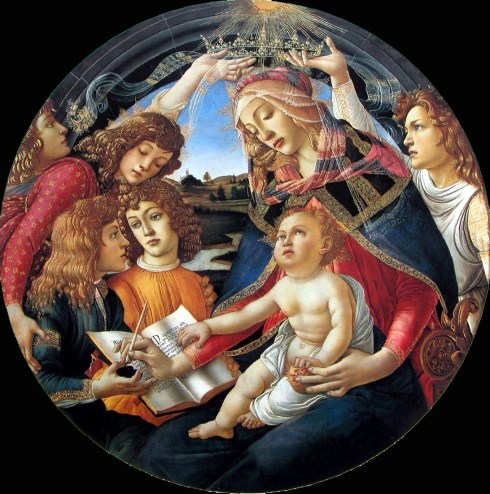
Our church recently began an Advent sermon series on the “Gospel in Song,” introducing the four great songs in the Gospel according to Luke that address the coming of Jesus. Each song, Mary’s Magnificat(Luke 1:46-55); Zechariah’s Benedictus (Luke 1:67-79); the angels’ Gloria (Luke 2:13-14); and Simeon’s Nunc Dimittis (Luke 2:28-32), derives its name from the first word of the respective texts in Saint Jerome’s Vulgate translation of the Bible into Latin. For example, “Magnificat” is Latin for “[My soul] magnifies.” Saturated with references to the Old Testament, Luke’s record of Mary’s (the Mother of Jesus) song continues to draw attention to the radical proclamation of the Gospel.
As the Latin language has become something of a quaint, archaic language of the past in our contemporary, secular society, only to be occasionally revived by classical education programs and home schoolers, the impact of songs like the Magnificat simply sound foreign to the modern ear. However, the Christian church in the West has put the Latin text of the Magnificat to music as part of the worship experience for centuries, and it remains one of the most beautiful expressions of biblical literary genre declaring the Gospel. God, in His wisdom, uses a wide variety of literary genres, including historical narrative, poetry, parables,… and song, in the Bible, to reveal His Truth to us.
Suppose that you’re a Christian who wants to share your faith with a Muslim. How would you go about doing that? Further, suppose that you appreciate how difficult it is for anyone to overcome what they have been taught adamantly since birth. Muslims who convert to Christianity are considered apostate and subject oftentimes to ostracism and harsh treatment. They break their family’s hearts. The penalty for apostasy in many Islamic countries is death. Conversion is serious business. Sharing could get very uncomfortable.
There are many, many testimonies online about Muslims who have converted to Christianity. Their stories are fascinating, heartbreaking, shocking, tragic, joyful, unlikely, and often involve dreams. Many relate miraculous healing or delivery from dire circumstances. Some, like the five Christians noted below who were raised by Muslim parents, answer a calling to witness to the global Muslim and Christian communities after they become Christians.
So what causes a Muslim to become a Christian? If you listen to Nabeel Qureshi or Abdu Murray, or even Mona Walter, you might get the impression that the common catalyst is steadfast friends who genuinely love them and reflect the love of Christ. While that appears to be true in many cases, after reviewing scores and scores of testimonies, there seems to be an even more common basis for Muslim conversions, namely critical thinking.
Critical thinking is not easy. It requires us to put away our feelings, our dogma, our subjective instincts, and to apply disciplined thinking that is “clear, rational, open-minded, and informed by evidence.” Sometimes the important questions are self-induced, and sometimes they are offered by friends who risk feeling a little uncomfortable. Either way they can move mountains.
What about our critical thinking? When we think about Muslims, do we envision terrorists? Are we that prejudiced? Or do we think about millions upon millions of people who need to hear the truth of the Christian Gospel? Are we ready to give a “reason for the hope” that is within us, with gentleness and respect? Do we have compassion for our brothers and sisters in Islamic countries who are persecuted for their beliefs? It’s very easy to feel anger and to hate when we are attacked. Terrorists are the enemies of free people everywhere. But what did Jesus say about our enemies? His words make us unique among the world’s religions, as does His sacrificial atonement. That should mean something.
We try not to give advice on Veracity, but we’re not at all above taking advice. Take it from Abdu Murray; if you want to reach out to a Muslim, don’t begin by attacking Islam—begin with the positive case for Christianity. If you want to engage in critical thinking, study Nabeel Qureshi’s Seeking Allah, Finding Jesus. Nabeel and his friend David Wood engaged in that process for five years. (If you watched David’s sociopath-turns-Christian testimony, don’t stop there.) Both of these guys were brilliant and committed to opposite truth claims. It got very uncomfortable at times between them, but their friendship only grew stronger as they subjected their beliefs to critical thinking. It cost Nabeel greatly. But he was willing to pay the price because ultimately he accepted the truth. I really cannot recommend his book highly enough. It is an incredible account of the power of friendship and apologetics in transforming even an ardent Muslim.
Take a little time to explore the links and testimonies of the incredible people below. If they are willing to risk their lives to share the Christian Gospel, as many of them do, maybe we shouldn’t worry so much about being uncomfortable.
Happy Thanksgiving, from your friends at Veracity. Wheaton College history professor, Robert Tracy McKenzie, and blogger at “Faith and History,” will get you right about Thanksgiving. Enjoy!
Many of you may be headed to the airport or the interstate for holiday travel, and if so, you might want to pass the time by listening to the podcast of a recent interview that I did with Professor Al Zambone of Augustana College. Zambone maintains a great site called “Historically Thinking” that features conversations with historians on a wide range of topics. Al and I had a lengthy conversation recently about popular memory of the First Thanksgiving, and you can find it here.
Alternatively, you might be interested in a different podcast on Thanksgiving that I did with my old University of Washington colleague, political scientist Anthony Gill, who moderates a wonderful site titled “Research on Religion.” You can access that podcast here.
Both individuals are wonderful scholars and you would find much of value on their sites.
What is biblical inerrancy? At one level, it is pretty simple and straightforward. As Christian philosopher and apologist Norman Geisler says, “The Bible is the Word of God, and God cannot err; therefore, the Bible cannot err.” If the Bible cannot err, the Bible is inerrant. Broadly speaking, I support this logic.
Such logic, essentially means, that when we read the Bible, we can have the confidence that God is speaking truth to us, through the sacred text. A so called “Bible difficulty” is due to either an error with the translation, a faulty exposition being given about what the Bible says, or because of some misunderstanding on the part of the reader. The problem is never with God’s Word itself.
Pretty clear, right? Well, as they say, often the “devil is in the details.” Different Christians sometimes have different ideas of what they mean by “inerrancy,” and these differences can have diverse consequences in the details. Digging into those details has led some people to be encouraged in their faith in times of doubt, while raising more doubts in the minds of others, and thereby providing fuel to the skeptics’ fire. How can this be?
Pure and undefiled religion before God the Father is this: to care for orphans and widows in their misfortune and to keep oneself unstained by the world.
James 1:27, NET
Islam and Violence
In our previous post on Basic Islam, we introduced the question, “Has true Islam been hijacked by radical elements, as many claim, or do the acts of terror that are so prevalent in the world today have epistemological roots in Islamic doctrine and theology?”
It’s been an interesting week. I met Nabeel Qureshi and asked him how he would answer that question. (I also attended several conference presentations on Islam, and heard some diverse opinions on how to respond to Islam and how to deal with Muslim refugees.)
It’s an extremely loaded question. On one hand, those of us who have been blessed with close friends who are Muslim have a hard time accepting that Islam equates necessarily to violence. On the other hand, we cannot ignore the proliferation of terror that is perpetrated in the name of Islam.
So which is it? What did Nabeel say?
He said, “My answer is summarized, violence is built into the DNA of Islam.”
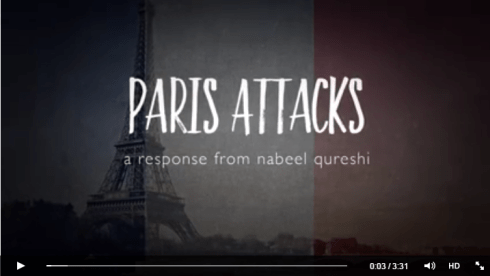
But he also referred me to several of his online videos and his book, Seeking Allah, Finding Jesus (which I bought from Audible and listened to in its entirety on the way home from the conference. If you want to read an incredible story about the power of friendship and the value of apologetics in winning people to Christ, read this book.)The next day, Nabeel posted the following three-minute video on his Facebook page.
Is the God of Islam the God of Christianity?
It would seem that because Christianity and Islam have their roots firmly in Genesis and Old Testament history that they worship the same god. But the biggest chasm between Muslims and Christians is the Trinity. While both faiths are monotheistic, Muslims abhor the idea that God exists in three distinct persons. In fact, the greatest sin in Islam (shirk) is to associate anyone—such as the Son or Holy Spirit—or anything with Allah.
But there is more to it than that. Theologians debate the moral sufficiency of the God of Islam, making strong arguments that Allah and the God of Christianity cannot be one and the same. While it may not be the first thing you would bring up with a Muslim friend, it’s important to understand. “The violence [that] is built into the DNA of Islam” is part of the moral sufficiency argument.
William Lane Craig’s recent presentation, entitled “The Concept of God in Islam and Christianity,” makes comparisons based on moral sufficiency. Dr. Craig takes on the unpleasant reality of the differences between Christianity and Islam. If we are going to reach Muslims for Christ, we better get used to the idea that we cannot ignore the differences. If this makes us uncomfortable, we are going to have to learn to deal with it.
No Shortage of Shortsighted Self-absorption
At both of the conferences I attended this week, there were sessions on Islam, including one entitled Responding to Islam. At that session, four presenters discussed ideas on how to handle the refugee crisis in the Middle East. One presenter, who has impressive credentials as a theologian, professor, and lawyer, gave a presentation on specific concessions he would require from Middle Eastern refugees wanting to enter the United States.
His presentation was full of the angry sentiment we hear on the news these days in the wake of the Paris attacks. It was also pompous, self-aggrandizing, and downright mean. He said several times that if his proposal kept good Muslims from entering the United States, “Worse things could happen.” Not exactly what one might expect from a follower of Jesus Christ.
One woman in the audience gave him favorable comments, and a man in the back asked for a copy of his paper. It may just be my impression, but there seemed to be more than a little appreciation for what he said.
Then a young man stood up and politely asked, “What is the New Testament basis for your proposal—in light of what the Bible has to say about orphans and widows?”
Wait a minute. We’re supposed to think and act according to the New Testament?! Orphans and widows…like in James 1:27? Are you kidding me? (I could get quite smarmy, so I’ll just stop there.)
Taking the High Ground
Nabeel was the first to speak at the panel discussion after that presentation. He was gracious and did not take on the mean presenter. He noted that his father was persecuted in Pakistan for his Islamic beliefs and that he came to the United States as a refugee. If we talk about responses to ISIS without realizing the unprecedented opportunity we have to share the Gospel with the Muslim world, we miss the point. We should consider what is happening to innocent Muslims. We are here [on this earth] to reach out to others. We must share the Gospel. For 1,400 years we have done virtually nothing to reach these people.
I really don’t have anything to add to that. “Pure and undefiled religion before God the Father is this: to care for orphans and widows in their misfortune and to keep oneself unstained by the world.”