J. I. Packer, at 89 years old, is still one of the great statesmen of the Christian faith today. A Christian book publisher, Crossway, has done a series of short, 3-minute interviews with Packer looking back over his substantial career as a theologian for the church, containing much wisdom for any and every Christian, old and new. Topics include, “What is Repentance?” and “What is Faith?”
Now, there is a twenty minute film reviewing his life… “In His Own Words.”
While writing this post, Islamic terrorists carried out a series of attacks in Paris on November 13, 2015. Our thoughts and prayers are with the victims’ families, friends, and all those affected by these atrocious acts of barbarism. At such a time as this it is quite difficult to think about Islam in any objective light. Has true Islam been hijacked by radical elements, as many claim, or do the acts of terror that are so prevalent in the world today have epistemological roots in Islamic doctrine and theology? Political leaders call for a war on terrorism, and we think about drone strikes and military missions. Sadly, people everywhere are being drawn into this war—whether it makes sense to them or not.
I am not inclined to run around claiming that the apocalyptic end of mankind is at hand, but regarding war Jesus said,
“For many will come in my name, saying, ‘I am the Christ,’ and they will mislead many. You will hear of wars and rumors of wars. Make sure that you are not alarmed, for this must happen, but the end is still to come. For nation will rise up in arms against nation, and kingdom against kingdom. And there will be famines and earthquakes in various places. All these things are the beginning of birth pains. Then they will hand you over to be persecuted and will kill you. You will be hated by all the nations because of my name. Then many will be led into sin, and they will betray one another and hate one another. And many false prophets will appear and deceive many, and because lawlessness will increase so much, the love of many will grow cold. But the person who endures to the end will be saved.” (Matthew 24:5-13, NET)
So for those who think that we can somehow ‘win’ the war on terrorism, read the book. These wars will be with us to the end. Not convinced? Take a look ahead at Revelation 13:7.
But we are not called to sit by idly. Should we fight terrorism? Absolutely, with our full might—not just our military might. Jesus did not fight with the sword or attempt to raise up a militant army, but He did call upon us to spread the Gospel truth in the name of the Father, Son, and Holy Spirit. We have to fight with the same kind of compassion, love, and commitment that Jesus taught. Not an easy thing to do at any time, let alone in the wake of terrorism. My contention in writing this series of posts is that if we are to share the Gospel of Jesus Christ with Muslims, we should know something about their faith.
Basic Islam – Part 3
In our first two posts on Islam, we’ve looked at the foundational documents of the faith and learned a bit about the history of Islam and Muhammad. In this post, we’ll take a high-level view of what Muslims believe.
As stated at the outset, the deeper you look into any major religion, the more divergent that religion becomes. It’s easy enough to go to trusted sources, say CARM for example, to get the basics, but there’s a potential inherent bias when you ask someone outside a particular faith to describe that faith. And that holds true for any major religion.
If you want to know what Muslims believe, one inside source would be IslamiCity.org. Their web page on Understanding Islam and Muslims was prepared by The Islamic Affairs Department of the Embassy of Saudi Arabia in Washington DC. Some Muslims would disagree with certain statements, but it is worth taking the time to read if you are interested in learning about Islam. (Hardliners within and outside the faith could argue that this representation is too polished and politically correct, and others argue that it is “anti-Western in general and anti-American in particular,” but it is helpful nonetheless.)
So, what do Muslim’s believe? In no particular order, that:
God is singular in personhood, with no peers. There is only one God in all existence. God has complete authority over humankind in this world and life after death. In Arabic, God’s name is Allah.
God is supreme, omniscient, omnipresent, unique from His creation, and in control of everything. Everything that exists does so by His permission and will.
God revealed himself through a chain of prophets starting with Adam and including Noah, Abraham, Ishmael, Isaac, Jacob, Joseph, Job, Moses, Aaron, David, Solomon, Elias, Jonah, John the Baptist, and Jesus. God’s final message to man was revealed to the prophet Muhammad by the angel Gabriel.
After the supremacy of God, Muslims believe that Muhammad was the supreme and final prophet.
Angels were created from light, and jinn are another type of being, created from fire, who are invisible yet all around us.
The Quran is the dictated word of God and is completely authoritative. The Hadith are the collections of sayings and deeds attributed to Muhammad. Muhammad is the exemplar of Islamic faith, and Muslims seek to imitate him.
Abraham, in the book of Genesis, is a patriarch of Islam. Abraham is believed to have built the Kaaba in Mecca.
Mosques are the most important places of worship and are always pointed towards Mecca, the city of Muhammad’s birth. Mecca contains the Kaaba, or “House of God,” which houses a sacred stone upon which Abraham held Ishmael when he was building the Kaaba. The Kaaba is the most sacred place in Islam.
Christians have misconceived God. Muslims strongly deny the Trinity. The greatest sin in Islam is the sin of shirk—which is equating anyone or anything to be equal with God. Muslims understand the Christian Trinity to consist of God the Father, Jesus, and Mary (not the Holy Spirit).
Jesus was a prophet, was born miraculously from the dust like Adam (not born of a virgin), but He is not divine. He performed miracles and was a great prophet, but He was never crucified (the likeness of Jesus was put on another man, and that man was the one who was crucified). God saved Jesus by raising Jesus up to God. Jesus was not resurrected from the dead.
There is a Day of Judgment and individual accountability for actions.
No sacrifice is required to be forgiven by Allah. Forgiveness can be achieved through faith in Allah, sincere repentance, and obedience to Islamic law. Thus, Jesus’ atoning sacrifice was not necessary.
The Hadith describe the “Five Pillars of Islam,” which are: 1) the Shahada, which is the proclamation, “There is no true God except Allah, and Muhammad is his messenger,” 2) Salat, the five daily prayers, 3) Sawm, fasting, 4) Zakat, charity, and 5) Hajj, the pilgrimage to Mecca for all Muslims who are able.
Muslims who adhere to the Five Pillars of Islam, remain in the faith of Islam, and sincerely repent of their sins go to Jannah (paradise) when they die. If they do not remain in the faith, they are apostate. Apostasy is handled in different ways under Islamic laws in different countries, with punishment ranging from execution to imprisonment, but in some countries there is no punishment.
Islamic law should govern the entire world. (Not all Muslims believe this, but many do.) The framework of Islamic law is called Sharia, and there is a great deal of controversy within Islam about what that law specifically requires and how it is enforced. Radical Islamists use particular interpretations of verses from the Quran and certain Hadith to justify their acts of jihad, which can include terrorism and other forms of barbarism.
There are sects and factions within Islam that practice religious observances and hold views that are outside the mainstream faith. Examples include the Shiite holiday Ashoura (for which I won’t even provide a hyperlink because it involves grotesque self-mutilation), honor killings, and continuing acts of terrorism carried out in the form of jihad and in the name of Allah.
If you are trying to understand “Islamic fundamentalism” or “radical Islam,” some form of interpretation of, and adherence to, Shaira law is involved. If you study Islamic history, there is no shortage of bloodshed—as Islamic-historian-turned-Christian-evangelist Dr. Mark Gabriel notes.
But we still haven’t addressed the question, “Has true Islam been hijacked by radical elements, as many claim, or do the acts of terror that are so prevalent in the world today have epistemological roots in Islamic doctrine and theology?” We will.
As a kid in middle school, I fell in love with Gordon Lightfoot’s song telling the haunting story of the tragedy. I pretty much had the whole song memorized. I still get goose-bumps every time Lightfoot gets to the part where he sings:
When suppertime came the old cook came on deck Sayin’ “Fellas, it’s too rough t’feed ya.” At seven P.M. a main hatchway caved in; he said, “Fellas, it’s bin good t’know ya!” The captain wired in he had water comin’ in and the good ship and crew was in peril. And later that night when ‘is lights went outta sight came the wreck of the Edmund Fitzgerald.
In my mind, I envision water breaking through that main hatchway, taking the ship down into the icy, cold lake. I get the chills just thinking about it.
The problem is that you have to allow Lightfoot some artistic license in his telling of the story. The fact is, we simply do not know what the “old cook” said, nor did the ship captain after that wire anything about “water comin’ in.” Earlier that fateful afternoon, huge waves had already broken over the deck of the “Fitz,” causing substantial damage, resulting in a “bad list” and the loss of both radar units. The last radio transmission to a neighboring ship was, “We are holding our own.” Some twenty minutes later, after 7 P.M., the ship went down.
Lightfoot’s imaginary speech from the cook makes no substantial alteration to the basic story. In fact, it aptly summarizes the desperate situation the crew were facing. However, what is potentially significant, is that detail about, “At seven P.M. a main hatchway caved in.”
Did someone forget to properly secure the hatchway? Was the hatch cover faulty? Was there human error involved?
It can make a difference.
Subsequent expeditions to the ship have since proven that there was no human error related to the ship’s demise. For the families of loved ones who were lost that evening, this knowledge absolves the crew of any wrongdoing on their part. When Lightfoot learned of the new evidence in 2010, he promised to alter the potentially offending lyric in future performances from:
At seven P.M. a main hatchway caved in; he said…
To a more accurate:
At 7 p.m. it grew dark, it was then he said…
Hatchways Caving In, as a Lesson for Christians When Reading Their Bibles
This could be a bit of a stretch for some, but in my mind, the story of the Edmund Fitzgerald tells us a lot about how Christians can better understand their Bibles, believe it or not.
Just like me with the Gordon Lightfoot song, people can often grow up with certain pictures in their mind about different passages of the Bible. An idea or image can easily stick in our head, when if you look at things a little more closely, in light of new evidence, it would require some changes to how we mentally represent something that the Bible says.
Here is a good example: in the King James Version (KJV) of the Bible, 1 John 5:7-8 reads like this:
For there are three that bear record in heaven, the Father, the Word, and the Holy Ghost: and these three are one. And there are three that bear witness in earth, the Spirit, and the water, and the blood: and these three agree in one.
I put the middle phrase in bold, because if you compare the same passage with the English Standard Version (ESV), it reads quite differently:
For there are three that testify: the Spirit and the water and the blood; and these three agree.
As with all modern translations, the explicit reference to the Trinity has been removed. This is not a glitch. Nor is it a conspiracy. This decision by modern translators is founded on good, historical evidence.
In the field of textual criticism, scholars work with ancient documents that have been copied and recopied over the centuries, in order to try to arrive at what is most probably the best and most accurate original reading of the text involved. This particular case, known by scholars as the Comma Johanneum, is famous in that there are no ancient copies of the New Testament that include this explicit reference to the Trinity. At best, the earliest we find any reference to the Comma Johanneum is about the 4th or 5th century A.D., and that was from a church homily, not a copy of the New Testament, according to textual scholar, Dan Wallace. The added phrase only appears rarely in medieval copies of the New Testament, mostly being found in Latin texts by the 15th century. The lack of clear, ancient evidence supporting the existence of this phrase casts serious doubts on it historical authenticity. Since Christian faith is founded on history, scholars are obligated to treat the scriptural text with a respect for history.
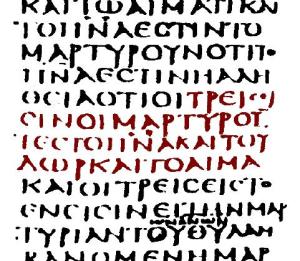
Codex Sinaiticus is one of the oldest copies of the New Testament discovered by scholars within the past two centuries. In this excerpt from I John 5:7-9, it lacks the explicit reference to the Trinity, the Comma Johanneum, that made its way into the King James Bible in 1611. The colored text reads, “There are three witness bearers, the Spirit and the water and the blood.” (image credit: “CODEX SINAITICUS 1 John 5:7- 8 Comma Johanneum” by Pvasiliadis – Own work. Licensed under Public Domain via Commons)
But once you get accustomed to a particular rendering, it becomes difficult to break old habits of thinking. Most scholars today agree with the great, late medieval textual critic, Erasmus of Rotterdam, who attempted to give Christians in the 16th century an improved, accurate text of the Bible. Erasmus suspected that a Latin copyist inserted the extra words into 1 John 5:7, probably with good intent, but nonetheless, it was not original to the text. So, Erasmus removed the phrase from his publication of the Greek New Testament.
However, a number of people who were so accustomed to the phrase demanded that Erasmus put it back. They complained that removing the phrase was an attack on the doctrine of the Trinity, as it is the only place in the King James Version of the Bible where there is an explicit reference to the Trinity. But when read in context, this passage is not necessarily meant by the New Testament author to teach the Trinity so directly, though one could allegorize the three-fold nature of the Godhead from these verses. The Trinity can be readily defended implicitly by examining other verses in the Bible. Removing the phrase does not take away anything regarding the biblical doctrine of the Trinity. Erasmus was aiming for the accuracy of that particular text, but others were more concerned about maintaining the traditional rendering that stuck in their minds and their imagination.
Erasmus caved into the pressure and reinserted the phrase in later editions of his Greek New Testament. The King James Version of the Bible, translated in 1611, is based on Erasmus’ later editions of the Greek New Testament, which is why the KJV preserves the phrase.
Now, I probably will never get accustomed to Lightfoot’s new rendering of the Wreck of the Edmund Fitzgerald song, though the new alteration is surely more accurate. Likewise, many people who grew up reading the KJV have become quite attached to the Comma Johanneum. So, I understand why some might complain about the changes found in modern translations of the Bible.
But think about those families who lost loved ones on the Fitzgerald. Lightfoot’s new rendering clearly preserves the honor of that crew that went down with the ship, in a way that the older, more popular version that I heard on the radio in the 1970s left unresolved. Likewise, when we read our Bibles, we should be more concerned about accuracy than trying to preserve the cherished memories of our Bible imagination.
Here, Gordon Lightfoot discusses why he changed the lyrics:
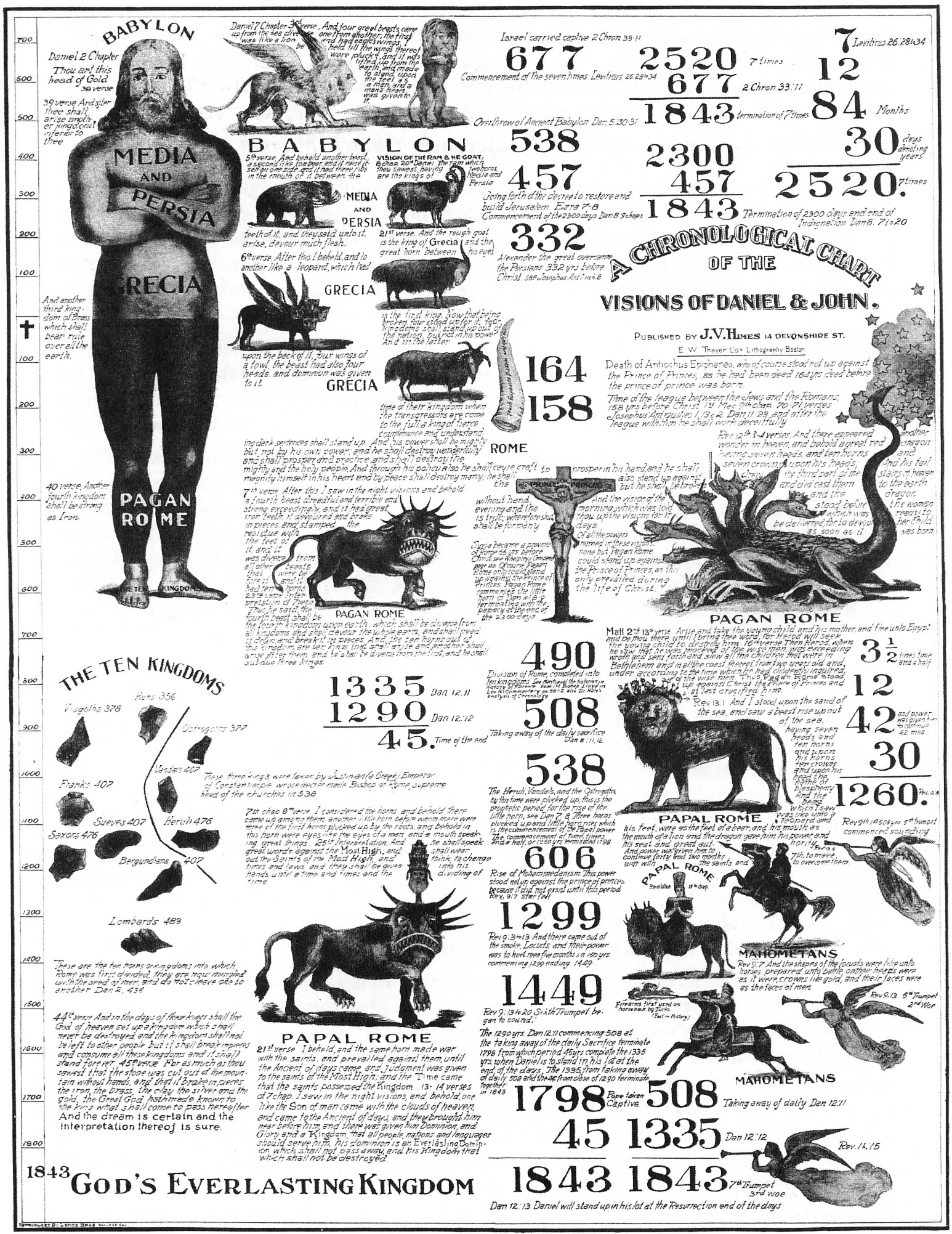
William Miller’s prophecy chart, identifying the Second Coming of Christ in 1843. It has as much detail, if not more, than a dispensationalist chart!! (credit: Wikapedia, click on for more detail).
From a Great Disappointment to ecstatic visions, from corn-flakes to flaky fanatics in Waco, Texas, the Seventh-Day Adventists, and their associated spinoffs, have shown themselves to be a peculiar movement, as we have discussed in the previous posts in this series (#1 and #2). In a less peculiar sense, Seventh-Day Adventists have championed the cause of religious liberty, the promotion of good diet and health reform, and a growing network of schools, hospitals, and other humanitarian missions, themes that have permeated the wider culture around them. Yet, in many ways, there are dramatic shifts going on within Seventh-Day Adventism that raise questions about the future.
Some Seventh-Day Adventists today are basically like any other Protestant evangelical Christians, except that they go to church on Saturdays. Others are very much into the whole Seventh-Day Adventist package of beliefs and practices, that have set the movement apart from the rest of Christianity. It really depends on the congregation, and even within congregations. That being the case, how should other Christians view the Seventh-Day Adventist movement, and where it is headed?
The Quran is believed by Muslims to be the word of God dictated by the angel Gabriel to Muhammad. The Hadith are the recorded sayings and actions of Muhammad. There are thousands of them, and many have questionable authenticity, so there is a grading system. The biographies of Muhammad, or sīra, are considered by some to be part of the Hadith. Muslims believe that Muhammad is the exemplar of their faith and they aspire to imitate him. The sīra provide information that helps in their practice.
All Muslims accept the authority of the Quran. As you get more into the Hadith, the faith divides into sects with differing interpretations and beliefs (not unlike Christian denominationalism). The authority framework is all important, and shapes the derivative interpretations of Islam.
If you’re going to understand the basics of Islam, you must know something about Muhammad, the early history of Islam, how the Hadith came into being and how they are used today, and how Sharia law forms the framework for Islamic jurisprudence.
If you want to get an overview in less than an hour, here is a very informed presentation by Nabeel Qureshi that can help. I appreciate Dr. Qureshi’s empathy for Muslims—too many Christians take the terrorism we see reported in the news and never get beyond those horrifying impressions to develop even a modest understanding of Islam. I’m not in any way suggesting that the world should empathize with the violence that is carried out in the name of Islam, but we cannot address what we refuse to understand. After all, if you want to share the Christian faith with Muslims, wouldn’t it help to know something about their faith?