Category Archives: Topics

Pentecost! Why the Charismatic Movement Freaks Out “Respectable” Evangelicals … (and What We Can All Learn)

Fired up by enthusiasm, the theology of “the baptism in the Holy Spirit,” is taking over the globe. But what is it exactly? (photo credit: Getty Images, Economist magazine)

Do you experience the presence of the Holy Spirit in your life? Would you say that you live a “Spirit-filled” life? Do you long for the power of the Holy Spirit to permeate your Christian walk and witness?

Or does a lot of talk about the Holy Spirit give you the “heebie-jeebies?” Have you ever been to a church meeting, where you heard “speaking in tongues,” saw people “slain in the spirit,” or claimed “faith healings,” and you felt a little bit… er…. uncomfortable?

What are we to learn then from the miracle at Pentecost?

When the day of Pentecost arrived, they were all together in one place. And suddenly there came from heaven a sound like a mighty rushing wind, and it filled the entire house where they were sitting. And divided tongues as of fire appeared to them and rested on each one of them. And they were all filled with the Holy Spirit and began to speak in other tongues as the Spirit gave them utterance (Acts 2:1-4).

My evangelical church has a wide set of backgrounds. Some have a Pentecostal or charismatic movement background, with positive views towards those experiences, bearing testimonies of the Holy Spirit working in incredible ways, that push us beyond rational, naturalistic categories. Others have had some exposure to such movements, but eventually left with a bad taste in their mouth.

Everyone else I know are in a group I call the “respectable” evangelicals. They generally maintain a low profile in church, though some will lift up their hands while singing worship songs, but not too high, less they feel self-conscious.

“Respectable” evangelicals are freaked out by “charismania.” They have heard of the abuse, ranging from phony faith healers to money-addicted, promoters of the prosperity gospel. There is now even this “New Apostolic Reformation,” whereby people think that God is restoring today’s church with real, live apostles, just like in the days of Peter and Paul, bearing all sorts of spiritual authority, that only the real Peter and Paul ever possessed.

It can be a real mess. Continue reading


History in Charleston: French Protestants Come to South Carolina

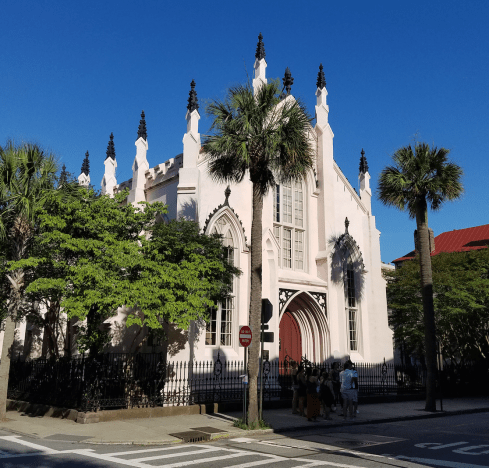
The French Huguenot Church in Charleston, South Carolina, one of the many church buildings in the “Holy City.” It is a beautiful structure, where I saw at least two, presumably engaged couples, getting their photo taken on the church steps.

My wife and I recently returned from a trip to Charleston, South Carolina, a city loaded with history. Charleston is known as the “Holy City,” due to the large number of church steeples that dot its historic skyline. One of these churches peaked my curiosity, as it ties into a lot of my family’s history. The old French Huguenot church, in Charleston’s “French Quarter,” has a remarkable story behind it.

Though the worship building was built in 1844, the French Huguenot community in South Carolina dates back to the late 17th century. In the previous century, during the tumultuous 16th century of the Protestant Reformation, a rapidly growing community of Reformed-minded Christians was spreading throughout France. The ideas of sola scriptura (Scripture alone), sola fide (faith alone), and sola gratia (grace alone), championed by Reformation leaders, such as Martin Luther and John Calvin, had captured the imagination of about 1/4 of France’s population.

But tensions were running high between these advocates for Reform, and more traditional Roman Catholics. Theology was mixing with politics to create a lethal stew. In one of the greatest tragedies of Europe, thousands of French Reformation believers, their families, and particularly their leaders, were killed during a mob uprising, the infamous Saint Bartholomew Day Massacre, in 1572. The massacre signaled the end of religious freedom for those advocates of Reform in France.

Of those who survived the massacre, thousands more of these French Protestants, also named “Huguenots,” (for unclear reasons), were forced to leave the country over the next 100+ years. This is where we get the modern word “refugee” from, a French word originally used to describe Huguenots who were exiled from their homeland.

Protestant countries across Europe extended asylum for these refugees. But the number was so great, that it became impractical for these French believers to remain in Europe. The “New World” in the Americas was opening up at the time, so a number of these refugees sought to try to make a new life for themselves in the Americas.

At least one of these groups of refugees, that eventually passed through England, then found their way to Virginia, in 1700, to live in a former Native American village, Manakin, southwest of Richmond, Virginia. A line of my ancestors, from the “Sallé” family, helped to establish Manakin, eventually blending into the larger surrounding, English-speaking society.


Joseph Manigault, descendant of French Protestant refugees who made it to the colony of South Carolina, built this grand Charleston home, from the wealth he gained from African slave-labored rice production.

Another group of French refugees made their way to Charleston, South Carolina, my focus here. The Huguenots of Charleston were enterprising, many of them being from the merchant and tradesmen classes, originally in France. Like their Virginia counterparts, these French Protestants began to blend into the larger English-speaking society as well, though many of them continued in passing along their Protestant Christian heritage.

The early 19th century home of Joseph Manigault, a descendant of these earlier French Huguenot pioneers, built a very large home in Charleston, which is now available to the touring public. It is tragically ironic, that the Manigault family, who left Europe because of oppression, became members of the ruling, elite class of antebellum South Carolina, making their fortune on the backs of African slave labor, through their network of labor-intensive rice plantations.
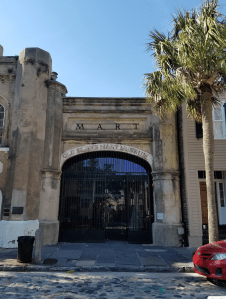
The Charleston Slave Mart Museum, originally a private slave market that opened after the public slave trading ended in Charleston, in the early 19th century.

While touring the Old Slave Mart, an indoor market where slaves were bought and sold in the first half of the 19th century, I discovered another French Huguenot connection. The Slave Mart interprets the history of the slave trade in Charleston. Some 40% of all African slaves, who entered English-speaking America, passed through the port of Charleston.

When looking at one of the exhibits, I ran across the slave name of Olaudah Equiano (1746-1797), who eventually became an early leader of the abolitionist movement. At a young age, Olaudah Equiano was kidnapped from Africa, and taken to America. He was eventually sold to an owner in Virginia, where he also received the name of “Gustavus Vasa.”

“Gustavus Vasa” is a very important name in my French Huguenot ancestry. “Gustavus Vasa” was the name of a 16th century Swedish king, who as told to me by my mother, offered temporary sanctuary to a group of French Protestant refugees, who most probably were some of my ancestors. The name “Gustavus Vasa” has been passed down for centuries in my family tree, where one of my uncles was known as “Uncle Gus.”

“Gustavus Vasa” has been an awkward name to pronounce, for Americans like me, so I was glad just to call my uncle as “Gus.” Nevertheless, the story is important. Presumably, my family’s ancestors passed the name down as a way of remembering what this Swedish king did to save the lives of my great-great-????? grandparents.
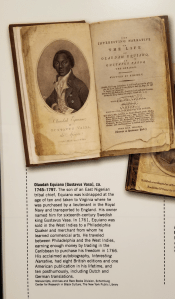
Olaudah Equiano (alias “Gustavus Vasa”) exhibit in the Slave Mart museum, in Charleston, SC.

Anyway, back to the main story… this particular African American slave, Olaudah Equiano (alias “Gustavus Vasa”), was eventually sold to a Quaker, who allowed Gustavus Vasa to purchase his own freedom. Upon gaining his freedom, Gustavus Vasa had not only become an outspoken evangelical Christian, with a vibrant love for Christ, he had also became an early advocate for abolition among freed African Americans, preserving his story in The Interesting Narrative of the Life of Olaudah Equiano, or Gustavus Vassa, the African.

This trip to Charleston, South Carolina helped me to piece together some things in my family’s history. But it also helped me to consider some of the more complicated elements of following in on the Christian journey.

On the one hand, I am inspired by the courage of my French ancestors, who stood for their evangelical faith in Christ, during a time when mass hysteria against French Protestants threatened their very lives. But I also see how tenuous it is to pass on this same faith from one generation to another. It disturbs me that it only took a few generations for descendants of once persecuted Christians to forget their past, and become the persecutors of others. But on the bright side, I am encouraged that an ancestral name in my lineage made its way somehow to one of the early advocates of abolition, a movement that eventually led to end the scourge of racial-based slavery in the United States.


Idols and Images: Ten Commandments, Yes, But How Do You List Them?

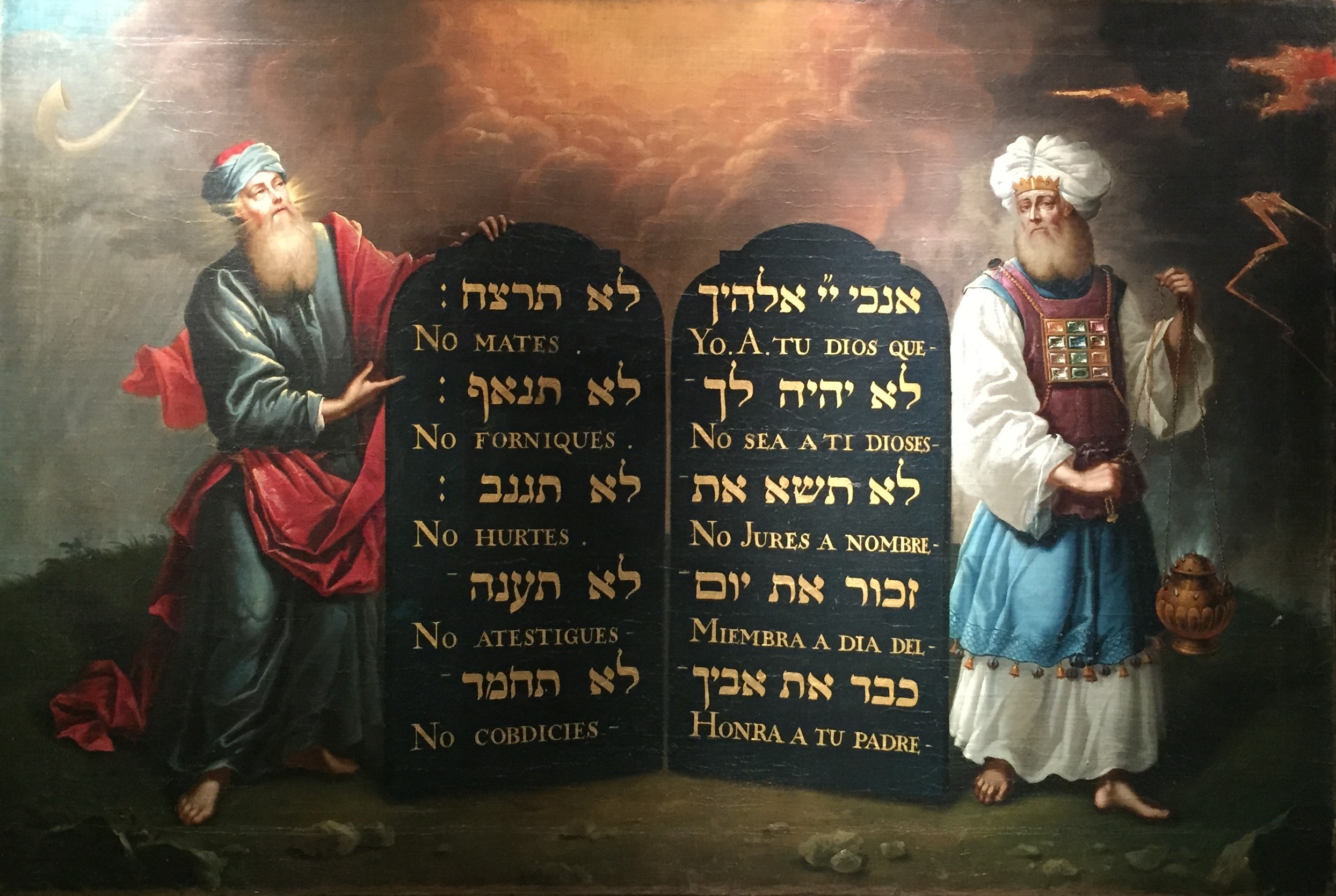
Moses and Aaron, with the Ten Commandments: Aron de Chaves (1674)

I received a little pushback offline on a previous post about dream catchers. I kind of expected that.

Christians have long struggled with the relationship between idols and visual images. Much of the controversy stems back to how Christians read the Ten Commandments, or more to the point, how various Christians read the Ten Commandments differently. An often ignored consequence of the 16th century Protestant Reformation illustrates the difficulty.

The Ten Commandments are derived from two passages from the Bible, Exodus 20:1-17 and Deuteronomy 5:4-21, texts that are very close to one another in content. But careful study demonstrates that not every Christian identifies all of the commandments in the exact same manner. However, contrary to some misguided assertions, there are no mainstream Christian traditions that have “changed” the Ten Commandments. Rather, the problem is in how different traditions have grouped the various commandments together.

An obvious question to start off with would be, so why “Ten” commandments? Well, we have three passages in the Bible that directly tell us of “ten words” given to Moses at Sinai (Exodus 34:28, Deuteronomy 4:13, and Deuteronomy 10:4).

However, the Bible was not divided up into a verse numbering scheme until the Protestant Reformation, in the 16th century. Therefore, in the early church, there was no intuitively clear way to group the Ten Commandments together. Even the Jews have had their own unique pattern of grouping the “commandments,” and it has not matched 100% with any Christian version. Continue reading


The “Breaking of the Bread” … or Whatever You Call It

“This is my Body… This is my Blood.”

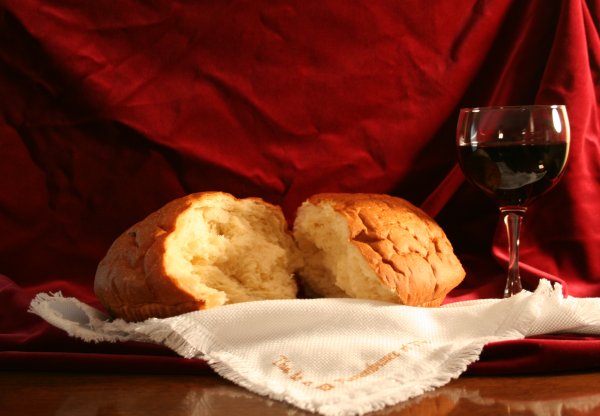
One Sunday of every month, and after the sermon, two ministers from my church, stand in front of a decorative wooden table, and instruct the congregation to receive the elements, in remembrance of Christ’s death upon the cross. But what to call this ceremony remains a subject of some debate.

At the first Pentecost, following the Resurrection, that signaled the birth of the church, we read that:

“They devoted themselves to the apostles’ teaching and the fellowship, to the breaking of bread and the prayers.”(Acts 2:32 ESV)

Many Christians still speak of “the breaking of (the) bread” to express what goes on at that table, though by association, it also includes the partaking of wine, or grape juice, as is done in my church.1 A long standing debate in the church at large, over what this means, invites rigorous discussion among believers. Does the bread and wine/juice merely symbolize the presence of Christ, as a memorial, or do they somehow point to a real, even physical(??), presence of the Lord Jesus, at that very moment?

We have explored some of the details of this controversy some time ago on Veracity. But for the moment, I have a simpler question: What do we call the whole thing, with the bread and the wine or juice, to begin with?

One of most original terms was the Greek “eucharist,” meaning “thanksgiving.” The terminology of “eucharist” goes back to the late 1st century, or early 2nd century worship manual of the early church, the Didache, to reference this most sacred meal. The term has biblical precedence behind it:

For I received from the Lord what I also delivered to you, that the Lord Jesus on the night when he was betrayed took bread, and when he had given thanks, he broke it, and said, “This is my body, which is for you. Do this in remembrance of me.”(1 Corinthians 11:23-24 ESV)

Nevertheless, a number of terms have arisen since then to describe the sacred meal, not just “eucharist.” So, what is the best terminology? Eucharist? The Divine Liturgy? The Blessed Sacrament? The Mass? What else? Continue reading


Should Christians Hold All Things in Common, Like the Early Church Did?

Members of a modern Hutterite colony, an Anabaptist group that practices sharing a “community of goods.”

Does the Bible teach that Christians should be communists, or socialists?

One of the hallmarks of the Radical Reformation, in the 16th century, was a desire to return back to following the pattern of the early church, who held “all things in common,” as taught in the Book of Acts. But what does it mean to hold “all things in common,” and does that apply to the church today? Is “communism” taught in the Bible? A look back to the 16th century controversy might give us some perspective in answering these questions.

Most Protestant Christians today trace their heritage back to what is called the magisterial Reformation of the 16th century. Early Reformers, such as Ulrich Zwingli of Switzerland, and Martin Luther of Germany, sought to work with the governing authorities, the magistrate, to implement the reforms of their associated movements. Both Zwingli and Luther believed that the medieval church had drifted away from its Scriptural moorings, over the years, and so they wanted to get people back to the Bible. But they wanted to do so in an orderly manner, which required the government’s assistance, as the contemporary values of religious freedom, or what some call “the separation of church and state,” did not exist back then.

However, in Ulrich Zwingli’s Switzerland, some people wanted to go further than where Zwingli was prepared to go. The controversy was partly based on two passages in the Book of Acts, when the message of the Gospel began to spread rapidly after Christ’s Resurrection, in the 1st century A.D.:

44 And all who believed were together and had all things in common. 45 And they were selling their possessions and belongings and distributing the proceeds to all, as any had need. 46 And day by day, attending the temple together and breaking bread in their homes, they received their food with glad and generous hearts (Acts 2:44-46 ESV). 
32 Now the full number of those who believed were of one heart and soul, and no one said that any of the things that belonged to him was his own, but they had everything in common. 33 And with great power the apostles were giving their testimony to the resurrection of the Lord Jesus, and great grace was upon them all. 34 There was not a needy person among them, for as many as were owners of lands or houses sold them and brought the proceeds of what was sold 35 and laid it at the apostles’ feet, and it was distributed to each as any had need. 36 Thus Joseph, who was also called by the apostles Barnabas (which means son of encouragement), a Levite, a native of Cyprus, 37 sold a field that belonged to him and brought the money and laid it at the apostles’ feet (Acts 4:32-37 ESV). 

The key phrase here is that they “had everything in common.” Some of Zwingli’s followers in Switzerland took this quite literally, believing that all true followers of Christ should renounce all private property, and simply share together in a “community of goods.” That sounds sort of like a Christian version of  “socialism” today… or even, “communism.” Continue reading