Category Archives: Apologetics

Should the Old Testament Be Unhitched from Christian Faith? … (Acts 15 and Andy Stanley)

Megachurch pastor Andy Stanley. He is stirring controversy again, but he is also getting Christians (like me) to think about stuff that we are not always prepared to deal with.

A lot of skeptics find the Old Testament to be a problem. A lot of Christians, if they are honest, do too.

But at the first great church council, in Jerusalem, in Acts 15, you get the impression that the earliest Christians were willing to get rid of the legal requirements of the Old Testament, in order to reach more people, with the Gospel. Staunch Jewish members of the early church resisted this, wanting Gentile converts to become circumcised, as a condition for salvation. But those like the Apostle Paul convinced the church leadership to conclude otherwise:

For it has seemed good to the Holy Spirit and to us to lay on you no greater burden than these requirements: that you abstain from what has been sacrificed to idols, and from blood, and from what has been strangled, and from sexual immorality. If you keep yourselves from these, you will do well (Acts 15:28-29 ESV)

In other words, if the Gentiles Christians were willing to adhere to these four basic requirements, they could remain in the church, without (at least the men) falling under the knife. At first, this sounds straight forward, until you read elsewhere later in the New Testament, where the exact requirement for abstaining from food sacrificed to idols, appears to be set aside as a “disputable matter,” as explained by Paul in Romans 14 and 15, where Christians can follow their consciences, as long as they do not cause other believers to stumble.

The main point seems to be that Christians should put an emphasis on unity, and that the requirements laid down in Jerusalem were more about keeping peace, than they were about adhering to moral principle.

One of America’s most influential pastors, Andy Stanley, of one of the largest churches in Atlanta, Georgia, North Point Community Church, has gone a step further, in a 2018 sermon that has caused a firestorm of controversy. Stanley lands his message by saying, “Peter, James, Paul elected to unhitch the Christian faith from their Jewish scriptures, and my friends, we must as well.

Andy Stanley has received quite a bit of pushback (Dr. Michael Brown at Charisma magazine, Wesley Hill at First Things). In understanding the Old Testament to be a problem, for many people today, is pastor Stanley throwing out the baby with the bathwater?

If you look at Acts 15, I find that many modern Christians have a problem with even the basic requirements adopted at the Jerusalem council. With respect to the requirement to abstain from “sexual immorality,” a lot of evangelicals are quick to lament how same-sex marriage, and other traditional, sexual immorality issues are being compromised, in certain quarters of the church.

But with equal force, we see the early church condemning, at least here in Acts 15, the eating of food sacrificed to idols, consuming blood, and eating the meat of animals that still have blood in them (what has [not] been strangled). And yet, how many Christians do you see today worrying about eating any food, in connection with idolatry?

Even more unsettling, and more relevant to modern Christians, what about eating red meat? Do you like your steak rare or medium rare? Are you violating the requirement laid down by the first great council of the church?

What are we to make of the binding force of the Acts 15 decree, for today’s Christians? How are we to relate to the Old Testament, rejecting what is an obstacle to faith in Jesus, without throwing the baby out with the bathwater?
Continue reading


Fragments of Truth

Interested in the integrity of biblical manuscripts? Don’t miss this one-night-only showing on April 24th, 2018.

Local showings: https://www.fathomevents.com/events/fragments-of-truth

Buy your tickets through the above link (they are going fast).

HT: Dave Rudy


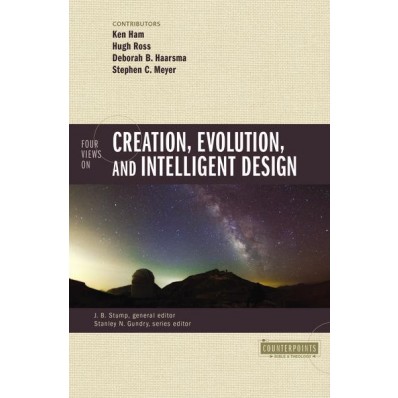
Four Views on Creation, Evolution, and Intelligent Design: A Book Review

If I had to pick one book that concisely gives an overview of the controversy over human origins, Four Views on Creation, Evolution, and Intelligent Design would be it. Part of Zondervan’s Counterpoint series, this book manages to pull together four of the leading Christian thinkers, about science and faith issues, to have them dialogue with one another in a spirit of charity and mutual respect (…for the most part).

I have been looking forward to this book for some time, as the writers are the most visible representatives of their respective positions in the evangelical Christian world today. Ken Ham, the president of Answers in Genesis, the Creation Museum and Kentucky’s Ark Encounter, defends a Young Earth Creationist position. Hugh Ross, president of Reasons to Believe, defends an Old Earth Creationist position. Deborah Haarsma, president of Biologos, defends an Evolutionary Creationist position. Stephen C. Meyer, a senior fellow with the Discovery Institute, defends an Intelligent Design position. Each contributor wrote an essay for the book, and the other three contributors wrote a response to that essay, followed by a rejoinder, by the original essayist.

There is simply no other book resource available today that gathers these differing points of view together in one volume, on this difficult topic. That, in and of itself, is a major accomplishment. A verse in Proverbs makes the point: The first to state his case seems right, until another comes and cross-examines him (Proverbs 18:17 CSB). Sadly, many Christians only hear one point of view, failing to consider other perspectives, leading to mistrust of other believers who might see things somewhat differently.

This is not to say all points of view are correct. They are not. There is but one truth. But it is difficult to properly uphold the truth, if you have not taken the time to consider other biblically responsible options. Proverbs suggests that we should hear one another out before making a firm judgment. Continue reading


One Question


Stephen Hawking, Pi Day, and God


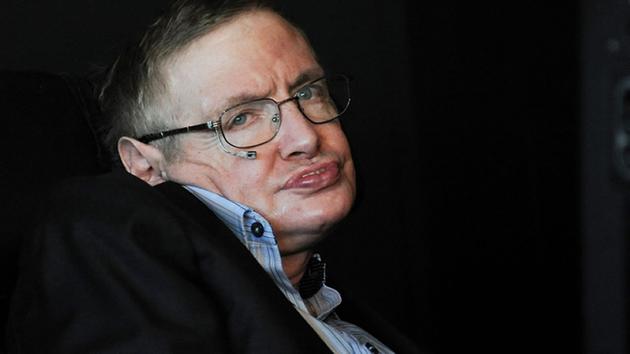
I was munching on my second piece of pie this afternoon, when I heard the news that Stephen Hawking had just died.

I work at a university, and it can be a geeky place, at least for the scientifically inclined. Stephen Hawking was not simply a brilliant scientist, who managed to think big thoughts, even while dealing with a terribly debilitating disease. He was an international celebrity, a champion for a scientific worldview. So, it is only fitting that Hawking would end his earthly life on what is now known as “Pi Day,” the mathematician’s holiday, March 14…  ( 3.14… get it??)

That’s right. Several computer geeks brought into work their freshly baked pies to celebrate PiDay.

Science has a certain allure, in that a growing segment of the world’s population believes that science can solve the world’s problems. Many have left “religion” behind, particularly Christianity, as Western culture has been gradually, yet successfully, displacing Christendom with a secular world outlook. We see this in the story of Stephen Hawking.

I first read his wonderful and amazing A Brief History of Time over a Christmas break, and it still leaves my head spinning. This was Hawking’s 1988 blockbuster popular science book, that sought to put heavy-duty concepts like the Big Bang, gravity, and the nature of time down on the bottom shelf. During those days, Hawking indicated that the laws of physics “may have been decreed by God, but God does not intervene to break the laws.” But within a few years, Hawking began to change his tune: “It is not necessary to invoke God to … set the universe going.”  By 2011, he made this statement on a Discovery Channel documentary, “We are each free to believe what we want and it is my view that the simplest explanation is there is no God. No one created the universe and no one directs our fate.”

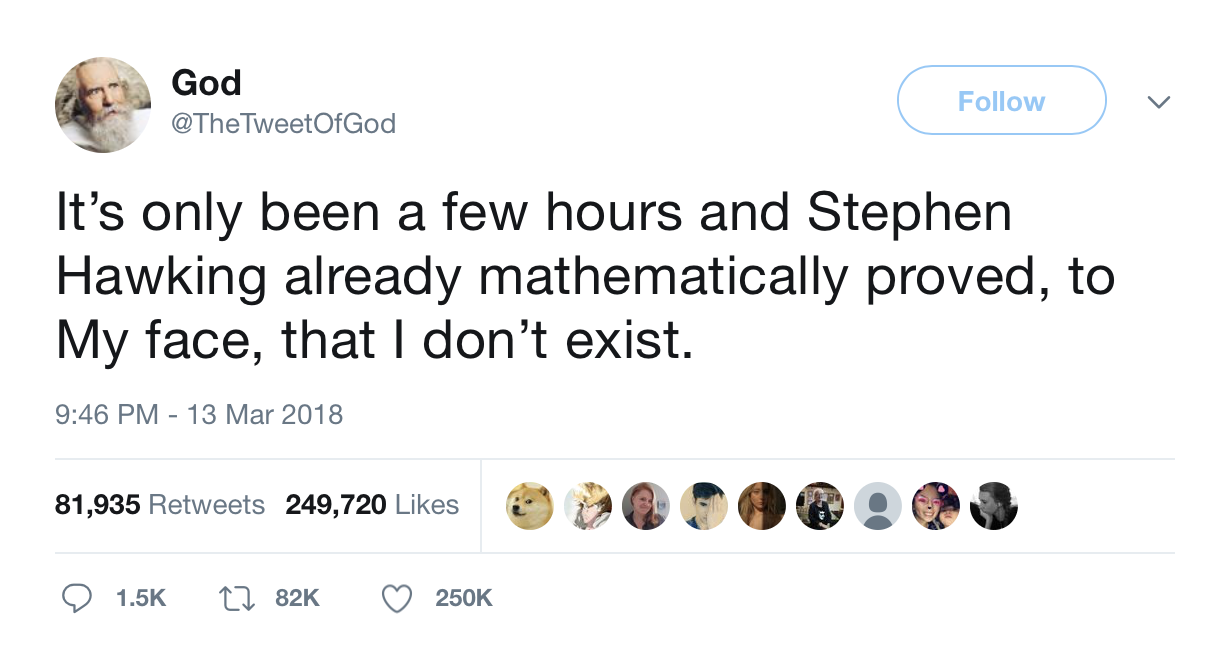
Well, science does have extraordinary explanatory power, but there is quite a bit of hubris in Hawking’s statement. Someone put some humor to this, in a Twitter feed:

Yes, the world has lost an extraordinary human being, in Stephen Hawking. Nevertheless, a more modest assessment of what science can and can not do, is sorely needed. This is where informed Christians need to step up to the forefront, and engage our culture. Trying to use science to somehow “prove” God is not going to work. What we need to show is that science does not stand in conflict with the Christian faith. We need to artfully say that the story of the Bible has the greatest explanatory power, that includes, not excludes, the story that science is trying to tell.

Christians are great consumers of science-inspired technologies, from Google to iPhones to modern medicine. However, many Christians see science itself as a threat to faith, or they are too busily occupied with disputes among themselves to engage the great challenges of our day. This does harm to the witness of the church. Believers need to stand together. Let us pray that Christians gain the wisdom and the courage to boldly tell the story of Jesus Christ to a skeptical world.