Author Archives: Clarke Morledge

About Clarke Morledge

Unknown's avatar
Clarke Morledge -- Computer Network Engineer, College of William and Mary... I hiked the Mount of the Holy Cross, one of the famous Colorado Fourteeners, with some friends in July, 2012. My buddy, Mike Scott, snapped this photo of me on the summit.

Animal Death and Suffering Before the Fall?

From the Royal Society, a graphic showing how a 2008 fossil discovery demonstrates the link between the modern turtle and its ancient ancestors.  Is there a sufficient theological reason to reject mainstream science, or Biblical reason to accept it?

From the Royal Society, a graphic showing how a 2008 fossil discovery demonstrates the link between the modern turtle and its ancient ancestors. Is there a sufficient theological reason to reject mainstream science, or Biblical reason to accept it?

When Abraham Lincoln was a small boy, he would sometimes join his friends in doing cruel things to animals. But he was uneasy about it and eventually Lincoln’s conscience kicked in. Once when schoolmates began to torture a turtle, Lincoln intervened and scolded his friends for committing a horrible act of wrong.

Human sympathy for suffering animals runs deep. I am one of those people who slow down on the highway… or even stop… when I see a helpless and confused turtle trying to cross the road. Now just consider this idea for a moment: according to mainstream science, most of the animals that have ever lived belong to species that have long ago become extinct. A lot of turtles have been “run over” by the relentless progress of evolution.
Continue reading


From The Dust

What is the role of scientific discovery in Christian faith?  Many today feel that the practice of modern science is not very friendly to belief in the Bible. Is there a way that Bible-believing Christians can make peace with the work of the modern scientist?

From The Dust is a recent documentary film that aims to reframe the discussion regarding the Bible and Science by looking at how we read the Scriptures and how we think about the art and beauty of science.   When we read Genesis 2:7, we get a grand view of the glory of God as He creates Humanity in His Image:

Then the Lord God formed the man of dust from the ground and breathed into his nostrils the breath of life, and the man became a living creature (ESV).

How does Science complement and illuminate the Biblical picture of creation?   Watch the film trailer for an idea:

With interviews by leading and influential Biblical scholars, scientists and theologians from diverse perspectives, such as N.T. Wright, Alister McGrath, John Polkinghorne, John Walton, Jason Lisle, Terry Mortenson, and Pete Enns, From The Dust hopes to reinvigorate the Christian imagination on how we approach these issues.

If you are cheap like me, you can simply review some of the film clips at the movie’s website or view them at the BioLogos website to get an idea of what it is like.  If you really like it, you can order the film through BioLogos, or download on iTunes.

Stretch your mind and enjoy!

Coming Next Weekend!!  Veracity Takes It Out of CyberSpace and Into Live and Personal Discussion!!

Facts & FaithWant to explore more about these issues in conversation with others? Then please join us at the  Facts & Faith Symposium, at the Williamsburg Community Chapel, several Sundays in November, 2013 (the 10th, 17th and 24th) at 6:30 pm.


Killing Jesus: I Guess It All Evens Out?

First, there was Reza Aslan's Jesus the Zealot.  Now, there is Bill O'Reilly's Killing Jesus.   Both books have their merits, but I would suggest sticking with books written by less politicized New Testament biblical scholars....and if you do not have time for that, just stick with the Bible.

First, there was Reza Aslan’s Jesus the Zealot. Now, there is Bill O’Reilly’s Killing Jesus. Both books have their merits, but I would suggest sticking with books written by less politicized New Testament biblical scholars….and if you do not have time for that… just stick with the Bible, please.

Several months ago, I reported on Veracity about Reza Aslan’s controversial yet popular book, Jesus the Zealot. Several waves of biblical scholars mostly panned the book, citing that despite a few thoughtful ideas here and there and some very engaging storytelling, Aslan fails to contribute anything substantially new to the discussion regarding our understanding of the historical Jesus. Now, just a few months later, conservative news commentator Bill O’Reilly has made his stab at writing a biography of Jesus of Nazareth, Killing Jesus.

Over at Anthony Le Donne’s scholarly Jesus Blog, we find an initial take on O’Reilly’s (with co-author Martin Dugard) latest blockbuster, following on the heels of other popular subjects, such as Killing Kennedy and Killing Lincoln. Sadly, Le Donne is not impressed so far. At best, Le Donne finds O’Reilly’s use of biblical and historical sources to be inconsistent. But here, Le Donne quotes one of O’Reilly’s leading statements at the beginning of the book:

“Jesus was executed. But the incredible story behind the lethal struggle between good and evil has not been fully told. Until now. At least, that is the goal of this book.” (page 4)

Wow. Such hubris. Despite the thousands and thousands of pages already printed investigating the historical identity of Jesus of Nazareth, O’Reilly is telling us that only now will he begin to tell us the full story.

That is simply incredible.

Just think about this for a moment. Here are two books by Aslan and O’Reilly that have rocketed to the top of the New York Times best seller lists. The folks at the apologetics website Stand to Reason appear to be some of the few Christians who generously find O’Reilly to be somewhat helpful, but even they stop short of a full endorsement. Furthermore, even Ken Ham at Answers in Genesis finds something to disapprove of regarding Killing Jesus. In some cases, O’Reilly takes the New Testament accounts at face value for being historical. At other times, he dismisses key aspects of the Gospels as historically valid. In the reviews I have seen, it does not seem at all clear what O’Reilly’s method is for making his historical judgments.

I wonder why you do not see books by top-notch evangelical New Testament scholars like N.T. Wright, Craig Blomberg, Ben Witherington, Craig Evans, Gregory Boyd, Mike Licona, Gary Habermas, D. A. Carson, Gregory Beale or Darrell Bock at the top of the New York Times Best Seller lists? On the positive side, both Aslan and O’Reilly show that people are still fascinated with the person of Jesus Christ, which provides a very natural opportunity for the believer to start up spiritual conversations with their neighbor.  However, it is difficult to restrain myself from thinking that politics might be part of the reason for Aslan’s and O’Reilly’s success with their books.  I do not mean to step on anyone’s toes, but it would concern me if the story of Jesus is getting manipulated here to support some different agendas.  I suppose that if Reza Aslan writes something that appeals to so-called “liberals” that O’Reilly feels compelled to write something appealing to so-called “conservatives”. I guess it all evens out perhaps?

Just a Few Weeks Away!!

Facts & FaithCome join the Veracity community at the Facts & Faith Symposium, to be held at the Williamsburg Community Chapel, on several Sundays in November, 2013 (the 10th, 17th and 24th) at 6:30pm.


John MacArthur’s Strange Fire

I normally do not blog on timely topics, but this one is too important to pass up. Last week, Southern California pastor John MacArthur led the Strange Fire conference. MacArthur’s passion in hosting this conference was to call the evangelical church to publicly refute what he sees is the error of the Charismatic Movement.

There are a few things to say about this. First, John MacArthur is very influential in the church and he is not alone in his views. MacArthur’s radio ministry, Grace to You, is heard by thousands and thousands of Christians across the world on a daily basis. MacArthur, who stands in a rather curious mix of Reformed and Dispensationalist theology, is a master communicator known for his effectiveness in the skill of expository teaching from the Bible. MacArthur is also a cessationist, which means that he believes that the supernatural manifestations of the Holy Spirit, such as speaking in tongues, ceased to be active in the church at the end of the Apostolic age, the first generation of the early church.

Secondly, the Charismatic Movement that MacArthur is protesting against is perhaps one of the fastest, if not THE fastest, growing movements in the church worldwide. While the growth of Pentecostal and Charismatic churches is modest in the United States, it is a completely different story in places like South America and Asia. Literally millions of people are being exposed to different expressions of the Charismatic Movement. I know from personal experience how significant this is as I helped to lead the music ministry at a small Charismatic church for a brief period back in my college years.

Thirdly, positively speaking, many, many Christians have been extremely blessed by what they have experienced in Charismatic churches and grown spiritually by their teachings. On the other side, tragically as with other movements, there has also been a large number of other Christians who have experienced spiritual abuse, theological confusion and tremendous disappointment in Charismatic communities of faith.

Needless to say, not everyone is happy with John MacArthur’s blanket characterization of the movement as a whole (see Adrian Warnock here and here with Loren Sandford for CharismaNews). There is a good chance that people in conservative churches will be having “spirited” conversations about John MacArthur’s conference (and the new book associated with it) for some months to come. Despite the controversy, MacArthur is raising critically important issues for the church. Down the road, Veracity will tackle the phenomena of the charismata in future posts, but hopefully it will be done in a more irenic and less polarizing manner than what MacArthur has done with Strange Fire.

Coming Soon!

Facts & FaithPlease join the Veracity community at the Facts & Faith Symposium, to be held at the Williamsburg Community Chapel, on several Sundays in November, 2013 (the 10th, 17th and 24th) at 6:30pm.


C.S. Lewis, Myth, and the “E” Word

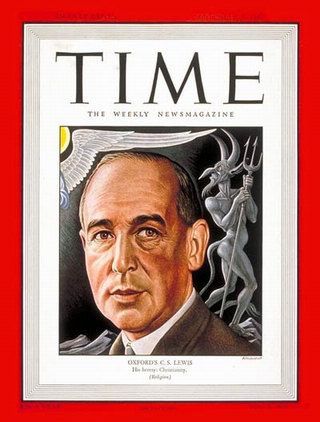
C.S. Lewis on the cover of Time magazine, 1947.  Did he ultimately find "Evolution" to be compatible or in conflict with Biblical faith?

C.S. Lewis on the cover of Time magazine, 1947, perhaps the most popular Christian apologist of the 20th century. Did he ultimately find “Evolution” to be compatible or in conflict with Biblical faith?

A few years ago, a series of letters written by C. S. Lewis back some seventy years ago came to light that has given scholars some questions as to the Narnian’s changing views regarding the “E” word. By the “E” word, I mean … “evolution”.

The “E” word is generally something you do not say in polite company around many evangelical Christians, unless you want to say something negative. Here at Veracity, we have no qualms over discussing topics related to the “E” word. Yet the stakes are high, as many students of Scripture have noted. Some say that evolution is the greatest threat to the truthfulness of the Christian message. Others, to varying degrees, say that evolution is at least partly, if not fully, compatible with Christian belief.

How do  you sort this all out?  It sure would be helpful to know what one of the most popular Christian apologists of the last one hundred years, Oxford’s C. S. Lewis, might have thought about the matter.
Continue reading