Author Archives: Clarke Morledge

About Clarke Morledge

Unknown's avatar
Clarke Morledge -- Computer Network Engineer, College of William and Mary... I hiked the Mount of the Holy Cross, one of the famous Colorado Fourteeners, with some friends in July, 2012. My buddy, Mike Scott, snapped this photo of me on the summit.

Benedictus, Hanukkah and Jesus

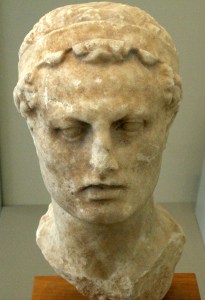
Syrian king Antiochus IV Epiphanies persecuted the Jews, which later triggered the Maccabean revolt, remembered today during Jewish holiday of Hanukkah (source Wikipedia: Altes Museum, Berlin)

Syrian king Antiochus IV Epiphanies persecuted the Jews, which later triggered the Maccabean revolt, remembered today during the Jewish holiday of Hanukkah (source Wikipedia: Altes Museum, Berlin)

Following on last week’s post on the Magnificat, from our church’s Advent sermon series on the “Gospel in Song,” we now consider the Benedictus, the Song of Zechariah, from Luke 1:68-79. The Benedictus is the great prophecy given by Zechariah regarding the birth of his son, John the Baptist (Luke 1).

In the last book of the Old Testament, Malachi, in the very last few verses, we read:

“Behold, I will send you Elijah the prophet before the great and awesome day of the Lord comes. And he will turn the hearts of fathers to their children and the hearts of children to their fathers, lest I come and strike the land with a decree of utter destruction.” (Malachi 4:5-6 ESV).

After this, the prophetic voice found in sacred Scripture is silent for some four hundred years. When would this “Elijah the prophet” come and prepare the way for the Lord?

Readers of the New Testament understand that this new “Elijah” is none other than John the Baptist.  Zechariah, the boy’s father, would sing of the “blessing”, or “benedictus”, in Jerome’s Latin Vulgate translation of the Bible, of the coming prophet who would announce that the Lord “has raised up a horn of salvation for us in the house of his servant David” (verse 69), where the “horn” is a reference to the deadly weapon and tremendous power of Jesus, the coming Messiah.

However, it is important to set the Benedictus within its proper historical context. Many Christians assume that since there is a Scriptural gap between Malachi and the New Testament, that nothing of significance happened here. But this would be terribly wrong.

A body of Jewish writings, primarily written in ancient Greek, did appear during this four hundred year “silent” period. Many of these writings found their way into the Septuagint, a collection of Greek translations of the Old Testament that effectively became the “Bible” for the early Christian movement. These writings that were not of Hebrew origin are typically known as the Apocrypha. In Roman Catholicism, the Apocrypha are considered to be deuterocanonical, or “second canon,” whereas for Protestants, these writings are simply known for being useful in terms of spiritual edification, but not sufficient for establishing doctrine. Consequentially, the lesser status of these writings has meant that the significance of these writings are often forgotten in our churches today.

But one very important incident, the Maccabean revolt, is preserved for us in the apocryphal writings of 1 and 2 Maccabees. When the Syrian Greeks led by Antiochus Epiphanes took over the land of Israel, they desecrated the Jewish temple and forbade the worship of the one True God. In response, Jewish revolutionaries led by a Judas Maccabeus resisted and successfully defeated the pagan invaders, against tremendous odds. This remarkable incident in Jewish history became the foundation for the celebration of Hanukkah.  Jesus Himself celebrated Hanukkah during his earthly ministry (John 10:22-23).

Some scholars have even suggested that the Benedictus, and perhaps the Magnificat, as well, have their historical roots, in some way, as Maccabean war songs. One might be able to see a connection here when Zechariah sings “that we should be saved from our enemies and from the hand of all who hate us “(verse 71). Whether or not these scholars are correct, is not so important. What is important is that we can surely appreciate how the early Jewish followers of Jesus saw that the message of Christmas was not simply about a sweet boy lying in a manger. Rather, they could see that the message of the Gospel, as announced by Zechariah, was a bold cry for light in the midst of a dark and hopeless world, which dovetails in rather nicely with the celebration of Hanukkah. Zechariah ends his song with:

To give light to those who sit in darkness and in the shadow of death, to guide our feet into the way of peace (Luke 1:79).

May we better understand that revolutionary message today, too.

The following 4-minute video from a Messianic Jewish community in Israel sums up the connection between Hanukkah and Yeshua (Jesus) rather well.
Krampus: “Santa’s” Dark Side

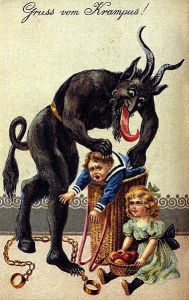
A 'Greetings for the Kampus' Christmas postcard from the early 1900s (source: Wikipedia)

A ‘Greetings from the Kampus’ Christmas postcard from the early 1900s (source: Wikipedia)

Just in time for this Christmas season, there is a new movie in theaters with a twist on Santa, Krampus (view trailer here). Krampus is actually an ancient, Alpine pagan character from pre-Christian Austria, a horrific beast who comes once year to scare children into good behavior. As the Gospel spread in that part of Europe centuries ago, the legend of Krampus got intertwined with the celebration of the Christian feast day for Saint Nicholas, on December 6. Old habits are hard to break! National Geographic has an informative write-up on the revival of Krampus celebrations, which generally takes place the night before Saint Nicholas’ day.

As Western culture continues to loosen its moorings to Christendom, it should not surprise us that Krampus makes his way to America. Krampus is yet another attempt in postmodernity to distract us from considering the mystery of the Incarnation. But it would be wrong-headed for Christians to dismiss Christmas itself as simply being of some pagan invention because of Krampus. We really need to be a bit “tongue in cheek” about this. So, I thought it might be helpful to relink a couple of older Veracity posts that dive into the history:


How Rosa Parks Became the “Patron Saint” of the Civil Rights Movement

Sixty years ago today, Rosa Parks, a “faithful member of St. Paul’s AME Church in Montgomery,” Alabama, refused to give up her seat to a white man on the bus. Gospel Coalition blogger, Justin Taylor, tells the story in this Washington Post article of how Rosa Parks, through her Christian faith, effectively became the “patron saint” of the American Civil Rights movement on December 1, 1955. Taylor notes five misunderstandings about Parks that have been distorted by popular history. While another woman previous to Parks challenged the bus segregation laws, it was the almost “biblical quality” of Parks that made her an iconic figure. How many of us today have the almost “biblical quality” that set Rosa Parks apart from others on that day in 1955?

Here is an interview with Parks before her death in 2005:

Explore these other Veracity postings on:


Magnificat

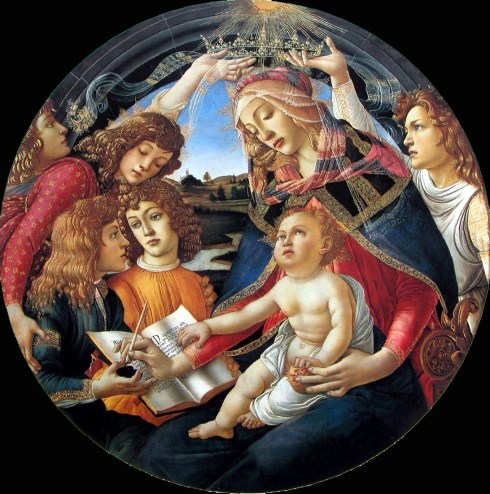
Sandro Botticelli's Madonna of the Magnificat (1481, Italy)

Sandro Botticelli’s Madonna of the Magnificat (1481, Italy)

Our church recently began an Advent sermon series on the “Gospel in Song,” introducing the four great songs in the Gospel according to Luke that address the coming of Jesus. Each song, Mary’s Magnificat (Luke 1:46-55); Zechariah’s Benedictus (Luke 1:67-79); the angels’ Gloria (Luke 2:13-14); and Simeon’s Nunc Dimittis (Luke 2:28-32), derives its name from the first word of the respective texts in Saint Jerome’s Vulgate translation of the Bible into Latin. For example, “Magnificat” is Latin for “[My soul] magnifies.” Saturated with references to the Old Testament, Luke’s record of Mary’s (the Mother of Jesus) song continues to draw attention to the radical proclamation of the Gospel.

As the Latin language has become something of a quaint, archaic language of the past in our contemporary, secular society, only to be occasionally revived by classical education programs and home schoolers, the impact of songs like the Magnificat simply sound foreign to the modern ear. However, the Christian church in the West has put the Latin text of the Magnificat to music as part of the worship experience for centuries, and it remains one of the most beautiful expressions of biblical literary genre declaring the Gospel. God, in His wisdom, uses a wide variety of literary genres, including historical narrative, poetry, parables,… and song, in the Bible, to reveal His Truth to us.

One of these compositions belongs to Johann Sebastian Bach, the great German composer of the 18th century. As you listen to Bach’s 1723 interpretation of the Magnificat, while reading the English text, or better yet, following this Latin-to-English interlinear translation, does this not stir your heart to worship the Lord Jesus?


THANKSGIVING PODCASTS TO LISTEN TO WHILE YOU TRAVEL

Happy Thanksgiving, from your friends at Veracity. Wheaton College history professor, Robert Tracy McKenzie, and blogger at “Faith and History,” will get you right about Thanksgiving. Enjoy!

rtmckenzie's avatarFaith and History

Many of you may be headed to the airport or the interstate for holiday travel, and if so, you might want to pass the time by listening to the podcast of a recent interview that I did with Professor Al Zambone of Augustana College.  Zambone maintains a great site called “Historically Thinking” that features conversations with historians on a wide range of topics.  Al and I had a lengthy conversation recently about popular memory of the First Thanksgiving, and you can find it here.

Alternatively, you might be interested in a different podcast on Thanksgiving that I did with my old University of Washington colleague, political scientist Anthony Gill, who moderates a wonderful site titled “Research on Religion.”  You can access that podcast here.

Both individuals are wonderful scholars and you would find much of value on their sites.

View original post
