
Author Archives: Clarke Morledge

About Clarke Morledge

Unknown's avatar
Clarke Morledge -- Computer Network Engineer, College of William and Mary... I hiked the Mount of the Holy Cross, one of the famous Colorado Fourteeners, with some friends in July, 2012. My buddy, Mike Scott, snapped this photo of me on the summit.

Deep Dive Into Romans: Why Saul Became Paul

Deeper-Dive

For those in the Williamsburg, Virginia area, you might be interested in an Adult Bible Class held at the Williamsburg Community Chapel, 9:30am – 10:40am, during the winter term of 2016, where we will be taking a “deep dive” into the Apostle Paul’s arguably greatest letter, the Book of Romans. Our church recently spent 10-weeks going through the first eight chapters of Romans. But frankly, Romans is filled with so many riches and questions that I thought it would be great to give an opportunity for folks to get together and dig deep into this most remarkable and influential book of the Bible. The course description:

Still not getting Romans? Have a lot of questions? Get ready to dive deep into Paul’s Letter to the Romans, and explore where church history, apologetics, and theology meet. An in-depth look into Paul’s greatest letter of the New Testament, paying particular attention to how the truths in Romans can be applied in a society today that is becoming increasingly indifferent to the Christian message.

Here is a very rough schedule of topics for the weeks ahead, subject to change (Room 156, most weeks):

  • January 10: Introduction to Romans
  • January 17: Romans 1:1-17. Paul’s Thesis for the Letter.
  • January 24 (location TBA): Romans 1:16-17. How Paul Uses the Old Testament.
  • January 31 (location TBA): Romans 1:18-2:5. Natural vs. Special Revelation.
  • February 7: Romans 1:26-27. Same-Sex Attraction and a Christian Response.
  • February 14: Romans 2:6-29. Judgment by Works.
  • February 21: Romans 3. The Righteousness of God and Justification.
  • February 28: Romans 4. The Example of Abraham.

A student in the first class this past week asked a very interesting question: So why was “Saul’s” name changed to “Paul”? Is there any significance in his name change? (Acts 13:4-12 ESV)

Well, the answer is, quite simply, we do not know for sure. Throughout the Bible, there have been incidents of name changes that reflect drastic changes in someone’s life, such as when “Abram” became “Abraham” in Genesis. In Paul’s case, his given Jewish name was “Saul.” However, Saul was also a Roman citizen, so by virtue of his Roman pedigree, he was also given a Roman name, “Paul.” Mosts scholars agree that Paul eventually adopted the name “Paul” exclusively as part of his calling to be an apostle to the Gentiles. Since Paul did not want to put up any unnecessary barriers in building relationships with the Gentiles, he opted to forgo using his Jewish name, Saul, when meeting new friends in his Gentile audiences. Paul’s sensitivity towards the cultural differences among the Gentiles helped to further his objective to break down the wall of hostility between Jew and Gentile, perhaps the greatest concern expressed in his letter to the Roman Christian community (For a rough timeline of Paul’s life, with approximate dates for his letters, consult this graph from the Blue Letter Bible).
If you want to catch up from what we talked about last week, you can read up from an early Veracity post introducing the Books of Romans. Enjoy!


Second Temple Judaism Timeline

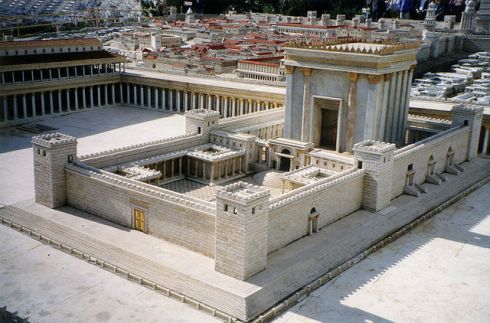
Second Temple in Jerusalem, from the Holyland Model in Jerusalem. I saw this on my trip to Jerusalem years ago, but this photo from Wikipedia is better.

Second Temple in Jerusalem, from the Holyland Model in Jerusalem. Based on the writings of Josephus. I saw this on my trip to Jerusalem years ago, but this photo from Wikipedia is better.

When the Jews returned from the Exile in Babylon, in the late sixth century B.C., Jerusalem and its original temple lay in ruins.  Leaders like Nehemiah and Ezra helped to lead the people to rebuild the city and the temple. This “Second Temple” survived until being destroyed in 70 A.D., by the Romans. During that 600 year period, the Jews were dominated by a range of empires, including the Persians, the Greeks, the Syrians, and finally the Romans, though they were able to manage a brief period of self-rule during the Maccabean Revolt. Much of the later part of the Second Temple period is unfamiliar to many students of the Bible, as the last prophet we have in the Old Testament is Malachi, leaving about a four hundred year gap in the biblical chronology unaccounted for until the birth of Jesus. But modern scholarship today indicates that knowing this period of Israel’s history is critical to understanding the cultural context for the New Testament.

Recently, I discovering this interactive timeline for the Second Temple Judaism period at the BibleOdyssey.org, sponsored by the Society of Biblical Literature.  I have been looking to something like this for awhile, so I am glad that BibleOdyssey.org put it together fairly recently. This is a great reference tool for your study of the Bible.

Just a word of caution: the Society of Biblical Literature includes a very wide spectrum of scholarship, conservative evangelical as well as liberal critical, so some of the dates given for a few of the biblical books might raise a few eyebrows.  For a comparable list of dates for the writing of Old Testament books from a conservative evangelical perspective, you might want to look as well at Matt Slick’s listing at CARM.org.


The Great Christ Comet

Just in time for the Christian celebration of Epiphany, on January 6….

A few years ago, John Paine and I (following John’s lead) introduced the apologetic work of Rick Larson, regarding the date of Jesus’ crucifixion and the circumstances surrounding the birth of Jesus. Rick Larson is most known for his work on researching The Star of Bethlehem.

The father-in-law of Bible scholar Colin R. Nicholl got a copy of The Star of Bethlehem DVD, by Rick Larson, and convinced Nicholl to watch it. Despite the excellent production value of the film, Nicholl was not convinced by Larson’s argument. Egged on by his discussion with his father-in-law, Nicoll left his teaching position at Gordon-Conwell Theological Seminary to devote himself fully to the study of the Bethlehem star. The fruit of his research is available in the new book, The Great Christ Comet: Revealing the True Star of Bethlehem. You can read a brief interview with the author at the Gospel Coalition blog.

I would normally pass over something like this, except that the book comes with some high recommendations, including megachurch pastor Louie Giglio, Oxford scholar John C.Lennox, popular Christian writer Eric Metaxis, New Testament scholar Simon Gathercole, whose work has been discussed previously on Veracity, and my New Testament professor from my seminary days, Donald Hagner, among others. I took a peak at Eric Metaxas’ interview with Nicholl and I thought I would share it with you.  As John Paine would say, “judge for yourself.” Let me know your opinion: Do you think Colin Nicholl is right?


Is the Virgin Birth Prophecy a Mistranslation?

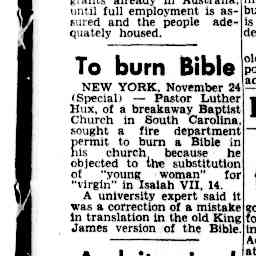
The media coverage of the burning of the RSV, the “Revised Satanic Version” of the Bible. From the November 25, 1952 edition of the Courier Mail, Brisbane, Australia. Luther Hux made quite a news splash all over the world.

“Behold, a virgin shall conceive and bear a son, and his name shall be called Emman′u-el” (Matthew 1:23 RSV)

Therefore the Lord himself will give you a sign. Behold, a young woman shall conceive and bear a son, and shall call his name Imman′u-el. (Isaiah 7:14 RSV)

Bible Burning

“Luther Hux knew full well that the RSV was unholy, and accordingly he announced his intention to burn a copy of the new Bible,” so reports historian Peter Johannes Thuessen, from his In Discordance with the Scriptures: American Protestant Battles over Translating the Bible (p.96). Hux, a North Carolina Baptist pastor, had recently received a copy of the new “Revised Standard Version” of the Bible, published that year in 1952. In his fury over what he saw as a “mistranslation” of Isaiah 7:14, Luther Hux was determined to make a show over this “Bible burning” in front of as many press reporters as possible. Isaiah 7:14 is the famous prophecy of the virgin birth, as referenced by the Gospel writer Matthew. All previous English translations of this verse referred to a “virgin,” not a more generic “young woman,” as the new Revised Standard Version had done. Thuessen continues:

On the night of 30 November Hux delivered a two-hour oration and then led his congregation from the white-frame Temple Baptist Church into the cold autumn air, where every member received a small American flag. Climbing onto the bed of a waiting truck, Hux held aloft a copy of the RSV on which he had written the word “fraud.” Instead of burning the whole book, however he ripped out and ignited the page bearing Isaiah 7:14. “This has been the dream of modernists for centuries,” he shouted, ” to make Jesus Christ the son of a bad woman.” (p. 97)

Burning part of a Bible? It would hardly register a blip on the 24-hour news cycle at CNN today. But back in 1950s North Carolina, the “Buckle of the Bible Belt,” you just did not do things like that.

Well, at least he was being patriotic about it.

But what if Luther Hux was right? Was the Revised Standard Version (RSV) a fraud? Was the RSV, from Hux’s own word’s, “the Master Stroke of Satan?”

I am not approving of “Bible burning,” but actually Luther Hux was onto something. What Hux did not know at the time is that he had stumbled upon an issue that has puzzled Bible scholars now for decades,… if not centuries.
Continue reading


Top Posts of the Year 2015

As a way of closing out the year 2015, I thought I would highlight what I thought were some of the most thought-challenging blog posts and news articles of 2015, and why. Some caution is in order, as several of these posts can be disturbing to read. Nevertheless, they are important because the stories conveyed by the authors have ramifications for how we as followers of Jesus practice our faith in our world today.

  • Graeme Wood’s article in The Atlantic, What ISIS Really Wants, helps to shatter the myth that the aims the Islamic State of Iraq and the Levant having nothing to do with genuine Islam. Sure, moderate Muslims are repulsed by ISIS, but if you study their agenda to re-establish an Islamic caliphate, then you will recognize that the motivation behind ISIS comes straight out of a literalistic reading of the Koran.
  • As discussed here on Veracity, numerous media outlets reported on the statement made by Wheaton College faculty member, Larycia Hawkins, that Christians and Muslims worship “the same God,” that led to her being placed on administrative leave. The incident revealed tensions within the church, in view of the recent problems with terrorist attacks by radical Islamic groups, and the future status of 4 million Syrian refugees flooding the world. How should Christians relate to people from Islamic cultures?
  • National Geographic‘s Maureen Orth, in her front-cover article on the Virgin Mary shows just how seriously the Roman Catholic Church takes miracles associated with appearances of the Mother of Jesus. Is there a problem when people look to such “signs and miracles” to guide their faith, or does such a dependence on such things undermine the principle of the all sufficiency of Scripture alone to guide us towards the Truth? How do you discern the difference between a genuine miracle of God and a fake? The first reported sighting of Mary goes back to 40 A.D…. while she was still alive.
  • In a somewhat related story, Christianity Today‘s Bob Smietana investigates the connection between royalties from the popular evangelical worship song, “How Great is Our God,” and a church leader in the Nashville area who is under a cloud of suspicion regarding prosperity doctrine teachings and sexual abuse. There appears to be fine line between faithfulness to the Gospel and careening off a spiritual cliff (UPDATE: 12/31/15)
  • Rod Dreher, a Christian blogger, writes in the American Conservative that the recent debates over LGBT rights means that the “American way of life” is on a collision course with traditional, orthodox Christianity.  The culture wars, as we have known it, are over, and the battle for hearts and minds is in the up-and-coming generation of youth in our churches. Christians need to rethink how to go about biblical discipleship in a rapidly shifting culture, including considering the so-called “Benedict Option.“
  • Ever wonder who popularized terms like “anorexia,” “PTSD,” and “biopolar disorder” in the modern vocabulary of psychology? Look no further than Robert Spitzer, the psychologist intellectual who died on Christmas Day, 2015, in this piece written by Amy Argetsinger for the Washington Post. Spitzer helped to steer the psychology profession to declare that homosexuality was not a psychological disorder in the 1970s. In the early 2000s, his work took a different turn, declaring from one of his studies that reparative therapy could actually cure homosexual orientation, which served as a very promising sign to the growing “ex-gay” evangelical Christian movement. However, this conclusion was later rescinded by Spitzer’s own reevaluation in 2012. Later that same year, Exodus International, the largest “ex-gay” evangelical Christian ministry in the world, closed its doors, following Spitzer’s revised conclusion that reparative therapy not only fails to help people in most cases, but that it can also cause great psychological harm. A growing view among evangelical Christians, while still believing in the Bible’s opposition to same-sex behavior, now agrees that reparative therapy is to be avoided, according to this article by Jonathan Merritt for The Atlantic.
  • And to top it off…. the biggest NON-stories for 2015… drum roll please….. the prophecy non-fulfillments regarding the Four Blood Moons and the Mystery of the Shemitah predictions…. ZZZZZZ…. surprise, these two were sleepers!!

A few of the above stories can get you a bit depressed. Here are few antidotes to the pessimism that indicates that God is doing some incredible things in our world today. May we be ever mindful of God’s providential care in the New Year!
