Author Archives: Clarke Morledge

About Clarke Morledge

Unknown's avatar
Clarke Morledge -- Computer Network Engineer, College of William and Mary... I hiked the Mount of the Holy Cross, one of the famous Colorado Fourteeners, with some friends in July, 2012. My buddy, Mike Scott, snapped this photo of me on the summit.

Jonah’s Nineveh and Modern-Day Mosul

In July, 2014, militants of the Islamic state blew up the Tomb of Jonah, a memorial site with significance for both Muslims and Christians, as it honored the famous Old Testament prophet, called to preach in the city of Nineveh, now part of modern-day Mosul, in northern Iraq.

In July, 2014, militants of the Islamic State blew up the Tomb of Jonah, a memorial site with significance for both Muslims and Christians, as it honored the famous Old Testament prophet, called to preach in the city of Nineveh, now part of modern-day Mosul, in northern Iraq.

Much of the attention surrounding the Book of Jonah focuses on the story of Jonah being swallowed for three days and three nights by a “whale.” There is a lot of confusion about this. For one thing, the actual Bible text calls it a “great fish,” and not a “whale” (Jonah 1:17). But in this post, I want to focus briefly on the city where Jonah was called to preach: Nineveh.

Nineveh was the capital of the ancient Assyrian empire. The Bible talks quite a bit about the threat that the dreaded Assyrians posed for the Israelites, a threat that was eventually realized by the destruction of the Northern Kingdom of Israel, in the 8th century before the birth of Christ. So, you only imagine the horror experienced by the prophet Jonah, first mentioned in 2 Kings 14:25, when he was called by God to urge the citizens of Nineveh to repent, and come to know the God of Israel.

Nineveh was the last place Jonah wanted to be.

The city of Nineveh is in the news quite a bit these days. Nineveh is part of the greater city of Mosul, in Iraq, where a coalition of military forces have been trying to force the Islamic State out of the city. Many skeptics may dismiss the story of Jonah as a “fairy tale,” but the story of what has happened in today’s Mosul is tragically real. For example, thousands of Christians have had to flee the city from the Islamic State, and surely, some remain, fearful for their lives. We should pray for them. Given what we know about Nineveh/Mosul today, I can relate a bit to Jonah’s desire not to go the Nineveh. I would not want to be there either! Continue reading


One Reason Why John Stott’s Stand Against Martyn Lloyd-Jones Mattered

Fifty years ago this week, the great British evangelical independent preacher, Martyn Lloyd-Jones, clashed with Anglican, John R.W. Stott, another great British pastor, over the future of the evangelical movement in the United Kingdom. Jones was urging evangelicals to leave corrupt institutions, whereas Stott pushed back, reminding fellow evangelicals of the importance of maintaining a Christian witness. Stott’s argument won the day, yet Puritan historian, Iain H. Murray, believes that the acceptance of Stott’s efforts led to evangelical compromise. However, the following blog post, by British blogger Alastair Roberts, offers a different perspective, that I find helpful to think about.

Alastair Roberts's avatarAlastair's Adversaria

A couple of days ago, Justin Taylor published an interview with the Rev Dr Andrew Atherstone, upon the fiftieth anniversary of a pivotal event in English evangelical history. At the National Assembly of Evangelicals on October 18, 1966, two of the biggest figures among British evangelicals in the day, the Welsh minister of Westminster Chapel in London, Martyn Lloyd-Jones, and John Stott, rector of All Souls Church, had an important dispute about the future of evangelicals within the Church of England.

Lloyd-Jones gave an address calling for evangelicals to pursue visible unity with other evangelicals, accusing Anglican evangelicals of schism for their failure to unite with evangelicals outside of the Church of England, and of serious compromise for their continued involvement in a mixed denomination alongside doctrinally and spiritually unfaithful persons. Although he was the chairman, Stott publicly responded to Lloyd-Jones’ remarks, resisting his claims and appeal to Anglican evangelicals.

View original post 1,180 more words


Who is the AntiChrist?

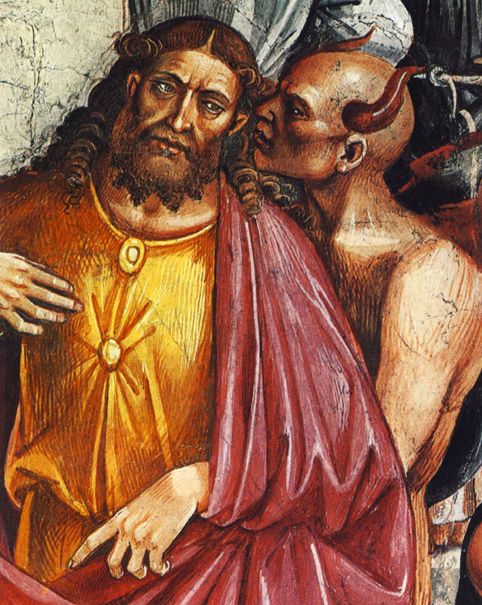
Luca Signorelli. The Deeds of the Antichrist (1499-1504). Signorelli portrays the devil counseling the Antichrist. With an American Presidential election coming around the corner, I wonder who so-called "prophecy experts" might be pick as the one and only Antichrist?

Luca Signorelli. The Deeds of the Antichrist (1499-1504). Signorelli portrays the devil counseling the Antichrist. With an American Presidential election coming around the corner, I wonder who so-called “prophecy experts” might pick as the one and only Antichrist in our day?

So, who exactly is “the” antichrist?

Back in high school, I knew someone who was convinced that President Jimmy Carter was the antichrist. Carter was a very convincing orator in the 1970s, connecting extremely well with voters frustrated with the then current political situation. Carter even said that he was a “born again” Christian. But by negotiating a peace treaty in the Middle East between Israel and her enemies, was Carter fulfilling the prophecy of Daniel 9:27, the antichrist who would “confirm the covenant with many?”

Okay, let us fast-forward some 35 plus years. He may not have been the best President we have ever had…. but the antichrist?

A lot of people speculate on who this antichrist might be. From military dictators to American presidents, the list of possible candidates seems about as endless as the human imagination (some folks even vote for their favorite picks). Most people get their information about the antichrist from books, movies, late-night cable TV, neighbors and friends.

But how many people know what the Bible actually teaches about the antichrist?  You might be surprised to discover that a lot of popular ideas about antichrist owe more to overly fertile imaginations than the clear teaching of Scripture.
Continue reading


Did An Army of 600,000 Israelites Conquer the Land of Canaan?

The traditional Sunday School image shows Joshua leading about 600,000 armed Israelites into the land of Canaan, across the river Jordan. But was that really the size of Joshua's army?

The traditional Sunday School image shows Joshua leading about 600,000 armed Israelites into the land of Canaan, across the river Jordan. But was that really the size of Joshua’s army?

When we read about the nation of Israel crossing the river Jordan to enter the Promised Land, in Joshua 4, something stands out, if you read very carefully. Joshua 4:13 tells us this:

About 40,000 ready for war passed over before the Lord for battle, to the plains of Jericho (ESV).

From this verse alone, you might think that there were a total of 40,000 soldiers in the army of Israel, set to conquer the land. The problem is that according to a census taken prior to the crossing of the river Jordan, of all of the Hebrew men of fighting age (Numbers 26:1-4), the census gave a total number of 601,730 (Numbers 26:51). A previous census taken near the beginning of the wilderness journey, just after the Exodus from Egypt, reveals about the same number, 603,550 (Numbers 1:45-46). The second census is different in that the first generation in the wilderness had perished, replaced by a new generation, leaving only Joshua and Caleb from the first generation still among them, but the numbers are in the same ballpark. Clearly there is a problem lining up the 40,000 armed men that crossed the Jordan with the some 600,000+ recorded in each census.

Nevertheless, the problem is more difficult than this: Assuming a 600,000+ army, this would give you a much larger population total, if you include women and children, at least around 2 million.

That is a lot of people.

In Deuteronomy 7:1-7, we read that God was sending the Israelites into a land to clear away seven different nations of people, each nation being larger than Israel herself. That means at least 14 million people were living in the Promised Land that Israel was to possess, in Canaan, which would be greater than the current population of the corresponding land in the Middle East now. Considering that Gaza alone is one of most densely populated places on earth, it is difficult to comprehend such large numbers of people in the ancient near east, particularly when the current archaeological data shows that the land of Canaan was far less populated then than it is now.

How do we try to resolve this difficulty?1
Continue reading


Nat Turner’s Virginia Slave Rebellion, Hollywood, and How We Read the Bible

In August, 1831, a literate slave and Bible preacher, Nat Turner, led a rebellion against his white masters, in rural Southampton County, about a one hour drive south of where I live in Williamsburg, Virginia. After the 48-hour mass killing of 55 whites ended, Turner’s insurrection was eventually crushed, and tougher laws were enacted to try to prevent such slave uprisings in the future.

Nate Parker’s new film, The Birth of a Nation, is a fictionalized retelling of this tragic and violent story (deserving of the R-rating)…and just to think, the events depicted only happened less than two hundred years ago, practically in my own backyard. The film’s director is enveloped in controversy, and early reviews of the film are mixed. Intended to subplant the legacy of the 1915 silent film of the same name, a cinematic apology for the Ku Klux Klan, Parker raises a number of important issues, but one wonders what the film will actually accomplish.

Gospel Coalition blogger, Justin Taylor, summarizes some of the most significant elements regarding the history behind the film’s story. For more details on the history, you can start with the Nat Turner Project. Some historians are disappointed with the inaccuracies of the film, which frustrates me, as I am more interested in the actual history than I am in Hollywood’s fantasies. Does the film tell us about what really happened, or does it tell us more about the mind and state of contemporary pop-culture? How much of the film is about Nat Turner, and how much of it is about the film’s director, Nate Parker?

In the film trailer below, the Nat Turner character recites 1 Peter 2:18, in an effort to encourage his fellow slaves to keep in line. I confess that I, as do so many other evangelicals, tend to water this passage down:

Servants, be subject to your masters with all respect, not only to the good and gentle but also to the unjust (1 Peter 2:18 ESV).

I have euphemistically tried to replace “servants” with “workers,” and “masters” with “supervisors,” but does that really get at the original context? I am afraid not.

Slavery during the New Testament period is difficult to comprehend in modern terms, and it was very different from how many Americans viewed slavery prior to the Civil War. As I have argued elsewhere (here and here), many of my southern, Virginia evangelical forefathers did not properly understand passages like this either. Instead, they read things into the Bible that were not there.

If any Veracity readers end up seeing the film, I would like to know your thoughts.