Evangelism; that is, sharing one’s faith in Jesus concerning “the Gospel” with a non-believer, is the heartbeat of evangelical Christianity. However, knowing what constitutes “the Gospel” can stir up a lot of conversation among Christians themselves, and that is a good thing. We should never take for granted what is meant by “the Gospel.”
Many Christians rely on “The Bridge Illustration” used by the Navigators in sharing “the Gospel.” Others cling to the “Four Spiritual Laws,” popularized by CRU (formerly Campus Crusade for Christ).
I did not grow up in evangelical circles, but my experience as a Christian since in my youth in college has ingrained in me a framework familiar to at least some evangelical Christians for sharing one’s faith with a non-believer: the so-called “Romans Road.”
The “Romans Road” is a simple method for sharing the Gospel with another person, using selected verses from the Apostle Paul’s letter to the Romans:
Romans 3:23 emphasizes that all people have sinned and fall short of God’s glory. We are all rebels who do not meet up to God’s moral standard.
Romans 6:23 indicates that while the penalty for sin is death, the free gift of God is eternal life for all who put their trust in Jesus Christ.
Romans 5:8 states that God demonstrates his love for us, in that while we were still sinners, Christ died on the cross for us.
Romans 10:9 shows us how to respond to faith in Jesus, namely by recognizing that Jesus is Lord and that Jesus bodily rose from the dead.
Romans 10:13 gives us the assurance that all who call upon Jesus as Lord will indeed be saved from the consequences of sin.
Romans 8:1 announces that there is no condemnation for those who accept Jesus Christ as Lord.
While today I do not know that many churches that still use this tool for evangelism, it at least gives a good summary for how many Christians understand the Gospel. So, when asked, “What is the Gospel?,” the answer is often “Go down the Romans Road.”
However, advances in biblical scholarship over the past fifty years have suggested that many Christians today, particularly those from a “Reformed” theological background, might be misreading certain things Paul wrote in the Book of Romans. Of course, Christians have been sharing the Gospel with their friends and neighbors for centuries, almost 2,000 years ago if you consider that Jesus started preaching perhaps as early as the year 26 CE, by some calculations. Yet the “Romans Road” method of sharing the Gospel in particular has actually only been around since about the late 1940s, with predecessor methods long before that.
Some date the exact “Romans Road” formulation to a Texas Baptist preacher, Jack Hyles, in 1948. As the story goes, Hyles printed up copies of the “Romans Road” (called the “Roman Road,” in the singular, back in those days). The famous World War 2 general, Douglas MacArthur, got his hands on one of those copies, and shared it with his military staff. Hyles’ work was then translated into numerous languages, and distributed across the world.
Well, that is one version of the story, which some historians dispute…. and that was a number of decades ago. Does the “Romans Road” need an update for the 21st century?
Theologian N.T. Wright thinks that the “Romans Road” is a fine Gospel-presentation, as far as it goes. But he insists that this classic “Romans Road” understanding of the Gospel does not go far enough in explaining what Paul is teaching in the Book of Romans.
For this influential British theologian, the typical “Romans Road” is too focused on an individualistic understanding of salvation, thus missing the point as to what Paul was really getting at in his letter to the Romans. Rather, Paul’s main message is an emphasis on God’s covenant faithfulness to the whole world, in renewing creation and building together a new multi-ethnic family of God.
For some, Wright’s revised “Romans Road” offers a refreshingly different look at Paul’s greatest letter in the New Testament, while triggering a sense of deep suspicion of Wright, if not downright rejection, among other Christians. Agree or disagree, N.T. Wright’s interpretation of Romans will sharpen how one reads this most theologically dense letter by Paul.
So, what is the fuss all about?
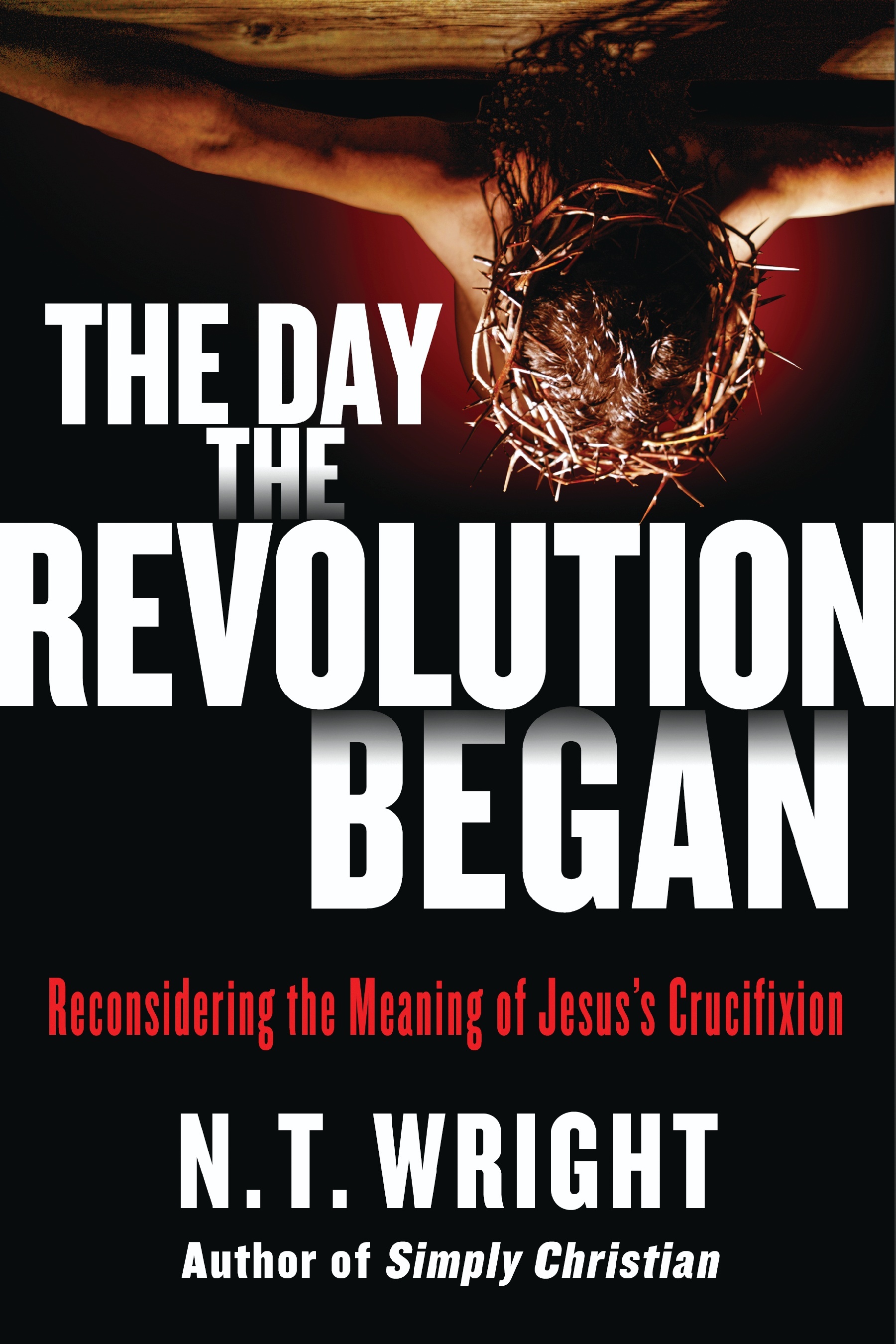
The Day the Revolution Began, by N.T. Wright. This is part two of a multi-part review focused on N.T. Wright’s understanding of Paul in the New Testament. This blog post considers Wright’s view of the first seven chapters on the Book of Romans, and compares it to a common reading of these chapters in Romans, as exemplified by Reformed Bible teacher, John Piper. Start with the part one of this blog post series, if you need to catch up.
N.T. Wright’s Reading of Romans 1-7 (and Part of 8), from The Day the Revolution Began
Recently, I finally finished Wright’s The Day the Revolution Began: Reconsidering the Meaning of Jesus’s Crucifixion, his detailed argument explaining what the death of Christ on the cross really means. In my Veracity review of that book, I promised to come back to Wright’s treatment of Romans. Of the 400 pages of The Day the Revolution Began, a hefty chunk of that book is dedicated to walking through a good bit of Paul’s letter to the church in Rome. Add onto that a follow up work by Wright, Into the Heart of Romans, a close up look at chapter 8 in Romans, then I knew that taking a tour down N.T. Wright’s “Romans Road” might be a worthy trip to take for a couple of blog posts. [1]
However, the problem is that N.T. Wright takes a different approach to Romans than what many evangelical Christians are accustomed to. So, here we go, a summary look at N.T. Wright’s “Romans Road” revised. If you are like me and know something about the Book of Romans, you might have heard that Romans 1-4 is all about the doctrine of justification, whereby the sinfulness of humanity is demonstrated as the rebellion from God it truly is, and that through the death of Jesus, Christ died in our place, so that we might be saved. Then, we read that Romans 5-8 is all about the doctrine of sanctification, whereby having justification all under our belts as believers, we now learn how to be gradually free from the power of sin, so that we can live the “Normal Christian Life.” [2]
As one might suspect, N.T. Wright believes that this common framework for how to read Romans is completely wrongheaded, missing the point which Paul is really trying to make. In my Veracity review of The Day the Revolution Began, I summarize the narrative arc which Wright believes is implicit in Paul’s thinking throughout his letters, and in Romans in particular. For Wright, the themes of exile and restoration, passover and exodus, and the renewal of creation run just below the surface throughout Paul’s writings, occasionally poking through with explicit references only now and then. [3]
At the root of the problem, as Wright puts it, is that many Christians living in the post-Reformation era have been wrongly reading Romans through the lens of a “works contract,” whereby God expects human beings to act a certain way, by living according to good works. However, God also knows that sinful human beings are unable to fulfill the demands of the “works contract.” Humans try, but they fail to meet God’s demands for holiness. Therefore various texts in Romans are employed to show us that a different contract of “grace” is now available, showing us that those who now believe in Jesus can know that Christ is the one who fulfills all of the requirements of the “works contract.” Christ therefore does what we could never do for ourselves. All we have to do is put our trust in Jesus that he has done everything for us, and then we will be saved.
For Wright, this narrative is fine as far as it goes. But it is not what Paul is talking about in the Book of Romans.
N.T. Wright on Romans 1
In Wright’s reading, we often begin by misunderstanding what Paul is getting at in Romans 1:17 when writes about the “righteousness of God.” In standard Reformed readings of this verse, the “righteousness of God” is about God’s moral standard, a standard which humans can not live up to on their own efforts. Wright believes this is a misreading of Paul. Instead, the “righteousness of God” would be better translated as God’s “covenant faithfulness.” In other words, for Wright, Paul is talking about God “being in the right,” in keeping his covenant promises to his covenant people.
The failure to read Paul correctly here causes people to miss what Paul is saying next in Romans 1:18-32. Traditionally, in Reformed circles, this passage is about the problem of sin, due to humanity’s moral depravity, which results in God’s wrath against human disobedience. However, in Wright’s approach, Romans 1:18-32 is fundamentally about idolatry, the great problem of the Gentile, whereby the Gentiles turn away from God to worship idols, which then leads to the problem of sin.
N.T. Wright on Romans 2
Likewise, in many traditional Reformed circles, Romans 2:1-29 is about a hypothetical Jew, who believes that they can earn God’s good favor by their good works. This hypothetical Jew is representative of everyone, whether they be Jewish or Gentile, who thinks that they can enter God’s heaven with their good behavior.
Wright thinks that this way of thinking wrongly situates the role of the Law of Moses in the context of Scripture. This is a bit of a caricature, but here is Wright’s analogy of this wrong way of thinking:
“God has parked his broken-down car in a side road somewhere and has completed the journey on foot. He has jettisoned the covenant with Israel and has instead intervened in person, in Jesus” (Wright, The Day the Revolution Began, Kindle location 5243).
Wright, on the other hand, sees Romans 2:1-29 as specifically targeting the Jews, and their failure to keep God’s covenant. There is nothing fundamentally wrong with the Law of Moses. Rather, Israel’s disobedience kept them from being a blessing to the Gentiles. Simply keeping to Torah practices like circumcision does not prevent the Jews from experiencing God’s judgment, for the Jews have missed the bigger picture as to what God was calling them to do and be:
“Romans 2:17–3:9 is concerned, first, with the worldwide purpose of Israel’s divine vocation (2:17–20); second, with Israel’s covenantal failure (2:21–24; 3:2–4)” (Wright, Revolution, Kindle location 5,132)
Despite some various differences, both the standard Reformed view of Romans 1-2 and Wright’s revised view are not entirely incompatible from one another. Yet the flashpoint becomes evident in the next chapter, Romans 3, particularly in the densely theological statements of Romans 3:21-26 . [4]
N.T. Wright on Romans 3
Romans 2 then leads into what Wright says is the crisis of Romans 3:1-19, whereby God’s covenant faithfulness; that is, the “righteousness of God,” is questioned. For:
“How is God to be faithful to the covenant—to rescue and bless the world through the Jews—if Israel is faithless?” (Wright, Revolution, Kindle location 5,132)
Wright believes that this way of framing Paul’s argument makes better sense of Romans 3:1-9, which in Wright’s view, comes across as muddled in the standard Reformed treatment of the passage.In Romans 3:1-9, Paul asks a series of questions. For example, in verses 3-4, Paul asks if the Jews were unfaithful to the covenant, does their unfaithfulness cancel out God’s faithfulness? “By no means,” says Paul. “Let God be true and every man a liar!”
A standard Reformed reading is to say that the “righteousness of God” is about God’s moral perfection. The Jews may think that they have an advantage because they have the Scriptures, but in reality they have no more advantage than anyone else. All fall short of God’s moral perfection.
Wright responds that another narrative is at play here, a theme focused on the story of Israel that extends into Romans 4: Paul is concerned that since Abraham was promised that God would use ethnic Israel to save the world, but that ethnic Israel had also fallen into sin, how can God honor promises made to Abraham without letting sin go unpunished?
In verses 5-8, Paul addresses another yet peculiar concern, for:
“If our unrighteousness serves to show the righteousness of God, what shall we say? That God is unrighteous to inflict wrath on us?” (Romans 3:5 ESV).
A standard Reformed reading is to focus on the individual, whether they be Jew or Gentile. Paul is bringing up a typical way the sinner tries to rationalize their own sin: “If my sin makes God look good by contrast, why would God condemn me to hell?” Paul rejects this as absurd.
Yet Wright suggests something different is going on here. This line of questioning in Romans 3:1-9 is more about a Jewish person who admits the failure of God’s covenant people, but who sees this as a way whereby God’s covenant keeping shines brighter than Israel’s unfaithfulness to the covenant. God would not punish Israel, for if God did so this would indict God as going against his covenant promises. Yet Paul rejects this, for God can still judge Israel without breaking any promises made to Israel.
Paul would conclude in Romans 3:9, in the standard Reformed view, that the individual sinner is not better off living in their sin, as they must continue to face the judgment of God. Paul’s reciting of various passages from the Psalms in Romans 3:9-20 is meant to show the utter fallenness of humanity.
Yet in Wright’s view, Paul is specifically concerned about stripping away any privileges the Jews think they have over and against the Gentiles. The Jews are just as vulnerable to sin as are the Gentiles.
A Deep Dive Into Romans 3:21-26
This all sets the stage for the pivotal passage of Romans 3:21-26. But it first helps to contrast some of the ideas that lead to the divergence of thought between a standard Reformed reading of this passage and what led Wright to move away from this reading to what he articulates in The Day the Revolution Began.
To play off the title of Wright’s book, the “revolution” began with the emergence of the so-called “New Perspective on Paul,” which arose in scholarship in the wake of the Jewish holocaust inflicted by the Nazis during World War 2. A common story during the post-Reformation period has been that Judaism has been primarily a works-based religion, whereby “good Jews” were thought to stockpile their good works in an effort to earn God’s favor.
The problem with this type of thinking is that while there are indeed cases where some Jews have thought like this, this characterization does not accurately reflect what Jews in general themselves think about their faith as described in the Old Testament. This characterization has the unfortunate consequence of putting the God of the Old Testament at odds with the God of the New Testament. It makes it look like the God of the Old Testament is a God who is all about works-salvation, earning God’s approval by trying to keep God’s Law, as established by Moses. This is put in contrast with the God of the New Testament who is a God of grace.
But since Christians believe that the God of the New Testament is the same God as the God of the Old Testament, it would not be correct to say that God is about “works” in the Old Testament while shifting to be about “grace” in the New Testament. Rather, the message of God’s grace permeates both the New and the Old Testament. Christians worship one God, not a schizophrenic God who changes in his disposition towards people over time. What is different about the message of the Old and New Testaments is that in the Old Testament, God’s people are waiting for the Messiah to come, whereas in the New Testament, the Messiah has already come in the person of Jesus of Nazareth. Salvation for anyone, whether they be Jew or Gentile, is contingent on having faith in Jesus as God’s true Messiah.
If there is one thing that can be gained from this so-called “New Perspective of Paul,” an idea for which N.T. Wright champions, is that the message of God’s grace is all over the whole Bible, and not just the New Testament. With that in mind, we can explore Romans 3:21-26.
Imputation, The Righteousness of God, and Atonement for Sin in Romans 3:21-26 ??
For a Reformed thinker, like John Piper, the mechanism of imputation resolves the mystery as to how God accomplishes salvation in Romans 3:21-26. The “righteousness of God” found in this passage is about a gifted status, whereby God’s good and right moral status is imputed, or credited to the believer’s spiritual bank account through Jesus. Humans experience a spiritual debt to God, by falling short of God’s glory (Romans 3:23). In turn, the “alien righteousness” which by virtue of Jesus’ divinity belongs to him is then declared to be something which belongs to the believer, through this imputation. In Romans 3:25, Piper leans in towards saying that Jesus is a “propitiation” for us, satisfying God’s wrath against our sin. [5]
God remains one who is “just,” in punishing sin, while also being the “justifier,” thus acquitting the sinner who has faith (verse 26). Because the righteousness of Christ has been imputed to us, God no longer sees our sin but instead sees the moral perfection of Christ.
N.T. Wright takes a different approach by translating key terms differently from how someone like John Piper would interpret them. As mentioned earlier, Wright sees that the “righteousness of God” is more about God’s “covenant faithfulness,” as opposed to a gifted status imputed to us. Furthermore, whereas John Piper might see the “faith in Jesus Christ” mentioned in Romans 3:22 as being the “faith,” and therefore the “trust,” we have in Jesus, Wright translates this instead as the “faithfulness of Jesus.” Compare the ESV with Wright’s translation of Romans 3:21-22a: [6]
But now the righteousness of God has been manifested apart from the law, although the Law and the Prophets bear witness to it— the righteousness of God through faith in Jesus Christ for all who believe. (ESV)
But now, quite apart from the law (though the law and the prophets bore witness to it), God’s covenant justice has been displayed. God’s covenant justice comes into operation through the faithfulness of Jesus the Messiah, for the benefit of all who have faith. (Wright)
For Wright, this “faithfulness of Jesus” is not about something imputed, or credited to us. This is not about some legal transaction of moral credits. Rather, it is Jesus as the Messiah doing that which Israel simply was not able to do, to fulfill the covenant and make a way for salvation for the whole human race (and the renewal of creation). The mission of the Messiah was in part meant to establish the loyalty of the God of Israel to the covenant made with God’s people.
Wright’s complaint with the standard Reformed narrative offered by Piper is that it is too narrow. It focuses so much on the moral failure of humanity that it misses specific clues right there in the text. First, the standard way of reading Romans 3:23 is focuses on the “for all have sinned” part, completely ignoring what the “fall short of the glory of God” part. The “glory of God” part is a reference to the Temple theme, whereby Israel was called to worship God and God alone. But Israel fell into idolatry, just alike all of the other nations, missing out on God’s glory. The root problem behind sin is idolatry (Wright, Revolution, Kindle location 5185).
Secondly, it misses the point as to why Paul brings up Abraham in Romans 4:1-25. For Wright, the story of Abraham is meant to contrast the faithfulness of Abraham with the “faith-less-ness” of Israel later on, in how Israel had forsaken and fallen short of the covenant for which they were called, to be a blessing to the Gentiles (Wright, Revolution, Kindle location 5221).
It might be worth adding some of my own commentary at this point. While John Piper and N.T. Wright are indeed saying different things here, I do not see any real reason why Paul could not have both ways of thinking present in his mind as he has written these verses. I see no need to present a stark dichotomy between what Piper is saying as opposed to what Wright is saying. Instead, I would argue that Paul has a richness in his vocabulary for allowing for both an understanding the “righteousness of God” as an “alien righteousness” credited or “imputed” to us, as well as understanding the “righteousness of God” as God’s “covenant faithfulness,” in that God is always “in the right” in keeping God’s own promises. [7]
Yet perhaps the most controversial point is found in Romans 3:25, where Paul writes about our redemption that is in Christ Jesus. Look at how different translations render this verse about Jesus:
“Whom God put forward as a propitiation by his blood, to be received by faith. This was to show God’s righteousness, because in his divine forbearance he had passed over former sins” (ESV)
“God presented Christ as a sacrifice of atonement, through the shedding of his blood—to be received by faith. He did this to demonstrate his righteousness, because in his forbearance he had left the sins committed beforehand unpunished” (NIV)
“God publicly displayed him at his death as the mercy seat accessible through faith. This was to demonstrate his righteousness, because God in his forbearance had passed over the sins previously committed” (NET)
“Through his faithfulness, God displayed Jesus as the place of sacrifice where mercy is found by means of his blood. He did this to demonstrate his righteousness in passing over sins that happened before” (CEB)
Translations do differ. For example, the ESV translation listed above speaks of Jesus Christ as a “propitiation,” whereas the CEB at the end of the list describes Jesus as “the place of sacrifice.” So, what is going on here?
One Word Can Make All The Difference
The Greek word, hilasterion, translated by the ESV (and the older KJV) as “propitiation,” is only found twice in the New Testament. A lot of scholarship over the last one hundred years has gone into trying to figure out what this word actually means. [8]
But the prevailing scholarship today, while not a complete consensus, is that hilasterion means the “mercy seat,” or the atonement cover, corresponding to the cover of the ark of the covenant, from the Old Testament. The only other place in the New Testament where this word is found is in Hebrews 9:5, where “mercy seat” has been the traditional translation.
In Romans 3:25, translations like the New English Translation (NET) and the Common English Bible (CEB) take this meaning, which suggests a location, recalling the “mercy seat” where the high priest sprinkled animal blood to make atonement for the sins of Israel before God on the Day of Atonement (Yom Kippur), in the way that the Old Greek translation of the Old Testament, the Septuagint, put it.. Therefore, Paul is imagining here that Jesus himself is the location where atonement takes place. Following this prevailing view, Wright now holds to the idea of “mercy seat,” or as he puts it in his own published translation “the place of mercy.”
[9]
The fact that there is no complete consensus for how to translate hilasterion is evident by the way the NIV translates the term: “a sacrifice of atonement.” The NIV is non-commital here, but N.T. Wright has been known to be not much of a fan of the NIV’s treatment of the Book of Romans. Here is how Wright translates verses 25-26:
God put Jesus forth as the place of mercy, through faithfulness, by means of his blood. He did this to demonstrate his covenant justice, because the passing over (in divine forbearance) of sins committed beforehand. This was to demonstrate his covenant justice in the present time: that is, that he himself is in the right, and that he declares to be in the right everyone who trusts in the faithfulness of Jesus.
Wright leans in towards the “mercy seat” (or “place of mercy“) translation of hilasterion, but he carefully notes the connection this has with the reference to the “blood” of Jesus which follows. The “blood” is what matters here, not the actual bodily death of Jesus. Of course, it is the death of Jesus which makes the “blood” of Jesus available, but the death itself is not the focus in Paul’s thinking. Wright picks up on this by observing how the scholarship of Leviticus has shifted the conversation within the last fifty years or so: [10]
“In the ancient Hebrew scriptures the death of the sacrificial animal was not the heart of the ritual; it was only the preliminary event. What mattered was that the blood, symbolizing the life that would “cover” all impurities of whatever sort, would then be presented on the altar“(Wright, Revolution, Kindle location 3140).
Scholars have known for centuries that the language of atonement in the New Testament eventually goes back to how the Levitical system of sacrifices functioned in the Old Testament. Whereas the Levitical system, with repeated sacrifices in the Temple, was an on-going practice among the ancient Hebrews, the death of Jesus in the New Testament serves as that one-time event which supersedes the Levitical system. In the age of the Messiah, there is now no more need for animal sacrifices.
However, what more recent scholarship has shown is that the emphasis in the Levitical sacrificial system was not on the death of the animal, but rather, on the blood of the animal being sprinkled on the altar. The traditional idea has been that the animal being sacrificed in Leviticus was slaughtered on the altar. However, more recent scholarship shows that this idea is completely wrong. The animal was never killed on the altar. Instead, it was the offerer of the animal who killed the animal away from the altar.
What was crucial for the Levitical sacrificial system was what happened next. The priest would collect the blood from the killed animal and then apply it to the altar via sprinkling. Again, what really mattered was getting the blood to accomplish the atoning ritual, not the killing of the animal itself. On the Day of Atonement, as taught in Leviticus 16, the blood was brought into the Holy of Holies and then sprinkled on the “mercy seat” itself. [11]
Likewise, when we think of the death of Christ on the cross, what matters is not some need for the Father to kill the Son for purposes of merely punishing the Son, as though the anger of the Father is appeased by the death of the Son. Rather, the death of Jesus makes his blood available for the purposes of purification and decontamination. Christ, as the “mercy seat,” sits metaphorically on top of the Ark of the Covenant, which contains the tablets of the Law. For Wright, the blood of Jesus acts to cover the transgressions of the covenant. [12]
Furthermore, Wright emphasizes that Romans 3:25 is not about “God’s punishing of Jesus on behalf of people’s sins” (Wright, Revolution, Kindle location 5540), based on the second half of the verse, which the ESV translates as: “This was to show God’s righteousness, because in his divine forbearance he had passed over former sins.”
There is something odd here that I had not noticed before: This passing over of former sins means that the sins were not punished, which is just the opposite and contrary to some interpreters who somehow think God is punishing Jesus on behalf of the people’s sins. [13]
In other words, the second half of verse 25 indicates more of a sense of acquittal for these former sins, or at least a delay in dealing with these sins, as opposed to any kind of punishment in accordance with God meting out wrath. In fact, there is not one reference to “wrath” anywhere in Romans 3 whatsoever. The theme of God’s “wrath” is clearly present in Romans 1-2. But the theme of “wrath” is not picked up again until the next chapter, in Romans 4:15, and then later in Romans 5:9. [14]
You would think that if Paul in Romans 3 is vitally concerned about any satisfaction of God’s “wrath” he would have mentioned it in this very theologically dense chapter. But he does not. Instead, the resolution to the “wrath” problem resulting from human sin is not addressed until Romans 5, two chapters later. Wright picks up on that by suggesting that the standard Reformed view is reading something into Romans 3 from other parts of Paul’s writings. It makes me wonder if this is a case of having the right doctrine but obtaining it from the wrong set of verses! [15]
N.T. Wright on Romans 4
According to a typical Reformed view of chapter 4, Abraham provides an example of someone who was “ungodly” who received the alien righteousness of God through a legal transaction. Using a bookkeeping analogy, Abraham’s faith was “credited” or “imputed” as being righteous.
For Wright, the example of Abraham (as noted briefly above) in Romans 4:1-25 is actually framed differently by Paul. No legal transaction takes place. Rather, when God looks at Abraham’s faith, God passes a verdict declaring that: “This man is a true, faithful covenant partner“. Being “credited” or “counted” as righteous does not mean that you are given a covering of Christ’s moral perfection. Rather, it means that God declares someone as a true member of God’s covenant family. Again, here “faith” is not about Abraham putting his belief in God, but instead Abraham is showing his faithful loyalty to God; that is, “faith” is not about faith “in” someone, but instead it is about “faithfulness to” a covenant. [16]
In Wright’s interpretation, he highlights:
“The whole passage, from 2:17 to 4:25, is all about God’s covenant with Israel and through Israel for the world and about the true worship at the heart of this covenant, the worship of the one true God, which replaces the idolatry of 1:18–23 and thus undoes the sin of 1:24–32” (Wright, Revolution, Kindle location 5308).
One of the struggles I have had with a standard Reformed view offered by John Piper, of Roman 4, is that I have often heard that Abraham himself was “reckoned” to be righteous. However, the problem is that this is not what the text says. Look at Romans 4:3-5:
“Abraham believed God, and it was counted to him as righteousness. Now to the one who works, his wages are not counted as a gift but as his due. And to the one who does not work but believes in him who justifies the ungodly, his faith is counted as righteousness” (ESV).
The word translated here in the ESV as “counted,” or the traditional “reckoned” (KJV), from the Greek logizomai, serves as the basis for the doctrine of imputation as found here in chapter 4. But notice that it was Abraham’s “faith” (or “belief“) that was counted, or credited as being righteousness. The text does not say that “Abraham was credited as being righteous,” rather it was “Abraham’s faith.”
If Abraham’s “faith” here is described as Abraham’s “believing loyalty” to Yahweh, then frankly, N.T. Wright’s explanation makes more sense than the standard Reformed view, which requires an additional exegetical step to arrive at Abraham himself as being credited, or imputed, with the righteousness of God.
However, it is important to give the standard Reformed reading some credit here, and allow it a fair reading. Here are some of the attempts to try to cover that additional exegetical step, as the understanding of Abraham’s “faith” is far from certain:
It is suggested that this ultimately means that the object of that faith, namely Christ’s provision and God’s graciousness, is what satisfies the demands of righteousness, and not the psychological act of believing itself. For if the act of believing itself is the righteousness that God accepts, then faith becomes a “work” which replaces the Law. This is the friction point where Piper has a tough time accepting Wright’s view, as Piper believes that Wright is somehow smuggling in a type of “faith” as essentially a “work” which tries to save, but ultimately that type of “faith” can not save. [17]
John Piper describes genuine “faith” as a clear window pane. The value is not in the glass itself, but rather in the light of Christ’s righteousness which shines through the window. So when God looks at Abraham’s faith, God is looking at Abraham’s complete dependence on the righteousness of God, and that righteousness alone.
Another way of putting it is this: When the text says that Abraham’s “faith is counted as righteousness,” that means that when God looks at Abraham’s empty receiving hands; that is, Abraham’s faith, God treats Abraham as if he possesses perfect divine righteousness. [18]
Lastly, Piper tends to emphasize Romans 4:20:
“No unbelief made [Abraham] waver concerning the promise of God, but he grew strong in his faith as he gave glory to God” (ESV)
This suggests it was only by way of his faith that Abraham was imputed with righteousness, not having an righteousness of his own. For if Abraham was directly said to have righteousness credited to him, then Abraham might have looked upon his faith as something deserving glory, thus suggesting that the glory belonged to him. Instead, the emphasis on Abraham’s faith, which is an admission that one does not possess righteousness for oneself, ensures that the glory belongs to God and God alone, and not Abraham.
It is important to try to clarify what is meant by “faith” here, where the Greek word is “pistis” in Romans 4. Among scholars, the precise meaning of “pistis” is heavily debated, and there seems like there is no end to the debate. For Piper, faith is a passive trust, an empty hand which receives Christ’s active moral obedience imputed to us.
For Wright, faith is covenant loyalty, trustful allegiance, and allegiance to the one true God. Faith is not a “work” that earns salvation. Instead, faith is the genuine badge and marker of a person who is a member of God’s covenant people. [19]
For Wright, what is credited to Abraham is not some alien righteousness belonging to Christ that has been legally transferred to Abraham. Rather, what is credited to Abraham is an acknowledgement that Abraham has submitted to God through believing loyalty to God’s covenant.
Which view offers the best explanation of Abraham, his faith, and the righteousness of God in Romans 4? In my view, Piper’s view takes an additional exegetical step which tries to fit a round peg into a square hole, or at least it appears that way. For if Paul really wanted us to know that Piper’s interpretation is what he had in mind, Paul would have simply said in Romans 4:3-4:
“Abraham believed God, and it was through his faith that he was counted as being righteous. Now to the one who works, his wages are not counted as a gift but as his due. And to the one who does not work but believes in him who justifies the ungodly, through his faith he is counted as being righteous” (modified ESV made to fit a straight-forward Reformed reading).
But Wright’s perspective is not entirely straight-forward either. For Wright requires the reader of Romans to have a different view of “faith” and “righteousness,” the latter which Wright defines as “God’s covenant faithfulness,” which is not commonly understood in Reformed evangelical circles. Plus, Wright’s view makes for a more complex story. Here is how Wright summarizes and compares the standard “Romans Road” view with his “New-Exodus” view:
‘Paul is not simply offering a roundabout way of saying, “We sinned; God punished Jesus; we are forgiven.” He is saying, “We all committed idolatry, and sinned; God promised Abraham to save the world through Israel; Israel was faithless to that commission; but God has put forth the faithful Messiah, his own self-revelation, whose death has been our Exodus from slavery.”‘ (Wright, Revolution, Kindle location 5821)
The standard “Romans Road” view is short and sweet, so to speak. Wright’s view may connect the dots from Romans 1-4 better, but the summary is far from simple. I have had to read Wright’s summary of his view several times through before I got the whole picture. So I am at a toss-up to know what to do with it all. I am not entirely persuaded which direction to go is right at this point, as both perspectives have their strengths and weaknesses.
N.T. Wright on Romans 5 up through Romans 8
Instead of breaking the continuity of Romans 1-4 and 5-8, which the standard Reformed approach does by assigning the doctrine of justification to the former passage and the doctrine of sanctification to the latter passage, Wright sees Romans 5 as a continuation of Paul’s overall argument. In particular, Romans 5:9 reads as:
“Since, therefore, we have now been justified by his blood, much more shall we be saved by him from the wrath of God” (ESV).
For Wright, the reference to being “justified by his blood” recalls what Paul says earlier in Romans 3:21-26 (Wright, Revolution, Kindle location 4644). Of course, in order to obtain the blood of Jesus to accomplish the work of atonement, Jesus needed to die. The blood of Jesus cleanses, but the death of Jesus is not about Jesus himself being punished by the Father for our sins. Otherwise, it makes no sense for Paul to then say here in Romans 5:9 that furthermore we shall be saved by Jesus from the wrath of God, a future event.
In other words, the “propitiation” reading of hilasterion in Romans 3:25 butchers Paul’s line of thought in Romans 5:9. So, the “propitiation” reading of Romans 3:25, in any sense of trying to appease the wrath of God, is simply impossible without rendering Romans 5:9 as rhetorical nonsense. Instead, to read Romans 3:25 as being about the blood of Jesus cleansing the “mercy seat,” thus allowing the believer to enter into sacred space is the best reading, which dovetails perfectly into Romans 5:9, which actually does address the question of God’s wrath, but in the sense of God withholding wrath against us, on the day of Final Judgment. [20]
To put it another way, it would appear that by the time we get to Romans 5:9, both Wright and the standard Reformed perspective finally sync up together, demonstrating that Paul is indeed addressing the problem of God’s wrath against human sin and rebellion, and the role of Christ in dealing with that wrath. It is worth noting that later in Romans 8:3-4, Wright finds the clearest statement supporting the concept of penal substitutionary atonement, a hallmark of historic Protestant Reformed theology, as I explain in detail in my Veracity review of Wright’s book on the topic.
It is at Romans 5:9, reinforced in Romans 8:3-4, where Wright follows in a great strand of Christian tradition, which says that Jesus took upon himself the consequences of human sin through his death upon the Cross, so that we might not bear those consequences upon ourselves. The debate it seems is over what is meant by those “consequences,” and how those “consequences” are experienced by Christ, as the Son of God in relation to Father.
The focus of Romans 5:12-21, which compares and contrasts Adam with Jesus, then shows to us that “The Adam project, for humans to share in God’s rule over creation, is back on track” (Wright, Revolution, Kindle location 4,656). What Adam was meant to do, got derailed by sin. Yet now the Messiah has come, as the Messiah fulfills the vocation of Israel to bring about the story of salvation for the world, for Jew and Gentile. What God intended all along to be the purpose of Israel has now been realized by the coming of Jesus.
In Wright’s narrative framing, Romans 6-8 is all about describing a new Exodus. Particularly when readers wrestle with Romans 7, the debate is often about whether Paul is talking about his pre-Christian experience or Paul is talking about the “normal Christian life.” But to Wright, this debate obscures what Paul is really doing here:
‘We can even learn some important theology—just as you could learn quite a lot of English grammar by listening to Bob Dylan’s songs, though that isn’t why the songs were written, and there are many lines that don’t work if you try to use them in that way. It’s the same with Romans 6–8. These three chapters, in fact, are the full exposition of what Paul meant in Romans 3:24 when he described the unveiling of God’s saving purpose as “the redemption which is found in the Messiah, Jesus” ‘ (Wright, Revolution, Kindle location 4,695)
As Wright likes to present his case, the theme of the Passover runs under the surface on Romans 6-8, with only occasional direct references to the Old Testament Exodus:
“These three chapters, like Galatians 4:1–11 only much more fully, constitute an Exodus narrative. Why would Paul want to write an Exodus narrative at this point? Because Jesus chose Passover as the explanatory setting for what he had to do. The early church from then on, as we have seen, used Passover as the basic route toward understanding why he died” (Wright, Revolution, Kindle location 4,701).
‘Romans 6:2–11 is all about the death of the Messiah and about the fact that those who are baptized into him must “reckon” that they too have died. This death was like the passing of the Israelites through the Red Sea’ (Wright, Revolution, Kindle location 4,708). [21]
Paul uses the theme of the crossing of the Red Sea to symbolize baptism associated with Jesus’ death. Then when Paul dives into the taxonomy of sin, as in Romans 6:15-23, he describes sin as a power which enslaves. Wright sees Paul as using the Exodus as an analogy, where the Israelites are freed from their slavery, just as Paul’s Christian hearers in Rome are freed from their slavery to sin:
‘ “Sin” in this sense is more than simply individual “sins.” It is the slave master, the jailer, the Pharaoh from whose grip one is freed by coming through the water. That is what Jesus’s death has achieved’ (Wright, Revolution, Kindle location 4,715)
Romans 7:4 then summarizes Paul’s argument thus far, pivoting towards the next stage of the argument, such that when the Messiah died, God was condemning sin in the flesh, the key idea for Wright’s understanding of penal substitution in Romans 8:3-4:
‘When the Messiah died, “you”—anyone who belongs to the Messiah, anyone who is a member of his “body”—died at the same time’ (Wright, Revolution, Kindle location 4718).
Romans 7 has the famous passage where Paul speaks about the struggle with sin with personal pronouns, “I” and “me.” But who is he talking about here? Is this about Paul’s personal experience before he became a believer in Jesus? Or is this about his current experience as a believer in Jesus? Wright answers this as “neither”:
‘Who is the “me” here? The “I” and “me” of Romans 7 is a literary device through which Paul is telling the life story of Israel under the Torah. He doesn’t want to speak of Israel as “they,” as though he were dealing with “others,” people distant from himself’ (Wright, Revolution, Kindle location 4803).
For Wright, the “I” of Romans 7 is telling the story of the Israelite living under Torah. It can have application at the individual level for any non-believer before meeting Christ as well as the struggle with sin for the person who becomes a believer in Christ, but this is not the main message Paul wants to communicate. The crucial point is discussed in Romans 7:13, in reference to that “good thing,” namely Torah. Wright translates this as:
“Was it that good thing, then, that brought death to me? Certainly not! On the contrary; it was sin, in order that it might appear as sin, working through the good thing and producing death in me. This was in order that sin might become very sinful indeed, through the commandment.”
Again, this is about the story of Israel living under Torah, not strictly some autobiographical description of Paul’s lived experience. Romans 7:13 echoes what Paul was saying earlier in Romans 5:20. It is worth saying here that critics of Wright will contend that Wright’s narrative is too complex, holding layers of abstraction which are not explicitly evident in the text. [22]
Evaluation of Wright’s Thesis of Romans Thus Far
Several things can be summarized as to how Wright’s reading of Romans mirrors a standard Reformed “Romans Road” reading of Paul’s greatest letter, and how Wright’s particular reading identifies problematic elements in that standard Reformed reading of Romans. Here is my evaluation thus far:
- Wright’s definition of the “righteousness of God” as God’s “covenant faithfulness” is at odds with the standard Reformed definition which sees the “righteousness of God” as God’s perfect moral character as displayed through the life of Jesus. But I see no essential reason why both understandings of the “righteousness of God” cannot both coexist in Romans. The “righteousness of God” is a rich theological term which finds its particular meaning in a particular text brought to light through the surrounding context of Paul’s thought. Therefore, N.T. Wright is wrong to insist that his reading of the “righteousness of God” cannot stand alongside a standard Reformed reading of Romans, across the broad length of Paul’s letter. Likewise, Wright’s critics are wrong to suggest that Wright is somehow denying some crucial element of the Gospel
- Wright’s view of Romans 1 and 2 differ somewhat from the standard Reformed reading, but I am not convinced that such differences are completely incompatible.
- Taken on its own, the typical Reformed reading of the rare Greek word hilasterion in Romans 3:25 as “propitiation” makes sense. However, within the context of Paul’s larger argument in the whole letter, a strict reading of “propitiation” as somehow appeasing the wrath of God, simply does not work without rendering other parts of Paul’s letter unintelligible. Wright has made a convincing argument here. Nevertheless, Wright’s argument does not nullify other ways of defending penal substitutionary atonement based on other Pauline texts, as Wright himself admits regarding Romans 8:3-4.
- Wright’s argument against imputation, in the standard Reformed reading, in Romans 4 has some weight to it. However, this need not make any other standard Reformed readings of imputation in Pauls’ letters impossible. I am still on the fence on how to handle Romans 4 more broadly, but Wright’s rejection of imputation across the whole of Paul’s thought, as commonly understood in Reformed circles today, fails to convince. As I note in a previous Veracity blog post, there a number of scholars who find many elements of the so-called “New Perspective on Paul” to be persuasive in taking a different reading of Romans, but who do not buy into Wright’s idiosyncratic rejection of the doctrine of the imputation of Christ’s active righteousness.
- Wright’s argument that that the typical division of Paul’s letter into two parts; that is, Romans 1-4 is about justification, and Romans 5-8 is about sanctification, needs to have a better answer from those who defend a more standard Reformed reading of these texts. On the other side, Wright’s overall argument that the theme of a new Exodus, which serves as the narrative guide to Romans 1-8, is more implicit as opposed to being explicit, which is a weakness in Wright’s thesis. Paul could have easily said, “Let me give you an example from the history of Israel to explain what I am talking about here,” but Paul does not come out say that. Yet Wright’s proposal casts some serious doubts about any two part division of Romans 1-8 championed during the post-Reformation period in typical Protestant thought.
- Wright’s argument that the “I” of Romans 7 is telling the story of the Israelite living under Torah is provocative, and in many ways, it avoids the pitfalls often associated with the age-old debate as to whether Paul is referencing his life as non-believer before becoming a Christian, versus Paul’s on-going struggles with sin as a Christian. However, I am still not sure what to do with this either.
- Even when I disagree with Wright, or find his arguments not entirely convincing, I still find him stimulating as an author. I always want to learn more from him.
Wright’s treatment of everything we find in Romans thus far leads to the climax of Paul’s argument in Romans 8, the heart of Paul’s letter. Much of what is said here in this blog post is taken from Wright’s The Day the Revolution Began, whereas his most recent work on Romans 8 is found in Into the Heart of Romans, which I am currently working my way through. I will take a break at this point and come back to Wright’s take on the “Romans Road” in an upcoming blog post.
Notes
[1] A lot of Christians have a deep suspicion about N.T. Wright because he at one time embraced a pretty standard Reformed view of the Book of Romans, which he has since moved away from due to his embrace of the New Perspective in Paul. For example, in a recent YouTube video comment asking about N.T. Wright’s views, another commenter responded to me with “Beware of [Wright’s] views. [Wright denies] God’s necessary wrath against all ungodliness, his expression of his hatred for sin“. I see a lot of that anti-Wright rhetoric online. I have covered this issue in other blog posts, so I am not going to rehearse this controversy again here. Back to text
[2] As a college student, I recall working during the summers as an usher in a movie theatre, where I spent my work breaks reading Watchman Nee’s The Normal Christian Life. Nee’s book sought to expound Romans 5-8 pretty much along the lines of the kind of “Romans Road” thinking that Wright thinks is deficient. As a fairly new Christian, who was just trying to understand the Bible, I got hung up on Nee’s explanation as to what Paul meant by “reckoning,” where Nee framed his book by unhelpfully dividing Christians into two different categories, that of ordinary Christians who struggle under human effort to follow Christ and “higher life” Christians who live is “spiritual victory,” a prominent feature of Keswick theology popular in late 19th century British evangelicalism through the mid-20th century. Throughout reading the book, I kept wondering if I was “reckoning” hard enough in order obtain “spiritual victory” regarding certain areas of sanctification that seemed lacking in my life. Nee’s book was obsessed with a kind of spiritual “navel-gazing” that I never caught onto. I recently looked up what AI had to say about N.T. Wright and Watchman Nee, and here is how AI contrasted the two:
Nee’s View: Nee frames “reckoning” as a progressive mental and spiritual discipline—a vital psychological pivot where a believer consciously counts God’s facts as true to gain victory over sin.
Wright’s Counter-Perspective: In his commentaries on Romans 6, Wright explains logizomai(reckoning) primarily as a legal, objective status update. For Wright, Paul is telling the Roman church: “Look at the reality of your baptism; you legally belong to the new world order now, so stop acting like slaves to the old one.” Wright would likely warn that Nee’s methodology turns an objective, historical reality into an exhausting, internal mindset game. Back to text
[3] N.T. Wright dives into the details of Paul’s thought in his weighty magnum opus Paul and the Faithfulness of God, and a companion volume Interpreting Paul: 3 (Collected Essays of N.T. Wright). This blog post instead focuses on the material found in several chapters found in Wright’s more popular work, yet slightly academic, The Day the Revolution Began. Back to text
[4] It bears keeping in mind that Paul only mentions “heaven” twice in Romans, Romans 1:18, and Romans 10:6, where neither passage according to Wright is in reference to “going to heaven” when you die. Chatgpt provides a succinct analysis comparing Wright’s view and certain standard Reformed views of Romans 2. The primary sticking point is over the identity of the “law keeping Gentile” in Romans 2:14:
- N.T. Wright’s View (Gentile Christians). Wright argues that the phrase “by nature” modifies “do not have the law” (meaning they are Gentiles by birth), rather than describing how they obey. For Wright, these are actual Gentile Christians who fulfill the law’s true intent through the Spirit-written heart promised in Jeremiah 31, anticipating the argument in verses 26–29.
- The Hypothetical Reformed View (Unbelievers as a Foil). Many traditional Reformed commentators (such as Charles Hodge and John Murray) argue Paul is describing pagan Gentiles who occasionally follow basic moral instincts via their God-given conscience. In this view, Paul uses their occasional moral awareness not to say they are saved, but to prove that even Gentiles know right from wrong and will still stand condemned at the final judgment (Romans 2:15–16).
- The Regenerate Reformed View (Gentile Believers). Other Reformed scholars (including John Calvin, Augustine, and Thomas Schreiner) agree with Wright that Paul is describing regenerate Gentile Christians, since fallen unbelievers cannot truly fulfill God’s law. However, unlike Wright, they insist this obedience is the evidence of saving grace rather than the basis for their covenant inclusion.
- “Gentiles who by nature do not have the law…“ This reading supports Wright and the regenerate view, identifying them simply as ethnic Gentiles who now keep the law through Christian faith. The CSB and NET translations supports this reading.
- “…do by nature what the law requires.“ This reading supports the hypothetical pagan view, suggesting non-Christians possess an innate, natural sense of morality that leaves them without excuse before God. The ESV translation, along with most other English translations, support this reading.
The notes in the NET Bible for this verse show: ‘Some (e.g. C. E. B. Cranfield, Romans [ICC], 1:135-37) take the phrase φύσει (phusei, “by nature”) to go with the preceding “do not have the law,” thus: “the Gentiles who do not have the law by nature,” that is, by virtue of not being born Jewish.’
For Wright, the “true Jew” of Romans 2:25-29 is a Gentile Christian, whereas for under a standard Reformed perspective the “true Jew” is anyone ethnically Jewish or Gentile, who has been inwardly regenerated by the Holy Spirit and united to Christ through faith. Standard Reformed exegesis maintains that Paul’s unified goal from Romans 1:18 to 3:20 is to prove that all people—both Jew and Gentile—stand condemned before God, making Romans 2:25–29 a foil to expose Jewish hypocrisy rather than a positive portrait of Christian justification.
Wright has often been accused of using Romans 2 to say that Paul believed in a final justification by works, when Jesus finally returns to set the world a right. This has been thought to fly in the face of a standard Reformed reading which says that works can never justify us, even on the final day of Christ’s judgment. Only faith, grounded in the final work of Jesus on the cross, can alone justify. Yet Wright resists this characterization of his position in his Interpreting Paul: 3 (Collected Essays of N.T. Wright). See the essay in chapter 2, “Justification by (Covenantal) Faith to the (Covenantal) Doers: Romans 2 within the Argument of the Letter.” Here is Wright’s response: “I have sometimes been accused of saying that the final judgment has its ‘basis’ in ‘the totality of the life led’, and I plead guilty. But my critics then ignore what I say later in the same paragraph, that the whole thing is ‘utterly dependent on the basic gospel events of the Messiah’s death and resurrection‘” (Wright, Interpreting Paul, p. 31). Back to text
[5] John Piper has a paper defending his reading of Romans 3:25-26 available at the Desiring God website: The Demonstration of the Righteousness of God in Romans 3:25,26, Published in Journal for the Study of the New Testament 2 (7): 2-32. A YouTube short video of a sermon excerpt by Piper summarizes his view. Back to text
[6] Tom Schreiner argues that N.T. Wright’s definition of the “righteousness of God” falls short of the mark: “God’s righteousness expresses his faithfulness to his covenant, and yet this is not the same thing as saying that God’s righteousness is his faithfulness to the covenant. God’s righteousness fulfills his covenant promises, but it does not follow from this that we should define righteousness as covenant faithfulness.” (Schreiner, Paul, Apostle of God’s Glory in Christ: A Pauline Theology, pp. 211-212). Schreiner bases his dismissal of Wright’s view having been convinced by Charles Lee Irons refutation of Wright in Irons, Charles Lee. The Righteousness of God: A Lexical Examination of the Covenant-Faithfulness Interpretation. WUNT 2.386. Tübingen: Mohr Siebeck, 2015. See review of Irons by Matthew Monkemeier . See Schreiner’s review of Irons. Wright sees Romans 3:21-22a as saying that God is keeping his word. In contrast, Charles Lee Irons is saying that Paul is describing the “righteousness of God” in these verses as a forensic gift of legal right-standing given to sinners. I have not been able to find where or if Wright responds to Irons’ work. Back to text
[7] Where I might differ with Piper is that the language of imputation might wrongly lead to the idea that there is some kind of “legal fiction” going on, such that when God looks at us God no longer sees us in our sinful condition, but instead God sees us clothed in Jesus. The problem with this is that it makes the wrong use of the metaphor of being “clothed in Christ” in Galatians 3:27. See my review of Matthew Thiessen’s The Jewish Paul and his argument for Paul’s pneumatic gene therapy. In Paul’s New Testament setting, to be “clothed” with something is to actually take upon oneself the characteristics of what you are wearing. For example, in the ancient Greco-Roman world, to wear the soldier’s uniform is part of what it means to actually become a soldier. It implies an inward transformation. To be “clothed in Christ” does not mean that the nice clean robes of Jesus are wrapped around our still dirty, sinful bodies. Rather, being “clothed in Christ” leads to an inward transformation, where we experience a mysterious “union with Christ,” as John Calvin would put it. Obviously, Piper does acknowledge our “union with Christ,” but it would appear that he separates the work of justification from the work of sanctifications too much, placing our “union with Christ” largely if not wholly in the second category. As to Wright’s contention that the “righteousness of God” is specifically about God’ “covenant faithfulness,” this does make more sense in certain passages, but here in Romans 3, it need not be so restrictive as to rule out any notion of imputation. Back to text
[8] In the late 20th century, a debate raged between C.H. Dodd, who in the Revised Standard Version (RSV) of the Bible translated hilastērion as “expiation,” suggesting that Jesus Christ cleanses of our guilt. Leon Morris argued for the older translation of “propitiation,” as found in the KJV, contending that Dodd’s “expiation” was too weak to communicate the full force of Paul’s thought. J.I. Packer, a leading light among conservative evangelicals, favored Morris’ translation, as the concept of “propitiation” fits in better with the classic Reformed understanding of penal substitutionary atonement, indicating that Jesus satisfied or “propitiated” God’s wrath against sin, thus pleasing God. Kevin DeYoung is a good example of someone who still thinks “propitiation” is the best rendering of hilastērion. Romans 3:25 has often been thought of as classic text in favor of penal substitutionary atonement. But it turns out that there are other, better texts in the New Testament which speak to penal substitutionary atonement.
The concept of “propitiation” communicates the idea of providing pleasure or satisfaction to someone, but as I note back in my Veracity review of Father Stephen De Young’s book on The Religion of the Apostles, in the Old Testament, it was not the death of the animal that was pleasing (propitiating) towards God. Rather, it was the aroma of the sacrificial meal. You can think of it as the pleasure one gets from a barbeque, when you smell the meat roasting over an open fire or charcoal, etc. Unless you are a hunter or a butcher, most people today never kill an animal for the purposes of cooking meat for a barbeque. But those who enjoy having a barbeque typically like the smell of what they are cooking, which makes it “propitiatory” by nature. So there is inherently nothing wrong with translating hilastērion as “propitiation.” The rub comes in trying to interpret exactly what is meant by the “propitiation.” To think that God the Father is pleased by the death of the Son as an act of appeasement to his wrath fundamentally misunderstands Paul’s understanding of atonement in Romans 3:25. … Interestingly, the well-known Jewish counter-missionary, Tovia Singer, pushes back on various Christian misundertandings of atonement in his various YouTube videos. Back to text
[9] In earlier commentaries on Romans 3:25, Wright tended to follow the more traditional reading of “propitiation” for the Greek hilastērion. The point which Wright is trying to make is that Romans 3:21-26 has nothing to do with the doctrine of penal substitutionary atonement, even though there are a number of Reformed interpreters who make that type of argument. Instead, Wright does argue that Paul does hold to a view of penal substitutionary atonement, but this doctrine is only supported in Romans at Romans 8:3-4, and not in Romans 3:21-26. Some scholars are not won over by Wright’s view that Romans 3:21-26 is not about penal substitutionary atonement. But even if Wright is correct about Romans 3:21-26 not being about penal substitutionary atonement, there are other passages which still suggest that penal substitution offers at least more plausible, or even most probable readings. Back to text
[10] Greg Lanier, a Reformed scholar, takes the “mercy seat” reading of hilasterion, but he takes a more classic(??) Reformed view, contra N.T. Wright, as he explains in this YouTube video. Lanier sees that Paul in Romans 1:18-3:20 is emphasizing that the breaking of God’s law is sin that needs to be punished. Lanier describes what is happening in Romans 3:25 as the wrath of God falling on Jesus, by Jesus taking the role of the “mercy seat” and the “blood,” in that the wrath of God must go out somewhere. However, merging the role of the “mercy seat” and the “blood” is awkward at best. In this common PSA reading, the wrath falls on Jesus instead of us. Wright would probably (?) argue that God’s wrath falls on sin, through the work of Jesus in Christ becoming flesh, not on Jesus himself, as a substitute for us in our sinful state. Lanier has other videos on Romans 3, including for Romans 3:9-20 and Romans 3:21-26 (leading into the video linked above). For the full Greg Lanier “From Greek to Pulpit” covering the Book of Romans playlist, see link here. Back to text
[11] Wright notes the difficulties involved in translating Romans 3:25 into English:
“The Hebrew word kappōreth was rendered in the Greek translations of scripture as hilastērion. This posed quite a problem when English translations of scripture were being produced. One could hardly say that God put forth Jesus as a “lid” or even as a “covering.” That is why some translations made the innovation of rendering the word as “mercy seat,” though the lid of the ark was not a “seat” in the modern sense except perhaps in the sense we use when we describe the heart as the “seat of the emotions” (hence, perhaps, Tyndale’s rendering as “seat of mercy,” the place from which mercy flows, where it is to be found). Strictly speaking, the “lid” was not the place of “mercy” as such, but the place of both “meeting” and “cleansing.” This was where God met with his people; and, in order for this to take place, it was where the priest cleansed the sanctuary from the defiling effects of the past sins of Israel with the sprinkled blood of the sacrifice” (Wright, Revolution, Kindle location 5506).
This explains why Wright does not strictly use the terminology of “mercy seat” in his translation of Romans 3:25, but instead insists upon “the place of mercy.” The translation as “the place of mercy” makes sense as God is both a God of justice and a God of mercy, but justice and mercy are not the same thing. Justice is about getting what you deserve, whereas mercy is about not getting what you deserve. Both justice and mercy are at play in the atoning work of Christ through his death. Back to text
[12] Wright notes that the scapegoat of Leviticus on the Day of Atonement was not sacrificed (Wright, Revolution, Kindle location 5528). Wright summarizes: “So when Paul writes in Romans 3:25 that God put Jesus forth as a hilastērion, he does not mean that God was punishing Jesus for the sins of Israel or the world. Had he wanted to say that, he would not have echoed the language of the Day of Atonement” (Wright, Revolution, Kindle location 5537). Back to text
[13] One might argue that Romans 3:25 shows that God had allowed former sins to go unpunished, but that in Romans 3:26, God now acts with the death of Christ to deal with sin: “It was to show his righteousness at the present time, so that he might be just and the justifier of the one who has faith in Jesus” (ESV). True, God does deal with sin here, but if there ever was an opportunity to come out explicitly to express the concept of wrath, this would have been the obvious place to do so. Paul gets to that in Romans 5:9, but why not here in Romans 3? I have yet to find a defender of a standard Reformed view answer that question, other than by assuming that the hilasterion of Romans 3:25, often translated as “propitiation,” means that God the Father is taking pleasure in the death of the Son, for our sins.
But this is not what “propitiation” means, as the Old Testament Levitical context indicates that “propitiation” is about the pleasing aroma of the sacrifice, and not the death of the animal itself. So if the death of Jesus takes the place of the Levitical sacrificial animal, it can not mean that God the Father takes pleasure in the death of the Son. Instead, God the Father takes pleasure in what results from the death of the Son, which is not the same thing. Much as how someone who likes to grill meat on their Green Egg, or some other backyard grill mechanism, takes pleasure in the aroma of a finely prepared steak, etc., the same is true regarding how God takes pleasure in the aroma of the Levitical sacrifice. Most backyard chefs rarely even kill the animal being grilled, much less take pleasure in the process. But they do take pleasure in the process of grilling the already dead animal, which was most probably slaughtered by the grocery butcher, or someone else. See my Veracity review of Father Stephen De Young’s Religion of the Apostles, which goes into detail regarding the Old Testament context for understanding the atonement language of propitiation.
I recently looked back at my old copy of J.I. Packer’s Knowing God, where he addresses Romans 3:25 and the topic of propitiation (Packer, Knowing God, pp. 162ff). I have immense respect for Packer, but I think Wright has some valid critiques of Packer’s position, at least when it comes to Romans 3:25. Packer takes the translation of hilasterion for granted as being “propitiation” without any discussion. In Packer’s defense, as noted in previous footnote, he was more interested in the debate against C.H. Dodd’s translation in the Revised Standard Version of Romans 3:25 as “expiation,” which Packer viewed as weak, favoring instead Leon Morris’ translation of hilasterion as “propitiation.” Packer does not consider any other alternatives. It is unfortunate that Packer is no longer with us to be able to respond to Wright’s critique. There is another possible translation of hilasterion to consider, but I hope to cover that in a future blog post. Back to text
[14] What makes this even more complicated is that several translations of “wrath” in the Book of Romans inserts the phrase “of God,” as in “the wrath of God,” even though the original Greek lacks the “of God.” If this is taken to mean “the wrath of God” is specifically the wrath of the Father inflicted upon the Son, then it might suggest that Father is the one who has anger against humanity because of sin, whereas the Son is more about appeasing the Father’s wrath, which not only is an idea not found in the text of Scripture, it threatens the unity of the divine persons of the Trinity. For the Son’s hatred of human sin is just as relevant as the Father’s hatred of human sin, and likewise, the Father’s love for humanity is just as relevant as the Son’s love for humanity. Back to text
[15] Romans 3:27-31 is then a bridge to Romans 4, reminding Paul’s audience that God is not only the God of the Israelites but also the God of the Gentiles as well. This then, after Romans 4, sets up Paul’s next argument in Romans 5. So, this issue with Romans 3 is not that Jesus does not address God’s wrath against sin, for clearly Paul spells this out in Romans 5. The issue is that we should be reading Paul by him laying out a progressive set of arguments, where material in earlier parts of the letter are built to support arguments in the latter portions of the letter. Unfortunately, the Reformed tradition has had the tendency to read Romans 5 back into Romans 3 in order to try to make sense of Paul, when we should be reading this the other way around; that is, sequentially, the way Paul actually presents his series of arguments.
Even an astute preacher like Tim Keller, one of my personal heroes, does the former when commenting on why Romans 3:25 says that God “left the sins committed beforehand unpunished“:
“If God had really and totally forgiven the sins committed by his Old Testament people, they would be gone; nothing more would need to be done. But Paul is showing us that in fact God had not forgiven them, so much as left them unpunished, until he punished his Son for them at the cross” (Timothy Keller, Romans 1-7 For You, Kindle location 1138).
Everything Keller says is right until the final phrase: “…until he punished his Son for them at the cross.” The text does not say this in Romans 3. The paying of sin’s debt is not described until Romans 5. Wright would then clarify that it is not the Son who was punished by the Father, but rather, that sin was punished (Romans 8:3), which is later in Paul’s set of arguments. In Romans 3:26, Wright argues that God is being both just and the justifier is about God’s covenant faithfulness, which is not concerned about any legal transaction here. However, God can still be both just and the justifier in the more traditional Reformed terminology as being both just and merciful, without yet addressing the question as to how God’s future wrath might be satisfied, which is a topic of Romans 5. Keller ends up pretty much in the same place as Wright does, but jumps the gun a bit by bringing the solution to wrath earlier into Paul’s thesis in Romans than the text allows.
To summarize, in Romans 3:25, God is putting forth Jesus as the “place of mercy,” which is another way of saying that God is making the believer into sacred space. In that sacred space, believers are purified and cleansed from all ritual and moral impurity. It is only later in Romans 5 where Paul also lays out God’s purpose to satisfy God’s wrath against sin, following the explicit reference to the love of God being “poured into our hearts through the Holy Spirit” (Romans 5:5) . “For if while we were enemies we were reconciled to God by the death of his Son, much more, now that we are reconciled, shall we be saved by his life” (Romans 5:10). That reconciliation is made possible by Jesus’ substitutionary death for us on our behalf (Romans 5:6-11). Paul then is layering on top of the hilasterion language of Romans 3:25, the language of reconciliation, and then the language of substitution. This substitutionary nature of Jesus’ death is explained in detail by Simon Gathercole, in his Defending Substitution, pp. 96ff, through his analysis of Romans 5:6-8.
Why this is so important is that it is often said that defenders of N.T. Wright’s view, like The Bible Project’s Tim Mackie, such as in this YouTube video, have removed the wrath of God (at least the solution to it) in Romans 1-4 by not emphasizing the “propitiation” aspect of of Romans 3:25, which is a charge made by Reformed critics such as Australian pastor Richard Sweatman. But if you watch the video carefully, Mackie is quite explicit in saying that it is human “sin which is punished and paid for.” The real disconnect here is that the particular solution to resolving the wrath of God is described in Romans 5, not in Romans 3, and this is penal aspect of the cross is made explicit later in Romans 8. Back to text
[16] For Wright, Paul’s reference to Abraham is meant to echo Isaiah’s story of the Suffering Servant in Isaiah 53 (Wright, Revolution, Kindle location 5617). Back to text
[17] John Piper in 2007 wrote a book long critique of N.T. Wright, The Future of Justification: A Response to N.T. Wright (2007) whereas N.T. Wright responded to Piper in his 2009 book long response Justification: God’s Plan and Paul’s Vision (2009). Among thoughtful Christians who ponder theology, these two books are “fire!!” Back to text
[18] I have not been able to find where Tom Schreiner addresses this problem of Abraham’s faith being imputed as being righteous somehow leading to the conclusion that Abraham himself being considered as righteous. For example, in Tom Schreiner’s comprehensive work on Paul: Paul, Apostle of God’s Glory in Christ: A Pauline Theology, where I would anticipate he would say something about this (p. 219), Schreiner states that Romans 4:5 teaches that we are declared to be right (imputation) through faith (my emphasis), but ignores how you get from Abraham’s faith (or our faith) being declared to be righteous to Abraham himself ( or ourselves) being declared righteous. Perhaps Schreiner addresses this else where, but I can not seem to find it. Back to text
[19] The debate about the meaning of “pistis,” as in either “faith in Christ” (the typical view) or “the faith of Christ” or “the faithfulness of Christ” is widely disputed among evangelical scholars. In contrast, the debate about the meaning or importance of imputation has a general consensus among theologians. Nevertheless, N.T. Wright stands as a outlier who sees no real connection between the standard Reformation idea of the imputation of Christ’s alien righteousness with what Paul is talking about in the Book of Romans. While the application of imputation is a bit unclear in Romans 4, there are other places in Paul’s writings where imputation makes sense with better clarity. For example, in 2 Corinthians 5:19, Paul states that “God was reconciling the world to himself in Christ, not counting people’s sins against them. And he has committed to us the message of reconciliation” (NIV). By not counting (the basis for imputation) people’s sins against them, it could be said that the righteousness of Christ was imputed to their spiritual bank account, thereby erasing the debt caused by sin and disobedience. While one might argue that there is some legal use of imputation here, the more direct use of the Greek logizomai, translated here as “counting,” carries with it a sense of a financial transaction as an analogy for how sins are forgiven. When a debt is canceled, that means that the one who cancels the debt is paying off what is owed by the debtor. Anyone who has loaned money out to someone else, but where the debt was never paid back by the debtor knows exactly that a financial transaction has taken place, even if nothing is received back from the debtor. The one who makes the loan is paying off the debt of the other, essentially making a gift to the debtor. Jesus affirms this aspect of forgiveness in the parable of the unmerciful servant, Matthew 18:21-35. Yet for some reason, there are those who think that when “canceling a debt,” no payment is involved, which really suggests a rather bizarre definition of what a “debt” is. Back to text
[20] Wright’s argument is to say if being “justified by his blood” is just another way of saying being saved from God’s wrath, then Romans 5:9 sounds really strange, and needlessly repetitive: ““Since, therefore, we have now been [saved from God wrath’s by his blood], much more shall we be saved by him from the wrath of God” (ESV modified by Wright’s suggestion). Interestingly, the blood of Jesus in only mentioned twice in the Book of Romans, here in Romans 5:9 and the earlier reference in Romans 3:25. When I went looking for Tom Schreiner’s comments on this difficulty it appears that Schreiner ignores it. If Schreiner does indeed comment on it, I do not know where he does that. … I did find a commentary written by Robert Mounce (father of Bill Mounce, whom I greatly respect and admire), which examines Romans 5:9. The senior Mounce argues that in verses 9-11, an a fortiori (how much more) structure is used by Paul:
In this paragraph Paul twice argued from the greater to the lesser. The first premise is that we have now been declared righteous by virtue of the shedding of Christ’s blood (the greater). Since that is true, it is far more certain that we will be saved from wrath by him (the lesser).
In other words, the justification by Jesus’ blood is the greater thing, whereas God’s saving us from future judgment is the lesser thing. Is Mounce suggesting that the justification by Jesus’ blood is inclusive of handling of God’s wrath in Romans 3:25, thereby making Romans 5:9 a tautology, which creates the very problem which Wright criticizes? Mounce’s view is problematic in that he admits that this “how much more” structure is a reversal from the typical Greco-Roman a minori ad maius logic used by other Greek writers in Paul’s day. The evidence provided by Mounce for this reading is weak. In particular, the logic is inconsistent with Paul’s logic just a few verses later in Romans 5:15 and Romans 5:17, where the logic moves in the opposite direction: from the lesser reality of Adam’s sin to the greater superabundance of Christ’s grace (a minori ad maius). Mounce maintains that Romans 5:15, 17 moves from greater to lesser as well, but this seems to go against what the text actually says. Wright’s reading of Romans 5:9 that the “justified by his blood,” in terms of the Christ as the mercy seat whereby sacred space is cleansed, leads then in the other direction than what Mounce argues for, that of being “saved by [God] from the wrath of God.” In other words, the lesser is Christ as the mercy seat and the greater is the saving from God’s final judgment. Mounce’s view reverses this line of thinking, which seems contorted. It seems like Mounce is trying to find some kind of distinction between the two phrases of Romans 5:9 in order to keep Paul from sounding oddly repetitive, in order to protect his view of Romans 3:25. Mounce’s position seems forced, or awkward, at best.
….. Regarding the doctrine of imputation, while it is problematic to see how this works in Romans 4 (as noted above), it makes better sense to see imputation at work in Romans 5:12-21 here in Romans, which borrows from the imputation language previously used by Paul in Romans 4. See J.V. Fesko, Death in Adam, Life in Christ: The Doctrine of Imputation, particularly chapter 2. Unfortunately, Fesko does not mention the difficulty of Abraham’s faith being imputed to him as being righteous, as opposed to Abraham himself. Fesko does, however, find some substance to a Reformed understanding of imputation from Romans 4:5-6, whereby God “justifies the ungodly,” because of Abraham’s faith, which then applies to anyone who has faith. Here it could be said that faith is the instrument, not the merit of righteousness. For if faith was the merit of righteousness, then faith would be reduced to a work, which does not fit Paul’s theology. One could argue that it is because of faith that the ungodly are justified, but it still does not fully answer why Paul says that faith is imputed/counted as righteous and not to Abraham himself elsewhere in this chapter of Romans. Why does Paul not come out directly and say that Abraham himself was imputed/counted as righteous? Why do you have to wait to verse 6 to figure out what is meant by all the verses about Abraham and his faith elsewhere in Romans 4 (see verses 3, 5, 9)? So while the doctrine of imputation can be found in Romans 4:5-6, the link between the believer being “justified” and the believer being “imputed/counted” as righteous across the whole of Romans 4 is not made entirely clear. Does it mean what Fesko, Piper, Schreiner, etc. mean (the righteousness of God as Christ’s moral perfection, an “alien” righteousness), or does it mean what Wright means (the righteousness of God as God’s covenant faithfulness)? I am still not persuaded which way to go here. Back to text
[21] As a side note, Wright acknowledges that Paul’s argument regarding baptism in Romans 6:2-11 is not about trying to persuade the Roman Christians to get baptized, but rather Paul assumes that these Christians are already baptized, establishing this as a normal practice. Baptism here is about Paul’s ethical charge for believers to live out the reality of their baptism: Be who you really are! As an Anglican, Wright accepts the practice of infant baptism as baptism is the formal practice for admitting someone into God’s covenant community, just as circumcision of infant boys has done the same in the Old Testament covenant. However, baptism does not automatically confer the status of salvation, just as circumcision did not automatically mean that all Old Testament Jews, of whom the male children were all circumcised in infancy, remained faithful to the covenant. Loyalty to God’s covenant is the requirement of faith, but this should not be confused with any concept of reducing baptism to a work which would somehow guarantee salvation. Believing loyalty is the key, not an accumulation of religious works. Back to text
[22] Critics of Wright’s position on Romans 7 thinks he over-reads the concept of exile and restoration in the text, as the exile/restoration language in the most explicit sense is missing. But Wright defends his case, for example, by citing Romans 7:23, where Paul speaks about sin taking “me” “captive,” where the word for “captive” here is aichmalōtizonta, where a first century Jew would immediately recognize this as language associated with the Babylonian Exile. The “Wretched man that I am! Who will rescue me from this body of death? Thanks be to God through Jesus Christ our Lord!” found in the following verses Romans 7:24-25 would therefore immediately suggest restoration from exile. For a helpful comparison between N.T. Wright and John Piper regarding the issue of the “New Perspective on Paul,” which surrounds the controversy between the Wright/Piper readings of Romans, I would recommend a series of blog posts written by Preston Sprinkle which explains the controversy in a reasonably clear manner. Back to text