East Meets West: Francis and Kirill Made History Last Week

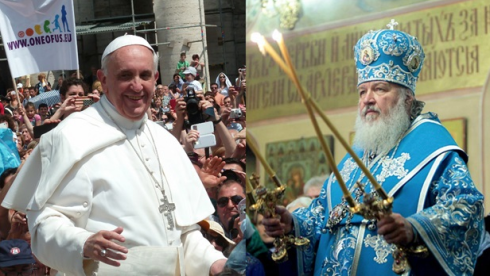
Roman Catholic Pope Francis and Russian Orthodox Patriarch Kirill made history in February, 2016. (Photo credit: Edgar Jimenez / Flickr | Larry Koester / Flickr)

Roman Catholic Pope Francis and Russian Orthodox Patriarch Kirill made history in February, 2016. (Photo credit: Edgar Jimenez / Flickr | Larry Koester / Flickr)

I recently attended a Roman Catholic funeral mass for a neighbor of mine. It had been years since I had attended a Catholic memorial service. Catholic worshipers genuflected, as the sanctuary filled up with smoke from the priest’s incense, an ancient practice of the church, things that you would never see in my Protestant Evangelical church. It reminded me of just how disconnected Protestant Evangelicals can become from other traditions within greater Christendom….

In my town, the two largest churches are made up of Protestant Evangelicals (my church) and the Roman Catholics, respectively. A number of decades ago, a group of families from Greece settled in the area, and opened up a bunch of restaurants. These families became the backbone of a relatively new Greek Orthodox church in town, opened just a few years ago.

Roman Catholics, Eastern Orthodox and Protestants make up the three great wings of Christianity, and yet these traditions are often isolated from one another. In general, Protestant Evangelicals know about Roman Catholics, but their reactions to Catholicism are mixed. Some are curiously fascinated with the traditions associated with Catholicism, and they are drawn to certain aspects of Catholic piety. They read their Henri Nouwen, Thomas Merton, and J.R.R. Tolkien, and they like the idea of going off to a Catholic monastery once in awhile for a retreat. But they do not always understand the whole “transubstantiation” thing… much less the incense. On the other side are those who have run as far away as they can from Rome, ditching their rosary as an “instrument of Satan,” believing that not a lot has really changed since the sixteenth-century Protestant Reformation. But probably, most Evangelicals stand somewhere in the middle, curious… yet cautious… about the Roman pontiff and his followers, … and those funny looking hats the Pope wears.

Evangelicals know even less about the Eastern Orthodox, such as the Greeks who have those restaurants in town. The Orthodox have the funny hats, too. The Orthodox have their “smells and bells,” which for the typical Protestant Evangelical leads to great bemusement. “But are they really Christians?,” many perplexed Protestant Evangelicals will honestly ask. That is what you get when you rely on movies like My Big Fat Greek Wedding for information about the Eastern church.

This sense of unfamiliarity is probably why last week’s meeting between Pope Francis and Russian Orthodox Patriarch Kirill does not register on the typical Protestant Evangelical radar. But it really should.

When Pope Francis and Patriarch Kirill embraced one another in Cuba, it was the first time in about 1,000 years since the chief leader of the Roman Catholic church met with one of the highest ranking leaders in Eastern Orthodoxy. In 1054, the Eastern and Western churches split, technically about a relatively obscure dispute over a line in the Nicene Creed, the filioque controversy, but mostly it was over who was really leading the church: was it the bishop of Rome, the Pope, or was it a college of bishops, as advocated by the great churches of the East?

The closest analogy in the Protestant Evangelical world that could come to mind is if cessessationist Bible teacher, John MacArthur, would have a meeting and a handshake with charismatic evangelist, Joyce Meyer. Now, that would rock a lot of people’s worlds!

It is difficult to say what might come of this meeting between the Pope and the Russian church leader. It was not like the Pope was meeting with all of the Eastern Orthodox leaders.  The balance of influence wielded by the Greek, Russian, Antiochene, and various other Eastern churches is a sensitive matter. Both leaders made a joint plea  for unity and a call to aid Syrian and other Christians, enduring hardship due to war, and the threat of terrible persecution.

Nevertheless, it was historic. Could this be the start of some real reconciliation? Christianity Today’s coverage of the meeting is worth reading.

The Fellowship of Christian Athletes and the Story of Don McClanen

Don McClanen was a young, college basketball coach when he persisted and persisted to have a meeting with Branch Rickey. Rickey, who is most known today as the Brooklyn Dodgers executive, who broke the color barrier in Major League Baseball, by signing Jackie Robinson, finally met with McClanen for an historic five hour meeting. It was out of this meeting that the vision for the Fellowship of Christian Athletes (FCA) was born in 1954.

Don McClanen died this week at the age of 91.

I was not much of an athlete in college, but when the track and field coach of the local high school and a student called me to find out if I would play guitar at their local FCA meetings, I accepted. FCA meets in groups called “huddles,” and I was impressed by the fact that on many campuses, FCA was often the only interdenominational Christian fellowship group encouraging young people to grow in their relationship with Jesus Christ through prayer, Bible study and worship.

It is quite common now for professional athletes to make bold proclamations of their faith in public, but this would be hard to imagine if it  had not been for Don McClanen’s commitment to reach young people for Jesus. McClanen’s personal vision for FCA was in response to reading that at least 17 million American youth in the early 1950s had no church experience or exposure to the Gospel.


People to Be Loved: Why Homosexuality is Not Just an Issue

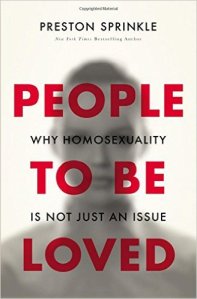
People To Be Loved: Why Homosexuality is Not Just an Issue, by Preston Sprinkle. Moving past the culture wars to love people with biblical truth.

People To Be Loved: Why Homosexuality is Not Just an Issue, by Preston Sprinkle. Moving past the culture wars to listen…. and love people with biblical truth.

What is THE number one issue impacting the evangelical church today, especially among young people? Some may think I am going out on a limb here to be so bold. Okay. I get that. But I am going to say it anyway.

I am not a betting person, but if I did wager, I think I would be right on this one: If you actually have a frank conversation with people under the age of 30 in the church today, it should not be difficult to arrive at a consensus: the issue, broadly speaking, is about gender and its relationship to sexuality. This would include issues like transgender, same-sex marriage, and same-sex attraction in general. What does it mean to be male? Or female? Young people, particularly those already in our churches, have a lot of questions about these issues and what the Bible has to say about them. But let us focus in on one of these in particular: homosexuality.

Unless you have been living in a cave for the past twenty years, you might have noticed a gigantic sea change regarding public opinion regarding same-sex attraction in Western culture. Hollywood personalities, like Ellen Degeneres, have in a sense, normalized social acceptance of same-sex behavior. The U.S. Supreme Court recently declared same-sex marriage to be a legal right. Even Super Bowl Half-Time shows appear to be joining in on the cultural realignment, in the minds of many. The situation has been building for some time, but looking back, it seems like the changes have been happening overnight.

When I have had discussions with Christians since the June, 2015 ruling in Obergefell v. Hodges, most have voiced the sentiment that America is going to “hell in a hand basket.” For many believers, this recent mega-shift in Western culture is an indication of a spirally downward decadence of a once Christian culture. Many fear that we have become Sodom and Gomorrah. Conservative Christian intellectuals wring their hands over what to do about the crisis of morality in the West.

The issue at a cultural level is indeed significant. We could spend a lot of energy debating what many consider to be cultural moral decline.

However, that is not what I want to talk about here. Can we shift gears on this discussion? Because the issue is deeper than Supreme Court decisions. The issue hits a lot closer to home.

It involves our churches.

It involves people with names, hurts and stories.

It involves family members, children of Christian parents, neighbors, co-workers, and friends.

It probably involves someone you know.

Homosexuality is not just an issue.

It is about people to be loved.

Chances are very high that a young person growing up today, in an evangelical church, personally knows of someone, perhaps even a close friend, who struggles with questions of same-sex attraction. But such a friendship puts that young person into a real quandary. Many Christians somehow “know” that the Bible condemns homosexuality, but they simply do not know how to care for friends or family members who wrestle with feelings of same-sex attraction. They know somehow that same-sex marriage is wrong, but what do you say to someone in your school, workplace, or church who admits, “Hey, I think I might be gay?”

Sadly, most local churches are not equipped to handle these type of issues. There are a few cases where someone, who has questions about their own same-sex attraction feelings can talk to a friend or small group about their dilemma. But these situations are sadly rare. If someone has mustered up the courage to step forward to tell their pastor or other trusted Christian leader that they have some sort of same-sex attraction, many times they are met with an awkward response.  Some are gently told to keep quiet, as this is an embarrassing type of sin. Or, it is simply too controversial to talk about in a local church setting. So, the same-sex attracted person is then encouraged to find help in some para-church ministry, shuttled off to talk with some expert or Christian psychotherapist outside of the local church for support.

In some cases, these type of para-church support systems work. Many times, however, they do not. The worst cases end in tragedy. Teenagers who wrestle with their sexuality are getting thrown out of their Christian homes, something that justifiably enrages mainstream journalists. The suicide rate of people who struggle with same-sex attraction type issues is staggering, and many blame the Christian church for the problem.

Many Christians today are seeing how badly things are going with this type of approach to homosexuality. Some, like young author Matthew Vines, author of God and the Gay Christian, argue that evangelical Christians need to change their view on homosexuality, simply accepting that same-sex behavior through gay and lesbian marriage is actually a good thing and approved of by God. Vines, and others, go on to argue that Christians who oppose same-sex marriage are simply “on the wrong side of history” and need to get over their “fear” of the homosexual.

In response, some people simply refuse to talk about the subject and prefer to sweep it under the rug.

Others are saying, “Hey, not so fast. We get the idea that the church has been handling the issue of homosexuality in the church rather poorly.  This is a point well taken. But perhaps we need to rethink this a bit more before dismissing two-thousand years of Christian teaching. Let us take another look at what is going on. What does the Bible actually teach on this subject?”

I know that the emotions are intense. A number of Christian families I know are deeply divided. In some circles, talking about “same-sex attraction” has become a taboo, for fear of offending someone. Some families know that there are simply some conversation topics at Christmas dinner that are not to be discussed!

The reputation of the church has suffered in the midst of this crisis. Blogger Rachel Held Evans is worth listening to here. Evans notes that according to author David Kinnaman, in his book unChristian, a recent Barna Group survey among Americans 16-29 years old indicates that the word “anti-homosexual” is the most common word that describes the Christian faith.

Really? I mean, I surely would not want to be associated with any group or movement primarily known for hating people, whether that be same-sex attracted people, much less anyone else!

This issue does not and will not go away. The names and faces of people who have the courage to speak up about their own sexual struggles still trouble us. How does someone, who does not have a super-deep knowledge of the Bible, know what to think? Has the church really been wrong on this for two-thousand years?

Continue reading


C.S. Lewis, the Scandal of Particularity, Science & Revelation

Reading about my Veracity co-blogger John Paine’s adventures in England, and seeing the photos of the Eagle and Child, it made me think of C. S. Lewis. Until recently, I have never been a very avid C. S. Lewis reader. My problem is a bit different from John’s. Sure, Lewis can at times be hard to get through, but my primary difficulty is that I have a rebellious streak against reading popular Christian authors.

Back when I was in college in the mid-80’s, it seemed like EVERY Christian I knew was reading C. S. Lewis. Or at least, they planned to read Lewis. Lewis just seemed a bit too trendy to me, and Lewis himself thought that his work would be long forgotten within years of his death. At that time, Lewis had been dead for twenty years, and it just seemed like there was a desperate need for new voices, and aside from exceptions like Francis Schaeffer, evangelical Christianity was not producing many with the kind of substance Lewis possessed. I respected Lewis, but I had little desire to fall into the “Lewis crowd.” So I bought a small stack of MacMillan published titles from the college bookstore, and there they sat on my shelf, unread, for years.

The situation is different today. C. S. Lewis is still popular, but mostly through his children’s works, and not so much through his apologetics writings. Among evangelicals now, I find that C. S Lewis is someone everyone has heard of, but few have really read. Like me, those books just sit up on the shelf, and many Christians say, “Maybe someday I will try to crack open some of Lewis’ more challenging writings.”

A few years ago, my rebellious spirit prompted me to go against this evangelical malaise and actually read Lewis. I read The Great Divorce, and it gave me a whole new way of thinking about the doctrine of hell. Lewis’ Space Triology was up next, and it made me wish I had read through the whole series thirty years earlier! Sure, there are some peculiar constructions in Lewis’ style that seem outdated, but the man had a grasp for ideas that in many ways was years ahead of his time. It would probably help us if we were to dust off those Lewis books on our bookshelf, and engage what Lewis had to say. This video by pastor John Piper, tells us why Lewis is still important:


Here is one of those ideas in Lewis that has had me thinking a lot recently….
Continue reading


Do Atheists Just Suppress the Truth in Unrighteousness?

Greg Koukl is an apologist with Stand to Reason ministries. In the following 3-minute video clip, Greg tries to answer the question, “are atheists just suppressing the truth in unrighteousness?” From Greg’s reading of Romans 1:18-32, it is not just “atheists” for whom the question can be asked. Anyone who is not a believer in Christ would fall within this category.

Does Greg’s video get at the idea that Paul is trying to communicate here? Watch the video, read Romans 1:18-32, and let me know what you think.

NOTE: For those who want a little more background into this challenging passage of the Apostle Paul’s, you should be aware that Paul’s critique of pagan idolatry in Romans 1 is rooted in the Jewish theological perspective of his day. Sometime within 200 years prior to Paul ‘s writing his letter to the Roman church, an unknown Jewish writer penned the so-called “Wisdom of Solomon,” part of the Greek Septuagint, as well as part of what many Protestant Christians call the “Apocrypha.” In the Wisdom of Solomon, the writer extols the virtues of wisdom grounded in the worship of the True God of Israel, and contrasts this with the idolatry of paganism just as Paul does. Note the striking parallels in Romans 1 with Wisdom 13 and 14.