Vatican II, Embracement, and Pope Francis: Roman Catholicism Today

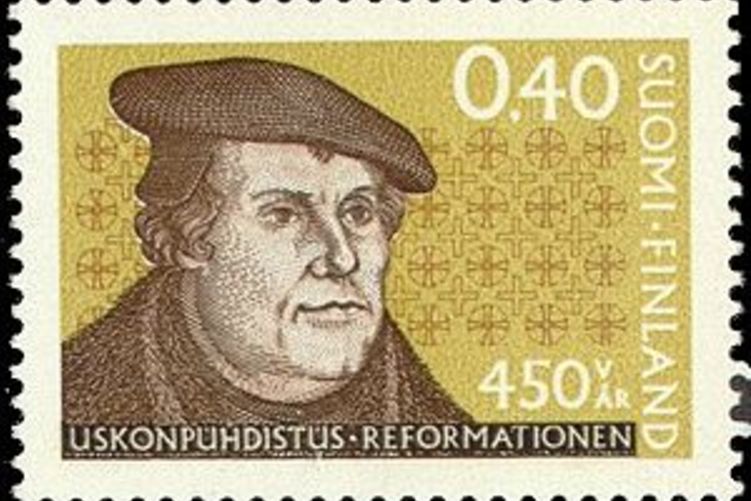
Martin Luther, a “heretic” or “a witness to the Gospel?” How has the Roman Catholic communion changed in 500 years? (credit: Finland stamp from 1967, from a ETWN web page)

I need some help from my Roman Catholic friends. It is difficult to figure out exactly what is going on in Rome today.

An Italian evangelical leader, Leonardo De Chirico, gave a very thoughtful 30-minute message at a recent Ligonier Conference, in this year of remembering the 500th anniversary of the start of the Protestant Reformation. In the video below, Chirico argues that in order to understand Roman Catholicism today, we need to have in mind three concepts/names:

  • Vatican II: The 16th century Council of Trent codified for hundreds of years what has been traditionally understood to be Roman Catholicism, the high water mark for the Catholic Counter-Reformation, a formulation of doctrine that sought to refute many of the reforms of Martin Luther and other Protestants. The next major council, Vatican I, set much of Roman Catholicism against the changing modern world of the 19th century, affirming the work of the Council of Trent, and reinforcing traditional boundaries. But the early 1960s, Vatican II council changed all of that. However, Vatican II did so, not by altering the doctrine of the church, but rather, by changing the tone and attitudes towards those outside of the Roman communion.
  • Embracement: Vatican II set the wheels in motion, whereby this change of tone and attitude has characterized the trajectory of the Roman church for the past fifty-plus years. Pope John Paul II and Pope Benedict put the brakes on much of this Vatican II trajectory, embodying the doctrinal commitments that have traditionally defined Rome. Still, incremental changes in smaller ways, in terms of a warmer spirit of embracement and inclusiveness of others, made their way into the church. But the doctrine remained effectively the same.
  • Pope Francis: Now however, unlike his recent predecessors, Francis has downplayed the doctrine and turned up the warmth of this new spirit of embracement. Arguably, Francis is the first truly “Vatican II”-like Pope. In the past four years since his ascendancy, Francis has hinted at or suggested various reforms in the church, some that point towards reconciliation with other parties in the universal Christian community (like Protestants and Eastern Orthodox), some that thrill liberals and others outside of  the church, and some that horrify Catholic conservatives.

What are we to make of all of this?

Briefly stated, on the one hand, Roman Catholicism has never been a monolithic movement, even during the era of the Council of Trent. On the other hand, Protestants can easily misrepresent what Roman Catholics believe and think, and that does harm to efforts to try to heal the divisions of the last 500 years. That being said, here are two things that come to mind as examples of what puzzles me, as to what is coming out of Rome in the Pope Francis era:

  • A generation ago, those Catholics who experienced the tragedy of divorce, were conscience-bound to go through the process of securing an annulment for improper Catholic marriages. Nowadays, fewer divorced Catholics even bother with the annulment proceedings. Also, according to authoritative Catholic tradition, regular confession is a required sacrament of the Catholic Church, and yet, I know many Catholic friends who rarely, if ever, go to confession. What are we to make of all of this?

Leonardo De Chirico offers some insights from a Reformed Protestant perspective. I can imagine that many traditional Catholics might be terribly dismayed by all of the changes. Can any of my Roman Catholic friends help me out here? Are Chirico’s observations correct?

Ligonier Ministries, associated with Bible teacher R. C. Sproul, has some great resources, particularly for those with interest in the theology of the Protestant Reformation. In this year, the 500th anniversary of the Reformation, Ligonier sponsored their annual conference, with the theme of the Reformation, and you can even view all of the videos of the conference on YouTube.



A Modest Defense of the “Billy Graham Rule”

There is quite a bit of chatter in social media recently about Vice President Mike Pence’s adherence to the so-called “Billy Graham Rule.” Many have mocked Pence’s statement that “he never eats alone with a woman other than his wife.” Briefly, the “Billy Graham Rule” was an unwritten pact between the early members of Billy Graham’s evangelistic team, that they would avoid even the appearance of infidelity. These men pledged not to eat, travel, or meet with any woman alone, except their wives. This rule, which covered more than just the issue of sexual infidelity, served to protect this ministry from the allegations of impropriety, for a long string of decades, that many Christians have admired as basic, common sense.

Surprisingly, the criticism of this rule has come, not simply from secular sources, but from Christians as well. Much of the furor concerns the endless egalitarian versus complementarian debates that consume the energies of many of today’s Christians (I tell some of my story here). Progressive Christian blogger, Rachel Held Evans, tweeted that “Jesus scandalized the disciples by meeting with a woman for a drink,” a reference to Jesus’ meeting of the Samaritan woman at the well, in John 4.

The critics have a point. The “Billy Graham rule” arose during a time when it was relatively uncommon to find women in the work force, in the late 1940s. When I began my career in engineering in 1980s, things had drastically changed in society. For about five years, I shared a large office with three other women engineers. There were times when I was alone with one of these women in the office, and neither of us thought anything about it. It was just part of our jobs to work together. So I get it.

But such critics have obscured something essential, in their defense of seeing women fully integrated in the workplace. The “Billy Graham rule” should not be lost as some legalistic concept, to be discarded as being sexist. Rather, we must be mindful of the principle that undergirds the rule, namely, that all people, men and women, who wish to honor their Lord, should not put themselves in compromising situations.

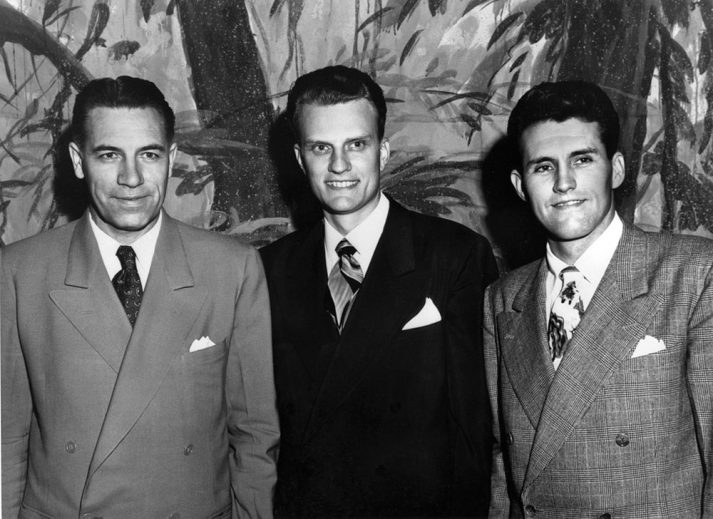
George Beverly Shea, Billy Graham, and Cliff Barrows, the young evangelists, who sought to live lives above reproach.

Fundamentally, people like Pence and Graham have been simply protecting their marriages, protecting themselves, and protecting those who have come under their familiar influence. As followers of Jesus, we should all do the same. The human tendency towards sin is much stronger than we are willing to admit to ourselves and realize. What often starts off as legitimate and harmless in our interpersonal relationships, business or otherwise, can easily slip into something completely inappropriate, over a period of time. The principle behind the Graham rule is that we should have those checks and balances in place that will keep us honest. All of us need healthy boundaries, to keep us from crossing lines of behavior, that we would soon regret. Just ask those former pastors and ministry leaders who failed to keep an appropriate version of the “Billy Graham rule,” starting counseling relationships privately, with those of the opposing gender, who after a small indiscretion here and there, eventually lost their jobs, scandalized their ministries, and destroyed their families.

The drawings of those specific boundaries will change as cultural conditions change, and such “rules” may still look strange to outsiders. Jesus met with the woman at a public well, not a dimly lit, secluded room. Yet the concept of a public well, in first century Palestine, seems strange, when contrasted with the contemporary American workplace or ministry setting. We will need to tweak certain applications of the principle behind the “Billy Graham rule,” in a culturally contextual manner. But the principle of avoiding compromising situations is a good thing to keep. Let us not mock that.


Ivor Noël Hume, and the Evidence for Faith

Ivor Noel Hume, in the filming of "Search for a Century," a 1970s Colonial Williamsburg production.

Ivor Noël Hume, actor turned famous archaeologist, in the filming of “Search for a Century,” a 1970s Colonial Williamsburg production.

Ivor Noël Hume, a pioneering archaeologist of colonial America, died on February 4, 2017. As the New York Times tells it in their remembrance, Hume was an “accidental, self-taught English-born archaeologist who unearthed the earliest traces of British colonial America.” He was the director of archaeology at the Colonial Williamsburg Foundation from the mid to near late 20th century, excavating 18th century Williamsburg, as well as 17th century settlements in the area, notably, Wolstenholme Towne, at the Carters Grove estate. Most locals now know of the place as part of Martin’s Hundred, in the neighborhood of the Kingsmill community subdivision.

I only met Mr. Hume a few times growing up as a kid, but my late father, George Alan Morledge, worked with him at Colonial Williamsburg. My dad, an historical architect, had been hired by Colonial Williamsburg vice president, Ed Kendrew, to assist in the team effort with the archaeologist Hume. From digging below ground to restoring 18th century structures above, these historians across various disciplines enjoyed the pursuit of evidence that helped to reconstruct Williamsburg, and other local, historical sites, to paint a portrait of what life really looked like in the early years of colonial Virginia.

Many consider Hume to be the “father of historical archaeology.” As I remember him, mostly through my dad, Ivor Noël Hume was quite a character.
Continue reading


The Tim Keller Controversy at Princeton: And What It Means for the Church

OOOOPS!!  It was a shocker when the Oscars mistakenly first awarded Best Picture to “La La Land,” instead of “Moonlight.” But who would think that a leading Protestant seminary would do the same type of thing? (photo credit: Kevin Winter/ Getty Images)

Normally, when a theological seminary gives an award to someone in the greater community, the announcement brings about as much excitement as saying how many millimeters your grass has grown up so far this spring. But when the prestigious Princeton Theological Seminary announced that Tim Keller, a New York City pastor, was to be awarded the esteemed Abraham Kuyper Prize for Excellence in Reformed Theology and Public Witness… and then later rescinded the offer, it created quite a stir.

Tim Keller is probably one of the most well-known, conciliatory voices in the conservative evangelicalism movement. His books on the Bible, marriage, and particularly, apologetics, like Reason for God and Making Sense of God: An Invitation to the Skeptical, have helped millions to better understand how the Gospel of Jesus Christ effectively relates to the challenges of living in a postmodern culture. The Gospel Coalition, an organization that Keller helped to found, is a “go to” resource for many evangelicals, for encouragement, Bible teaching, and cultural analysis.

Interestingly, Keller in the past has had his critics on the extreme conservative side. Keller’s openness to some aspects of evolutionary creationism has come under a suspicious eye, for some, while others have branded his book, Generous Justice: How God’s Grace Makes Us Just, as uncritically paving the way towards an embracement of socialism. But most evangelical Christians, who know anything about Tim Keller, regard him as a gracious and thoughtful spokesperson for evangelical faith, even if there is disagreement on relatively minor matters, according to Richard Mouw, former president at Fuller Theological Seminary, and a past recipient of the very same Kuyper prize, awarded at Princeton Seminary.

Tim Keller

Tim Keller: A type of evangelical thinker who models the kind of irenic approach to Christian apologetics, that Veracity tries to follow.

However, when some members of the Princeton Seminary community realized that Keller was a member of the Presbyterian Church of America (PCA), a Christian denomination that does not confer ordination on women, or practicing gay or lesbian people, they became angry over the Seminary’s plans to honor Keller with the Kuyper award, leading to the rescinding of the award offer. Apparently, you just can not make everybody happy. As a type of compromise, Keller has still been invited to speak on the topic of mission at the seminary, an invitation which he graciously accepted. Yet the controversy regarding Keller forebodes several signs, that do not look good for the health of the Christian community in America in our day. I will list four, but see if you agree with these assessments:

  • Oversimplifying Complex Points of View. Keller’s position on both women’s ordination and gay/lesbian ordination was the stated reason for rescinding the award. Issues concerning how men and women relate to one another, and how the church can best address the concerns of the LGBTQ community, are quite complex, so it seems rather flatfooted for dissenters at Princeton to base their protest over Keller’s theology of ordination. While it is true that the large majority of evangelicals do oppose both women’s and gay/lesbian ordination, there is also a significant voice among evangelicals that opposes gay/lesbian ordination, but believes that the question regarding women’s ordination is still a matter of vigorous debate. Yet there is even another debate among Christians as to what constitutes ordination in the first place. Presumably, Tim Keller’s wife, Kathy Keller, who at one time advocated for women’s ordination, but now opposes it, would never be eligible for the Kuyper award, per the dissenters at Princeton. Keller’s dissenters at Princeton do not seem to be aware of these divergent, complicated factors, apparently out of step with the discussion in the evangelical church body at large. Jim Daly, of Focus on the Family, insightfully remarks that Princeton Seminary needs Tim Keller more than Keller needs Princeton. Is Princeton in danger of unnecessarily conflating complex issues together?
  • The Intolerance of Tolerance. For years, progressives in various churches have complained that conservatives have shut down conversations on sensitive, controversial issues. So, it seems strange that progressives at Princeton would attempt to try to “marginalize” a moderate figure like Tim Keller. Even a few progressive types, like Jonathan Merritt, of the Religion News Service, believes that Princeton’s actions are over the top, observing that Keller is no misogynist and no bigot. So, when did an attempt to maintain fidelity to the long standing traditional interpretations of Scripture make someone a misogynist or bigot?
  • The Flipping of “Orthodoxy” Upside Down. For much of the 19th and early 20th century, Princeton Theological Seminary was self-consciously the guardian of conservative evangelical orthodoxy. Abraham Kuyper, for whom the Princeton award is named for, was one of the distinguished leaders of confessional evangelicalism, in the latter 19th century and early 20th century, at one time the Prime Minister of the Netherlands. Kuyper’s doctrinal commitments mirror much of what Keller’s denomination, the PCA, believes. Some even argue that Kuyper negatively would be greatly more conservative than Tim Keller. Is it not strange that if Abraham Kuyper were alive today, that he would not be eligible to receive an award that bears his name?
  • The Polarization of American Christianity. It is as though the extremes on both sides, conservative and progressive, are getting more extreme, and those who propose a more measured, moderate approach to sensitive issues, are caught in the crossfire. Will divisive rhetoric continue to polarize Christians, or will voices be allowed to emerge that promote dialogue and unity, while preserving orthodox faith?

While there are some at Princeton who begrudgingly will allow Tim Keller to come and speak, anyway, we here at Veracity have no hesitation in offering the kind of thoughtful engagement with contemporary issues that Tim Keller offers to the church, as well as the largely secular folks at Google. Here is Keller’s talk at Google last year, articulating the main ideas found in Making Sense of God: An Invitation to the Skeptical (be sure to hear the question that is relevant to the fundamental concern of the dissenters at Princeton, and Keller’s response, starting at the 52:45 mark).

UPDATE: March 29, 2017


Botticelli and the Search for the Divine

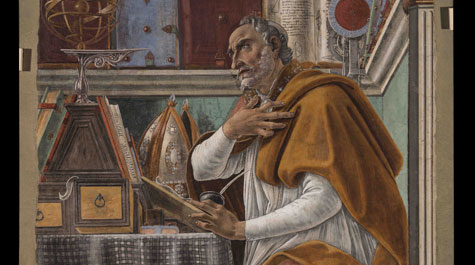
Sandro Botticelli, Sant’ Agostino nello studio (Saint Augustine in the studio), Fresco, Chiesa di San Salvatore in Ognissanti, Florence.

It is worth your time, if you are in the Williamsburg, Virginia area, to consider viewing the Sandro Botticelli exhibit at the Muscarelle Museum and the College of William and Mary, on tour in the United States, but only at the Muscarelle until April 5.

As an Italian renaissance painter, who counted Michangelo and Leonardo Da Vinci as contemporaries, my favorite painting is that of Saint Augustine, in his study. Augustine is in the process of writing to St. Jerome, who had recently died, though Augustine was not aware of this, when he began his letter. As the story goes, the scene anticipates Augustine’s reaction to a vision of hearing St. Jerome’s voice, rebuking him for trying to understand the mysteries of Heaven, with Augustine’s earthbound reason.

Many of Botticelli’s works were lost when an exuberant 15th century Dominican priest, Girolamo Savonarola, sought to rid Florence, Italy of objects that might tempt one to sin, on the Mardi Gras festival. Thankfully, not all of Botticelli’s works were destroyed during the Bonfire of the Vanities, so be sure to catch a glimpse of them at this, the first traveling exhibit of Botticelli’s work, to the United States.

Enjoy.