Category Archives: Topics

Inerrancy and Infallibility

We cannot explain or resolve all parts of Scripture. However, to surmise that apparent conflicts in the Bible must be ‘errors’ is an arrogant and dangerous supposition. Too many people give up too easily—if it doesn’t make sense they aren’t willing to dig deeper. Or to trust. Bible

A few years ago I listened as wise, godly friends discussed the inerrancy and infallibility of the Bible. All of them are mature Christians. The issue was not the authority of Scripture for faith and practice. The issue was whether it is necessary and/or appropriate to include in our statement of faith that the Bible contains the ‘inerrant’ and ‘infallible’ word of God.

While I try not to get too personal with this blog, the most that I can contribute on this topic is personal. Specifically, the more I study, the more it all makes sense. Not just in a little way, but in one “Oh wow!” realization after another. Many (not all) passages that at one time confused me or caused me to wonder if the text was correct came into sharper focus with deeper study. This detailed-study-leads-to-edification process has happened so many times that my views on the inerrancy and infallibility of the Bible have strengthened considerably.

Just one example—I audited an apologetics course entitled Creation and the Bible by Reasons To Believe. Dr. Hugh Ross, an astrophysicist and the founder of Reasons To Believe states in his testimony that he became a Christian by reading the foundational books of the world’s religions and discarding them one by one based upon scientific errors apparent in their text. When he got to the Bible, however, he found 13 scientifically accurate statements about the creation of the universe in the first chapter of Genesis. If you take the time to dig, the details are amazing and dramatically support the case for ascribing inerrancy and infallibility to the Bible.

There’s no shortage of opinions on the accuracy of the Bible. Our post-modern culture promotes individual opinions and disharmony over conformity and agreement. Fine. Got it. No one wants to give a straightforward yes or no to the question of Biblical inerrancy, and actually that should be the case. What do you do with translation differences, poetry, allegorical statements, the use of Koine (slang) Greek, textual criticism, differing accounts of the same events by different authors, a lack of modern technical precision, observational descriptions of nature, the use of hyperbole and round numbers, variant selections of material in parallel accounts, and so on? It takes a fair amount of clarification before we can get to a yes or no response.

But the concepts behind these adjectives are extremely important, and there are those who have done a very good job building a case for unity on this topic. The Chicago Statement on Biblical Inerrancy is a document worthy of very careful reading. Before I read it, I had my own unfocused views on the subject. After reading it and thinking it through, I’m in. I support the Chicago Statement.

So back to the question of whether it is necessary or appropriate to include that the Bible is inerrant and infallible in our statement of faith. In its constitutional context, the Williamsburg Community Chapel’s statement of faith is reduced to eight points about which we believe so strongly that we would break fellowship with those who would disagree. In this context, personally I believe it is appropriate—but not necessary—to include these terms (see Article XIX of the Chicago Statement). In other words, would I break fellowship with someone who was struggling with the genealogies of Christ in Matthew versus Luke? No. Would I break fellowship with someone who insisted that the differences in these genealogies prove the errancy of the Bible? Absolutely. More importantly, do I believe that the Bible is the inerrant and infallible, inspired word of God? Yes.

______
2015 Personal Discipleship - Week 8
Click on the images inside this file to link to the online resources. (You may need to adjust your browser settings to allow the links to work, or open it in iBooks, or save it to your desktop and open it with Acrobat Reader.)

HT: Dave Rudy

Purim in 5 Minutes

We are currently in the middle of the traditional Jewish feast of Purim, celebrating the classic story from the Book of Esther in the Bible, describing how the Jewish people during the Babylonian/Persian exile were saved by the faithful actions of one woman, Queen Esther. Jews from all over the world gather together to retell the story, many of them making loud noises whenever the name of Haman, the wicked villain of the story who desired to wipe out the Jews, is mentioned.

A Jewish friend of mine gave me some hamantash, a traditional three-cornered cookie filled with different yummy fillings, which represents the antagonist Haman. If you are not familiar with this Jewish festival, or the Book of Esther, you might enjoy this 5-minute explanation produced by a traditional Jewish website, aish.com:


What is Lent?

I just came home from our church’s Ash Wednesday service, with some charcoal on my forehead, reminding me and others around me of our own mortality.

I know that many evangelical Christians do not celebrate Ash Wednesday, or the season of Lent, for that matter, because it is not directly taught within the Bible. I can understand that, but the unfortunate rumors that the season of Lent has pagan roots is without foundation. Instead, the practice of Lent is thoroughly grounded in a tradition begun in the early church, for which traditionally-minded liturgical churches continue to celebrate, along with a growing number of evangelical churches. So while the specific practice of Lent is not mentioned in the Bible, the concepts of repentance and self-examination as we prepare our hearts to meet the crucified and risen Christ celebrated on Easter Sunday are most definitely grounded in Scripture.

For more on the history of Ash Wednesday and Lent, see this Veracity posting from last year. Columbia Publishing House, an arm of the Missouri-Synod Lutheran Church, produced the following video, a short under-3-minute introduction to what Lent is all about:

HT: Gene Veith’s Cranach blog at Patheos.com


Keeping It Real

Personal Discipleship Week 2

Click on the images inside this file to link to the online resources. (You may need to adjust your browser settings to allow the links to work, or open it in iBooks, or save it to your desktop and open it with Acrobat Reader.)

(Note: For those interested in the calculations for the precise dating of the first Easter, here is the link to the paper Dr. Ken Petzinger shared with our Personal Discipleship class.)

Truth is not relative. Truth is not—as Ogden Nash so eloquently wrote—that “people believe what they believe they believe.” Truth is not dogma. It is not—as Ravi Zacharias argues—logically inconsistent, empirically inadequate, or experientially irrelevant. Truth is incredibly important. Truth is the reason Jesus Christ was born and came into the world.

“In fact, for this reason I was born, and for this I came into the world, to testify to the truth.”
John 18:37c (NIV84)

Okay, okay…Why spend time studying ‘truth’? People who harp on ‘truth’ make me nervous (and sometimes nauseous). Sometimes dangerous ideologies are launched on malformed or manipulative notions of truth. Got it. But objective truth is the proper basis for personal discipleship. Without objective truth, the door is open to wield the Bible as a weapon, perverting the very purpose of Divine revelation. Without objective truth one can hold up the Bible and say with a clear conscience, “The Bible says it, I believe it, that settles it!” (New Testament scholar Daniel Wallace calls this attitude “bumper sticker theology.”) Among many other problems, that approach has a glaring flaw—an inherent internal focus. In other words, “that settles it (for me).”

Those who ascribe to a “that settles it (for me)” approach to the Bible tend to miss the beauty that comes from understanding how well it can withstand objective, historical, logical, philosophical, and (yes) scientific scrutiny. It takes a great deal of effort to “work out your own salvation with fear and trembling” (Philippians 2:12), but the juice is worth the squeeze.

We don’t tell people what to think on Veracity, but we’re not afraid to share opinions. Rather than sticking our heads in the sand and ignoring challenges to the Bible and the Christian faith, why not take a hard look at these challenges and study the appropriate responses? Could it be that the reason some Christians are unwilling to address atheistic or skeptical objections is that, deep down, they fear the answers might be inadequate? Why upset the applecart when it is settled (for me)? Could it be laziness or complacency?

With objective truth as the basis for personal discipleship, our studies can become rich and full of awesome discoveries. Without it we’re apt to flounder, or even end up spiritually bankrupt. Okay, enough of my testimony.

“The gospel of Jesus Christ is beautiful and true, yet oftentimes one will ask, “How can it be true that there is only one way?” Odd, isn’t it, that we don’t ask the same questions of the laws of nature or of any assertion that lays claim to truth. We are discomfited by the fact that truth, by definition, is exclusive. That is what truth claims are at their core. To make an assertion is to deny its opposite. Rather than complain that there is only one way, shouldn’t we be delighted that there is one way?”
Ravi Zacharias, Think Again – Deep Questions, 28 August 2014

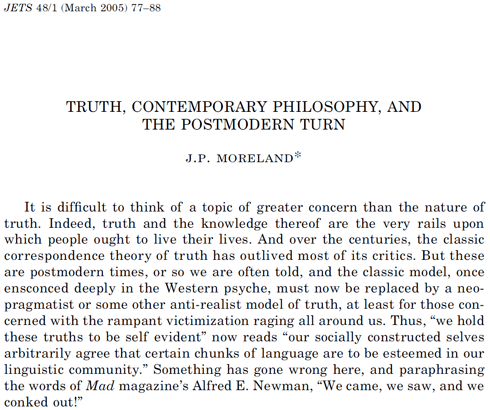
In addition to J. Warner Wallace’s excellent video on The Case For Truth, there are two essays I would recommend for anyone interested in personal discipleship. The first is a brief blog post by Ravi Zacharias entitled “Deep Questions.” The second is a paper delivered by J.P. Moreland at the Evangelical Theological Society, November 18, 2004. Click on the images below to read these essays.

Ravi-Zacharias: Truth

J. P. Moreland: Truth


American Sniper, Dietrich Bonhoeffer, and the Christian Faith

I want to say something about a movie I have not seen, American Sniper. In fact, I think my wife and I are among the handful of Christians in our church who have not seen the movie yet.

This latest film by Clint Eastwood, is about Chris Kyle, a sniper credited with some 160 kills during the Iraq War, a record in American military history. According to folks who have gone to see the film, and from this review by the Internetmonk, Kyle’s father gave his son advice when he was young: “there are three kinds of people: sheep, wolves, and sheepdogs. Most people are sheep, they need protecting from the wolves that threaten them. The boy better not think of being anything but a sheepdog — strong, protective, using whatever means necessary to guarantee the safety of his own“.

Chris Kyle is called to be a sheepdog.

The film raises disturbing issues.

As it should.

On the one side are those who view Chris Kyle as the ultimate hero to be celebrated, representing the virtuous forces of good heaping judgment upon the forces of evil. On the other side are those who see in the rush among evangelical Christians to glorify Chris Kyle a horrific sense of betraying the very pacifist ethic of Jesus as taught within Scripture. I am torn about seeing the film because I wonder a lot about the deeper issues lurking behind the camera lens.

Partly, American Sniper is contentious because of some of the historical inconsistencies resulting from what Clint Eastwood portrays in this haunting, tragic story, or what he leaves out by omission. But the other part is that while the film thoughtfully raises crucial issues, I wonder if it really explores them in any rich, theological depth. According to one review at the Patheos Anxious Bench blog, Chris Kyle slips a Bible into his pocket early in his youth, and he carries this Bible with him throughout his life. But what function does this Bible have for Chris Kyle? Is it God’s Word to him imparting a theological vision of what it means to be called as a sheepdog, or is it merely a talisman, a type of “good luck” charm, carried with him as a form of protection and sign of God’s blessing?

If you saw the movie yourself, how would you answer this?

For anyone who understands the Bible’s claim to be the very Word of God, and if you are a student of these Holy Scriptures, you can not help but be drawn into questions about violence, justice, and peace within the Bible. How do you reckon that one of the great ten commandments, “thou shalt not kill” (Exodus 20:13) with God’s other commands to wipe out peoples such as the treacherous Amalekites?:

Now go and strike Amalek and devote to destruction all that they have. Do not spare them, but kill both man and woman, child and infant, ox and sheep, camel and donkey (I Samuel 15:3 ESV).

We are called to love our neighbor on the one hand, but what are we to make of this uncompromising “kill man and woman, child and infant,” and all of their animals? This is pretty heavy stuff to consider indeed, but it is part of the matrix of questions for which the sacred writers want us to grapple. Is the message of the Bible one of peace and non-violence, or is it a message about justice where the use of deadly force is at times necessary, or a message that if left unfiltered condones genocide as many critics complain?

How do we reconcile the Sermon on the Mount and Jesus’ call to love one’s enemies (Matthew 5:44) with the Apostle Paul’s admonition to obey the governing authorities (Romans 13:1-7), even if that requires some to serve in the military and kill other human beings?

These are age old questions. What is the right answer? Is it the “Just War Theory” of Saint Augustine, who instructed that there are times where the sniper must resort to acts of violence for the sake of some greater good? Or is the Christian to always pursue the path of non-violence, as articulated by the traditional Quakers and the Anabaptists? Different followers of Jesus have come to different, thoughtful conclusions to these matters.

I recently finished reading Eric Metaxas‘s biography of the 20th century German theologian, Dietrich Bonhoeffer, who became a participant in the Resistance against the Nazis, entitled Bonhoeffer: Pastor, Martyr, Prophet, Spy. How was it that this pastor and academic Bible teacher able to at one time embrace a commitment to pacifism, following the path of non-violence inspired by Mohandas Gandhi, only to then become involved in the plot to assassinate Adolf Hitler?

Dietrich Bonhoeffer, discussed earlier on Veracity, did not see the Bible as a mere talisman.  Metaxas makes it clear that Bonhoeffer wrestled with what God says in His Word. Bonhoeffer saw himself as a patriotic German citizen in a supposedly “Christian nation,” ready to participate in military service as required for the defense of that country but he also knew that the Nazis were intent on wiping out the Jewish people, and yet the Jews had no defense against the German war machine. To borrow from American Sniper, the European Jews were the sheep, the Nazis were the wolves, but was Bonhoeffer really called to be a sheepdog?  As Bonhoeffer basically put it, if you see a madman driving a car down the road heading towards a group of children, you must throw a wrench into the wheel in order to slow down the car, even if it meant the eventual harm to the madman driver. But how can a follower of Jesus pick up that wrench himself as a weapon … without becoming sucked into the very web of evil that defined Hitler?

“We are not to simply bandage the wounds of victims beneath the wheels of injustice, we are to drive a spoke into the wheel itself.”

How about this, Veracity reader?

I will go see American Sniper if you promise to read Metaxas’ book on Dietrich Bonhoeffer.

Do we have a deal?

One of the most perceptive comments about the American Sniper film came from one of my small group members who saw it. While it is very tempting to want to pick up a gun and blow away every suspected terrorist you can find, to wipe out those whom we perceive as standing in the way of God’s justice, we must be mindful that “there but for the grace of God go I.” Before we begin to demonize every “extremist” out there and wish for their death, we must be willing first to look deep inside ourselves and examine the demons within.

What really separates me from that evil person “over there?”

Here is another way of putting it: how does one imagine oneself as a sheepdog protecting the sheep, when you have the “wolves” living inside of you? We may debate the question of violence in the Bible and how the Christian is supposed to think about it, but hopefully the unequivocal message of the Scriptures is that the source of all violence comes from within the human heart: your heart and my heart.

It is what the Bible calls “sin.”

If you do not believe me, try reading Romans 3.

The heart is deceitful above all things, and desperately sick; who can understand it? (Jeremiah 17:9 ESV)

Answering the questions raised by American Sniper and Dietrich Bonhoeffer are not easy, but grappling with our own sin, the demons within, those inner “wolves,” is the first place to start.