Category Archives: Topics

Can We Trust the Bible?

“The Bible says it, I believe it, that settles it.”  Really?!

Many theologians and pastors strongly disagree.  If there was such a thing as a fantasy theology team, my top (living) draft picks would include: Dick Woodward, William Lane Craig, Hugh Ross, Ravi Zacharias, Matt Slick, Tim Keller, John Yates, Michael Card, Ray Vander Laan, Andy Stanley, Lee Strobel—and Daniel Wallace.

Here’s a slightly irreverent, very funny, and spot-on lecture by Dr. Wallace given at Dallas Theological Seminary about the “worst Christian slogan ever concocted” (my apologies in advance to people from Arkansas).

Seriously, how much research is there to corroborate Dr. Wallace’s observations and conclusions?  How reliable are the Bibles we have today?

Continue reading


The New Mormonism… And the Old

The Church of Jesus Christ of Latter Day Saints is changing. Once a marginal, persecuted sect isolated in the frontier regions of Utah in the 19th century, the movement popularly known as “Mormonism” has entered the American mainstream. Out with the “old”, in with the “new”.

Years ago, the stereotypical Mormon was a clean cut, college-aged student wearing a white buttoned-down shirt and a name tag, riding down your street on a bicycle. Now he is a professional business executive, a famous entertainer, or even a presidential candidate. In the “old” Mormonism, a Mormon was someone who wore weird underwear and perhaps thought that he might become a god of his own planet someday. Now in the “new” Mormonism, he is happily married and upholds traditional and wholesome American family values and loves his country. Sure, Mormons still have the bicycles and the underwear, but now they are those good-looking neighbors next door who always seem so nice and friendly and hug their kids…. Yeah, come to think of it… in my experience, every single Mormon gal I have ever met has been really cute.

Former Mass. Governor Mitt Romney is the first major Mormon candidate for the United States Presidency since…… Joseph Smith ran for the office in 1844.

But the Latter Day Saints (LDS) are changing in other ways, too. True, new membership rates indicate over 14 million LDS members worldwide and that number is steadily rising. However, the rates for active membership are actually in decline. LDS General Authority Marlin Jensen has stated that “attrition has accelerated in the last five or ten years.” Some research shows that even since the early 1990s, for every new Mormon convert there is at least one Mormon who leaves the church or simply becomes inactive. The LDS movement is hemmorraging, and hemmorraging fast. Out with the “old”, and in with the “new”. What explains these changes? How can evangelical Christians respond to the changes within Mormonism when doing apologetics? Continue reading


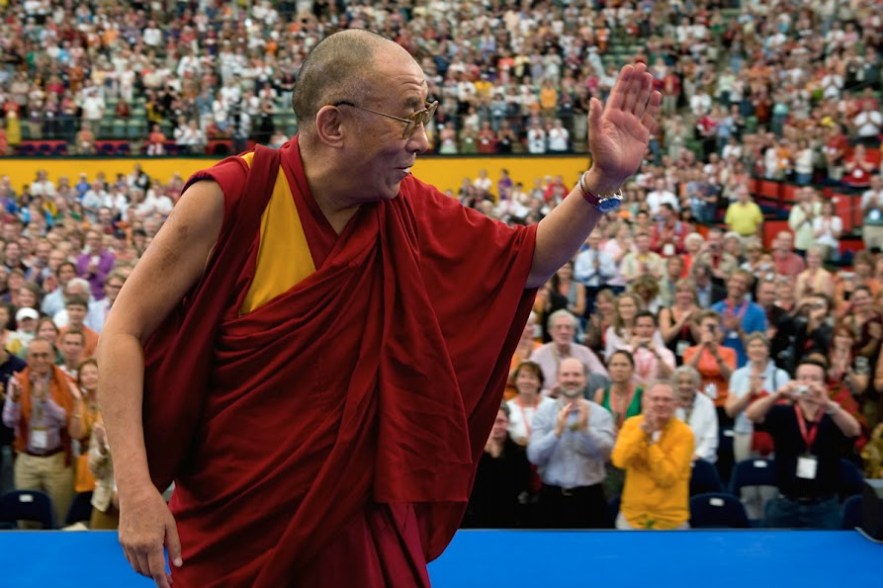
The Dalai Lama is Coming!

I play soccer with a group of friends at the College of William and Mary, where I work as an IT staff person.  At the end of one of our games, we were talking about the upcoming visit by the Dalai Lama to speak at William and Mary Hall, on Wednesday, October 10.   There were several jokes about strange Eastern religious customs and how hot it would be to wear a monk robe all day long.  One made a sly remark about attaining “enlightenment” from the marijuana fumes rising up from the crowded Kaplan Arena this coming Wednesday from smuggled-in contraband.   This is a big deal event for the College, with several thousand tickets sold out within minutes to hear the venerable representative of international Buddhism.  So what is the big deal about the Dalai Lama?
Image

The 14th Dalai Lama

Actually, Tenzin Gyatso is the 14th reincarnation of the Dalai Lama, according to Tibetan Buddhist tradition.   For hundreds of years, an unbroken line of spiritual teachers in Tibet have instructed the Buddhist faithful.  But the Dalai Lama is more than a religious leader position, it is also a  political role, unifying all of the Tibetan region north of the Himalayan mountains in Asia.  So when Communist China invaded Tibet in 1950, it put the current Dalai Lama into a difficult situation.   After a failed uprising against the Chinese in 1959, the 14th Dalai Lama fled and established a government in exile in India.  The United States government has at times given support to the Dalai Lama’s efforts on behalf of the Tibetan people during the past fifty years.

Over those years, the exiled Dalai Lama has served as an international ambassador  in the West for Buddhism.  There are Four Noble Truths of Buddhism:  (1) all of life is suffering, (2) all human desire leads to suffering, (3) the annihilation of desire releases us from suffering, which is enlightenment, and (4) there is an Eightfold path  to that enlightenment; that is, right view, right intention, right speech, right action, right livelihood, right effort, right mindfulness, and right concentration.  Buddhism, however, is not a monolithic movement.   The Dalai Lama represents part of the  Mahāyāna tradition.  But the most popular form of Buddhism in the West is a more concentrated variant, Zen Buddhism, first propagated largely by the famous Japanese philosopher,  D. T. Suzuki, in the early to mid-20th century.  Oddly enough, Buddhism is considered by many to be a “religion” but the more philosophical traditions are  technically atheistic.   Even so, there are syncretic flavors that combine animistic beliefs with traditional Buddhist philosophy.    The study of Buddhism can get very complicated very quickly. Continue reading


Bible vs. Science: Seven Approaches

John Paine has invited me from time to time to offer a “guest post” on some topic of interest on the Veracity blog. This is a real “step of faith” for John as you don’t always know what you are going to get when you allow a guest to post! That being said… here we go!

The Bible vs. Science. Is there an eternal conflict between the two, or is the warfare between them nothing more than a modern myth? Is belief in the Bible simply a matter of “blind faith”, contrary to contemporary scientific thinking? Should the contributions of modern science have any impact on how we are to interpret Scripture? These are important questions, and different Christians have arrived at different answers. The type of answers we adopt will have an impact on how we explain our faith to a non-believing co-worker, neighbor, or family member. So how do we make sense of the Bible vs. Science debate within the church and contemporary culture?

A few years ago, I shared in our Williamsburg Community Chapel small group a model of how different people have responded to these type of questions. After having worked as a computer engineer at NASA for 15 years and now at the College of William and Mary for 12 years with a lot of “scientific” types of people, I would suggest that there is a continuum of seven basic positions in the Bible vs. Science debate.

This continuum moves along a spectrum ranging from a purely biblicist view that opposes Science to a purely science-only view that opposes the Bible. In the middle are various views that seek harmony between the Bible and Science or that view the Bible vs. Science debate as a distraction to what really matters (Click on the picture below to enlarge the diagram, if you need to see it better):

Image

At the ends of the spectrum are two extreme positions. On one end is the Fideist approach. The term “fideist” is derived from the concept of having faith at the expense of reason. A Fideist approach argues that science is completely irrelevant to matters of biblical faith. It is a type of “blind faith” in Scripture. The Bible is the only real source of truth, and so the only purpose for Science today is to give us a means for predicting future events. Science does not tell us much about God’s actions in Creation, nor can it really tell us anything about God Himself. While an approach like this is common among church-goers who show very little interest in science, it is not a view held by that many serious thinkers. About the closest serious thinker that I know of who advocates a position close to this is the recently deceased John Robbins of the in Texas. Robbins’ intellectual hero was Gordon Clark, a popular philosophy professor for many years in the mid-20th century at Wheaton College. Continue reading


Matthew 23, Laying Down the Law

False Glory

False Glory by Odilon Redon, 1885

If you want to understand the New Testament you have to understand the Apostle Paul. And you can’t get very far into Paul’s writings before you come across one of his main themes—abuse of “the Law.”

Just what is or was the Law, and why does Paul devote so much energy and passion to it?  Before you get to Paul however, it is important to understand what Jesus himself actually said about the Law.  The identity of Jesus is tightly resolved if we understand the answer to this question.

Lee Strobel describes the prophesies that could only be fulfilled by Jesus. Mathematically, the odds that anyone who ever lived could fulfill only 48 of the Old Testament messianic prophesies were calculated by Dr. Peter Stoner to be one chance in ten to the 137th power—unimaginably small.  Add to that the Messiah had to color between the lines, so to speak, in fulfilling and not changing the Law, and you have what Lee Strobel would call the unmistakable “fingerprint of Christ.”

Continue reading