Category Archives: Topics

A Harbinger of Typology Gone Awry?

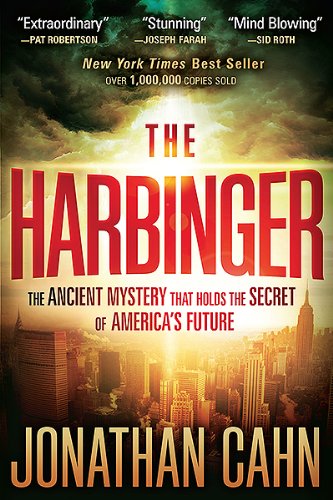
The Harbinger.  Popular New York Times Bestseller by pastor Jonathan Cahn.  Fact or fiction?

The Harbinger. Popular New York Times Bestseller by pastor Jonathan Cahn. Fact or fiction?

“Have you read The Harbinger?” The wife of the elderly couple in the restaurant asked me with great curiosity and concern. “I am not sure what to think of all of it, but it sounds like a prophetic warning for America!”

Sometimes going out to lunch can get you into trouble. As we were finishing up a meal with some friends and getting ready to leave, this couple at another table wanted to have a “conversation” with me. Well, it was more like a monologue than a dialogue. I was thinking that this would be brief, as my wife and friends had already left the restaurant, but this couple just kept going on and on about this “Harbinger” book, among other topics. I needed a rescue but there was none to be had. My wife was understandably upset, by this time waiting on her crutches outside the restaurant. After I finally left the couple as they were still in mid-sentence, I was sorely rebuked by my wife for leaving her stranded in the parking lot, after she had recently undergone foot surgery. Ouch. I had messed up. Boy, was I in trouble!

But I was not the only one in trouble. As I did a little more research later into The Harbinger, I realized that there are probably a lot more folks in trouble!

You see, I do not have cable TV, so I’m am pretty clueless about what passes for pop culture and the round-the-clock news cycle these days. But apparently, a Messianic Jewish pastor, Jonathan Cahn, has written a blockbuster novel, The Harbinger: the Ancient Mystery that holds the secret of America’s Future. As of late June, 2013, after 75 weeks on the New York Times Best Seller list under the paperback trade fiction category, The Harbinger, sat at #19. That is quite remarkable for a book written by an evangelical Christian author.

Now, the book may indeed be a great story if you like that particular genre, mixing non-fiction into primarily a fictional story. The problem is that it is sometimes hard to figure out the line where the non-fiction ends and where the fiction begins.
Continue reading



Dogs Who Know the Lord

Dooty Morledge.  1996-2013.

Dooty Morledge. 1996-2013.

We had to put our dog down today. Our little Italian greyhound, Dooty, was seventeen years old, and he had lived a full life. He was a sweet little dog, and he particularly gave my wife a lot of comfort and joy.

Ever since we got back from the vet, I have been weepy. I keep expecting him to chase me around the house, wagging his tail.

But he is not here anymore. Gulp.
Continue reading


Biblical Tension

“It seems easier to go to a consistent extreme than to stay at the center of biblical tension.”
Robertson McQuilkin

Scaling El Capitan, photo by Bronson Taylor Hovnanian, 2011


A sagacious Veracity reader recently served up the above quote while discussing perspectives on the role of women in church leadership.  I hadn’t heard it before, but it sounded profound and worthy of some quiet-time bird dogging.  I quickly traced it to Robertson McQuilkin, a man of great integrity.

The Christian faith inherently involves biblical hermeneutics—simply put, we have to interpret the text in the Bible.  In wrestling with our different interpretations there seems to be no limit to the chasms we create over issues large and small.

So this new quote from Robertson McQuilkin seemed to hold potential as a way to work though our differences.  Jesus was the master of big thinking, never getting lost in the details.  When we disagree, one tact is to find a higher principle, teaching, or value upon which we can agree.  We can use tension to elevate to a higher common ground.  Lots of things don’t work without tension.  Maybe biblical tension is prescribed for our health and well being.  The left versus the right, with peace in the middle.  No more getting stuck in the parking lots of our own arguments. Continue reading


Under the Hood

Head Gasket Repair

Push Rods and Rockers, 2008


I spent a couple of weeks writing this post, adding and removing parts, only to end up with an over-spiritualized, not-very-good penultimate result.  After some painful edits, how about I just get right to the point?

The original idea for this blog was to have a place for “Sharing resources that corroborate the Bible.”  While we remain quite committed to that theme, we’re finding our voice in a slightly different major chord.  Consequently we are changing the tag line for Veracity to “Sharing the Joy of Personal Discipleship.”

What is personal discipleship?  It’s an answer to the darkness of man we see all around us every day.  It’s keeping our eyes on the only thing that counts—faith expressing itself through love (Galatians 5:6b, NIV84).  We define personal discipleship as the process in which a believer or seeker takes personal responsibility for investigating the claims and content of the Bible. Continue reading


Taizë

This coming  Sunday, our church will sing a modified version of a Taizë worship song, “Holy Spirit, Come to Us.” Songs from Taizë are generally simple, short choruses based on the Bible. In the original Taizë community, these worshipful, chant-like songs are sung over and over again multiple times. Here is a recording of the original version of “Holy Spirit, Come to Us.”

But what is Taizë? In the spring of 1940, the German army overran the defenses of France, bypassing what was thought to be the impenetrable Maginot Line, shattering the confidence of the French people.  Roger Louis Schütz-Marsauche, who was raised in a Swiss Protestant Reformed family, was absolutely stunned by the overwhelming power of Nazi Germany’s military might. But he believed that God was much bigger than the Nazi war machine. He rode on a bicycle to the small town of Taizë in unoccupied France near Switzerland, where he spent two years hiding Jewish refugees from the grip of the Nazis. He was forced to leave Taizë for a few years, but “Brother Roger” was able to return in 1944 to start a small community of men committed to living in poverty, chastity, and obedience. From that time forward, “Brother Roger” and his band of like-minded were committed to a quest for reconciliation in the spirit of Christ.

Over the years, along with other refugees, tens of thousands of young people from all over the world have come to visit the community. What is particularly unique about Taizë is the ecumenical nature of the community, Protestants and Catholics, all living together in a monastic style focused around prayer, work and hospitality. But the most profound influence of Taizë is the music.

Various churches around the world offer Taizë services that can give you a taste of how meditative music and silence is practiced in the original Taizë community. In the Richmond, Virginia area, the Richmond Hill Retreat Center at 2209 East Grace Street offers a Taizë prayer service on the first Monday of every month at 7:30pm.
