Category Archives: Apologetics

How We Got the Bible (Part 3)

The Church no more gave us the New Testament canon than Sir Isaac Newton gave us the force of gravity. God gave us gravity, by His work of creation, and similarly He gave us the New Testament canon, by inspiring the individual books that make it up.”
J. I. Packer, God Has Spoken: Revelation and the Bible, 3rd ed.

“We should not imagine a committee of church fathers with a large pile of books and these five guiding principles before them when we speak of the process of canonization. No ecumenical committee was commissioned to canonize the Bible.”
Norman L. Geisler and William E. Nix, From God To Us Revised and Expanded: How We Got Our Bible

One of the great misconceptions about Christianity involves the canonization of the Bible (that is, deciding which books comprise the whole, inspired, holy Scripture). For whatever reasons, people tend to imagine some sort of ecumenical process—dragging out over several centuries—where well respected officials in the early and medieval church came together and decided which books were in and which books were out. But as we can see from the quotes above from three of the most conservative Bible scholars, church councils did not produce the Bible.

Ecumenical Councils

Conservative Christian scholarship disallows any notion that ecumenical councils somehow selected the Bible from a list of candidate documents. But there were ecumenical councils, lots of them, so what role did the councils play in the canonization of the Bible?

First, recognize that church councils were necessary for the governance and order of the church. The precedent was set at the Council of Jerusalem in Acts 15, attended by the apostles themselves. There were heresies and challenges to Christian doctrine. There were matters of church discipline and orderly worship that had to be addressed. There was confusion about Gnostic teaching and guidelines for living. Later there would be questions about which books and letters belonged in the canon of Scripture—and which did not.

Shortly after the legalization and state patronage of Christianity within the Roman Empire, the church began to hold ecumenical councils. The first was called by Constantine the Great on May 20, 325 at the Royal Palace in Nicaea. The focus of the Nicene Council was the divinity of Jesus and the clarification of the Trinity. It produced the Nicene Creed, which was later amended to be close to the Apostles Creed. (Sidebar—Did Jesus descend into hell? Here’s a brief discussion about this controversy.) Contrary to modern misconceptions—perpetuated by Dan Brown in The Da Vinci Code—Constantine did not determine the New Testament canon and the First Council of Nicaea did not even address the topic of the canon of Scripture.

Over the following centuries, there would be many more ecumenical councils and synods, continuing through to the present day. Which meetings are recognized as ‘ecumenical‘ depends largely upon denominational perspective. 19th century church historian and theologian Philip Schaff documented the canons of Seven Ecumenical Councils between 325 and 787 CE (which he defined as “councils which have always, and still do, receive the unqualified acceptance of both East and West”):

  1. The First Council of Nicaea,
  2. The First Council of Constantinople,
  3. The Council of Ephesus,
  4. The Council of Chalcedon,
  5. The Second Council of Constantinople,
  6. The Third Council of Constantinople, and
  7. The Second Council of Nicaea.
Philip Schaff - Ecumenical Councils

Philip Schaff meticulously documented the canons of the historic ecumenical councils of the Christian church.

However, history is replete with other councils that are not accepted as ecumenical by the Eastern and Western churches (‘Eastern’ meaning Eastern Orthodox, and ‘Western’ meaning Roman Catholic and other denominations that developed in Europe). For example, the Synod of Hippo (393 CE) and 3rd Council of Carthage (397 CE) produced authoritative lists of the sacred scriptures. Later, the Council in Trullo (also called the “Quinisext Council,” 692 CE) ratified the canons of these councils—but did not specifically state the list of books considered to be divinely inspired. So why didn’t everyone accept the canons of Hippo and Carthage as ecumenical? As you might imagine, church politics had a lot to do with it—and still does. Hippo and Carthage did not have wide representation from the church as a whole and were heavily influenced by Augustine of Hippo, as later critics would argue.

Page 885 of Schaff’s text contains the list of canonical scriptures from the Council of Carthage. This list includes the Apocrypha in the Old Testament but clearly identifies the 27 books of the New Testament. (We’ll explore the Apocrypha in a future post.)

The canons of the ecumenical councils make for dry reading in parts, not unlike reading the formal minutes from a business meeting where much discussion is reduced to a few statements. Nevertheless, check out the canons of these councils as recorded in Schaff’s monumental work. In addition to the seven ecumenical councils, he also documented the records from other councils, including Hippo, Carthage, and Trullo. Much of what these clergymen dealt with is now irrelevant. Troublesome heretics have long ago died, many of the controversial theological and doctrinal problems have faded in time, and frankly no one cares about how to handle “him who persuades a slave to leave his master under pretence of religion.” When you read the canons, it becomes clear how challenged the Christian church was over matters large and small—and how pious many of these councils must have been.

‘Orthodox’ Christianity

Over the centuries since the Ascension of Jesus Christ, the church found more issues to debate, and more reasons to divide. Rather than serving to unite believers, later ecumenical councils proved to be dividing mechanisms by laying out denominational distinctions.
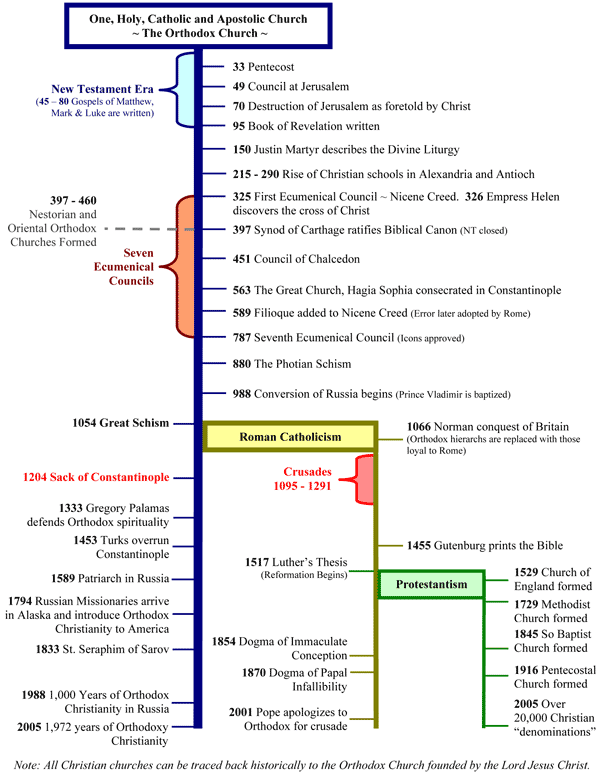
Church History Timeline (credit: http://www.stspyridons.org/timeline/)

Church History Timeline (credit: http://www.stspyridons.org/timeline/)

As shown in the timeline on the right, the Christian church remained essentially united through the early councils. Then, one word (Filioque) caused the Great Schism of 1054 and the ‘orthodox’ church began splitting into more and more denominations.

So…in all the deliberations of the historic synods and councils of the early and medieval Christian church, Christians cannot find agreement on the canon of Scripture. The scholars quoted at the beginning of this post seem to be justified in the strength of their statements. Church councils did not produce or canonize the Bible.

Think about it. Is it reasonable to believe that God would inspire holy Scripture and that it would then need to be ratified by church councils before being recognized as such?

If we rule out the deliberations of church councils as the deciding authority, how then can we know what books comprise the canon of holy Scripture? We’ll take that up in our next post on this topic…

Can We Trust the New Testament Canon?

…but in the meantime, here’s a brief interview with Dr. Michael Kruger that addresses that very important question.

HT: Philip Schaff, Norman Geisler, William Nix, Michael Kruger, Christian Classics Ethereal Library (CCEL)

Additional Resources
From God To Us
The Ecumenical Council

Happy Halloween…Er… Reformation Day!!

Martin Luther nails his Ninety-Five Theses to the Wittenberg church door. Most people associate October 31st with Halloween, but students of church history know this as "Reformation Day"

Martin Luther nails his Ninety-Five Theses to the Wittenberg church door on All Hallows Eve, 1517. Most people associate October 31st with Halloween, but students of church history know this as “Reformation Day”

Like any kid growing up in an American secularized society, I liked the whole Halloween thing. I have a serious weakness for chocolate, so I always looked forward to going door to door to see how many chocolate treats I could get. Sure, there were horror stories about  people sneaking razor blades into mini-candy bars, but I was willing to take the risk. As I got a little older, I would try to terrify the neighborhood kids by playing Pink Floyd’s Echoes album through my bedroom speakers out the window as costumed figures approached our house.

Okay. I stopped that pretty quick when my mother learned about it and reprimanded me for making a few of the little kids cry.

When I began to take my spiritual journey with Jesus Christ seriously in high school, I began to hear other types of horror stories about Halloween from my new church friends. There were tales about its connection to Satanism at worst, or perhaps just only a milder, yet just as bad, connection to Wiccan, Druid and other forms of pagan religions… and those “dreadful” Harry Potter books.

I began to see a shift in evangelical churches away from celebrating “All Hallows Eve” towards things like having “Harvest Parties” or “Fall Festivals.” Well, I can surely appreciate the effort to shift the focus, but I am not so sure how successful it has been.

Instead, I think if we really want to shift the focus away from the negative aspects of Halloween, then we should instead take a page or two from church history. On October 31st, 1517, Martin Luther approached the door of the Wittenberg church with a list of his Ninety-Five Theses regarding abuses in the Roman church. What he nailed to the door of that church that day has forever changed the face of Western Christianity… and the whole world!

Martin Luther had kicked started the Protestant Reformation, a movement that resulted in perhaps the greatest revival of spiritual vitality and love for the Scriptures that the world has ever seen.  But Martin Luther’s Reformation belongs not just to Protestants. It belongs to the whole Christian church. Even those Roman Catholics who murmured about Luther must admit that change was necessary to correct some serious problems. It was through the efforts of people like Martin Luther that the Bible came to the common people in their native tongue, a privilege that most Christians today simply take for granted. It was also through the turmoil of the Reformation that made the Western world into what it is today, providing the intellectual and cultural incubator for the growth of modern science and capitalism. So even if someone is not a Christian, Luther’s Reformation has made an incredible impact upon world history.

So, instead of getting all flustered about those trick or treaters coming to our doors to unwittingly fan the flames of pagan traditions, let us as believers consider a completely different approach, encouraging people to remember this day in world history, where one man with a hammer in hand and a powerful set of ideas birthed in Scripture changed the world.

Let us celebrate Reformation Day!

 Additional Resources:

Do you have no idea what Luther’s Ninety-Theses were all about? Check out the following interview with Carl Trueman, professor of church history at Westminster Theological Seminary in Philadelphia.

And one final “treat” courtesy of something I found on Andrew Wilson’s Twitter log from “Across the Pond.” Enjoy!:

HT: Timothy George on First Things, and Andrew Wilson at Think.


Bumgarner Blues

"Madison Bumgarner on September 3, 2013" by SD Dirk on Flickr - Originally posted to Flickr as "SF Giants Madison Bumgarner". Wikipedia

“Madison Bumgarner on September 3, 2013” by SD Dirk on Flickr. Wikipedia

Okay, I really wanted the Kansas City Royals to win the World Series this year. It would have been a wonderful Cinderella story, but it was not to be. The Series belonged to a young pitcher for the San Francisco Giants, Madison Bumgarner.

Wow. What a performance. Bumgarner shut out the Royals in game 5 and then in game 7 closed out the final innings without allowing a single score from the Royals. Baseball does not get any better than that.

I did not know this before, but it turns out that Madison Bumgarner is also an evangelical Christian, according to an interview he gave about four years ago. As long as his stellar performance this past week does not go to his head, this extraordinary athlete will serve as an inspiring example to a generation of young baseball pitchers out there growing up in families all across the country.

So, why did I title this blog post the “Bumgarner Blues?” Well, I am continually struck at how so many cultural celebrities from a Christian background who make the scene are athletes. Rarely do you find public intellectuals or respected spokespersons representing an evangelical point of view in the wider culture. Over the next week, you will surely see the lanky, dark curly haired figure of Madison Bumgarner graced over the pages of magazines and Internet websites. Well, great for him, great for the San Francisco Giants, and great for Christian believers for whom baseball is an important part of life.

But when was the last time you saw someone like a C.S. Lewis, a Malcolm Muggeridge, or a Billy Graham hailed across the Internet media landscape? Who stands up to present the Gospel in such a persuasive way that others will thoughtfully listen to the message, even though they might respectfully decline to accept that message? Why is it that great evangelical scholars like Daniel Wallace, Darrell Bock and Ben Witherington, or even prolific pastors like John Piper or Tim Keller, fail to register much of a bleep on the cultural landscape… even on Christian media? Aside from some moral scandal or political debate, about the only time you get a glimpse of an evangelical spokesperson is when someone tips over some line theologically, like a Rob Bell (to the left) or a John Hagee (to the right).

Okay. I can think of one public intellectual or spokesperson over the past ten years who stands out as an exception: National Institutes of Health director Francis Collins. Can anybody think of others?

Sure, you can probably find a number of reasons where blame can get assigned, such as perhaps a media bias of some sort. Okay, I get that. But I wonder if the trouble is not something within the church, too. Do we really value public thought for the sake of Christ, seeking earnestly to give a reason for the hope that we have in Jesus? It will take more than phenomenal baseball players like Madison Bumgarner to draw the world’s attention to the Savior.

Where are the public intellectuals and spokespersons for the faith today?

I wonder.


Agreeing to Disagree

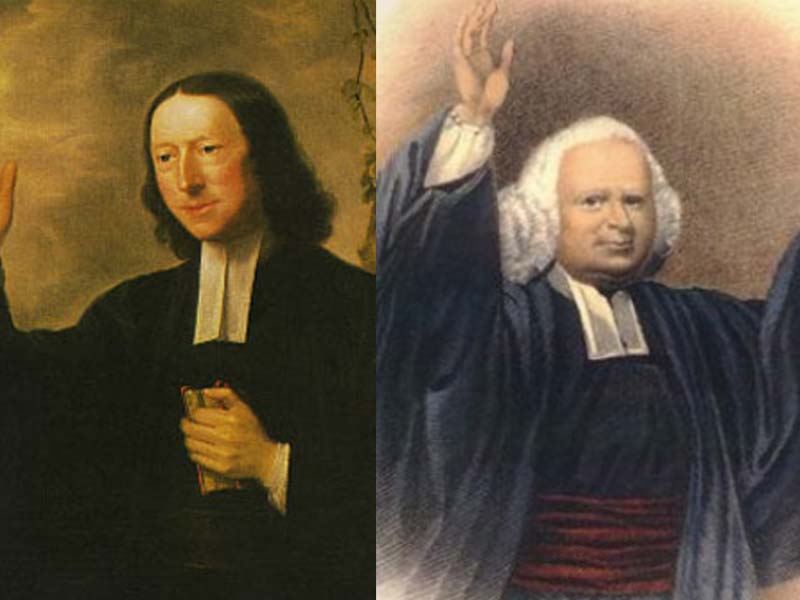
John Wesley (1703-1791) and George Whitefield (1714-1770) were the most well-known Christian leaders in the English-speaking world of the 18th century. Yet they struggled with each other regarding some significant points of Christian doctrine.

John Wesley (1703-1791) and George Whitefield (1714-1770) were the most well-known Christian leaders in the English-speaking world of the 18th century. They struggled with each other regarding some significant points of Christian doctrine, and through their dialogue they introduced the notion of “agreeing to disagree” into Christian discourse.

Sometimes “agreeing to disagree” with fellow believers can be difficult. I know. I have been there. But first, let me give you some historical background…

In 18th century England and America, two of the most celebrated figures were George Whitefield and John Wesley. Whitefield and Wesley would travel up and down the American Eastern seaboard and across the British Isles preaching in the open air. The first “Great Awakening” can largely be attributed to how God used these two men to lead many thousands into a relationship with Jesus Christ, perhaps one of the greatest spiritual revivals in the history of the church.

But Whitefield and Wesley had some rough spots in their relationship with one another. In one important matter, they differed in terms of some significant Christian doctrine. George Whitefield, a Calvinist theologically, believed that when Jesus Christ died on the cross, He died only for the elect who would come to know Christ. If you were not among the predestined elect, Whitefield concluded that the Bible taught that Jesus had not died for you. John Wesley, an Arminian theologically, vehemently rejected this teaching. For Wesley, Jesus Christ died for all of humanity, whether someone received Christ or not. Though these men clearly differed on the extent of Christ’s atoning work on the cross and how that related to predestination, they were united in many more things in terms of doctrine than over that which they were divided.

The prolonged controversy between Whitefield and Wesley was at times very tense. Though I do not recall the reference, my understanding is that John Wesley was the more quarrelsome of the two men. But it is to John Wesley’s credit that eventually when he was asked to deliver a memorial sermon when George Whitefield died, he was extremely charitable to his evangelistic counterpart. In that sermon, Wesley uttered a most memorable phrase:

“There are many doctrines of a less essential nature … In these we may think and let think; we may ‘agree to disagree.’ But, meantime, let us hold fast the essentials…”

Since that remarkable sermon, Christians over the years have recalled Wesley’s words that he at times exchanged with his colleague Whitefield about “agreeing to disagree.” Though these men still had their points of conflict, in the end, they were able to consider each other not as enemies but rather as friends, as brothers in Christ, despite their disputes over some points of doctrine.

It is a lesson that the evangelical church today still needs to hear.
Continue reading


How We Got the Bible (Part 2)

Christians believe that the Bible is the inspired word of God. In this post—the second in our series entitled “How We Got the Bible“—we will explore what biblical inspiration really entails (and what it does not entail). The Bible itself claims to be the inspired, special revelation of the one true God.

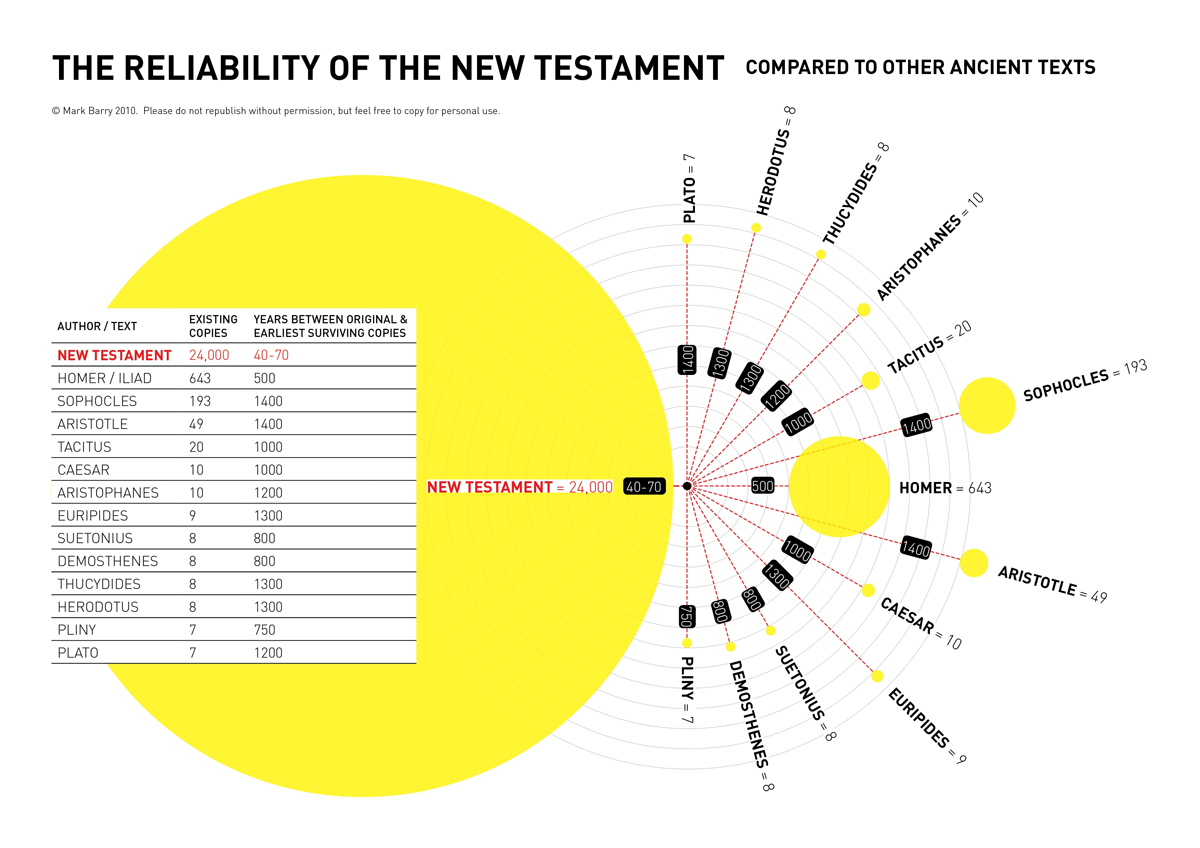
The Bible is completely unique. Not sure? OK, let’s make a list of all books that took over 1,500 years to complete. With parts dating back more than 3,500 years, in which the most recent contributions are 1,900 years old. Written by 40 or so authors who corroborate each other’s writings. Containing accurate historical accounts of ancient events that have shown up repeatedly in archaeology (don’t skip over the preceding hyperlink). Claiming to reveal the plan of a loving God for his creation. With massive amounts of self-deprecating text to condemn the authors. Predicting trouble and ostracism for those who live by its teaching. Containing specific prophecies, many of which have proven true over long periods of time. Dwarfing other ancient writings in terms of the number and quality of  surviving manuscripts.

How long is our list now?

Reliability of the New Testament

The Bible has no peers when it comes to the number and quality of surviving ancient manuscripts. (Infographic credit: Mark Berry, http://visualunit.me/)

When researching for this series I was primarily interested in focusing on how the biblical canon was developed—specifically how did we end up with the 66 books that comprise the Bible, what about the Apocrypha, why not other books, and so on. Biblical canon is an extremely interesting topic, but it rightfully fits in the context of a larger question:  How did we get the Bible? (We’ll get to the topic of biblical canon in forthcoming posts in this series—and by the way, there are lots of interesting, new publications on canonicity.)

Drs. Norman Geisler and William Nix wrote a comprehensive text entitled From God To Us Revised and Expanded: How We Got Our Bible that begins with the topic of inspiration. This post will follow that text, which should be required reading for every Christian and student of the Bible.

Whether you are died-in-the-wool biblicist or a Christian neophyte, it’s difficult to fully appreciate the implications of our understanding (or denial) of the inspiration of the Bible. Not just in terms of heaven or hell as an end result, but whether we can trust the Scripture. I just returned from the National Conference on Christian Apologetics, which included some strong rhetoric about the inspiration, inerrancy, and infallibility of the Bible (and a fantastic session on the biblical canon). Clarke attended most of the same sessions, so I won’t turn this series into a discussion about inerrancy. He will no doubt address many of the nuances and implications of the “battle for the Bible” in future posts. But consider these two questions:

  • Is it even reasonable that an all-powerful and perfect God would inspire the writers of the Bible to produce a text containing errors?
  • If God did not inspire the writing of the Bible, isn’t it just the product of human writers, and if that is the case why should we submit to its authority, teaching, and claims?

There are lots of corollary questions, and your answers would reveal a great deal about your understanding of the Christian faith. But for now let’s take a cue from Geisler and Nix and start with the topic of biblical inspiration.

My notes from reading their text are presented below. For a more robust and authoritative treatment of the topic I highly recommend reading From God To Us Revised and Expanded: How We Got Our Bible. Words in quotes are directly from Geisler and Nix (except where Scripture is being quoted). Continue reading