Category Archives: Apologetics

Canaanite DNA and Biblically-Illiterate Journalism

An ancient Canaanite skeleton gives us clues to the DNA history behind a people group in the Middle East. (Credit: Dr. Claude Doumet-Serhal)

A recent study indicates that much of the DNA record of modern day Lebanese can be traced back to the Canaanite people described in the Bible. Sadly however, a number of mainstream journalists got the story wrong.

Archaeological studies over the years have raised a number of interesting questions about how the Biblical record is tied to history. But when the genome of 4,000-year-old Canaanite skeletons were sequenced, the discovery supports a significant aspect of the Bible’s historical claims.

However, you would never grasp that idea from a New York Times article reporting the discovery. Deuteronomy 20:16-17 does show that the Israelites were to completely wipe out the Canaanite peoples, when they take hold of the Promised Land.

“You shall devote them to complete destruction, the Hittites and the Amorites, the Canaanites and the Perizzites, the Hivites and the Jebusites, as the Lord your God has commanded” (v.17)

Yet the Times article goes on to miss the target, “But a genetic analysis published on Thursday has found that the ancient population survived that divine call for their extinction, and their descendants live in modern Lebanon.” The implication is that the Bible got it wrong.

Other media outlets did pretty much the same thing, with scathing headlines, such as “Study disproves the Bible’s suggestion that the ancient Canaanites were wiped out” (The Telegraph), and “New DNA study casts doubt on Bible claim” (Mother Nature Network)

However, if these journalists had kept on reading the Bible, they might have realized a problem. While Israel achieved notable victories at Jericho and Ai, the destruction of the Canaanites was far from complete.  Judges 1:27-28 specifically tells us that the Canaanites were not all wiped out by Joshua’s conquest of the land:

“…the Canaanites persisted in dwelling in that land…” (v.27)

Many of the Israelites tried to splice belief in the God of the Bible with beliefs in the Canaanite gods. More than a few Israelites intermarried with the Canaanites, adopting a syncretic form of religion. All of this behavior brought God’s judgment on the Israelite people, when God condemned their idolatrous actions. To miss this part of the story is to fail to understand the narrative within the Bible itself.

So, far from disproving the Bible, the survival of the Canaanites down to the present day actually confirms what the Bible claims. If we would but only read the text.

Thankfully, some of the news organizations have realized their error and made the appropriate corrections. The Telegraph made a note in their article, acknowledging the correction, and changed the headline more appropriately, as did Mother Nature Network. Science magazine did the same with their news story.

The irony behind the whole thing is that skeptics will often reject the Bible, on moral grounds, because of the supposed claim that the Israelites committed mass genocide against a large Canaanite population. But then they ding the Bible again, on historical grounds, when they discover that the supposed, full-blown, genocidal annihilation of the Canaanites never took place. Does anyone see something wrong with this picture?

There is a twist to all of this, too. True, Joshua’s conquest of the Promised Land, no matter how you envision the scale, and there is evidence to show that the traditional view is greatly oversized , did result in a lot of violent death. But were the Canaanites, properly speaking, the target of God’s wrath? Dr. Michael S. Heiser, an expert in Semitic languages, writes that the Anakim giants were actually the target for elimination, and not the Canaanites. His book, The Unseen Realm, is on my “to-be-read” list, but he gives an overview of his contrarian argument here. I am not sure what to make of Heiser’s argument yet, but he knows his Bible. The point is: there is more to the Bible than what most people realize.

Biblical illiteracy is at an all-time high, despite the ease of access to reading and studying the Bible, in a digital age. So, it does not help when mainstream journalism propagates errors, largely out of Bible-reading ignorance. As the proliferation of news sources abounds in the digital age, perhaps part of the problem is due to cuts among copy editor staff, at major newspapers, as Old Testament professor, Claude Mariottini, reports in another “fake news” story about archaeology in the land of the Bible (… a “BOO” for Fox News).

The best way people can correct such mistakes is pretty simple, and it does not take a Bible scholar to figure this out:

READ AND STUDY THE BIBLE.

HT:  Breaking Israel News.


Historic Jesus

JamestownVeracity


Pluralism In Your Face

Editorial comment:

I’m not a political person. Faith means much more to me than politics. I do have strong opinions about the need to keep politics out of practicing and sharing our faith because equating the importance of God and politics is disrespectful to God. And it’s unwise. There is scriptural guidance in the form of an argument from silence—Jesus did not politicize His teachings. At the risk of appearing to taint this ethic, please dismiss the political and constitutional implications of the following material and focus on the core questions.


In potentially uncomfortable situations, most of us have some fear of rejection or confrontation that compels us to be silent about our faith. Thinking about it ahead of time can help overcome those fears.

Imagine that you are on the hot seat. Attention is focused on you, and your beliefs are called into question. How would you respond? (If you’ve never been in this position it might be good to ask yourself, seriously, “Why not?”)

Earlier this month, Russell Vought, an evangelical Christian, was testifying during a confirmation hearing, and Senator Bernie Sanders questioned Vought’s beliefs. The following two-minute YouTube clip captures the contentiousness of the incident.

For context, please read what The Atlantic has to report. Pay careful attention to the scriptural citations. If you aren’t aware of the context, you could be inclined more to an opinionated, rather than informed, reaction.

Back to the question. Forgetting about the political and constitutional issues and personalities involved, how would you respond?

Just in case this topic comes up at your water cooler or cocktail party, here are some thoughts to help you prepare an answer.

  1. The teaching of Jesus does not foment hatred, bigotry, or intolerance. Jesus said, directly, the greatest two commandments are to love God and love your neighbor. When questioned about whom He meant by ‘neighbor,’ Jesus taught the parable of the good Samaritan. Samaritans were held to be low-class people in the first century. By including them in the parable, Jesus made a clear point that His followers are to love others broadly and inclusively.
  2. As Christians, we believe the Bible contains the inspired word of God and is the final authority for faith and practice. We rely on what it says and do not have the liberty or right to make up our own brand of Christianity, or to cherry pick proof texts. There are many reasons, objectively and personally, for accepting the Bible as the inspired, holy word of God.
  3. Christians do not have the right to condemn people—we are commanded to love people—but God does have that right. If you really want to understand why, study the Bible. We, the created, are in rebellion against the Creator, and a holy and just God has a plan for the salvation of those who accept His complete sacrifice on our behalf. He has the right to condemn those who reject Him, as Scripture clearly teaches (again, read The Atlantic article).
  4. John 3:16, the most familiar passage of scripture in the New Testament, states, “For God so loved the world that he gave his one and only Son, that whoever believes in him shall not perish but have eternal life.” From this passage, we can see that God is loving and did not discriminate to whom salvation is offered. He offers salvation to the world.
  5. Jesus said directly that He is the way, the truth, and the life, and that no one comes to God the Father except by Him.
  6. The apostle Paul, who wrote half of the New Testament, taught that we are saved by our faith in Jesus, not by our works. While we all know people of every faith and creed who are indeed wonderfully good, salvation is by faith in Jesus alone. Again, we’re not free to make this up—it is directly stated in the Bible. Just because people are ‘good’ does not entitle them to salvation.
  7. Western culture is inebriated with pluralism. We resist anything that might impinge upon personal freedoms—such as a morally-based worldview. Pluralism by its nature appeals to a wide swath of voters and is therefore quite pragmatic in politics. But on logical and spiritual levels, pluralism comes up short.
  8. In logic, there is the law of non-contradiction, which holds that two opposite truth claims cannot both be true in the same sense at the same time. “There is either milk in the refrigerator now, or there isn’t,” as Norman Geisler says.
  9. The world’s major religions ALL have opposing truth claims. The nature of truth claims is that they are exclusive.
  10. Christianity teaches that Jesus was crucified and resurrected from the dead. Islam teaches that Jesus was not crucified and therefore did not rise from the dead. Keep it real. Both claims can be false, but both cannot be true. The apostle Paul wrote in 1 Corinthians 15:14, “If Christ has not been raised, then our preaching is futile and your faith is empty.” Christianity depends on the objective truth of the Resurrection.
  11. Hindus acknowledge multitudes of gods and goddesses. Buddhists say there is no deity. Muslims believe in a powerful but unknowable God. Christians believe that God is loving and personal. As Ravi Zacharias says, “The world’s major religions are not fundamentally similar and superficially different, they are fundamentally different and superficially similar.” Most advocates of pluralism don’t take the time to investigate the differences.

Pluralism may be good for getting votes, but it’s an empty and illogical worldview. Although I disagree with those who wish to cast Christianity into a cultural stew with the world’s other religions, my Christian faith compels me to love those who disagree. I wish we could at least all agree on that.


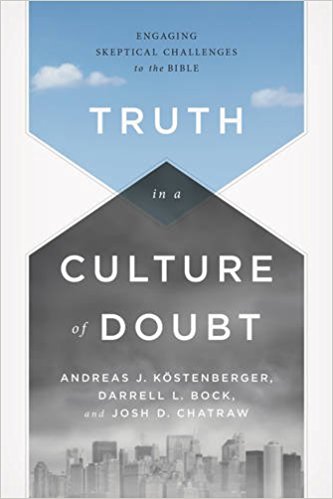
Truth in a Culture of Doubt: Brief Book Review

Still looking for that perfect gift book, for a high school graduate, off on their way to college? Consider Truth in a Culture of Doubt: Engaging Skeptical Challenges to the Bible, by Andreas Köstenberger, Darrell Bock, and Josh Chatraw.

Young people growing up in the church today face immense challenges from a culture skeptical to the Gospel. Leading the charge towards encouraging doubt is popular author and University of North Carolina religion professor, Bart Ehrman.

If you have never heard of Bart Ehrman before, you need to get out from underneath your rock, and learn about him. Ehrman grew up going to church and attending Christian colleges, but eventually lost his faith in the process. He has since authored five New York Times Bestsellers, and dozens of other books, all aimed at undermining confidence in the reliability of the Bible and its message.

What makes Ehrman’s skepticism so caustic, is that he knows his facts really, really well. He knows his Bible better than most Christians do, and he remains one of the world’s top textual critical scholars of the New Testament. The problem is that the conclusions he draws from his research are not always warranted. There are indeed very good answers to the issues he raises, that affirm the trustworthiness of the Bible.

In Truth in a Culture of Doubt, Köstenberger, Bock, and Chatraw, all evangelical and believing scholars themselves, tackle each of Erhman’s challenges in a very engaging manner, issues that every thoughtful Christian will face, as they seek to share their faith with their informed neighbors:

  • Is God Immoral Because He Allows Suffering?
  • Is the Bible Full of Irresolvable Contradictions?
  • Are the Biblical Manuscripts Corrupt?
  • Were there Many Christianities?
  • Are Many New Testament Documents Forged?

A nice little extra is a quick question and answer guide at the back of the book, that summarizes the basic arguments. Truth in a Culture of Doubt is an updated, more in-depth version of an earlier book by these evangelical scholars, Truth Matters, that I reviewed a few years ago. Though Truth in a Culture of Doubt was itself published back in 2014, the information packed in it is still relevant today, as the issues dealt within are not going away any time soon. Ehrman is still himself writing books, but more and more, any new issues that he writes about move further away from his area of expertise.

In many ways, the topics that Ehrman has been writing about for over fifteen years are not new. They are no more than popular distillations of scholarly, critical views in the history of Christianity, that have been taught in secular departments of religion at private and public universities for nearly a century now. Sadly, it has taken a barrage of these skeptical writings, in popular form, to force the evangelical church to better inform her people, and give better answers.

Read a brief excerpt from Truth in a Culture of Doubt here, then go buy the book for that young person you know, who is facing challenges from a skeptical culture.


Should a Christian Have a Dream Catcher in Their Car?


A number of years ago, my parents took a cruise ship to Alaska. On that trip, my mother found an attractive dream catcher, and she gave it to me as a birthday gift. I hung it up in my car, around the rear view window mirror, just as a way to remember her, and her thoughtful gift to me.

So, I was really caught off-guard a few years later, when a Christian friend of mine was offended that I had that dream catcher hanging in my car. Some Native American cultures historically revere dream catchers as religious symbols, intended to protect children from bad dreams and evil spirits. But the larger Pan-Indian movement in the 20th century, in an effort to raise awareness of Native American cultures among the majority population, adopted the dream catcher as a cultural symbol. Not all Native Americans share the exact same spiritual beliefs as the Ojibwe tribe, from where the dream catcher most probably originated years ago. My mother looked at it as a memorabilia keepsake, something she wanted to give to her son.

Christian apologist John Oakes, at the apologetics blog Evidence for Christianity, that I highly respect, has an article explaining why he personally would not have a dream catcher in his car. We both agree that having a dream catcher is a gray area, in the “disputable matter” category, as found in Romans 14.  Oakes does not think a dream catcher is sinful, but he personally would not have a dream catcher, as it might offend someone else, just as eating food sacrificed to idols might personally offend another Christian, in the first century church.

I support most of what Oakes is saying, but I take a different personal position. It is important to remember the context for Romans 14. There were Christians in the first century, who came out of pagan backgrounds, where eating food sacrificed to idols was readily practiced. Such practices would offend the conscience of those believers from those backgrounds, so this is why the Apostle Paul urged other believers, from different backgrounds, to carefully avoid insulting the conscience of the more sensitive believers, by avoiding such practices.

In the case of my Christian friend who objected to my mom’s dream catcher, this friend had no Native American background. Much less did this friend have any association with the Ojibwe tribe. Neither was this true of my mom, nor myself. Therefore, it was not anyone’s conscience that was being “offended,” but rather it was the rumored idea my friend had in their mind, of a dark power, that possibly someone, somewhere might be troubled by the presence of a dream catcher.

Though I appreciate my friend’s concern, that followers of Christ should reject idols, my response is this:

Good grief.

The effort that we could expend in trying to remove all  things in our lives that might possibly offend someone, somewhere in the world, is a fool’s errand. To apply Romans 14 in this manner, takes the text out of its appropriate, New Testament context. It would be a form a perverse legalism to constantly police our lives, searching for those practices or artifacts that might trouble someone, somewhere. The meaning of symbols constantly changes across various cultures today, being appropriated and re-appropriated with different meanings, quite frequently.

For example, the radical Islamic State (ISIS) has destroyed countless precious cultural artifacts of ancient Syrian culture, all in the name of stamping out idolatry. Technically, those Muslims were right in declaring various statues as polytheistic idols, from a past era. But would someone be tempted to worship these idols today? Possibly, but this is highly, highly unlikely. Most moderns view these artifacts as testimonies to history, and we therefore grieve their loss. As such destructive ideological extremism spreads, the preservation of valuable cultural heritages becomes more important than ever.

Just think about the evolution of the swastika, discovered by archaeologist Heinrich Schliemann, and more recently, the Confederate flag. At one time, these were symbols with positive meanings, but not anymore.

A popular, American Coca-Cola pendant, before the Nazi’s adopted the swastika as their symbol, and ruined it for everyone.

As Christians, we regularly use terms like “Sunday,” “Monday,” “Tuesday,” “Wednesday,” etc., to describe the days of the week. The Quakers of the 17th and 18th centuries refused to use that terminology for weekdays, as those names correspond to pagan gods, which were worshipped hundreds of years ago, during the pre-Christian era of Europe (the same logic applied to the first eight months of the Roman calendar). So those early Quakers would use terms like “first day,” “second day,” “third day,” etc., all very biblical terminology, to faithfully describe the days of the week. But to my knowledge, there are no people today, nor in the 17th century, who come or came from such pagan backgrounds, who might have or had such sensitive consciences. I do not see Christians today clamoring for altering the names of weekdays, who wish to rid our minds of such supposedly pagan mindsets, who might be tempted to worship the sun (Sunday), or the moon (Monday), or Thor, the god of war (Thursday).

Now, suppose I actually know someone, who would ride in my car, who really came from a background, where a dream catcher did possess some religious or spiritual meaning. They might see my dream catcher as an implicit endorsement, tempting them towards a spiritually harmful practice.

This would be an area where Romans 14, with respect to “disputable matters,” would be applicable. I would hope that in this case, I would discreetly take down my dream catcher, and slip it into my glovebox. I would not want something I have to become a stumbling block in their journey towards Christ.

But until then, I like having that dream catcher visible, as a way of remembering how much my mother cared for me. If there are any other Christians, who continue to object, I would say this: They probably have too much time on their hands, and they would be better off putting their efforts to rid our lives of “idols” to better use.