What happens after we die? Is there a “heaven?” Is there a “hell?” If so, what does either of these look like?
The historical development of these ideas is the subject of Bart Ehrman’s Heaven and Hell: A History of the Afterlife. Bart Ehrman is perhaps the world’s best known critic of evangelical Christian faith, having grown up in the evangelical world until he deconverted out of it in graduate school. His New York Times best selling Misquoting Jesus has made him one of most widely read biblical scholars in our day at the popular level, sought after by the media almost every time a major story arises within Christianity.
With such a title, Heaven and Hell: A History of the Afterlife really peaked my interest. As you will read in this review, I really got into it and made dozens of notes. For over the past few years during the COVID pandemic, I have known of several friends who died of the disease, some of whom were at a relatively young age. I, myself, had a close brush with death about four years ago, after an automobile slammed into my bicycle on a busy road, throwing me back into the driver’s windshield. Thankfully, the only major injury I had was a concussion, that knocked me out cold for about an hour. The paramedics told me that I could have easily died, if the driver had hit me at a higher rate of speed. So, the topic of the afterlife is pretty pertinent to me, a lot more urgent than when I was a teenager, when I thought I was invulnerable to death.
Did God forbid Adam and Eve to include hamburger in their diet?
Many vegetarians and vegans would agree with that. But an even broader group of Christians today believe that Adam and Eve’s restricted diet demonstrates that there was no animal death before Adam and Eve sinned in the Garden. Young Earth Creationists, whether they be vegetarians themselves or not, claim that in God’s good Creation there would be no animal suffering or death. This all changed once Adam and Eve fell from God’s grace. It was not until the time of Noah and the Great Flood that humans were finally allowed to expand their diet to include the eating of meat.
But Adam and Eve were not the only ones required to have such a restricted diet. Visitors at the Creation Museum in Kentucky have at times taken a photo of a sign that asks, “What did dinosaurs eat?” Unlike what you see in all of those Jurassic Park movies, T-Rex would not have been a carnivorous, meat-eater. Instead, he would have feasted primarily on perhaps flowering plants.
No Animal Death and Suffering Before the Fall: Rationale for Adam and Eve’s Vegetarianism?
There are many arguments advanced by Young Earth Creationism, but this argument about “no animal death before the Fall,” which leads to the corollary belief that Adam and Eve were vegetarians, is probably the strongest argument in favor of a Young Earth Creationist interpretation of the Bible.
After all, it really is hard for many to imagine how God could create the animal world, and then allow for animal death and suffering to exist, and still call such a creation “good.” It is reasonable to conclude that God’s good plan for the redemption of humanity would also include a solution for the suffering experienced in the created world of the animals. As the Apostle Paul tells us:
For the creation waits with eager longing for the revealing of the sons of God.For the creation was subjected to futility, not willingly, but because of him who subjected it, in hopethat the creation itself will be set free from its bondage to corruption and obtain the freedom of the glory of the children of God.For we know that the whole creation has been groaning together in the pains of childbirth until now (Romans 8:19-22 ESV).
The argument is summarized by Ken Ham, the President of Answers in Genesis, on a rainy Kentucky day by a graveyard:
First, we considered the question as to what “historical criticism” of the Bible is. Briefly put, historical criticism seeks to understand the origins of ancient texts in order to better get at the world “behind the text.” With respect to the Bible, this means trying to place our understanding of the Bible within the historical context of the ancient world of Israel, and first-century Palestine and the Greco-Roman world, where both the Old and New Testaments, respectively, were written.
Secondly, we looked how historical criticism developed over time. The standard story is that “historical criticism” of the Bible arose during the period of the Enlightenment, following the Protestant Reformation. But if we place the rise of historical criticism itself within its own historical context, we see that multiple stories emerge. For historically-orthodox minded Christians, historical criticism is a continuation of an attempt to better understand the Bible as the very Word of God, something that thoughtful believers have been trying to do since the reception of the canon of Scripture. However, for others, historical criticism has been an attempt to take the task of Biblical interpretation out of the hands of spiritual leaders in the churches, and place it in the hands of a different authority, whether that authority be the academic university or even the state. During the Enlightenment the idea was to appeal to the principles of science to resolve Bible interpretation issues, instead of relying on conflicting dogmatic traditions of various church bodies.
Thirdly, we have looked at how the practice of historical criticism in our churches has led to a split, dividing historically-orthodox believers from progressive Christians. On the one hand, the rejection of what is perceived to be “historical criticism,” found in various forms of “fundamentalism,” has led to a concern of an anti-intellectual spirit that marginalizes historical Christianity. On the other hand, the enthusiastic embrace of historical criticism in “progressive Christianity” circles has threatened to empty Christian teaching of any real content, that would distinguish the church from the secularization of the culture growing around the church. In other words, while “progressive Christianity” seeks to rescue Christianity from rigid dogmatism, it often ends up looking no different from the agnostic/atheist assumptions of the secular world.
Fourthly, we have examined a shift over the previous century with respect to the concerns brought to bear on the text of Scripture by historical criticism. Way back in the 19th and 20th centuries, advocates of historical criticism were primarily concerned with superstitious assumptions about the world made by more traditional forms of Christianity. Such superstitions tended to elevate the supernatural over and against the natural, thus sidelining the advance of science in the modern world. Now, in the 21st century, those concerns have dramatically shifted towards more social justice oriented questions, ranging from racism, to the treatment of women, and most recently, to various LGBTQ concerns. While people still wonder about truth claim of a Bodily Resurrection of Jesus, and its miraculous character, Western culture has become more focused on how the Bible is sometimes used as a weapon to hurt people. In other words, when it comes to reading and interpreting the Bible, in the 21st century, social justice concerns have superseded concerns about science, which were more of the primary concerns of the 19th and 20th centuries.
So, back to the question in the title of this blog post: Is “Historical Criticism” of the Bible a good thing?
A reasonable answer is this: YES, it is a good thing for the most part, but it really depends on the assumptions and attitudes one has when doing “historical criticism” of the Bible. For if we come to the text of Scripture in an attempt to knock down its authority, or otherwise distort its message, then it can indeed be a bad thing. On the other hand, coming to the Bible, with a spirit of openness to the Holy Spirit, and a sense of humility, can be a very, very good thing. In some cases, our traditional ways of thinking about the message of Bible will be challenged and transformed, while in other ways, the traditional teachings that have been handed down throughout the ages, will be reaffirmed and treasured more deeply.
How Do You Answer Critics, Who Try to Use “Historical Criticism,” to Attack the Message of the Bible?
Dr. Bill Mounce, who has served on the translation committee for the New International Version of the Bible, and as the New Testament Chairperson for the English Standard Version of the Bible, has heard of claims like these before. Critical scholars, most notably represented by those like University of North Carolina professor, Bart Ehrman, argue that the writers of the four Gospels were written by sophisticated Greek-speakers, who lived in a very different world from Jesus’ original followers, made up of mostly illiterate persons, like Peter the fisherman, who primarily spoke Aramaic, and only very little Greek. We have no real idea who exactly wrote the Gospels, though they were probably composed as completed works as late as the 2nd century, and therefore, the historical information presented in them can not be entirely trusted as being accurate about Jesus.
As with any scholarly claim like this, there are elements of truth here. Yes, the four Gospels we have probably did not originally have the names of their authors embedded in the text. Titles like, “the Gospel according to Mark,” were added to the text by the late 2nd century. Yes, Jesus’ original hearers primarily spoke and understood Aramaic, while all four Gospels are written in elegant Greek.
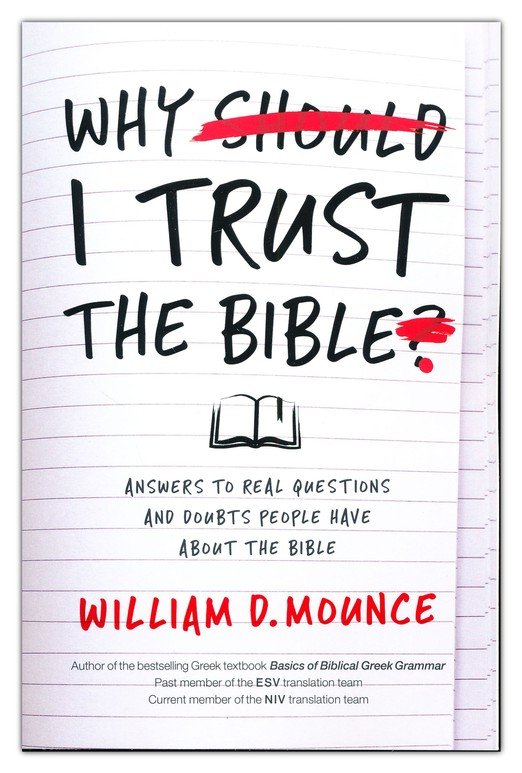
But as Dr. Mounce writes in his Why I Trust the Bible: Answers to Real Questions and Doubts People Have about the Bible, the idea that it was really Matthew, Mark, Luke and John who wrote their respective Gospels, was the unanimous consensus by the mid-2nd century. If the Gospels were truly anonymous, we would have heard of other possible author names being put forward as alternatives. But we do not see any contested argument regarding the names of authors in the historical record. In the ancient world, where we had no mass communication systems, made available by today’s technologies like the Internet, the traditional names of the Gospel writers consistently flourished throughout the geographically vast area of the Roman empire.
Contrast this with the disputes over who wrote the Book of Hebrews, the only New Testament book that lacks a particular claim to a particular author. Tertullian argued that Barnabas wrote Hebrews. Other early church fathers suggest Clement of Rome, or Luke. Eusebius believed it was Paul. Some even say Priscilla wrote it. Origen concluded, “In truth only God knows.”
In the case of Mark’s Gospel, we do have good evidence that Mark was indeed the author. Though the writings have not directly survived, Eusebius tells us of the church father and writer Papias, the bishop of Hierapolis in Asia Minor, until about 130 CE, who was a disciple of John. Papias in these lost writings had written that Mark had become Peter’s interpreter. Furthermore, Clement of Alexandria attests to Peter being in Rome, preaching in perhaps the 60s, of the first century. This would indicate that Mark probably wrote his Gospel, based on the eyewitness testimony of Peter, as derived from sermons that Peter gave in Rome, prior to Peter’s martyrdom.
When Doubts Arise: Having a Reliable Guide to Answer Informed Critics
Bill Mounce givens seasoned, evidence-grounded answers, like the one above, to the type of doubts and questions raised by critics of the Bible today, in Why I Trust the Bible. Dr. Mounce makes judicious use of the insights gained by the “historical criticism” of the Bible, that enhance our understanding of the Scriptural text, rather than undermining it. Mounce’s audience is directed at ordinary Christian believers, who find themselves overwhelmed by the popular claims of skeptics, who are looking for reasoned explanations, that are readily accessible, and that do not descend into the overly technical. For those looking for more academic treatments of these topics, Mounce footnotes his references for those who want to dive deeper into these type of discussions.
I was particularly impressed with Dr. Mounce’s chapters on textual criticism, answering both the criticisms against New Testament itself popularly expressed by the famous atheist/agnostic scholar Bart Ehrman, as well as the King James Only-movement on the other side of the debate. Those few chapters alone are worth the price of the book, written at a level that most people should be able to understand, that covers all of the important questions that are typically raised on this topic.
I can quibble with Dr. Mounce on a few points here and there throughout the book. For example, Dr. Mounce’s claim that the “had formed” for the animals’ creation in Genesis 2:19, as found in the ESV and NIV translations, does not carry a sense of temporal sequence, has been criticized by other scholars as a form of cheating when it comes to certain Bible translations (see page 257). But such complaints are minor, as set within the context of the whole of Dr. Mounce’s excellent work.
All in all, Why I Trust the Bible is probably one of the best resources available, that critique some of the more extreme conclusions made within the “historical criticism” movement, regarding the Bible. From questions about the canon of Scripture to the latest intellectual fad of “Jesus Mythicism,” Bill Mounce hits nearly every major topic that skeptics will bring up about the Bible. That being said, this may not be the right book to give to a knowledgeable non-believer, who devours every book that Bart Ehrman publishes. Dr. Mounce pretty much assumes that his audience are either Christians, or those who are genuinely seeking information about the Bible. There are lots of great books now about the existence of God, how science and faith relate to one another, and social justice issues concerning Christianity, but if I had to pick just one book that specifically looks at the trustworthiness of the Bible, Why I Trust the Bible: Answers to Real Questions and Doubts People Have about the Bible stands near the top of the list.
One Serious Gripe
If I had one serious complaint to make about Why I Trust the Bible it would be that the book is too short. Why I Trust the Bible could have explored certain issues at a greater length and depth, but the author chose not to. Dr. Mounce’s book clocks in at around 280 pages, whereas British Anglican liberal scholar John Barton’s A History of the Bible: The Book and Its Faiths, ( reviewed earlier in this blog post series on Veracity ), and endorsed by Bart Ehrman, clocks in at a hefty and whopping 635 pages. Both books are written for a popular audience, and easily digestible. Both books address overlapping material. Both Dr. Mounce and Dr. Barton are world-class scholars. But in spite of the length of Barton’s A History of the Bible, that might easily scare off some readers, Barton’s book outsells Dr. Mounce’s shorter Why I Trust the Bible, and most likely, will continue to outsell it.
I wonder if the topic of “historical criticism” of the Bible is avoided by church-going believers, because they are afraid with what they might find there. Thankfully, Bill Mounce’s Why I Trust the Bible does not exploit such fears, as it actually does the exact opposite. But perhaps the popularity of John Barton’s A History of the Bible exploits the growing skeptical reading audience’s desire for more material to challenge historic, orthodox Christianity.
While conservative evangelical book publishing has continued to improve tremendously over the past few decades, substantial volumes geared towards the general public have languished when compared to similar texts produced by progressive Christian and non-believing scholars. Back when I was in seminary in the 1990s, I remember being mesmerized by books written by the progressive Bible scholar, Elaine Pagels, available at the Barnes and Noble bookstore, while being frustrated by the lack of alternative volumes written by otherwise equally competent conservative evangelical scholars, on similar topics, altogether absent from those Barnes and Noble bookshelves. Elaine Pagels was introducing me to a whole new world of “historical criticism,” but the evangelical churches I knew of in those days, addressed such topics with crickets!!
Is this the fault of evangelical book publishers, or the book reading market that tends to shy away from lengthy books of this type? I do not know that answer here. But what I do know is that we need more substantial books, along the lines of Mounce’s Why I Trust the Bible: Answers to Real Questions and Doubts People Have about the Bible, that help to counter a growing skepticism in an increasingly secularized world.
In closing out this book review, I am leaving a whole list of teasers that might inspire you to go out and buy the book. Thankfully, Dr. Mounce has released a set of short videos, most of them clocking in at well under 5-minutes, that give you a summary of each chapter, plus a few extra videos that dive a little deeper into more complex topics. Here is the link to the entire YouTube playlist, but right below is the first video in the list, and I have hyperlinked to the other videos in the playlist, just below that. This is great stuff for your own personal discipleship journey, and might even be useful in a small group setting. Enjoy!!
Yesterday’s Easter sermon covered the last few verses in the Gospel of Mark…. or did it?
If you pick up any copy of any modern English Bible translation, Mark 16 starts off telling the reader that the women came to the tomb, where Jesus was laid after the crucifixion, early on Sunday morning, only to find that the stone at the entrance of the tomb had been rolled away, and a “young man” (an angel perhaps?) sought to answer the questions that the women had in their minds at that moment:
‘And he said to them, “Do not be alarmed. You seek Jesus of Nazareth, who was crucified. He has risen; he is not here. See the place where they laid him. But go, tell his disciples and Peter that he is going before you to Galilee. There you will see him, just as he told you.” And they went out and fled from the tomb, for trembling and astonishment had seized them, and they said nothing to anyone, for they were afraid’ (Mark 16:6-8 ESV).
The end.
It is a very awkward ending to the Gospel. This unknown figure announces that Jesus has been risen from the dead, but there are no resurrection appearances of Jesus to the women. That is really odd, but that is what you have here.
The graveyard at Bruton Parish Church, in Williamsburg, Virginia. What if you were among the women to visit the grave of Jesus, and Jesus was not there, but someone told you that Jesus had been raised from the dead?
However, what is interesting is that most every modern Bible translation will then include a note. The English Standard Version (ESV) modestly reads, “Some of the earliest manuscripts do not include 16:9–20.” The New International Version (NIV) is bolder and more direct, “The earliest manuscripts and some other ancient witnesses do not have verses 9–20.”
Most of these modern translations will then have a footnote describing what is called the “shorter ending of Mark.” They will often include, in the main body of the text, what is called the “longer ending of Mark.” The most interesting feature of the “longer ending of Mark” is that it includes the infamous snake-handling verse (Mark 16:18), that some Christian groups in Appalachia use as a prooftext for handling live snakes in their worship services (Link to creepy National Geographic story on snake handling).
So, what is the story with these alternative endings for Mark?
Many Christians familiar with the King James Version (KJV) of the Bible will notice that there is no note at the end of verse 8, but that verses 9-16 are included anyway (the longer ending of Mark). Many therefore conclude (understandably) that the longer ending is the authentic ending for the Gospel of Mark.
However, most scholars (Christian and non-Christian) do not believe that the “longer ending” (or even the “shorter ending”) of Mark are authentic. But scholars differ as to why most of our earliest sources lack anything after verse 8. Perhaps Mark just left the Gospel as a cliff-hanger at the end. Perhaps the original ending to Mark’s Gospel simply got lost, as though the last few inches of Mark’s papyrus got ripped off. A handful of scholars even suggest that some type of oral tradition gives us the alternative endings to Mark that are found after verse 8. Others say that it just seemed too awkward for Mark to end the Gospel at verse 8, so other endings were invented to smooth out the ending of the story.
The bottom line is that we simply do not know how to account for Mark’s abrupt ending at verse 8. Aside from the snake-handling verse, which is perhaps an allusion to Paul being bitten by a snake on the island of Malta, and surviving (Acts 28:1-7), (and the related bit about drinking poison), there is nothing in verse 9-16 that is not repeated or covered elsewhere in the New Testament. No theological problems here. So, we do not lose any specific Christian doctrine if we recognize verses 9-16 as not being authentic.
But it does make for some interesting conversation!!
For a “shorter” summary of the broad scholarly consensus on Mark 16:9-20, you might want to briefly look at the 2 1/2 minute video below from a recent Mike Licona debate. For a “longer” summary, you can consider Mike Winger’s 2-hour video teaching on the topic. Mike Winger is one of most popular Christian Bible teachers / apologists today on YouTube, with over 400,000 followers. As a church pastor, with a YouTube channel on the side, Mike Winger says he spent 150 hours researching this topic. Did you ever think it was possible to spend 150 hours studying the final 12 verses of the longer end of Mark?