Author Archives: Clarke Morledge

About Clarke Morledge

Unknown's avatar
Clarke Morledge -- Computer Network Engineer, College of William and Mary... I hiked the Mount of the Holy Cross, one of the famous Colorado Fourteeners, with some friends in July, 2012. My buddy, Mike Scott, snapped this photo of me on the summit.

Were the Crusaders Medieval Terrorists?

Beheadings. Torture. Kidnappings. Execution-style murders. Unspeakable acts of barbarism. Rape as a weapon of war.

Today’s headlines are filled with atrocities, many of them associated with radical Islam. For example, my initial reaction is that the masked faces behind ISIS are clearly the “bad guys”and people in the West are the “good guys.” And then something mind boggling like the execution-style murders of three Muslims in Chapel Hill, North Carolina happens. It can get really confusing.

Examples of violence in history across the religious spectrum are invoked by journalists and political leaders in order to give us perspective. For many, the actions associated with extreme Islamic jihad are comparable to the aggressive militancy of the Crusades waged by Western Europeans in the Middle East during the medieval era. Countless readers of history, both from Christian and Islamic backgrounds, accept the narrative made famous by 20th century medieval historian Sir Steven Runciman that the Crusades remain the classic example of unprovoked, religious intolerance and unbridled fanaticism.

So, is this a fair comparison? Did the offensive actions of those medieval Crusaders provoke modern day extreme Islamic jihad? Or were the Crusades primarily intended to be an act of defense against the juggernaut advance of militant Islam over the preceding centuries?

Let’s face it. History can get really complicated, particularly when talking about violence, especially religiously motivated violence. How do we sort these things out?

Thomas F. Madden is a professor of medieval history at Saint Louis University. He is one of the leading academic historians on the Crusades. Many of the things Madden talks about regarding common misunderstandings of the Crusades may surprise you. Madden gave the following talk before a Catholic audience (here is a summary of his main points):


What is Lent?

I just came home from our church’s Ash Wednesday service, with some charcoal on my forehead, reminding me and others around me of our own mortality.

I know that many evangelical Christians do not celebrate Ash Wednesday, or the season of Lent, for that matter, because it is not directly taught within the Bible. I can understand that, but the unfortunate rumors that the season of Lent has pagan roots is without foundation. Instead, the practice of Lent is thoroughly grounded in a tradition begun in the early church, for which traditionally-minded liturgical churches continue to celebrate, along with a growing number of evangelical churches. So while the specific practice of Lent is not mentioned in the Bible, the concepts of repentance and self-examination as we prepare our hearts to meet the crucified and risen Christ celebrated on Easter Sunday are most definitely grounded in Scripture.

For more on the history of Ash Wednesday and Lent, see this Veracity posting from last year. Columbia Publishing House, an arm of the Missouri-Synod Lutheran Church, produced the following video, a short under-3-minute introduction to what Lent is all about:

HT: Gene Veith’s Cranach blog at Patheos.com


Who Are the Most Influential Skeptics Today?

Bill Nye, the Science Guy.  Comedian and science educator for a generation of young people.  Now a participant in the culture wars??

What do cultural celebrities like Bill Nye, Richard Dawkins, Neil de Grasse Tyson, Bart Ehrman, and Bill Maher all have in common? In different ways, the represent different forms of skepticism about the Christian faith.

In a recent Sunday School class on “Personal Discipleship,” I was asked this question: Who are the most influential skeptics today? 

How does one go about answering such a question? According to Canadian philosopher Charles Taylor, in his magisterial A Secular Age, a few hundred years ago it was virtually impossible not to believe in God. But nowadays, the shift is remarkable: for many in 21st century Western culture, it is very easy, almost inescapable, to not believe in God. Skepticism defines the current cultural mood, something that would have been mostly unthinkable just a few centuries ago.

Instead of trying to come up with some type of “Top Ten” skeptics list, I think it best to list out some of the more skeptical personalities today, each person representing a different type of skepticism that an evangelical Christian believer might encounter in their conversations with their neighbors, co-workers and even family members. So here we go….
Continue reading


Stephen Fry and the God of Oscar Wilde

Stephen Fry is an English comedian. Though not as well-known on the American side “of the pond,” Stephen Fry was interviewed on Ireland’s Public Service television recently where he expressed his views on God. The video went viral on YouTube, numbering over 5 million views in less that 2 weeks. Fry, like many skeptics, does not find satisfaction with how a “God” could create a world with so much suffering and evil in it… and that description is putting it…as they say…rather mildly (be forewarned).

In response, Justin Brierley, the British radio personality who moderates the Unbelievable radio podcast, a show I highly recommend, draws inspiration from one of Stephen Fry’s literary heroes, Oscar Wilde (the text of Brierley’s remarks can be found here). Though mostly known as being a skeptic, Oscar Wilde converted to Catholicism in the last few days of his life.

Casting aside questions about Roman Catholicism for the moment, how do you see Justin Brierley painting a different portrait of God than what Stephen Fry rails against? Oscar Wilde’s The Selfish Giant can be read here.


What About the Cavemen?

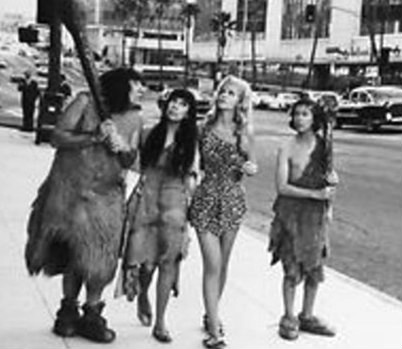
Some of this Veracity blogger's distance relatives, or just a really bad TV show from the 1960s? (It's About Time).

Some of this Veracity blogger’s distance relatives, or just a really bad TV show from the 1960s? (It’s About Time).

One of the most persistent challenges in trying to reconcile Biblical truth with the findings of modern science is this: What do you do with the cavemen?

The mainstream scientistic consensus today is that there have been human-like creatures discovered in the ancient fossil record that predate humans like you and me. Names such as Cro-Magnon man, homo erectus, and the neanderthal fill our imaginations with images of semi-ape, semi-human creatures hobbling or running around with crude tools, making grunting noises, many of them living in… well… caves. My wife thinks I must be related at times to these creatures, particularly when I get out of bed in the morning, bumping into things when I am barely awake!!

But seriously, could it be that these brute creatures are related to us, we homo-sapiens, or is such a concept alien to the teaching of the Bible? Does the existence of these creatures insult or even undermine the Christian concept of the special status of humanity’s uniqueness?

News within recent years suggests that there is some evidence of actual interbreeding between modern humans and neanderthals thousands of years ago, as in this story from the British Natural History museum:

So what does the Bible have to say regarding creatures like the neanderthal?
Continue reading