Author Archives: Clarke Morledge

About Clarke Morledge

Unknown's avatar
Clarke Morledge -- Computer Network Engineer, College of William and Mary... I hiked the Mount of the Holy Cross, one of the famous Colorado Fourteeners, with some friends in July, 2012. My buddy, Mike Scott, snapped this photo of me on the summit.

Daniel’s Seventy Weeks #5

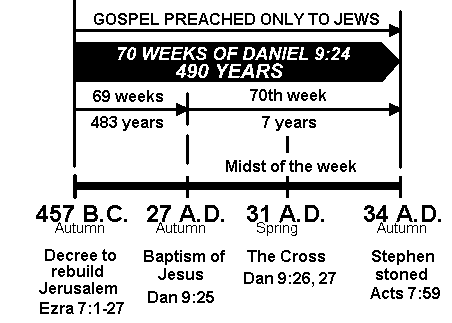
The primary traditional alternative to the more modern, dispensationalist reading of Daniel 9:24-27

A more traditional alternative to the more modern, dispensationalist reading of Daniel 9:24-27.  (Image credit: sdru.org)

If you have been following this series of blog posts (#1, #2, #3, and #4), you will know that the “Seventy Weeks” of Daniel 9:24-27 makes for a very demanding study. So, as we are getting very near to Christmas, I need to wrap this blog series up, even with all of the loose ends still out there.

Thankfully, neither your salvation, nor mine, hangs in the balance with getting Daniel 9:24-27 exactly right. For example, no central doctrine of the faith is at stake, as you ponder the mysterious meaning of Scripture phrases like “the people of the prince who is to come shall destroy the city and the sanctuary” (verse 26). But the study is well worth the effort, as it will spur you on in learning more about Biblical prophecy, just as it has done for me.

At one point in my studies, over the past two years in this passage, I ran into the following statement by Dr. Martyn Lloyd-Jones, one of Britain’s most brilliant and popular expositors of the 20th century. Lloyd-Jones lived in an era when many Christians tended to be very dogmatic in their particular interpretation of Daniel 9. His comments on the debate over Daniel 9’s “Seventy Weeks” are worth savoring:

“I am simply trying to put before you some of the various ideas and type of interpretation, while indicating, as anyone who is concerned to teach the Scriptures must do, the interpretation that most commends itself to my mind and to my understanding. I shall continue to repeat this because it seems to me to be the most important point I can make in connection with this whole subject. If I can somehow shake the glibness and the dogmatism that has characterised this matter I shall be most pleased, and I thank God that there are signs and indications that people are prepared to consider this matter anew. It may well betoken a period of blessing in the history of the Church.” (Great Doctrines of the Bible: God the Father, God the Son, God the Holy Spirit, The Church and the Last Things, page 119).

Martyn Lloyd-Jones has the right perspective. We are not talking about the deity of Christ, or salvation alone through Jesus, here. OKAY??? I may hold (and you may hold) to a different interpretation of a difficult passage like Daniel 9. Hopefully, believers can discuss this matter with clarity and charity towards one another, by studying the Scriptures anew. Continue reading

John Glenn: Christian Faith and the God of Creation

Annie and John Glenn, in 1965. They where married for 73 years, until his death in December, 2016.

Annie and John Glenn, in 1965. They were married for 73 years, until his death in December, 2016.

“To look out at this kind of creation out here and not believe in God is to me impossible,” so said astronaut John Glenn, during his space flight aboard the Space Shuttle in 1998. “It just strengthens my faith. I wish there were words to describe what it’s like.”

This is a powerful testimony, decades after he became the first American to orbit the Earth in 1962. The American novelist and secular writer, Tom Wolfe, in his essay on “The Faith of John Glenn,” in the Wall Street Journal, observes that Glenn’s Presbyterian confidence in God stood out back in the those early days of the Mercury program, too. In my years working as a contractor at NASA, I never had the opportunity to meet John Glenn, who recently died at age 95, but I always considered him to be a man of integrity and admiration.

By seeing God revealed in creation, above the curvature of the earth, John Glenn followed the lead of where his faith took him, which might seem controversial to some. In a day and an age where many think Christianity is in opposition to science, John Glenn was an advocate for science education in the public schools, even endorsing the teaching of biological evolutionary theory, seeing no contradiction between evolution and his Christian faith.

Christians today do indeed hold to a wide variety of differing viewpoints on the subject of creation and human origins. But I hope believers of all perspectives might be encouraged by the outspoken testimony of this man of faith, who saw God revealed in creation.


Daniel’s Seventy Weeks #4

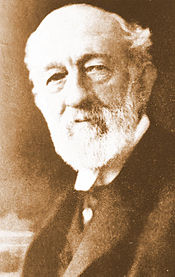
Sir Robert Anderson (1841-1918) is remembered by many Bible students today for his contribution to the interpretation of the book of Daniel. However, in the 19th century he was also known as a high ranking official at Scotland Yard, the second Assistant Commissioner of the London Metropolitan Police.

Sir Robert Anderson (1841-1918) is remembered by many Bible students today for his contribution to the interpretation of the book of Daniel. However, in the 19th century he was also known as a high ranking official at Scotland Yard, the second Assistant Commissioner of the London Metropolitan Police.

Daniel’s “Seventy Weeks” prophecy, as found in Daniel 9:24-27 is often regarded as the key text for understanding the prophecy perspective held by advocates of dispensationalism, as made popular by books and movies associated with Tim Lahaye’s Left Behind. Yet as we noted in a previous post in this series, this passage from Daniel plays actually a limited and somewhat obscure role in the New Testament, especially when compared to passages such as Psalm 110, which is quoted or alluded to some thirty times in the New Testament, as we sought to exposit earlier a few years ago on Veracity.

As I have been digging into the interpretation of Daniel 9:24-27, for nearly two years, inspired by the “astronomical” work of my friend, Ken Petzinger, I have been learning that the controversies surrounding these four verses of the Bible are fascinatingly complex. In this post, I want to lay aside some of the Bible interpretation issues aside, and focus instead on some questions of history:

So, where did the “dispensationalist” approach to Daniel 9:24-27 come from? Why is it that the prophecy of the “Seventy Weeks” has become so important in the minds of so many Christians, over the past hundred or so years?
Continue reading


People Disagreed With Jesus About the Bible Too

I am in the middle of posting a five-part blog series on the interpretation of Daniel 9:24-27, the famous “Seventy Weeks” prophecy, one of the most controversial Old Testament prophecies predicting the coming of the Messiah. Some scholars call it the “Dismal Swamp” of Biblical interpretation. After digging into this for about two years, I can believe it really is a swamp.

The passage is really fascinating and amazing, but the pervasive interpretive pluralism among Christians, as to what the prophecy means, can be overwhelming. There have been times where I have been tempted to throw my hands up in the air and give up. Thankfully, I ran into the following re-post from Derek Rishmawy’s blog that serves as a healthy antidote to following such a temptation.

Derek Rishmawy is also a co-host of the MereFidelity podcast, that I sometimes listen to, that combines thoughtful theological reflection and conversation, with engagement in contemporary cultural issues impacting the English speaking world. These guys are smart, and just listening to the British accents of some of the other co-hosts makes you feel a little bit smarter yourself, too. If you need some intellectual stimulus that you are not getting elsewhere, you should check out the podcast sometime at the MereOrthodoxy website.

Derek Rishmawy's avatarReformedish

Jesus talking“Yeah, but there are so many interpretations of that text, so many denominations claiming Scripture for their own, you can’t really say there’s a wrong way of reading it.”

If you’ve been in a Bible study or spent more than about 10 minutes surfing pop theology writings, you have probably run across a claim of this sort. The idea is that with so many different readings of Scripture, it’s either arrogant or hopeless to think we can come to a determinate, or correct understanding of it. In other words, the mere fact of interpretive disagreement ought to put us off from claiming anything very strong for our interpretations of Scripture.

This sort can take a couple of different forms.

First, someone can go full-blown, radical skeptic and just say that the text has no inherent, determinate meanings, only uses. Or maybe that it’s a springboard for our own thoughts about…

View original post 880 more words


Classic-Thinking: Thomas Oden

Thomas C. Oden wrote A Change of Heart, a theological memoir of how as a thinker he made the journey from Protestant Liberal to a truly evangelical and broadly ecumenical man of faith.

Thomas C. Oden wrote A Change of Heart, a theological memoir of how as a thinker he made the journey from a Protestant Liberal to a truly evangelical and broadly ecumenical man of faith.

“I loved heresy…But the Holy Spirit found me,” so said Methodist theologian Thomas C. Oden (1931-2016), who died December 8, 2016.

Thomas Oden had grown up in the world of mainline Methodism, in the mid-20th century. He fully imbibed the liberal theology of his day, immersing himself in the writings of Rudolph Bultmann and Paul Tillich. He was a leading thinker and theological spokesperson for a radical redefinition of Christianity that swept through American mainline churches in the 1950s to 1960s. He had admired the Vietnamese Ho Chi Min as an agrarian patriot. But then he realized that he had been wrong.

In an interview a few years ago with Southern Baptist leader, Al Mohler, Oden confessed that his enthusiasm for Marx was misguided. “I loved the fantasies and I loved the revolutionary illusions. I truly loved them… I was one of those who was way out on the far left edge of accommodating to modernity. And I don’t know how but the Holy Spirit found me.”

A caring Jewish friend had encouraged Oden to read the patristic writers, those fathers of the early church who wrote extensively within the first few centuries of the Christian movement. Up to that point, Oden “was able to confess the Apostle’s Creed, but only with deep ambiguity. But I stumbled over ‘he arose from the dead.’ I had to demythologize it and could say it only symbolically. I could not inwardly confess the resurrection as a factual historical event.”

When Oden finally realized that the bodily resurrection of Jesus was something that he must believe and eventually did believe, in order to be a true Christian, it reoriented his life. He spent the second half of his life repudiating the hubris behind the very liberalism that nurtured him, and sought to build a case for a consensual model of Christian belief, looking to those early, classic church fathers for guidance. His change of heart was now to serve the church, and not to seek after the latest theological fad of academia.

Oden never broke away from his modest, classically-informed Wesleyan theological leanings. He sought for reconciliation in the predestination and free-will debates that still divides Calvinists and Arminians. He eschewed debates over the age of the earth, charismatic gifts, the “proper” view of the millennium and the “End Times,” and other intramural discussions, in order to focus on the common vision of faith embodied in the early creeds of the church, like the Nicene Creed.

As having read Thomas Oden’s Classic Christianity: A Systematic Theology, as the basic theology textbook in seminary, I can say that Oden was not as strong as an apologist or a textual Bible scholar, but these were not his gifts. His gift was in drawing together the widest range of the greatest teachers in the historical Christian tradition, to give us a “big picture,” consensus view of what it means to believe as a faithful follower of Jesus: Classic Christianity at its finest!!

Michael J. Kruger, at the Canon Fodder blog, offers some lessons learned from Thomas Oden.
