
Crushing the Serpent: Did God Punish Jesus?, written by William L. Hess, a Christian YouTube apologist, has in its blurb on Amazon promoting the book like this: “What really happened at the Cross? Did the Father really forsake His son and ‘turn His back’ as some claim? How could an all-loving God punish someone innocent for the crimes of the world?”
These are good, honest questions. I have had numerous conversations with others, both Christian and non-Christian alike, who wonder about such things.
However, some Christians might take some offense, wondering why a self-professing Christian would ask questions like these: At first glance, a Christian immersed in a Protestant evangelical background might think that Will Hess is a “progressive Christian,” disillusioned with evangelicalism, using his platform on YouTube to deconstruct evangelical Christianity. But first glances can be deceiving. A closer look tells a much different story.
I can not help but think that Will Hess probably had a Stuart Townend song in mind when he wrote this book. “How Deep the Father’s Love for Us,” written some 30 years ago, is sung in countless evangelical churches. My church sings it about once a month. The first verse reads like this:
How deep the Father’s love for us,
How vast beyond all measure,
That He should give His only Son
To make a wretch His treasure.
How great the pain of searing loss –
The Father turns His face away,
As wounds which mar the Chosen One
Bring many sons to glory.
There is one line: “The Father turns His face away” that troubles some people…. including Will Hess. What is that line really talking about?
I wrote a blog post about that line in this song a few months ago on the Veracity blog, so I will not repeat that analysis here. But Will Hess has written an entire book trying to show why the underlying theology, in his estimation, for the line in this worship song is erroneous. It is a provocative claim, and one that needs to be considered and examined. It has to do with a doctrine called “penal substitutionary atonement.”
For Will Hess, there is a Scriptural doctrine of atonement, but the idea of “penal substitution” as connected with atonement is not good news.
It is bad news…. or at best, misleading news.
Here is my summary “hot take” review of the book: Crushing the Serpent: Did God Punish Jesus? is thorough, without being overly technical. It is readable by someone who is not a scholar. Still, it will make you think. It will open you up to considering other perspectives you might have never thought of much before. This book changed my mind on how to read certain passages of Scripture. I am a more careful thinker about the theology of atonement having read this book. However, Crushing the Serpent still has some problems. One particular problem stands out more than all of the others, in that it relies on popular caricatures of evangelical atonement theology as an ideological punching bag, as I will hopefully make clear in this fairly detailed review.
Buckle up, so here we go!
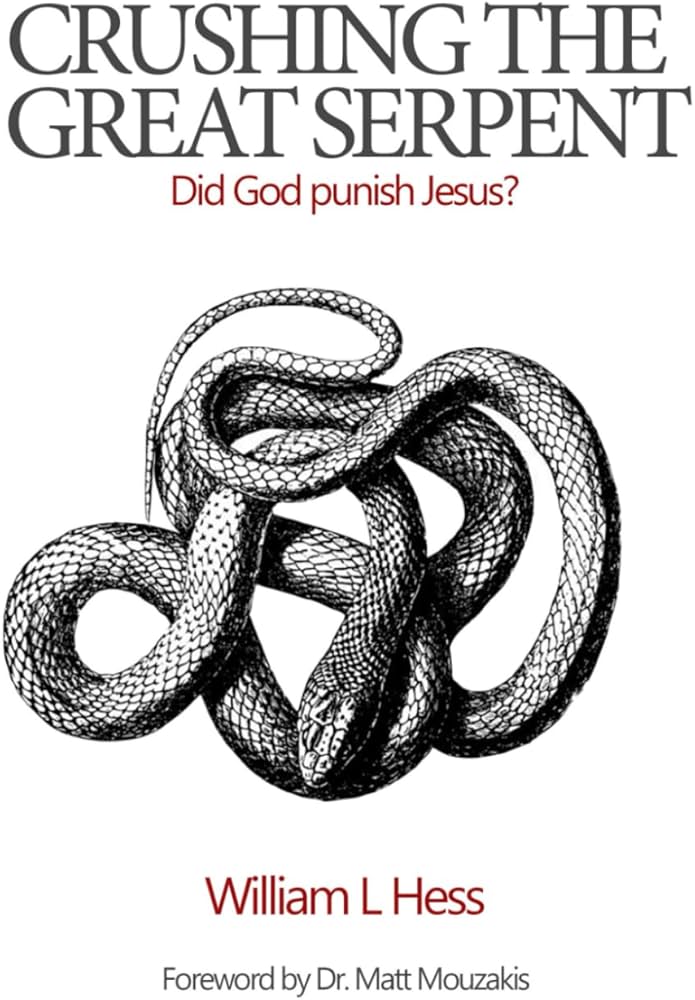
Crushing The Serpent: Did God Punish Jesus?, by William L. Hess challenges the doctrine of penal substitutionary atonement. While Will Hess does a good job in exegeting various texts in Scripture regarding the work of Christ on the Christ, its singular focus bent on undercutting the doctrine of penal substitutionary atonement is weakened by its repetitive reliance on caricatures of that doctrine.



