Tag Archives: reformation

Imputation: The Chocolate Chips in Luther’s Theological Cookie

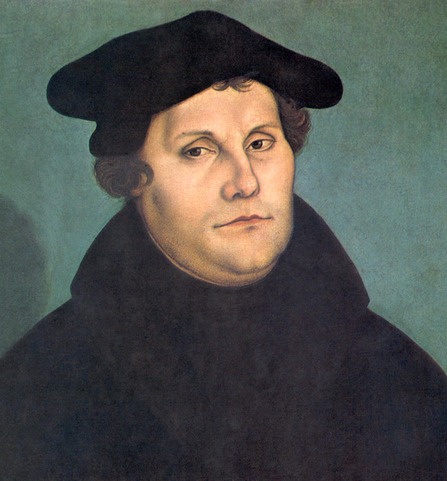
Martin Luther (1483-1546), by Cranach (credit: Wikipedia). “Imputation” was the core theological concept behind Luther’s thinking. So then, what is “imputation?”

Imputation. Have you ever heard of that word? We do not use it in normal conversation. But in the 16th century, imputation became a battleground idea for the Reformation. This crucial theological concept helps us think through a true understanding of the Gospel, even today.

Theologian Michael Horton, one of the scholars interviewed in the film documentary This Changed Everything, about the Reformation, likens imputation to a cooking analogy. If you try to make chocolate chip cookies, but leave out the chocolate chips, then you have pretty much left out the main ingredient. Likewise, many Protestants would argue that if you talk about the Gospel, but leave out imputation, then you end up with a chocolate-less cookie. Before we get at the definition of imputation, let us see why this might be so important. Continue reading


Mortal Sin, Venial Sin, and the Sin That Leads to Death?

Not having grown up in the Roman Catholic tradition, I was always puzzled by the whole idea of mortal versus venial sins. What is all of that about, and where is it in the Bible, (or is it)?

Well, it all stems back to one of the more difficult passages in the Bible to interpret:

If anyone sees his brother committing a sin not leading to death, he shall ask, and God will give him life—to those who commit sins that do not lead to death. There is sin that leads to death; I do not say that one should pray for that. All wrongdoing is sin, but there is sin that does not lead to death. (I John 5:16-17 ESV)

Bible scholars have been scratching their heads for hundreds of years on this one. Who is his “brother?” What are some examples of the different types of “sin“? What is meant by “death?” In other words, what in the world is John talking about here?

Spiritual Anxiety: Mortal vs. Venial Sins

Continue reading


Does the Roman Catholic Church Still “Sell Indulgences?”

Johann Tetzel, 16th century indulgences promoter, and “used car salesman.” Tetzel never visited Wittenberg, Germany, seeking to avoid the direct barbs of Martin Luther’s scathing critique (credit: Wikipedia)

When the German Dominican friar, Johann Tetzel (1465-1519), began to travel across Europe, urging people to contribute to the church fund for building St. Peter’s basilica, it fired up the indignation of one monk, Martin Luther. Many have quoted Tetzel’s couplet, that appeared to endorse the idea that the medieval Church was “selling indulgences.”

“As soon as a coin in the coffer rings, the soul from purgatory springs.”

The idea here is that Tetzel was encouraging almsgiving to the Church in exchange for offering more “time off” for loved ones in purgatory. Luther’s protest soon brought the Christian world into turmoil. But were Tetzel’s actions merely an abuse of the teachings of the medieval Church, or did they signal a deeper, more fundamental problem with the Church’s theology?

When Martin Luther first nailed up his Ninety-Five Thesis to the Castle Church door in Wittenberg, it may not have been clear to him as to how to answer that question. But as Luther began to receive more and more pushback from Church authorities, he began to think that Tetzel’s “used car salesman” tactics were more that just an abuse of an otherwise, acceptable doctrine. Rather, the whole theology of indulgences was based on a dangerously false interpretation of the Bible.
Continue reading


Did Luther Intend to Start The Reformation? (In Seven Minutes)

My bad” (??)

October 31, 2017 will be the 500th anniversary of when an obscure monk and theology academic, Martin Luther, nailed his Ninety-Five Theses to a church door in Wittenberg, Germany, a spark that has set off a controversy ever since. But what do we do with this event? Do we “celebrate” it? Do we “mourn” it?

How we answer these questions, typically stems from a larger question: Did Martin Luther intend to start the Protestant Reformation? Gordon-Conwell church history professor, Ryan Reeves, explores this question, in the following seven-minute video.

Whatever we do with Luther’s motives behind the Reformation, what we should not do, is to ignore the Reformation. The Reformation is not just some event, located in the recesses of the past. The debates around Reformation define for Christians, even today, what we think about the Gospel, the Bible, and the Church.

I will be teaching an adult Bible class, this fall (2017), at the Williamsburg Community Chapel, 9:30 to 10:45 am, in Room 128, that explores these topics in greater detail. Please leave a comment in the comments section, if you want more information about the class.


Statements: A Reforming Catholic Confession


Now, here is a theological statement that I can really get excited about!!

Since the Reformation, many have accused Protestants of being a divisive folk, unable to agree on much of anything, thus undermining the unity of God’s Church throughout the world. On the eve of remembering the 500th anniversary of the start of the Reformation, this is a charge that deserves some careful thought, before responding.

Yes, there are differences that can divide, but is there a core of fundamental beliefs that unites Protestants together? In there a “mere Protestantism,” recalling C.S. Lewis’ famous book, Mere Christianity?

Trinity Evangelical Divinity School theologian, Kevin J. Vanhoozer, says, “Yes!” In the following video, Vanhoozer explains that there is a core of common beliefs among Protestants. The Reforming Catholic Confession is a statement written that seeks to demonstrate that unified, shared core. Over 750 Christian leaders have already signed on, supporting this confession.

When I read the confession for myself, I wondered if this was even broader in scope than “just for Protestants.”  My hunch is that at least some of my Roman Catholic and Eastern Orthodox friends might even find agreement here as well. Read the Reforming Catholic Confession for yourself, and let me know what you think.

In general, I am always a bit cautious about “statements,” as they are rarely the final word on anything. At best, they are works in progress. But the Reforming Catholic Confession is the kind of statement that is really a great place to start. Tell your friends about it!

Can I get an “AMEN?!”
