
My church is doing a summer Bible study on the Minor Prophets of the Old Testament. If you want a brief introduction to the Book of Amos, with some helpful visual illustrations, you can not do much better than this 7-minute video by the “Bible Project.”
The Elusive Quest for the “Best” Bible Translation
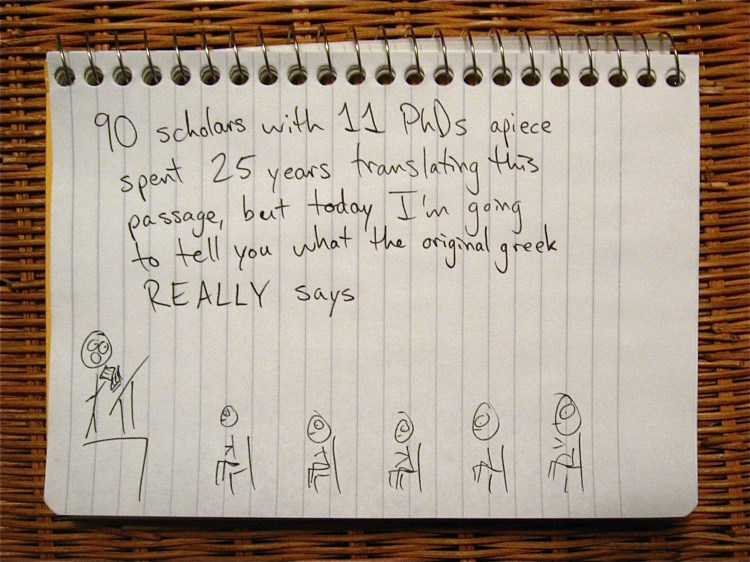
I ran across this comic today, posted in an excellent piece by Andy Naselli, a New Testament instructor at Bethlehem College & Seminary, founded by Minneapolis pastor, John Piper. Naselli’s argument is that while many Christians tend to argue that their favorite Bible translation is the best, and every other translation is inferior, it would greatly help if we had some humility here.
Evangelical Christians can get pretty picky when it comes to Bible translations that they implicitly trust. But one of my pet peeves is when people, who have absolutely no background in biblical scholarship, tend to think they know better than people who have been studying the Scriptures in-depth for decades.
The latest brouhaha is over a new Bible translation, the Christian Standard Bible, which is a revision of the Holman Christian Standard Bible. The Holman Christian Standard Bible (HCSB) was completed in 2004, by a team of scholars, sponsored by the Southern Baptist Convention. The new Christian Standard Bible (CSB) is a modern revision of the HCSB.
Critics have charged that the Christian Standard Bible, produced by conservative evangelical scholars, have nevertheless “changed” the Bible to make it “gender inclusive,” thus hiding a liberal agenda. But as I wrote a few years ago, in one of Veracity’s most widely read posts, the issue of “gender accuracy” between the ESV and NIV 2011 translations, two of the most popular translations read by Christians today, tends to vary from passage to passage. In other words, sometimes the ESV is more “gender accurate” than the NIV 2011, but in other cases, the NIV 2011 is more “gender accurate” than the ESV. I tend to prefer the ESV, but I see a number of strengths in other translations, such as the NIV 2011, and the new CSB.
It is true that no scholar, even conservative evangelical scholars, operates without a personal bias. Even the best scholars can be wrong at times. Therefore, one should not take the message of the comic to mean that the average person, without a PhD, should never be able to make their own informed decisions, when reading the biblical text, in order to understand its meaning.
All I am saying is that we all need a little dose of humility, and not quickly dismiss a Bible translation, simply because one or two passages in a different translation do not conform to our own presuppositions. My suggestion would be to visit BibleGateway.com, and pick some passages in your favorite Bible translation, and then compare them to something like the new Christian Standard Bible. Who knows? Perhaps reading something in a different translation may give you greater insight into the Bible.
Here is an interview with Trevin Wax, publisher of the CSB, about the new Bible, and with Tom Schreiner, one of the lead translators, and then a brief comparison review at BibleGateway.com, with other translations.
“Loving Day” and the Sin of Previous Generations

Virginia judge Leon Bazille’s handwritten theological justification for banning interracial marriage. He ends by saying, “The fact that [God] separated the races shows that he did not intend for the races to mix.” What Bible was he reading from?
What makes this so tragic for the Gospel is that a racist ideology had for centuries been falsely linked with the Bible. The biblical teaching that prohibited Jews from marrying people outside of the Mosaic covenant had been twisted to say that people of different skin-color, irrespective of God’s covenantal purposes, should not be allowed to marry.
Folks, unless you have not figured it out before by reading this blog, Bible interpretation matters.
In addition to what I wrote in reviewing Loving, a 2016 film of the story behind the Loving vs. Virginia case, I believe the legacy stemming from Christian rejection of interracial marriage is a good example of what is meant by this difficult passage of the Bible:
- “The Lord…[forgives] iniquity and transgression and sin, but who will by no means clear the guilty, visiting the iniquity of the fathers on the children and the children’s children, to the third and the fourth generation” (Exodus 34:6-7)
One application of this passage is that sin has its way of being repeated generation after generation, unless it is properly addressed, through confession and repentance. In recent decades, most Christians have thought that interracial marriage is not forbidden by the Bible, but over the past fifty years, this has not always been the case.
I have had more than one conversation in some thirty years, where a believer simply assumed that the Bible really did forbid interracial marriage. In every case where I challenged the believer to give me a prooftext, the answer every time was something like, “Well, someone told me it was in the Bible. I just do not know where it is.”
Mmmmpph.
Why would anyone go around saying “the Bible says,” when in fact, they have no clue as to what the Bible says?
At best, that is merely uninformed, or just plain, lazy-thinking Christianity. At worst, it is a subtle way of justifying sin. Furthermore, the fact that it took a secular court to force Christians to rethink how they were misinterpreting the Bible is a scandal in and of itself.
We should therefore not be surprised when so many in our society today apply the same logic about interracial marriage to same-sex marriage. As the thinking goes, “Christians were wrong to condemn interracial marriage some fifty years ago, so why should Christians be condemning same-sex marriage today? Marriage is about people loving one another and being happy as individuals making their own decisions. What does race and gender have anything to do with it?”
I can easily sympathize with what drives the argument, based on how poorly Christians in past eras misinterpreted the Bible. However, unlike the falsehood of racial ideology, the Bible does understand God’s purpose in marriage to have gender as an essential component to it. But how many Christians today think theologically about marriage?
- “So God created man in his own image,
in the image of God he created him;
male and female he created them” (Genesis 1:27)
Here Genesis sees human gender as a primary way of reflecting God’s character, demonstrating to the world around us, the nature of the God of the Bible. But how many of us think of God’s purpose for marriage in this way, as a means of displaying the attributes of God? The God of the Bible is Triune, the Father and Son in union through the bond of the Spirit, distinct persons yet in fundamental unity with one another.
Surely, those Christians from earlier eras who opposed interracial marriage were not theologically sound when they were thinking about marriage. Could it be that Christians today still need to learn more of thinking theologically about marriage? Could it be that we have some more confession and repentance to do today?
HT: The Gospel Coalition has a helpful article summarizing the significance behind Loving vs. Virginia.
Where Did the “Baptism in the Holy Spirit” Come From? (#2)

Fired up by enthusiasm, the theology of “the baptism in the Holy Spirit,” is taking over the globe. But what is it exactly? (photo credit: Getty Images, Economist magazine)
Second in a series of blog posts…
When my friend from high school asked me if I had received “the baptism in the Holy Ghost,” I had no idea that this question was a culmination of hundreds of years of church history, as Christians over the centuries have wrestled with what the Bible teaches regarding the Holy Spirit. I talked with various pastors and read several books. It really is a fascinating story.
The “Spirit of God” is first referenced in Genesis 1:2, right at the beginning of creation. But the doctrine of the Holy Spirit is not developed extensively within the pages of the Old Testament. Instead, the Holy Spirit makes a big splash in the New Testament, particularly in the writings of Luke, notably the Book of Acts.
For example, we read in Acts about the Samaritans who came to faith in Jesus
- “14 Now when the apostles at Jerusalem heard that Samaria had received the word of God, they sent to them Peter and John, 15 who came down and prayed for them that they might receive the Holy Spirit, 16 for he had not yet fallen on any of them, but they had only been baptized in the name of the Lord Jesus. 17 Then they laid their hands on them and they received the Holy Spirit.“(Acts 8:14-17 ESV)
Within the first few hundred years in the church, Christians generally took this “receiving of the Holy Spirit” to be part of the initial experience of the believer, someone who came to have faith in Jesus as the Messiah. Just as Peter and John “laid hands” on these new believers, that they might receive the Holy Spirit, so did early church leaders lay their hands on new disciples of Jesus, that they might be confirmed in their faith.1
This gave rise, particularly in the West, to the practice of confirmation, whereby these church leaders, who would mostly be called “bishops” within a few centuries, would visit different churches within their jurisdiction, meeting with new disciples in the growing Christian movement to make sure they had been properly instructed in the Christian faith. Confirmation was always closely associated with baptism, namely water baptism (as with the Samaritans, being “baptized in the name of the Lord Jesus”). But it was also associated with the initial inward experience of the Holy Spirit, otherwise known as the “baptism in the Holy Spirit.”
How did this theological idea develop? Continue reading
What is the “Baptism in the Holy Spirit?” (#1)
Fired up by enthusiasm, the theology of “the baptism in the Holy Spirit,” is taking over the globe. But what is it exactly? (photo credit: Getty Images/Economist magazine)
“… Have you ever been baptized in the Holy Ghost?”
Over the next few blog posts, I want to walk you through how a simple question lead me to a test of faith, and how the Lord, through an informed study of the Scripture, eventually led me through that crisis.
I was a sophomore college student in the early 1980s, having only been an active follower of Jesus for a few years. I did not know much about the Bible, but what little I had learned from my Bible teachers, I had trusted. So, when I went to visit some friends at a neighboring university, I was unprepared for the question I would receive.
It was a sunny, spring Saturday, and the local campus fellowships at Virginia Tech were putting on a Christian music festival. A bunch of friends of mine had hopped into a car, going down the road to Blacksburg, Virginia, to check it all out.
There I bumped into a slightly-older friend from my high school, who was finishing up at Virginia Tech. I did not know her that well. She was known to be a bit of a party-animal back in my high school, while I was a nerdy book kid. But it was to our mutual delight that we learned that we had both become Christians in the intervening years. We spent about twenty minutes swapping stories, sharing with one another how we had both come to faith. We both spoke of the joy of having a relationship with the Savior, and the confidence we shared in Jesus. Everything was very encouraging, until she stopped for a moment, pondered what she might say next, and then dropped the bombshell.
“Clarke, have you ever been baptized in the Holy Ghost?“
I can still remember my puzzled web of thoughts. Though she spoke in the terms of the old King James Version, of the “Holy Ghost,” and I understood her to be asking me as to when I received the “Holy Spirit.” The question from my friend confused me, as we had been sharing how we had both become Christians. Surely, we were both “baptized in the Holy Spirit” when we both became believers. At least, that is how I was taught in my Bible-believing church:
- “For in one Spirit we were all baptized into one body—Jews or Greeks, slaves or free—and all were made to drink of one Spirit”(1 Corinthians 12:13 ESV)
There is but one Spirit, and one baptism in the Spirit, into the one body of Christ. The Apostle Paul had settled the matter. We receive the Spirit upon conversion to having faith in Christ. That being the case, what was my friend from my days in high school talking about?
Doubts and questions flooded my mind: Was she implying that I really was not a believer in Christ, at least, not yet?
Or was she indicating that she had a type of “second blessing” experience of the Holy Spirit in her life, something that I had not experienced in my journey with the Lord, but needed to? She did talk about so-called “speaking in tongues,” but what did that have to do with the “baptism in the Holy Ghost/Spirit?” Could I really trust what I had been previously taught about the Holy Spirit?
I was confused.
The day in Blacksburg had been a lot of fun, with fellowship, great music, and times of praise to the Living God. But as I rode back along Interstate 81, to my college dorm that evening, I kept thinking about that awkward conversation with my high school friend. I had no clue what she was talking about, but I was determined to search the Scriptures to find out. It was a bit of a spiritual crisis for me, and I needed some answers.
Over the next few blog posts, I hope to show you what I learned in sorting this all out. I acknowledge that not everyone will agree with me, as to where I finally landed. All I ask is that you sift through the content of this series and line it up with the Word of God. I may not get everything right, but I know that His Word is True.
But first, we need to gain some historical perspective, that I will explore in the next blog post in this series.
Feel free to share our book…
Join the Conversation
Clarke Morledge on Elisabeth Elliot: A Life, Beco… Clarke Morledge on Elisabeth Elliot: A Life, Beco… Clarke Morledge on Elisabeth Elliot: A Life, Beco… Clarke Morledge on Elisabeth Elliot: A Life, Beco… Clarke Morledge on Elisabeth Elliot: A Life, Beco… Clarke Morledge on Elisabeth Elliot: A Life, Beco… Clarke Morledge on Paul: In Fresh Perspective, by… MM on Paul: In Fresh Perspective, by… Paul: In Fresh Persp… on 2 Corinthians 5:21 — The… Paul: In Fresh Persp… on Inerrancy and Interpretation:… Paul: In Fresh Persp… on Paul, A Biography, by N.T. Wri… Paul: In Fresh Persp… on Why N.T. Wright Can Be Both Fa… Paul: In Fresh Persp… on Was Winston Churchill a Warmon… Paul: In Fresh Persp… on The New Perspective on Paul, b… Crushing the Serpent… on Why Should the Death of Someon…


