
If you want a brief introduction to the Book of Habakkuk, with some helpful visual illustrations, it is worth watching this 7-minute video by the “Bible Project.” For another, deeper look at Habakkuk, with respect to how one verse in this book impacted the Protestant Reformation, take some time to ponder this post on Veracity, from earlier last year.
Mark Hitchcock Revelation Video Course: One Day Sale Today
Here is a quick post alerting folks to a great resource for studying the Book of Revelation, available on the cheap, but just for today. Over the past couple of years, various friends of mine have been digging into the Book of Revelation, in various Bible study groups. Revelation can be a daunting study.
Mark Hitchcock, pastor of Faith Bible Church, in Edmond, Oklahoma, is probably one of the leading authorities for a dispensational, premillennial approach to interpreting the Book of Revelation. Credo Courses is offering his 27-session course, that he normally teaches at Dallas Theological Seminary, for video download for just $25, for today only. It is normally about $200, so this is a steal. You can download it and watch at your leisure. What I like about Hitchcock is that he is very irenic in his approach, dealing accurately and fairly with alternative views, a virtue that I often find lacking in many popular approaches to this topic. If I was going to teach a Revelation class specifically from a premillennial perspective, this is how I would do it.
If you go to the Credo House website, you can view a sample…..
Is the “Baptism in the Holy Spirit” a Second Blessing Experience? (#4)

Fired up by enthusiasm, the theology of “the baptism in the Holy Spirit,” is taking over the globe. But what is it exactly? (photo credit: Getty Images, Economist magazine)
Fourth in a multipart blog series….
So, how did we get from the sacrament of confirmation or chrismation, from the early church, to contemporary Pentecostalism? The key to this is understanding the idea of a “second blessing” experience, in the life of a believer. The “second blessing” has a history stemming back to the founder of Methodism, John Wesley. Wesley had been an Anglican missionary in the early 18th century, in the English colony of Georgia. But in these early years, he considered himself to be mostly a failure, even from the very start.
On the ocean voyage across the Atlantic from England, Wesley’s ship was in a severe storm. But there was a group of Moravian missionaries on board that same ship, who calmly sang hymns and songs to God, praying for their safety, as their boat began to groan and crack under the beating of the pounding waves and swelling sea.
Wesley, on the other hand, was a nervous wreck. This missionary was completely scared to death. He and the Moravians survived the storm, but Wesley knew that they had some kind of peace and spiritual courage that he lacked. It was not until Wesley returned a few years later to England, where at a Bible study lecture, he felt his heart “strangely warmed.” He was never the same after that moment, experiencing great power in delivering hundreds and hundreds of sermons that fueled the fires of the Great Awakening in England.
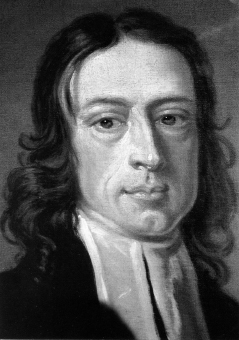
John Wesley, the 18th century evangelical leader, whose heart was “strangely warmed,” years after he had committed himself to follow Christ.
The Holiness movement in 19th century followed the theological lead set by John Wesley, and they began to speak of an experience with the Holy Spirit after conversion as a “second blessing.” It is therefore no surprise that William J. Seymour, and other leaders of the 20th century Pentecostal revival, built their theology of “the baptism in the Holy Spirit” on the foundations of the Wesleyan inspired Holiness movement. It bears repeating that these early, pre-Pentecostalism advocates of a “second blessing” were not “charismatic” in the sense of possessing the gift of “speaking in tongues,” or other miraculous gifts of the Spirit.
Furthermore, as briefly mentioned in the last blog post, these Holiness groups were not the only ones who believed in “the baptism in the Holy Spirit” as a “second blessing.” Prior to Wesley, various Puritan thinkers in the 17th and 18th centuries also made a distinction between becoming a Christian and “the baptism in the Holy Spirit.” Even though the Holiness movement, through groups like the Nazarenes and the Church of God, directly led towards contemporary Pentecostalism, in a way that the Puritan movement did not, it is helpful to examine this particular Puritan theology in some detail. A more recent example of this early, Puritan-inspired view can be found in the great 20th century Welsh pastor, Doctor Martyn Lloyd-Jones. Continue reading
Is “Speaking in Tongues” the Sign of the “Baptism in the Holy Spirit?” (#3)
Fired up by enthusiasm, the theology of “the baptism in the Holy Spirit,” is taking over the globe. But what is it exactly? (photo credit: Getty Images, Economist magazine)
After a break for a few weeks, we are picking up again with the third in a multipart blog series….
Azusa Street. Los Angeles, California. April, 1906. A new African American preacher in town, William J. Seymour, a son of former slaves, stood up to preach for several nights in a row. Seymour had been blinded in one eye, due to contracting small pox, when he was young. But this did not deter Seymour from delivering his message.
According to Seymour, many churches in his day were spiritually dead. The movement of the Spirit was not to be detected. Teenagers were bored by long, droning sermons. Petty squabbles consumed the energies of church people. Spiritual lifelessness had permeated congregations. Even in Los Angeles, churches were strictly divided along the lines of race. Something was severely lacking in the churches of early 20th century America.
Seymour began preaching for revival.
Crowds began to gather to hear Seymour preach. The meetings were so packed that the small buildings where they met started to crack, and larger meeting places were sought after. The emotional excitement was electrifying. People gathered from all backgrounds in the hundreds. Rich and poor, men and women, black and white, all gathered together to experience the movement of the Spirit. Economic, racial and other barriers collapsed as people were somehow…. moved by the Spirit. Continue reading
Pluralism In Your Face
Editorial comment:
I’m not a political person. Faith means much more to me than politics. I do have strong opinions about the need to keep politics out of practicing and sharing our faith because equating the importance of God and politics is disrespectful to God. And it’s unwise. There is scriptural guidance in the form of an argument from silence—Jesus did not politicize His teachings. At the risk of appearing to taint this ethic, please dismiss the political and constitutional implications of the following material and focus on the core questions.
In potentially uncomfortable situations, most of us have some fear of rejection or confrontation that compels us to be silent about our faith. Thinking about it ahead of time can help overcome those fears.
Imagine that you are on the hot seat. Attention is focused on you, and your beliefs are called into question. How would you respond? (If you’ve never been in this position it might be good to ask yourself, seriously, “Why not?”)
Earlier this month, Russell Vought, an evangelical Christian, was testifying during a confirmation hearing, and Senator Bernie Sanders questioned Vought’s beliefs. The following two-minute YouTube clip captures the contentiousness of the incident.
For context, please read what The Atlantic has to report. Pay careful attention to the scriptural citations. If you aren’t aware of the context, you could be inclined more to an opinionated, rather than informed, reaction.
Back to the question. Forgetting about the political and constitutional issues and personalities involved, how would you respond?
Just in case this topic comes up at your water cooler or cocktail party, here are some thoughts to help you prepare an answer.
- The teaching of Jesus does not foment hatred, bigotry, or intolerance. Jesus said, directly, the greatest two commandments are to love God and love your neighbor. When questioned about whom He meant by ‘neighbor,’ Jesus taught the parable of the good Samaritan. Samaritans were held to be low-class people in the first century. By including them in the parable, Jesus made a clear point that His followers are to love others broadly and inclusively.
- As Christians, we believe the Bible contains the inspired word of God and is the final authority for faith and practice. We rely on what it says and do not have the liberty or right to make up our own brand of Christianity, or to cherry pick proof texts. There are many reasons, objectively and personally, for accepting the Bible as the inspired, holy word of God.
- Christians do not have the right to condemn people—we are commanded to love people—but God does have that right. If you really want to understand why, study the Bible. We, the created, are in rebellion against the Creator, and a holy and just God has a plan for the salvation of those who accept His complete sacrifice on our behalf. He has the right to condemn those who reject Him, as Scripture clearly teaches (again, read The Atlantic article).
- John 3:16, the most familiar passage of scripture in the New Testament, states, “For God so loved the world that he gave his one and only Son, that whoever believes in him shall not perish but have eternal life.” From this passage, we can see that God is loving and did not discriminate to whom salvation is offered. He offers salvation to the world.
- Jesus said directly that He is the way, the truth, and the life, and that no one comes to God the Father except by Him.
- The apostle Paul, who wrote half of the New Testament, taught that we are saved by our faith in Jesus, not by our works. While we all know people of every faith and creed who are indeed wonderfully good, salvation is by faith in Jesus alone. Again, we’re not free to make this up—it is directly stated in the Bible. Just because people are ‘good’ does not entitle them to salvation.
- Western culture is inebriated with pluralism. We resist anything that might impinge upon personal freedoms—such as a morally-based worldview. Pluralism by its nature appeals to a wide swath of voters and is therefore quite pragmatic in politics. But on logical and spiritual levels, pluralism comes up short.
- In logic, there is the law of non-contradiction, which holds that two opposite truth claims cannot both be true in the same sense at the same time. “There is either milk in the refrigerator now, or there isn’t,” as Norman Geisler says.
- The world’s major religions ALL have opposing truth claims. The nature of truth claims is that they are exclusive.
- Christianity teaches that Jesus was crucified and resurrected from the dead. Islam teaches that Jesus was not crucified and therefore did not rise from the dead. Keep it real. Both claims can be false, but both cannot be true. The apostle Paul wrote in 1 Corinthians 15:14, “If Christ has not been raised, then our preaching is futile and your faith is empty.” Christianity depends on the objective truth of the Resurrection.
- Hindus acknowledge multitudes of gods and goddesses. Buddhists say there is no deity. Muslims believe in a powerful but unknowable God. Christians believe that God is loving and personal. As Ravi Zacharias says, “The world’s major religions are not fundamentally similar and superficially different, they are fundamentally different and superficially similar.” Most advocates of pluralism don’t take the time to investigate the differences.
Pluralism may be good for getting votes, but it’s an empty and illogical worldview. Although I disagree with those who wish to cast Christianity into a cultural stew with the world’s other religions, my Christian faith compels me to love those who disagree. I wish we could at least all agree on that.
Feel free to share our book…
Join the Conversation
Clarke Morledge on Elisabeth Elliot: A Life, Beco… Clarke Morledge on Elisabeth Elliot: A Life, Beco… Clarke Morledge on Elisabeth Elliot: A Life, Beco… Clarke Morledge on Elisabeth Elliot: A Life, Beco… Clarke Morledge on Elisabeth Elliot: A Life, Beco… Clarke Morledge on Elisabeth Elliot: A Life, Beco… Clarke Morledge on Paul: In Fresh Perspective, by… MM on Paul: In Fresh Perspective, by… Paul: In Fresh Persp… on 2 Corinthians 5:21 — The… Paul: In Fresh Persp… on Inerrancy and Interpretation:… Paul: In Fresh Persp… on Paul, A Biography, by N.T. Wri… Paul: In Fresh Persp… on Why N.T. Wright Can Be Both Fa… Paul: In Fresh Persp… on Was Winston Churchill a Warmon… Paul: In Fresh Persp… on The New Perspective on Paul, b… Crushing the Serpent… on Why Should the Death of Someon…


