Category Archives: Topics

Bible Genome

Bible Genome

Map of Direct Citations in the Bible

What Scriptures were most influential to the writers of the Bible?  Who cited whom? Which writers were most schooled in Scripture?  Which Gospel writer referred the most to other Scriptures?  How big a role did Revelation play in their thinking and teaching?  How about Genesis and Job?  How are the parts of the Bible connected?  Which books appear to have been written at the same time?

From God To Us Revised and Expanded: How We Got Our Bible by Norman Geisler and William Nix is a foundational text for those interested in the topic, and I can highly recommend pretty much anything by Dr. Geisler (more on that in a future post).

“Jesus and New Testament writers amply illustrate their belief in the full and complete inspiration of the Old Testament by quoting from every part of the Scriptures as authoritative, including some of its most disputed teachings. The creation of Adam and Eve (Matt. 19:4–6), the destruction of the world by a flood, the miracle of Jonah and the great fish (Matt. 12:39–40), and many other incidents are quoted authoritatively by Jesus. No part of Sacred Writ claims less than full and complete authority. Biblical inspiration is plenary.”
Geisler, Norman L.; Nix, William E. From God To Us Revised and Expanded: How We Got Our Bible. Moody Publishers.
Continue reading


Daniel WallaceDr. Dan Wallace has another outstanding post on Bible translation. His work and research are refreshingly real, and he clearly communicates what the Scripture tells us—and what it does not.

Daniel B. Wallace's avatarDaniel B. Wallace

There’s an old Italian proverb that warns translators about jumping in to the task: “Traduttori? Traditori!” Translation: “Translators? Traitors!” The English proverb, “Something’s always lost in the translation,” is clearly illustrated in this instance. In Italian the two words are virtually identical, both in spelling and pronunciation. They thus involve a play on words. But when translated into other languages, the word-play vanishes. The meaning, on one level, is the same, but on another level it is quite different. Precisely because it is no longer a word-play, the translation doesn’t linger in the mind as much as it does in Italian. There’s always something lost in translation. It’s like saying in French, “don’t eat the fish; it’s poison.” The word ‘fish’ in French is poisson, while the word ‘poison’ is, well, poison. There’s always something lost in translation.

But how much is lost? Here I want to explore…

View original post 1,508 more words


Peace

The Veracity blog is all about sharing, so for Christmas I’d like to share a gift that we all need so desperately—peace.

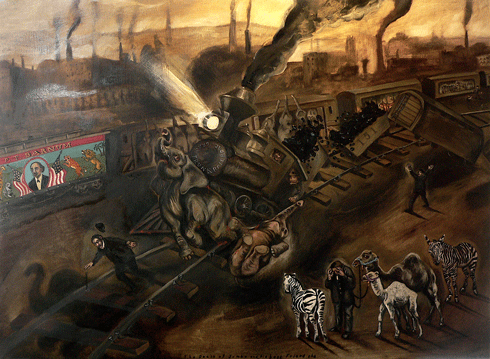
The Death of Jumbo by Sue Coe, 2007

The Death of Jumbo by Sue Coe, 2007

This year there’s no shortage of personal train wrecks and tragedies among my family and friends.  Through death, sickness, the collapse of relationships, or just the passage of time, many of them are dealing with insidious loneliness. And everyone has troubles. Yogi Berra was right, “The future ain’t what it used to be.” They’re all carrying on, but they all need peace. Just like you and me.

Peace isn’t linked to our circumstances—although a lot of misery certainly can be.  Some of the most peace-filled people I know have pretty difficult worldly circumstances.  But peace runs deeper than our circumstances.  Much deeper. Continue reading


It’s the End of the World?

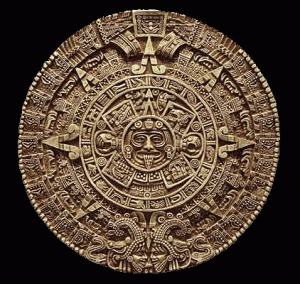
Descendants of the Mayan people were first evangelized by Spanish missionaries in the 16th century.   Once a great civilization prior to the arrival of the Spanish, the collapse of the Maya remains an enigma to anthropologists.... which partly explains the fanciful theorizing regarding the Mayan calendar among New Age movement enthusiasts.

Once a great civilization centuries before the arrival of the Spanish in the 16th century, the collapse of the Maya remains an enigma to anthropologists. The “Mayan mystery” partly explains the contemporary fascination with and speculation about their ancient calendar system.

Head for the hills, folks! THE END IS NEAR! The Georgia rock band, R.E.M., wrote “It’s the End of the World as We Know it (And I Feel Fine)” in 1988. Whenever I hear threats of impending apocalypse, I always hum that song. But seriously, should a Christian be concerned when we hear doomsday talk?

At the time of this blog posting, the fascination has been with the end of the Mayan calendar on December 21, 2012. Much has been made of potential cataclysm on this date, but the fact is that it really is not a big deal. On that date, the Mesoamerican Long Count calendar will need to flip over to the next b’ak’tun, according to Mayan mythology. Anthropologists who study Mayan culture contend that linking the idea of universal catastrophe with the end of the Mesoamerican Long Count calendar is simply speculation, having absolutely zero correspondence to historical Mayan thought. However, this does not dissuade popular New Age theorists from “cashing-in” on all of the fuss.
Continue reading


Your Move

Chess

How are you doing with your decision-making?

I have a long daily commute, with lots of time to fill running the Interstates of eastern Virginia.  Four months ago Veracity’s bass player, Clarke Morledge, got me into podcatching, and life hasn’t been the same since.  It’s definitely getting to me—there have been several times lately when I’ve been happy to be stuck in traffic.  Really.  I plug my iPhone into the car stereo and dive into a world of wonder, mentally shielded from the wacky races occurring all around me.  On-demand theology, philosophy, apologetics, interviews, sermons, and some of the world’s finest teaching.

If you need a how-to primer, check out our previous post on Podcasts & Podcatching, and give your spiritual life a real booster shot.  Try it, really.  If you want some great sources of Podcasts, check out Veracity’s Top 10 Scorers.

So What’s the Point of This Post?

OK, now that we have the mechanics out of the way, let’s get to the content.  One of my favorite (free) podcast subscriptions is Andy Stanley’s Your Move. Continue reading