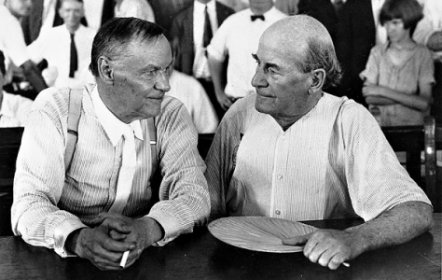
20th century cultural icons: cigarette smoking, agnostic advocate for science, Clarence Darrow vs. defender of the Bible, anti-evolutionist, populist politician, William Jennings Bryan, in the heat of a Tennessee summer.
Where I live here in Virginia today, it is blisteringly hot.
It reminds me of an event that happened exactly ninety years ago today in Dayton, Tennessee. It was July 20,1925, and the famed political statesman, William Jennings Bryan, had taken to the witness stand, to be scrutinized by one of America’s most famous trial lawyers, Clarence Darrow. At stake was a relatively minor case, where a young, substitute biology teacher, John T. Scopes, had been charged with breaking a Tennessee law prohibiting the teaching of evolution in a state funded school. But the case soon became a media circus, as reporters from all over the country flooded the small courtroom facilities in this rural town, forcing the proceedings to be held outside in the intense summer heat.
Bryan, an evangelical Christian, had assumed the challenge to defend the law, while Darrow, an avowed agnostic, was determined to defeat it. But when Bryan went forward to be examined by Darrow, to warn against the cancer of Darrow’s evolutionary philosophy, the events that unfolded would shake the nation. Darrow, an unrepentant skeptic, peppered Bryan again and again with questions about the Bible. In the end, Bryan was able to successfully defend the law, but Darrow proved to win the cultural sentiment, leading to a spread of anti-Christian ridicule across the country at large. Thus marked the moment where American Christianity divided into the “fundamentalist/modernist” controversy. The “fundamentalist” wing sought to defend that “old time religion,” demonstrating the wisdom of the Bible over and against the false “wisdom” of modern science. The “modernist” wing reacted in the other direction, by essentially cutting the supernatural aspects of the Christian faith out of the Bible, in an effort to supposedly “save” Christianity. During the past ninety years, evangelical scholarship and apologetics have sought to break through the impasse caused by this controversy, thereby moving the conversation forward to persuade a lost generation of the Truth of the Savior.
Unfortunately, much of America’s cultural memory of the Scopes Monkey has been shaped by the subsequent play and movie, Inherit the Wind, that took many liberties in the retelling of the story. For example, Inherit the Wind overlooks the fact that William Jennings Bryan took great interest in the case because he saw that the type of evolution being promoted in Scopes’ biology textbook advocated for eugenics, which he understood to be utterly immoral. Furthermore, the textbook, Hunter’s Civic Biology, contained the following statement that would hardly pass muster in today’s classrooms: “At the present time there exist upon the earth five races or varieties of man, …These are the Ethiopian or negro type, originating in Africa; the Malay or brown race, from the islands of the Pacific; the American Indian; the Mongolian or yellow race, including the natives of China, Japan, and the Eskimos; and finally, the highest race type of all, the Caucasians, represented by the civilized white inhabitants of Europe and America.” Also, William Jennings Bryan was not an advocate of Young Earth Creationism, as he generally thought that the “days” of Genesis 1 referred to long periods of time, not literal 24-hour periods.
As I read the transcript of Darrow’s interrogation of Bryan, I admire Bryan’s intended desire to defend the truth of the Bible. However, I am not very impressed with all of Bryan’s answers. I Peter 3:15 teaches, “Always be prepared to give an answer to everyone who asks you to give the reason for the hope that you have. But do this with gentleness and respect.” I would hope that if I were in Bryan’s shoes on that witness stand, I would do better. But would I really be prepared to do so, as the Apostle Peter admonishes?
If you were there on that witness stand instead of Bryan, burdened by the summer heat, and the heat of the skeptic’s questions, how would you respond? See the transcript of the proceedings below, and tell me what you would say differently. More on the Scopes Monkey Trial at ChristianHistory.org:
Continue reading