Category Archives: Apologetics

Why N.T. Wright Can Be Both Fascinating and Frustrating

Nicholas Thomas Wright. British New Testament scholar, retired Anglican bishop, ... and agitator among more than a few conservative, evangelical Protestants.

Nicholas Thomas Wright. British New Testament scholar, retired Anglican bishop, … and agitator among more than a few conservative, evangelical Protestants.

This fall, our church has been conducting a Bible study on the first eight chapters of the Book of Romans. We have been using a study guide written by an Anglican New Testament Scholar teaching at the University of St. Andrews in Scotland, N.T. Wright, Romans (N.T. Wright for Everyone Bible Study Guides).

I need not give you a biography of N.T. Wright, other than to say that Wright is perhaps one of the most influential evangelical scholars of our day. In the 1990s, Wright wrote about and impressively critiqued the rather infamous Jesus Seminar, that sought to determine the “truly” authentic sayings of Jesus in the Gospels simply on the basis of majority vote among the Jesus Seminar scholars. Wright also wrote perhaps the best contemporary defense of the bodily resurrection of Jesus Christ, The Resurrection of the Son of God (the only other book that comes anywhere close to exceeding Wright’s work is Michael Licona’s The Resurrection of Jesus: A New Historiographical Approach). He has been a bishop, and he regularly speaks all over the world, appealing to conservative and liberal-minded Christians alike, along with interested skeptics and seekers. N.T. Wright writes faster than most humans can read… and he is overall an excellent and engaging writer, writing for both academia and also for the popular audience, as with his C.S. Lewis-like introductory book to the Christian faith, Simply Christian: Why Christianity Makes Sense. For the intellectually inclined, Wright is very much like a C.S. Lewis for our times… and he even has a great English accent to listen to!

But Wright also disturbs many of his fellow Christians, particularly those from a Reformed theological background. Now, the study of Romans is incredibly rich and rewarding in and of itself, but if you are not familiar with N.T. Wright, you might find yourself perplexed by some of the things N.T. Wright argues for in his study book. Consider a note on Romans 1:17 that Wright gives us on pages 13-14 of the Romans study guide:

Here Paul introduces a word and theme that will be critical throughout the letter. The Greek word and its variants are often translated as “righteous,” “righteousness,” “just” or “justice.” The problem is that Paul (though writing in Greek) has Hebrew words and meanings in mind, which English translations often overlook…..the phrase “the righteousness of God” [refers] to God ‘s own faithfulness to his promises to Israel, to his covenant…He keeps his word and thereby shows his trustworthiness, justice and righteousness…. What does this mean for what Paul is saying in Romans? [God] does not impart or impute or transfer his righteousness, his just character [to the believer]….”

and here is this remark on page 26:

The phrase often translated “righteousness of God” … is not, as some have argued, a righteous quality that God gives or imparts to humans. It is God’s own righteousness, his being true to the covenant. This covenant faithfulness carries with it more of the overtones that Paul is trying to highlight, referring back to God’s covenant promises to Abraham to undo the problem caused by the sin of Adam. But Israel failed to both keep the law and bring the message of God to the nations.

For evangelical Christians who read this, those who have grown up hearing sermons about the “imputation” of Christ’s righteousness to the believer, primarily through Christ’s “active obedience” to the Mosaic Law, thus enabling God to see us clothed in Christ’s righteousness, instead of our sin, sentences like those above from N.T. Wright are frankly startling. It can even be downright maddening! So then, what is N.T. Wright up to here? (CAUTION: you might need to put your thinking cap on!)
Continue reading


Noah’s Curse

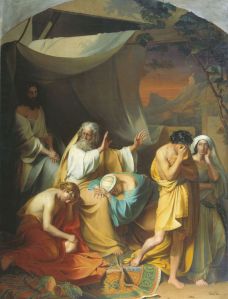
Noah curses his son Ham, a 19th-century painting by Ivan Stepanovitch Ksenofontov. Ham looks pretty white to me here, but for thousands of Christians in the American South from at least the 19th century to recent times, thought Ham had black skin.

Noah curses his son Ham, a 19th-century painting by Ivan Stepanovitch Ksenofontov. Ham looks pretty white to me here, but thousands of Christians in the American South, from at least the 19th century to even fairly recent times, thought Ham had black skin (photo credit: Wikipedia).

When Noah awoke from his wine and knew what his youngest son had done to him, he said,

“Cursed be Canaan;
a servant of servants shall he be to his brothers.”
He also said,

“Blessed be the Lord, the God of Shem;
and let Canaan be his servant.
May God enlarge Japheth,
and let him dwell in the tents of Shem,
and let Canaan be his servant.” (Genesis 9:24-27 ESV)

It was my first Christian retreat in college. I met another student just a few years older than me the first night of the weekend, and we struck up a friendship. But the next day, we had a conversation that has stuck with me for years. I have no idea how it got started, but it was about whether or not the Bible allows interracial marriage. My new friend, growing up in a rural part of southern Virginia, insisted that God absolutely forbids white people from marrying black people.

Where is that in the Bible?,” I asked with curiosity and amazement. I had only recently started reading  the Bible, so perhaps there was something in there that I had not seen yet. His response bothered me:

Well, I am not exactly sure where it is. But I know it is in there.”

Later that weekend, I asked him again if he could show me the verse.

He never was able to find it.

Let me rewind a few more years. I was a mere toddler when the famous Loving v. Virginia case was resolved in 1967, overturning Virginia’s statute forbidding “miscegenation.”  The Lovings, a black and white couple, from Caroline County, about an hour away from where I grew up, had driven up to Washington, D.C., to get a marriage license, where interracial unions were permitted. Upon returning to Caroline County, Virginia police raided their home, but the couple responded to their arrest by going all the way to the Supreme Court to defend their case … and they won.

Such action to change the law that had been embedded in the culture of the so-called “Bible Belt” was not a concern to my new college Christian friend in the early 1980s. In his mind, the Bible still forbade mixed marriages between people of different skin colors, and that was all he needed to know. He had no animosity towards African-Americans. He was really a nice guy, and a devout believer. It was simply and clearly taught in the Bible that God does not allow interracial marriage, according to him.

The problem was… and still is…. he had no verse from the Bible to back up his belief.

So, where did this whole thing about the Bible forbidding interracial marriage come from?
Continue reading


God Wrote a Book

John Piper, the main voice behind desiringGod.org, challenges me and encourages me in his exposition of and love for the Bible. Granted, there are times where he can be a bit over the top in his unashamed Calvinism. Nevertheless, there are some real gems, as when he teaches that the Bible offers us a window through which we can see the world from God’s perspective. Here he nails it. Great cinematography.


Surviving College Intellectually as a Christian

Michael Kruger was a young Christian when he entered his first year at the University of North Carolina. He thought he was prepared for the challenges to his faith at college, but when sat in a New Testament introduction class taught by Bart Ehrman, it nearly blew out his faith, much like the feeling of getting a flat tire and listening to all of the air hiss out.

Colleges across the country are now in session. Will young Christians survive their time at a university with their faith intact? Dr. Kruger, now the president of Reformed Theological Seminary in Charlotte, North Carolina, shares some wisdom about surviving “Religion 101” in the following 6 minute video. I highly recommend Dr. Kruger’s blog.


The Nephilim and the Wisdom of Not Knowing

Darren Aronofsky's Nephilim in his 2014 film, Noah. Rock-creatures that look like the tree-creatures in the Lord of the Rings?... Yeah, right.

Darren Aronofsky’s Nephilim in his 2014 film and environmentalist manifesto, Noah. Rock-creatures that look like the tree-creatures in the Lord of the Rings?… Yeah, right.

This summer, our church has been doing a “summer Bible study” on Genesis 1-11. Interestingly, the sermons have skipped over the part about the Nephilim, in Genesis 6:1-4:

When man began to multiply on the face of the land and daughters were born to them, the sons of God saw that the daughters of man were attractive. And they took as their wives any they chose. Then the Lord said, “My Spirit shall not abide in man forever, for he is flesh: his days shall be 120 years.” The Nephilim were on the earth in those days, and also afterward, when the sons of God came in to the daughters of man and they bore children to them. These were the mighty men who were of old, the men of renown (ESV).

I can understand that there are good reasons for skipping this passage. First, this passage is … uh.. a bit… weird. Secondly, no one really has a clue as to what this really means…. That is right. No one really knows for sure what Genesis 6:1-4 is all about… and neither do I.  Still, I think there is something we can still learn from the Nephilim passage. Continue reading
