Category Archives: Apologetics

The Eagle and Child in All of Us

And let us hold unwaveringly to the hope that we confess, for the one who made the promise is trustworthy. And let us take thought of how to spur one another on to love and good works, not abandoning our own meetings, as some are in the habit of doing, but encouraging each other, and even more so because you see the day drawing near. (Hebrews 10:23-25, NET)

image

Outside Christ Church College, Oxford. One of the most beautiful and profoundly ‘magical’ places we have ever been. Scenes from Harry Potter movies were shot here. Albert Einstein, John Locke, John Wesley, Lewis Carroll, and 13 of the 26 Prime Ministers from Oxford studied here. Carroll’s Alice in Wonderland was inspired here, and Alice was the daughter of the Dean of Christ Church.

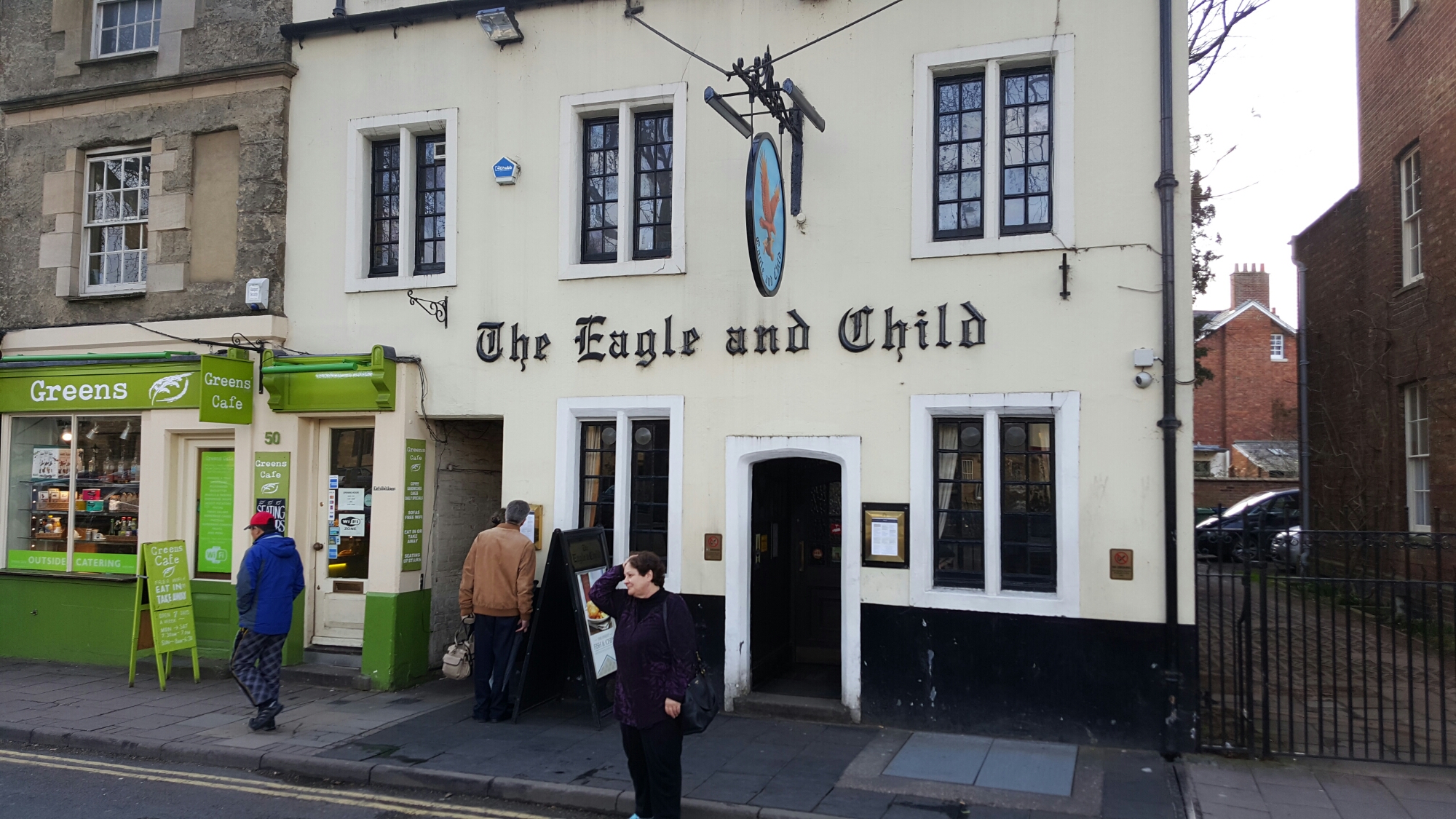
Yesterday, Marion and I travelled to Oxford and had a late lunch in the renowned Eagle and Child pub, where a group of famous Christians met regularly to encourage one another. We sat in the same nook where J.R.R. Tolkien, C.S. Lewis and others discussed ideas that shaped some of the most significant English literature to come out of the twentieth century. I couldn’t help feeling a little exuberant, so I took a few snaps with my cell phone and sent them off to friends and family.
image

I really didn’t want to write this post. I’ve never read any Tolkien. I’m no C.S. Lewis scholar. I find it difficult to read Lewis’ philosophical theology, preferring instead to listen to his books using Audible. His writing is undeniably brilliant and packed with words that connect the intellect to our faith. But as Dick Woodward once told me, “C.S. Lewis made things complicated, but I spent my entire ministry trying to make them simple—so people would understand.” One of the great wonders of the Christian Faith is that it works on both very simple and very complex levels.


image

image

Tuesday mornings at the Eagle and Child pub. This is where Tolkien, Lewis and others sat. The Gloucester sausages and steak and ale pie were quite good. We were late for lunch, so it wasn’t too crowded.

When Clarke received our photos from the Eagle and Child, he prodded me, reluctantly, into writing this post. But it occurred to me while sitting in the Eagle and Child that I have experienced and benefitted from the encouragement of some wonderful brothers and sisters. Brothers like Dave Thompson who will send long, deep, profound emails of encouragement at all hours of the night. And Dave Rudy, who always can add to any topic I may bring up (it’s amazing how much Dave has studied and absorbed). And Rob Campbell, who is the most devotionally devoted person I have ever met (and a finer friend you could not have). And Clarke Morledge himself, with an encyclopedic knowledge of all things theological and hermeneutical (his zeal is as contagious as his heart). And Ken Petzinger, a Princeton-educated physicist who is living proof that Christians also come with extreme intellectual capacity (and who always has something current to share from his personal studies). And Dick Woodward, who was such an encourager and gifted teacher. And Iris Rudy, who is such a good listener (and who commands respect when she speaks). And Tina Campbell, who works at being the most compassionate and hospitable person I know (and succeeds magnificently). And Marion, whom I could never thank appropriately for being such a wonderful, selfless person (and in whom I continually see the Gospel lived out).

So when the writer of Hebrews states, “And let us take thought of how to spur one another on to love and good works, not abandoning our own meetings, as some are in the habit of doing, but encouraging each other, and even more so because you see the day drawing near,” l get it. I am thankful for the Eagle and Child that all of us have experienced.

image

The University of Oxford has 38 Colleges and 6 Permanent Private Halls (PPHs) of religious foundation. There are cathedrals, churches and scenes like this everywhere you turn. I hope that you can visit Oxford soon!

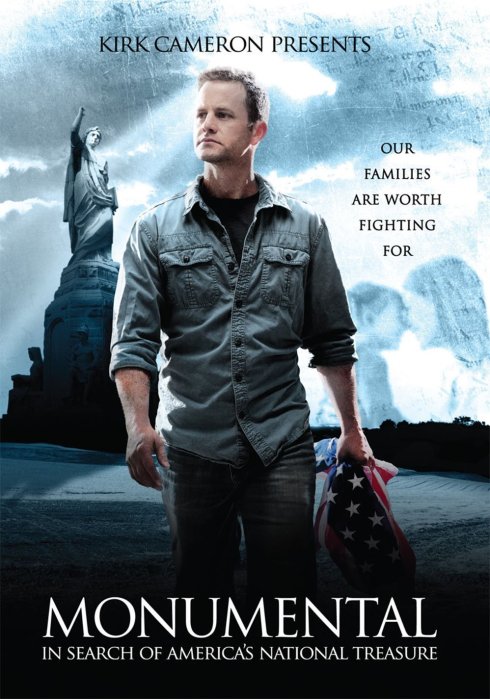
Kirk Cameron’s Monumental Missed Opportunity

Kirk Cameron's 2012 film, Monumental, is worth seeing, but only if accompanied by good, historical scholarship to correct the inaccuracies and misguided theology.

Kirk Cameron’s 2012 film, Monumental, is worth seeing, but only if accompanied by good, historical scholarship to correct the inaccuracies and misguided theology.

I love history. I love it because history tells us who we are. The study of history tells us about where we have come from as individuals and as societies, and it helps to tell us where we are going. We ignore the lessons of history at our peril, as George Santayana said, “Those who cannot remember the past are condemned to repeat it.” Sadly, we live in an age where we suffer as a culture, and particularly as a Christian church, from chronic amnesia. We risk fulfilling the prophecy of Santayana with such terrifying disinterest and apathy.

The story of the Christian faith is rooted in history. The life, death and resurrection of Jesus, as well as the narrative of ancient Israel, are events that exist within space and time. As believers, we are under obligation to get the story right. So, it bothers me when those of us as Christians, who should care the most about history, tend to misrepresent that history, fudging on the story at certain points to advance misguided theological agendas. Even if we deem the motives to be well-intended, we do no favors to the church and the surrounding world with unsubstantiated alterations that distort the telling of that history.

This explains the frustration I felt when I recently viewed Kirk Cameron’s 2012 documentary, Monumental. I was indeed entertained by watching Monumental, but I am not so sure if I was equally educated. As a work of amateur historiography, Monumental is worthy of consideration and a thoughtful discussion starter. But as a serious documentary of responsible scholarship, Monumental falls short. It made me want to plead with Kirk Cameron, the famous actor turned film producer, “can I call for a do-over?” I know that I am just a few years “late to the party,” but please allow me to explain.
Continue reading


The Great Christ Comet

Just in time for the Christian celebration of Epiphany, on January 6….

A few years ago, John Paine and I (following John’s lead) introduced the apologetic work of Rick Larson, regarding the date of Jesus’ crucifixion and the circumstances surrounding the birth of Jesus. Rick Larson is most known for his work on researching The Star of Bethlehem.

The father-in-law of Bible scholar Colin R. Nicholl got a copy of The Star of Bethlehem DVD, by Rick Larson, and convinced Nicholl to watch it. Despite the excellent production value of the film, Nicholl was not convinced by Larson’s argument. Egged on by his discussion with his father-in-law, Nicoll left his teaching position at Gordon-Conwell Theological Seminary to devote himself fully to the study of the Bethlehem star. The fruit of his research is available in the new book, The Great Christ Comet: Revealing the True Star of Bethlehem. You can read a brief interview with the author at the Gospel Coalition blog.

I would normally pass over something like this, except that the book comes with some high recommendations, including megachurch pastor Louie Giglio, Oxford scholar John C.Lennox, popular Christian writer Eric Metaxis, New Testament scholar Simon Gathercole, whose work has been discussed previously on Veracity, and my New Testament professor from my seminary days, Donald Hagner, among others. I took a peak at Eric Metaxas’ interview with Nicholl and I thought I would share it with you.  As John Paine would say, “judge for yourself.” Let me know your opinion: Do you think Colin Nicholl is right?


Is the Virgin Birth Prophecy a Mistranslation?

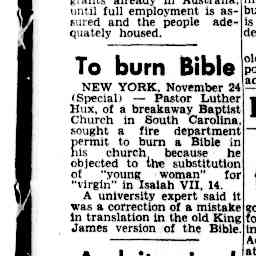
The media coverage of the burning of the RSV, the “Revised Satanic Version” of the Bible. From the November 25, 1952 edition of the Courier Mail, Brisbane, Australia. Luther Hux made quite a news splash all over the world.

“Behold, a virgin shall conceive and bear a son, and his name shall be called Emman′u-el” (Matthew 1:23 RSV)

Therefore the Lord himself will give you a sign. Behold, a young woman shall conceive and bear a son, and shall call his name Imman′u-el. (Isaiah 7:14 RSV)

Bible Burning

Luther Hux knew full well that the RSV was unholy, and accordingly he announced his intention to burn a copy of the new Bible,” so reports historian Peter Johannes Thuessen, from his In Discordance with the Scriptures: American Protestant Battles over Translating the Bible (p.96). Hux, a North Carolina Baptist pastor, had recently received a copy of the new “Revised Standard Version” of the Bible, published that year in 1952. In his fury over what he saw as a “mistranslation” of Isaiah 7:14, Luther Hux was determined to make a show over this “Bible burning” in front of as many press reporters as possible. Isaiah 7:14 is the famous prophecy of the virgin birth, as referenced by the Gospel writer Matthew. All previous English translations of this verse referred to a “virgin,” not a more generic “young woman,” as the new Revised Standard Version had done. Thuessen continues:

On the night of 30 November Hux delivered a two-hour oration and then led his congregation from the white-frame Temple Baptist Church into the cold autumn air, where every member received a small American flag. Climbing onto the bed of a waiting truck, Hux held aloft a copy of the RSV on which he had written the word “fraud.” Instead of burning the whole book, however he ripped out and ignited the page bearing Isaiah 7:14. “This has been the dream of modernists for centuries,” he shouted, ” to make Jesus Christ the son of a bad woman.” (p. 97)

Burning part of a Bible? It would hardly register a blip on the 24-hour news cycle at CNN today. But back in 1950s North Carolina, the “Buckle of the Bible Belt,” you just did not do things like that.

Well, at least he was being patriotic about it.

But what if Luther Hux was right? Was the Revised Standard Version (RSV) a fraud? Was the RSV, from Hux’s own word’s, “the Master Stroke of Satan?

I am not approving of “Bible burning,” but actually Luther Hux was onto something. What Hux did not know at the time is that he had stumbled upon an issue that has puzzled Bible scholars now for decades,… if not centuries.
Continue reading


Inerrancy and Interpretation: An Extended Review of Five Views of Biblical Inerrancy

What is biblical inerrancy? At one level, it is pretty simple and straightforward. As Christian philosopher and apologist Norman Geisler says, “The Bible is the Word of God, and God cannot err; therefore, the Bible cannot err.” If the Bible cannot err, the Bible is inerrant. Broadly speaking, I support this logic.

Such logic, essentially means, that when we read the Bible, we can have the confidence that God is speaking truth to us, through the sacred text. A so called “Bible difficulty” is due to either an error with the translation, a faulty exposition being given about what the Bible says, or because of some misunderstanding on the part of the reader. The problem is never with God’s Word itself.

Pretty clear, right? Well, as they say, often the “devil is in the details.” Different Christians sometimes have different ideas of what they mean by “inerrancy,” and these differences can have diverse consequences in the details.  Digging into those details has led some people to be encouraged in their faith in times of doubt, while raising more doubts in the minds of others, and thereby providing fuel to the skeptics’ fire. How can this be?

It all depends on how “inerrancy” is defined and defended. Have you ever thought about how the four Gospels treat Peter’s “three” denials of Jesus?


Continue reading