Author Archives: Clarke Morledge

About Clarke Morledge

Unknown's avatar
Clarke Morledge -- Computer Network Engineer, College of William and Mary... I hiked the Mount of the Holy Cross, one of the famous Colorado Fourteeners, with some friends in July, 2012. My buddy, Mike Scott, snapped this photo of me on the summit.

Martin and the Origin of “the Chapel”

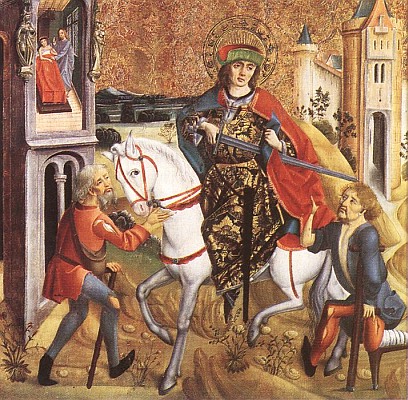
Martin of Tours cutting his cloak in half to give to a poor man. Herein lies the story of the term "the Chapel."

Martin of Tours cutting his cloak in half to give to a poor man. Herein lies the story of the term “the Chapel.”

In the 4th. century A.D., a young solider in the Roman army named Martin encountered a beggar one day in northern France. The beggar’s clothes were terribly worn. Martin was moved with compassion and cut his military cloak in half and gave it to the poor man.

Later that evening, Martin had an incredibly profound dream. According to one account, Martin experienced a vision, seeing Jesus Christ standing before him wearing his half cloak. Harkening back to Matthew 25:31-46, Martin is commended for giving Jesus part of the soldier’s cloak to wear. In response to this vision, Martin presented himself as a candidate for Christian baptism.

Martin had grown up in northern Italy, where Christianity had yet only a small influence in the wake of Emperor Constantine’s only recent acceptance of Christianity as a legal faith within his realm. Nevertheless, at age ten, he attended a local church against the wishes of his parents.

After being baptized as a Christian and serving for several years in military service, Martin laid down his sword and dedicated himself to missionary work and the monastic life. He made his way to the French city of Tours, where the people were so impressed with his devotion to Christ and his character that they tricked him into becoming the bishop of Tours. Martin had been urged to visit a sick person, only to arrive at the home greeted by a crowd demanding that he become their leader. The stunned Martin was not seeking this position, so he fled and hid himself in a barn full of geese. When the crowd found him, he was duly anointed as bishop as he smelled of geese manure.

Martin of Tours went on to become a great evangelist for the Christian faith, challenging the local pagan shrines with the confidence of an Elijah and opposing false teaching within the church, exemplified mostly in his time by the popularity of Arianism, a movement started years earlier by the heretic Arius who denied the full divinity of Jesus as the Son of God coequal with the Father, not too much unlike what modern day Jehovah’s Witnesses believe.

Nevertheless, Martin opposed the popular practice in his day of condemning heretics to death, preferring instead to use the art of persuasion to bring them to repentance. Magistrates dreaded seeing Martin, as they knew that the popular bishop would come and visit them, entreating them to release their religious prisoners. The magistrates felt so bad about possibility disappointing this godly man that they had to let their captives go.

After his death, Martin has been most remembered for the story of the cloak. The other half of the cloak he had kept became a medieval relic that was passed down from generation to generation, eventually in bits and pieces. This half cloak was considered to be a small cape, which was then kept in a small building called a cappella, in Latin. The priest who was in charge of the small cape relic was called a cappellanu. Later, as Saint Martin of Tours was declared to be the patron saint of the military, a cappellani was any priest who served in the military, which is the French root of the English word chaplain.

Parts of Martin’s cape were distributed in cappellas all throughout Europe. Over time, small churches like these were eventually called chapels, though the association with Martin’s cloak was eventually lost, particularly as Protestants began to reject the practice of venerating relics. Nevertheless, “the chapel” terminology has continued to be used, long after the remains of Martin’s cape decayed away.

The next time you go to “the chapel,” you might remember Martin and his famous cloak, part of which he gave to that poor beggar.

Oliver Cromwell’s Crisis

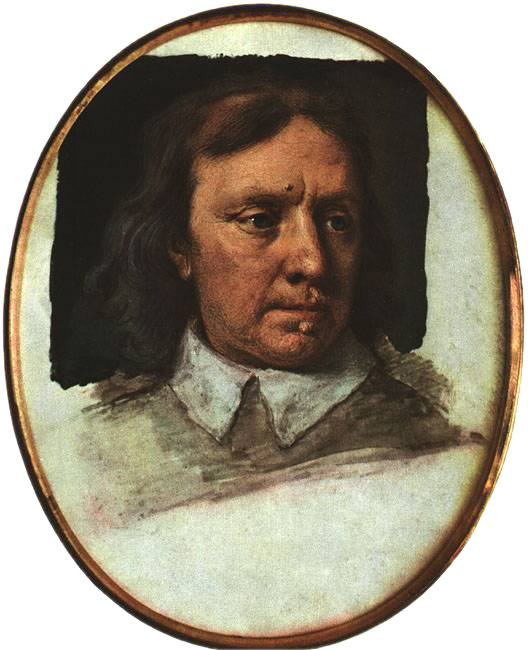
Oliver Cromwell (1599-1658), Lord Protector of England, and Christian reformer of church and civil governance. A hero of liberty to some. A fanatical tyrant to others.  From an unfinished portrait by Samuel Cooper (credit: Wikipedia)

Oliver Cromwell (1599-1658), Lord Protector of England, and Christian reformer of church and civil governance. A godly hero of liberty to some. A fanatical tyrant to others. From an unfinished portrait by Samuel Cooper (credit: Wikipedia)

By the early 17th century, the only type of governance that the English people had known for hundreds of years was the monarchy.  Along with the office of the king in the political realm, for Christians there was a corresponding office of bishop. The term bishop was derived from the Greek word episkopos, as found in Titus 1:7, typically translated today as “overseer.” Just as the king oversaw the worldly affairs of state, the bishop oversaw the spiritual affairs of the church.  King James I of England, who sponsored the famous English Bible translation that bears his name, was famously quoted as saying, “No bishop, no king.”

For James, a king can only rule a people properly with the assistance of bishops who could administer the spiritual life of Christian communities in accordance with the standard set by such a benevolent and divinely appointed king. King James, along with his bishops, saw this governing arrangement as quite efficient. But what happens when the people begin to lose confidence with their leaders? What happens when you can trust neither your bishop nor your king?
Continue reading


Podcasts for the Thinking Christian

Plumb LineJohn’ s recent post on William Lane Craig’s Defender Series of podcasts brought to mind that I should update my list of recommended podcasts for the thinking Christian (here is an earlier list John and I have discussed).  I do not have the time to read books as much as I would like, but the marvel of MP3 players is that I can download audio files and listen to them while I work in the yard or drive to and from work.

John’s suggestion of William Lane Craig as the “graduate school” for the next step following after Dick Woodward’s Mini Bible College is very appropriate. Dick was an amazing teacher who continues to impact the world through his unique ability to “put things on the bottom shelf” for people by exploring the basic contours of the Bible. Dr. Craig then makes it more in-depth in terms of helping you grasp and develop your own understanding of God (theology) founded on Scripture and then applied in terms of being able to offer a rational defense of the Christian faith (apologetics).

But just as there are fine and different academic graduate schools out there, there are different “graduate school” approaches to theology and apologetics. For example, Dr. Craig is probably one of the leading Christian apologists alive today, such that atheist Richard Dawkins awkwardly still refuses to debate him. But Dr. Craig is known for his “Middle Knowledge” approach to the issue of God’s sovereignty vs. free will. He is also known for his classical/evidentialist approach to apologetics.  Without digging too much into those things right now, let me just say that not everybody is totally with Dr. Craig on these issues. But, PLEASE, do not let that dissuade you from digging into William Lane Craig! He is awesome! It is just important to know that there are other approaches that Christians take to these issues. You might want to check out some of the other podcast resources available to get a flavor of what is out there. So here we go!

Continue reading


In One Short Moment… Heaven

I have had a pretty rough day today. But for some friends of mine grieving in Virginia Beach, Virginia, there is no comparison.

Mark Rodriguez, a 17-year old student at Norfolk Christian school, was a victim of a random shooter on Chesapeake Boulevard.  Mark was driving home from a graduation party when a bullet cut his life short. The shooter went on to kill a police officer, before being killed himself when he resisted arrest.

When Mark was just barely a toddler, his parents, Carlos and Leigh Ellen Rodriguez, lived in Williamsburg, Virginia, where I live. Carlos had come to serve as a missionary to high school kids in our community. It has been a long time, but I remember this little boy around their home, simply adored by their loving parents. I lost touch with the Rodriguez family after they left Williamsburg  in 1999 or so, but I am so grateful that Carlos and Leigh Ellen stood in the gap as they sought to share the Good News of Jesus Christ with teenagers in our community. Little would I know then that their oldest child that I just barely knew would never live beyond those teenage years. You see these senseless acts of violence in the media, but when it happens to a family and friends you know, it simply stuns you. You grieve.

As I watched the story unfold on the local television station today, I was then encouraged by the words that Carlos, now a pastor of a church in Virginia Beach, shared about his son. Though his son’s death appears senseless to us, in God’s perspective, there is a profound and griping vision within God’s economy:

Truly, truly, I say to you, unless a grain of wheat falls into the earth and dies, it remains alone; but if it dies, it bears much fruit (John 12:24 ESV).

Mark Rodriguez knew Jesus. In one short moment, his life on this earth was gone. Mark, an avid photography, kept a blog, but remarkably his last posting was about “Heaven”. You should read it.

At this point in time, it is difficult to know what fruit is being born because this grain of wheat was cut down. But as someone who has hope in Jesus, I am challenged by the immediacy of the task set before us to witness before a hopeless world of the grace and mercy found in Jesus and the hope of resurrection.  As Mark Rodriguez wrote before his death:

God is super good. I can’t wait to be with him forever:)

Do you share that hope?


A Year of Biblical Doubting #2

In verse 23, a "Proverbs 31" woman is described as someone whose husband "is respected at the city gates". Here, blogger and author Rachel Held Evans praises her husband "Dan" at the Dayton, Tennesse welcome sign.

In verse 23, a “Proverbs 31” woman is described as someone whose husband “is respected at the city gates”. Here, blogger and author Rachel Held Evans praises her husband “Dan” at the Dayton, Tennessee welcome sign.

Perhaps I am not qualified to write  about this?   After all, I am a guy, and I have no clue what really goes on with women.  Just ask my wife. But the topic of “biblical womanhood” comes up from time to time, and it concerns all of us in the Body of Christ.

A. J. Jacobs wrote a New York Times best seller a few years ago, The Year of Living Biblically, about his humorous, tongue-in-cheek attempt to follow all of the Bible literally for one year. In like manner, Rachel Held Evans titled her second book, A Year of Biblical Womanhood: How a Liberated Woman Found Herself Sitting on Her Roof, Covering Her Head, and Calling Her Husband “Master”. Here she recounts her story of spending an entire year trying to follow the Bible as literally as possible as a woman in every intricate detail. Along the way, she interviews other women who try to follow a particular pattern of “biblical womanhood”. What you do not find in the book generally winds up on her popular blog. We introduced Rachel Held Evans here on Veracity not too long ago. How well did her one year experiment go? What is Rachel Held Evans wanting to say?
Continue reading