Author Archives: Clarke Morledge

About Clarke Morledge

Unknown's avatar
Clarke Morledge -- Computer Network Engineer, College of William and Mary... I hiked the Mount of the Holy Cross, one of the famous Colorado Fourteeners, with some friends in July, 2012. My buddy, Mike Scott, snapped this photo of me on the summit.

Squanto, Thanksgiving and the Rest of the Story

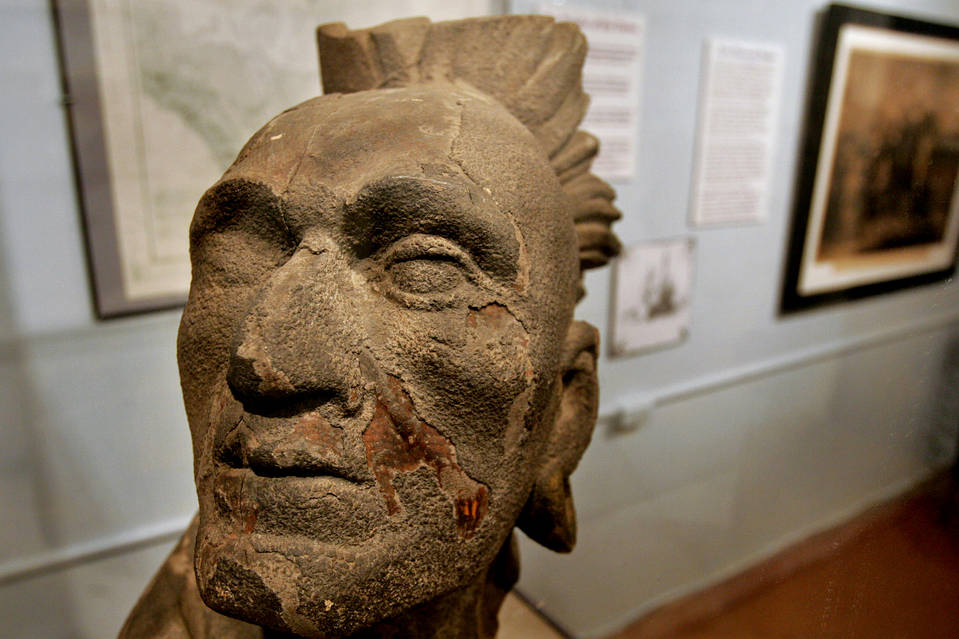
Squanto sculpture at Pilgrim Hall Musuem in Plymouth, Mass. (Credit: Wall Street Journal)

Squanto sculpture at Pilgrim Hall Museum in Plymouth, Mass. (Credit: Wall Street Journal)

If you are a Christian, you have probably heard of the story about Squanto and the Pilgrims, at Plymouth, generally retold around Thanksgiving. If not, I would encourage to read or listen to it. You can find it at the BreakPoint blog online, or through a wonderful children’s book written by Eric Metaxas. I will not retell the whole story here, but I will touch on the highlights.

Before the Pilgrims arrived in Massachusetts in the early 1620s, a young Patuxet Native American had been kidnapped by an English sea captain, and brought back to Europe. Squanto was bought from slavery in Spain by a Catholic monk, and eventually Squanto made his way to work in a horse stable in England, where he learned English and the Christian faith. He longed to go back home to his people in America.  But when he finally returned across the Atlantic, he discovered that his Patuxet tribe had been completely wiped out by disease, most probably small pox.

As providence would have it, Squanto then met the near-starving English Pilgrims. Squanto soon acted as an interpreter between the English and the native Wampanoag tribe, thus establishing peaceful relations between the English and the Wampanoag for at least fifty years. Squanto taught the English how to grow corn and catch fish, enabling the fledgling community to survive. Squanto appeared at just the right time… God’s time… to help establish this small Christian community in a new and hostile world.

It is a great story to tell around Thanksgiving. But often, as in the Breakpoint article/podcast linked above, some important details are left out when Christians typically retell it. Since the Christian aspect of Squanto’s story is hardly ever told in our public schools or secular media, it is understandable that the neglected details of God’s providential care be emphasized to try to balance out the history.

However, this particular Christian retelling of the story gives the false impression that Squanto was some type of angelic character, without sin, spot or blemish. But as Wheaton College historian, Robert Tracy McKenzie, tells us, there is more to the story.

As it turns out, Squanto felt at home neither with the English Pilgrims, nor the Wampanoag tribe, who essentially held Squanto as prisoner. William Bradford and Edward Winslow, the chroniclers at Plymouth who told the story, both described Squanto as someone who would play the Pilgrims and the Wampanoag off of each other. Squanto would use his unique role as language translator to enhance his standing in both communities, spreading false information about the intentions of both parties, setting himself up as the only one who could heal the divisions and prevent war. When the Wampanoag realized that Squanto was double-dealing, they sent a message to the Pilgrims, encouraging them to kill Squanto. But the Pilgrims still needed Squanto’s services, so they offered him protection. This made the Wampanoag mad, but neither did the Pilgrims trust Squanto the way they had before. Just a few years later, Squanto died of disease living among the English, confessing Christ as His Lord, but much remains unknown as to how much of a rift remained between Squanto and the others around him at the time of his death.

This does dampen our image of Squanto, but it still fits within a Biblical view of reality. The patriarchs of the Bible are hardly examples of moral perfection: Abraham offered his wife up as a prostitute, Moses was a murderer, and David was an adulterer and a murderer. Every human under the sun, including folks like Squanto, including you and me, are sinners in need of grace. When we fail to grapple with our insecurities and other sins, just as Squanto did, we break down relationships of trust.

The lesson is appropriate these days: After perhaps the most contested Presidential election in recent memory, the American nation is in many ways very divided today. Trust has broken down between many groups in American culture, and many are fearful. Trust has broken down even within the church, the household of God. The civic bonds that have traditionally held Americans together in the past have become greatly strained. The loosening of those civic bonds have further shown us where Christians, those of us in the church, have sought for unity in the wrong places. However, as followers of Jesus, if we really know and believe the Gospel, we can trust God and model for the non-believers around us what it means to love God and love one another. If we really wish to see healing in our land, such healing must begin within the household of God.

Yes, let us learn from the positive example of Squanto regarding the providence of God. But let us also keep in mind the negative example of Squanto, that we should re-examine ourselves, deal with our own sin before being quick to mistrust others, and model for others what it means to live in a community that loves God and loves one another.


Resounding: Cliff Barrows

Cliff Barrows (1923-2016)  ministered alongside evangelist Billy Graham, starting in 1946. Barrows led the music for the Billy Graham Crusades, believing that worship through music would resound with the glory of Christ, and bring many souls to the feet of the Savior. A website in memory of Cliff Barrows tells his story.


Lewis, Kennedy, Huxley… and the End of the Age of Innocence

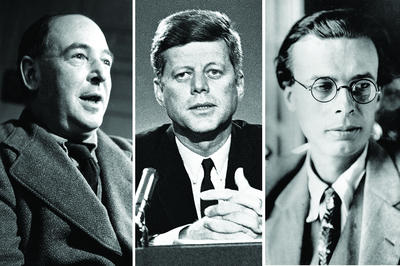
lkhThree deaths on one day, November 22, 1963, that marked the passing of an era. Justin Taylor, at the Gospel Coalition, chronicles the timeline of the events on that momentous day, with a blog post entitled “The Death of Narnia, Camelot, and the Brave New World: A Timeline of 11.22.63.”  Three iconic figures. Three different views of death. Three different visions of reality. Which vision of reality, Narnia, Camelot, or a Brave New World, best lives on, captivating your imagination today?

(As for me, Narnia is what draws me in)


Was Jericho a “City” or a Military Fortification?

The ruins of ancient Jericho, scarred by over a hundred years of archaeological digs, as seen from the air.

The ruins of ancient Jericho, scarred by over a hundred years of archaeological digs, as seen from the air. It would probably take no more than an hour or so to walk around the “city.”

I had the privilege of visiting the Holy Land some years ago, and one day our tour bus drove through the modern city of Jericho. At one point during our drive, our tour guide announced that we were passing the ancient site of Jericho. But before I had enough time to pull out my camera, we were gone and left the ancient “city” far behind.

It was not quite what I had imagined. As a kid, I was accustomed to hear the story of how “Joshua fit the battle of Jericho,” and destroyed the “city.” Now, when I think of “city,” I think of a relatively large population area. My hometown, Williamsburg, Virginia, is fairly small by the standard of most cities today, about 9.1 square miles in size, or just a little under 6,000 acres. Contrast that with ancient Jericho, which is approximately only 6 acres in size.

That’s about less than half the size of my small neighborhood.

Wow…. If ancient Jericho was really a “city,” then it must have been a really, itsy-bitsy small one. I suppose the people in such a really small “city” could have been packed in like sardines, but it got me thinking about what the Bible says in Joshua 6 about the “city” of Jericho. What are we to make of this?
Continue reading


Remembering My Dad on Veteran’s Day

USS Burton Island, Navy ice breaker, 1954.

USS Burton Island, Navy ice breaker, 1954.

Since my dad died earlier this year, I have corresponded several times with some of his old Navy buddies. My dad served as a Naval officer aboard the U.S.S. Burton Island, an ice breaker, along the Aleutian Island chain, during the Korean War. My dad formed some lifelong friendships with some of those men aboard that ship, a few of whom are still living strong.

Though my dad never saw combat, I am mindful on this Veteran’s Day of the contribution of those who have served in the military, like my dad. So many young people have sought to defend their country, whether it be the United States or some other nation, putting their lives on the line, honoring a sense of duty to their country, fighting for something they believed in.

Many have lived to tell about their experiences. Many others have not.

This is what I thought of today: I think of what happened 100 years ago this day, on November 11, 1916. It was just a few days before the end of the terrible Battle of the Somme, where British and German forces fought a battle of attrition over “No Man’s Land,” resulting in over one million casualties in this one battle alone, with no substantial gain from either side. The “Great War” was only about half-way over, with millions more dying, as it would be two more years exactly until Armistice Day, November, 11, 1918. The American version of Armistice Day was renamed “Veteran’s Day,” in 1954, the same year the above photo was taken of my dad’s ship.

I do not really understand what the whole point was concerning World War One. It is hard for me to grasp how all of that figured into the providence of God. But what I do know is that there were people on both sides who had stories to tell. These stories need to be told, and we need to hear them. This is true not just about World War One, but about any great human conflict, where different visions of morality, community identity, and faith come into dire conflict. Even if we do not understand why people were willing to risk their lives for something we do not “get,” we owe it to others to take the time to simply listen to their stories.

The week before my dad died, I read to him a letter from one of his Navy buddies. It was all about life aboard the ice breaker. My dad, who was suffering from dementia, brightened right up when I read to him these stories. My dad told me some of his own stories aboard the Burton Island. All my years growing up as a kid at home, my dad had never talked much about his Navy experience. But I frankly was not interested at the time, being more obsessed with getting along with the other kids in my school, worrying about my grades, and watching television. I only cared about what was in my “little world,” and never cared to know much about the stories of this man who raised me.

I am now glad that I took the time to listen… and to remember. I am so thankful now that in the last week of his life, my dad and I were able to share his experience of being a veteran, and what that meant to him. It made me realize that every veteran has a story to tell… a story that needs to be heard and remembered.

Thanks, Dad.
