Clarke Morledge -- Computer Network Engineer, College of William and Mary...
I hiked the Mount of the Holy Cross, one of the famous Colorado Fourteeners, with some friends in July, 2012. My buddy, Mike Scott, snapped this photo of me on the summit.
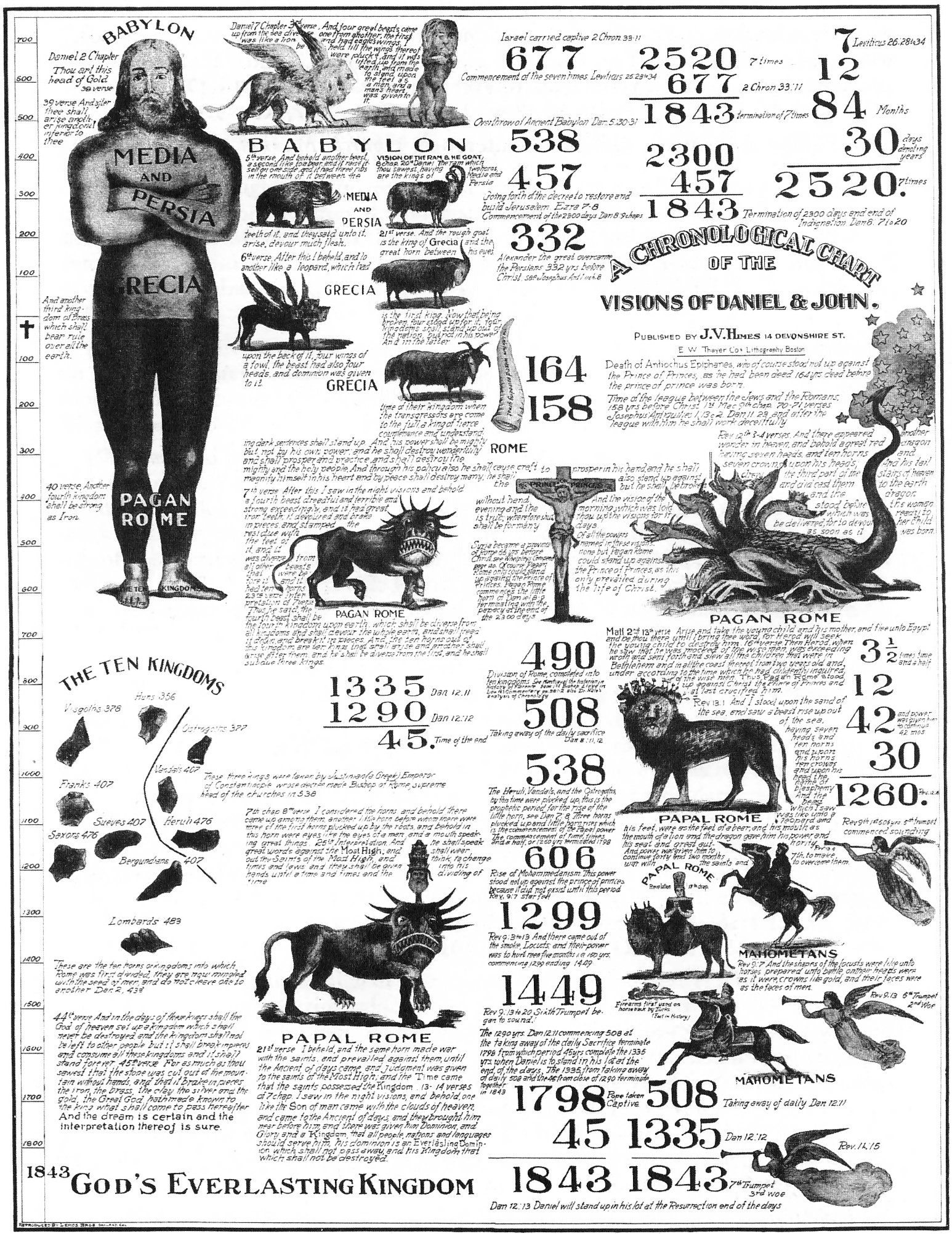
William Miller’s prophecy chart, identifying the Second Coming of Christ in 1843. It has as much detail, if not more, than a dispensationalist chart!! (credit: Wikapedia, click on for more detail).
From a Great Disappointment to ecstatic visions, from corn-flakes to flaky fanatics in Waco, Texas, the Seventh-Day Adventists, and their associated spinoffs, have shown themselves to be a peculiar movement, as we have discussed in the previous posts in this series (#1 and #2). In a less peculiar sense, Seventh-Day Adventists have championed the cause of religious liberty, the promotion of good diet and health reform, and a growing network of schools, hospitals, and other humanitarian missions, themes that have permeated the wider culture around them. Yet, in many ways, there are dramatic shifts going on within Seventh-Day Adventism that raise questions about the future.
Some Seventh-Day Adventists today are basically like any other Protestant evangelical Christians, except that they go to church on Saturdays. Others are very much into the whole Seventh-Day Adventist package of beliefs and practices, that have set the movement apart from the rest of Christianity. It really depends on the congregation, and even within congregations. That being the case, how should other Christians view the Seventh-Day Adventist movement, and where it is headed?
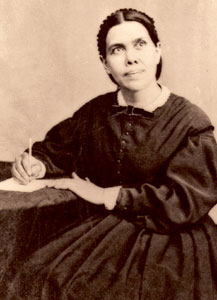
Ellen Gould Harmon White (1827-1915). Spiritual visionary who has given shape to the contemporary Seventh-Day Adventist movement (credit: Seventh-Day Adventist literature)
As alluded to in the previous post in this series, Seventh-Day Adventism is sort of like a round peg that does not quite exactly fit in the square hole of groups that make up evangelical Christianity. Consider, for example, the most influential founder of Seventh-Day Adventism, Ellen G. White.
Ellen G. White was considered to be the prophetess who held together the fledgling Adventist/Millerite movement that nearly collapsed after the Great Disappointment of 1844, when William Miller’s prediction of the Second Coming of Christ failed to materialize. But among evangelical Christians, she is viewed anywhere from being an outright false teacher, such as in this Tim Challies blog post, to an eccentric visionary, who has since had her excesses corrected by reforming elements within contemporary Seventh-Day Adventism.
So, who is Ellen G. White, and how did she help define what would become Seventh-Day Adventism? Moreover, what type of movement did she and other early leaders help create?
Ben Carson, former Director of Pediatric Neurosurgery at John Hopkins Hospital, and the subject of the film Gifted Hands, is running as a Republican candidate for the 2016 Presidential race. Carson credits his Seventh-Day Adventist upbringing, guided by his single mother, as one of the main factors in his success as a brain surgeon and bringing his family out of poverty (photo credit: cnn.com)
What is a Seventh-Day Adventist? To most people who know anything about them, Seventh-Day Adventists are those who go to church on Saturdays, instead of Sundays, and who have a pretty strict diet. Until recently, evangelical and mainline Christians have tended to view Seventh-Day Adventism as some type of strange sect or “cult.” But attitudes have been changing over the years.
I have not followed the political race for President much this fall. But what I have noticed is a large number of evangelical Christians have come out as strong supporters of Republican candidate Ben Carson. What is surprising about the Ben Carson phenomenon among evangelicals is that he is a Seventh-Day Adventist.
It was primarily through the influence of Baptist theologian and cult expert, Walter Martin, that evangelical Christians started to rethink attitudes towards Seventh-Day Adventism, as far back as the 1950s. In The Kingdom of the Cults, Walter Martin observes that there have been signs of change within the movement (p. 535):
It should be carefully remembered that the Adventism of today is different in not a few places from the Adventism of 1844, and with that change the necessity of new evaluation comes naturally…It is my conviction that one cannot be a true Jehovah’s Witness, Mormon, Christian Scientist, etc., and be a Christian in the biblical sense of the term; but it is perfectly possible to be a Seventh-Day Adventist and be a true follower of Jesus Christ despite certain heterodox concepts.
Not everyone agrees with Walter Martin’s assessment. Some still view Seventh-Day Adventists to be “outside of the camp.” But the general trend appears to be that Seventh-Day Adventists are “within the camp” of evangelicalism, even though they do possess some quirky beliefs.
So, how did Seventh-Day Adventism start, how did it get branded as being heretical, and then how has the movement become cautiously accepted today by other Christians as being relatively OKAY? No matter where you come down on Seventh-Day Adventism, the story of it all is quite peculiar. Continue reading
Recently, I was invited to go to a Halloween party this coming weekend. I need your help. What do I dress up as for this party?
Now, I know that a lot of Christians are deeply suspicious of Halloween: Is it not connected, at least remotely, to some kind of Satanic practice?
Well, the question has a point to make. After all, the timing of Halloween goes back to an ancient pagan festival, some say that was originated in Ireland, marking the beginning of winter. Samhain, pronounced “SAW-in,” from what I have learned, also celebrated the end of the harvest season. Since Samhain is at the same time of year as the traditional date for Halloween, the overlap gives the impression that Halloween has a pagan connection…. And since anything that distracts the believer from whole hearted worship of Jesus Christ could be considered “Satanic,” it only makes sense to raise such suspicion.
All Saints Day was celebrated by early medieval Christians to remember those Christian martyrs and other exemplary Christians who had gone on before them. All Saints Day, though originally in May, was moved to November 1st, under Pope Gregory (731-741 A.D.). All Souls Day, a related Christian festival to remember the faithful departed, particularly deceased relatives, was set on November 2nd. During the Reformation, the All Souls Day fell out of favor. But All Saints Day was held on by the English Anglican Church. All Saints Day is otherwise known as “All Hallows Day,” (Hallows=Holy, or Saint), which is how we get “All Hallows Eve,” or “Halloween,” for the night before on October 31st.
Halloween today is basically secularized, as are most holidays now, but as the 21st century merges into what appears to be a “post-Christian” era in the West, the revival of pagan practices associated with the ancient Samhain festival have started to reappear, such as among contemporary Wiccans. But even most honest observers admit that neo-pagan spirituality is in a continued state of flux, morphing and changing quite a bit.
We can have endless debates about how “Satanic” all of this is. Or we can take a tip from this 3-minute video at John Piper’s desiringgod.org ministries. Do you see Halloween as something to be avoided, or do you see it as an opportunity to be a witness for the Gospel?
Here is my spin on that this year: If Christians really want to “take back Halloween,” then we might want to take a few lessons from church history. I suggested to my wife that instead of a ghost, or something like that, she can dress up as a Christian saint at the party, such as Saint Thecla. Early accounts are sketchy, with various elaborations, but Thecla was surely one of the Apostle Paul’s most well-known converts to the faith, first meeting Paul in what is now modern day Turkey. According to this Eastern Orthodox source, Thecla was forbidden by her mother to go out into the street to hear Paul preach. But she was able to listen outside of her bedroom window, where she heard the Gospel. So, if someone asks my wife, “Who are you supposed to be?,” well, then, she has an opportunity to talk about Thecla’s story as she heard the Gospel of Jesus Christ, and had her life set free from the fear of darkness and death.
The point is this: perhaps one of the best ways to celebrate “All Hallows Eve” is to remember the examples of remarkable Christians who have died and gone before us. If you receive an invitation to a Halloween party, perhaps you can read up a bit on church history, dress up as some Christian figure from the past, and then use the opportunity to share the story of that person you came dressed as, with others at the party. Sure, it sounds a bit geeky, but it is a whole lot more interesting than dressing up as some “Superhero.”
For more on the origins of Halloween, New Testament scholar Ben Witherington has some perceptive comments to share in 3 minutes. In the meantime, I need to figure who I should be… and find a costume!
UPDATE: November 3, 2015
I need to make correction to an earlier statement, which suggested that the original All Saints Day spring celebration was moved to November 1st, partly to counteract the Samhain fall festival. A recent post at the Anxious Bench blog, references a work by historian Nicholas Rogers, arguing that while the Irish world, where Samhain came from, originally celebrated a feast for saints in April, the Germanic world, that did not recognize the Irish Samhain, had a feast for saints in November. This undermines the idea that All Saints Day was placed in November in order to try to supplant the Samhain festival. I am glad to be corrected, and so I modified the rest of the blog post. The study of history reveals some interesting surprises and busts a lot of pious fiction.
I went to my first InterVarsity Urbana missions conference some thirty-one years ago, in 1984. It was one of the last times Billy Graham ever spoke at Urbana, where he kept the attention of nearly 18,000 college students, challenging us to consider God’s call to go make disciples among all of the nations (Matthew 28:19-20). I can not think of any better place to gain a global vision of what God is doing in our world.
On December 27 to 31, 2015, InterVarsity Christian Fellowship is sponsoring yet again, another Urbana missions conference in St. Louis, Missouri, having outgrown the facilities at the University of Illinois Champaign/Urbana. Speakers include a worldwide representation of Christian mission leaders, including pastor David Platt, church planter Francis Chan, French Islamic studies professor Evelyne Reisacher, former Muslim Abdu Murray, missionary to the LGBT community Christopher Yuan, missionary trainer Paul Borthwick, and over 180 more. Hundreds of missionary organizations will be represented to give people thinking about a call to missions the perspective they need to understand where God might be calling them.
If you know of someone who should go, particularly a college student, then contact Urbana.org, and pray for God to work in the hearts and minds of these students. What is God doing in our world, and are you where God is at work?